Last updated
Credit Cards for Expats in Europe: Strategic Comparison and Evidence-Based Decisioning
Use Credit Cards for Expats in Europe: Strategic Comparison and Evidence-Based Decisioning to understand the moving parts before you pay, apply, sign, book, or rely on a third-party summary. It explains opening or using accounts, identity numbers, KYC evidence, cards, credit history, and payment access across Europe, then shows how to prepare identity, address, tax, income, source-of-funds, and card or credit evidence before an application is refused. The later sections connect executive summary, quick answer, and product types: do not compare the wrong things so the next step is easier to judge. Read it before submitting forms, moving money, choosing a provider, or assuming that a rule from another country applies.
This guide explains how to choose payment cards and credit cards in Europe without confusing four different products: basic account payment cards, debit cards, charge cards, and revolving credit cards. It is current for planning use as of May 18, 2026.
Executive Summary
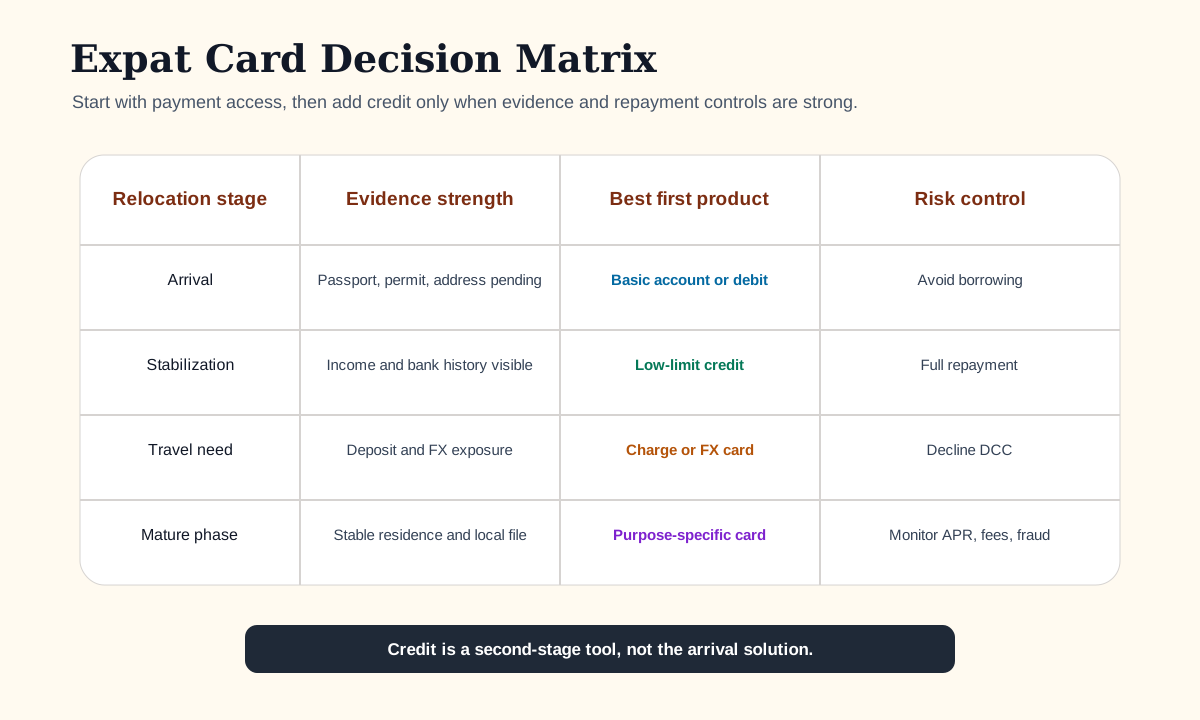
Most expats should build card access in stages.
| Stage | Best default | Why |
|---|---|---|
| Arrival | Basic payment account or debit-first card | Faster access and lower credit-policy friction |
| Stabilization | Local bank account plus documented income | Builds address, salary, and payment evidence |
| Booking and travel | Low-limit credit or charge card if needed | Useful for hotels, car rentals, deposits, and emergency holds |
| Mature phase | Purpose-specific second card | Only after fee, FX, and repayment controls are proven |
The critical distinction is this: EU law supports access to a basic payment account for legally resident consumers, but that right does not guarantee a credit card, overdraft, high limit, rewards product, or approval by a private lender.
Your Europe states that legally resident people in an EU country are entitled to open a basic payment account, and that the account should include a payment card for withdrawals and purchases. It also states that this does not necessarily include an overdraft or credit facility Your Europe: bank accounts in the EU.
Quick Answer
Expats can get credit cards in Europe, but approval depends on country, residence status, income, credit file, address history, bank relationship, and lender policy. If you are newly arrived, start with a basic payment account, debit card, or prepaid bridge. Apply for a true credit card only when you can prove local residence, stable income, repayment capacity, and a clear use case.
A good expat card stack usually has:
| Layer | Purpose |
|---|---|
| Local account and debit card | Salary, rent, utilities, direct debits, daily payments |
| Low-risk credit or charge card | Hotels, car rentals, travel deposits, emergency holds |
| Low-FX payment method | Non-euro travel and cross-border spending |
| Full-repayment rule | Prevents revolving debt from becoming structural |
| Backup card from another provider | Reduces lockout risk during travel or fraud review |
Product Types: Do Not Compare the Wrong Things
| Product | What it is | Credit risk | Best use |
|---|---|---|---|
| Basic account card | Card attached to a basic payment account | Usually none or low | Daily spending, cash withdrawals, online purchases |
| Debit card | Pulls from current-account funds | Low | Routine spending and bills |
| Prepaid card | Uses loaded funds | Low | Arrival bridge, budgeting, limited history |
| Charge card | Pay full balance each cycle | Medium | Deposits, travel, controlled expense management |
| Revolving credit card | Borrowed balance can carry over | High | Planned liquidity only |
| Secured credit card | Credit line backed by deposit | Medium-low | Thin local credit profile |
A card with "credit" in marketing may not function the same way across countries. Some European markets are debit-heavy. Others use charge-style settlement, overdraft-linked cards, or bank-account-led lending.
Legal and Regulatory Context
Basic payment account access
The Payment Accounts Directive gives people in the EU the right to a basic payment account regardless of place of residence or financial situation, according to the European Commission. It also improves fee transparency and bank switching European Commission: access to bank accounts.
This right helps expats because a basic account can create the first local payment footprint. It does not guarantee premium current accounts, savings accounts, overdrafts, or credit-card approval.
Consumer credit rules
Credit cards with borrowing features may fall under consumer-credit rules. The European Commission explains that consumer-credit rules require standardized information, disclosure of the annual percentage rate of charge, creditworthiness assessment, and a 14-day withdrawal right for qualifying credit agreements European Commission: consumer credit.
Directive (EU) 2023/2225 will apply from November 20, 2026. The Commission states that the revised directive expands the consumer-credit framework, including lower-value credit and some buy-now-pay-later structures European Commission: consumer protection in financial services.
Payment-services protections
EU payment-services law is relevant to card security and unauthorized transactions. PSD2, Directive (EU) 2015/2366, includes rules on payment-service liability and payer liability limits in specific circumstances EUR-Lex: Directive (EU) 2015/2366.
SEPA and euro payments
SEPA harmonizes cashless euro payments across Europe and covers credit transfers, direct debits, and card payments. The European Commission states that SEPA makes cross-border electronic euro payments as easy as domestic payments and covers the whole EU plus additional countries and territories European Commission: SEPA.
For expats, SEPA can matter more than the credit card itself because rent, utilities, insurance, subscriptions, salary, and tax payments often depend on account and direct-debit compatibility.
Eligibility: What Lenders Actually Evaluate
| Factor | Strong evidence |
|---|---|
| Legal residence | Residence permit, EU registration certificate, national ID, local tax number |
| Address | Lease, registration certificate, utility bill, bank statement, official correspondence |
| Income | Employment contract, payslips, pension statement, tax return, business accounts |
| Banking history | Local account activity, salary deposits, no unexplained returned payments |
| Credit file | Local credit bureau data where available, no adverse records |
| Debt burden | Existing loans, rent, dependents, and recurring obligations are affordable |
| Stability | Length of stay, contract type, probation status, renewal prospects |
| Identity consistency | Same spelling and date of birth across passport, permit, payroll, and bank records |
New arrivals often fail because they apply too early, not because they are inherently poor credit risks. A strong foreign salary may still be weak evidence if it is not visible to a European lender, not paid into a local account, or difficult to enforce.
Documentation Checklist
| Document | Use |
|---|---|
| Passport or national ID | Identity verification |
| Visa or residence permit | Legal residence and stay duration |
| Local address registration | Residence traceability |
| Lease or housing contract | Address and stability |
| Employment contract | Income and role |
| Recent payslips | Current repayment capacity |
| Tax assessment or return | Annual income verification |
| Bank statements | Cash-flow and conduct evidence |
| Existing credit reports | Optional support, not necessarily accepted |
| Marriage or family documents | Sometimes relevant for household income |
| Business registration and accounts | Self-employed income proof |
| Student enrollment and funding proof | Student-card or low-limit products |
Card Selection Framework
Step 1: Define the job of the card
| Use case | Preferred product |
|---|---|
| Grocery, transit, subscriptions | Debit card or basic payment account card |
| Rent and utilities | SEPA direct debit or transfer, not usually credit card |
| Hotels and car rentals | Credit or charge card with reliable preauthorization behavior |
| Online subscriptions | Debit or credit card with strong authentication |
| Non-euro travel | Low-FX-fee card with transparent conversion |
| Emergency liquidity | Low-limit revolving credit after affordability review |
| Credit history building | Local credit product only if reported and affordable |
Step 2: Choose by risk, not brand
| If your status is... | Better first move |
|---|---|
| Newly arrived, no local income yet | Basic account, debit, or prepaid bridge |
| Employed locally for less than 3 months | Wait for payslips unless preapproved |
| On probation | Avoid hard credit applications unless essential |
| Self-employed | Prepare tax, invoices, account history, and business registration |
| Student | Use student account products and avoid revolving balances |
| Frequent traveler | Prioritize acceptance, FX transparency, and card-lock controls |
| High foreign income but little local trace | Build local deposits and documentation first |
Step 3: Price the card under real scenarios
| Cost item | Ask before applying |
|---|---|
| Annual fee | Is it justified by benefits you will actually use? |
| APR or borrowing rate | What happens if you cannot repay in full? |
| Cash advance fee | Are ATM withdrawals treated as credit advances? |
| FX markup | What is charged above the scheme or reference rate? |
| Dynamic currency conversion | Can you reliably choose local currency at terminals? |
| Late-payment fee | What is the grace period and penalty? |
| Replacement card fee | What happens if the card is lost while traveling? |
| Insurance exclusions | Are residence, trip length, and age conditions met? |
FX and Dynamic Currency Conversion
Expats often lose more money through currency conversion than annual fees. The practical rule is simple: when paying abroad, choose the local currency unless you have verified that the offered conversion is cheaper.
EU cross-border payment rules require transparency for currency conversion charges in card-based transactions and credit transfers. The Commission has published guidance on currency-conversion transparency requirements for card transactions European Commission: currency conversion transparency statement.
| Question | Safer answer |
|---|---|
| Does the terminal offer home-currency billing? | Decline unless verified cheaper |
| Does the issuer add a foreign transaction fee? | Prefer clear low or zero markup |
| Are ATM fees shown before withdrawal? | Proceed only after reviewing all fees |
| Is the exchange-rate source disclosed? | Prefer transparent scheme or reference-rate explanation |
| Can alerts show converted amount quickly? | Enable real-time notifications |
Decision Matrix
| Profile | Apply now? | Recommended route |
|---|---|---|
| Arrived last month, no local payslip | Usually no | Basic account plus debit or prepaid card |
| EU worker with local contract and 3 payslips | Possibly | Low-limit card from salary bank |
| Non-EU worker with residence permit expiring soon | Caution | Renew status or provide extension evidence first |
| Self-employed consultant with 6 months invoices | Possibly | Bank-led card after tax and account evidence |
| Student with no income | Limited | Student account or secured/prepaid product |
| Retiree with pension income | Possibly | Provide pension statements and residence evidence |
| Frequent traveler with strong income | Yes, if evidence is local | Add FX-focused card and deposit-capable card |
| Digital nomad moving between countries | Caution | Avoid debt products until tax residence and address are stable |
Application Strategy
- Open or stabilize a local current account first.
- Route salary, pension, or recurring income into that account.
- Keep three to six months of clean statements.
- Avoid overdrafts, returned payments, and rapid address changes before applying.
- Apply first with the bank that sees your income.
- Request a conservative limit.
- Set full-balance autopay if the product allows it.
- Keep a backup card from a separate issuer or network.
- Review fees, statements, and FX charges monthly.
- Do not apply repeatedly after a rejection without identifying the cause.
Operational Risk Controls
| Risk | Control |
|---|---|
| Application rejection | Apply only after residence, income, and address evidence are strong |
| Excessive credit exposure | Start with the smallest useful limit |
| FX leakage | Pay in local currency and compare monthly conversion costs |
| Deposit failure | Test hotel, car-rental, and preauthorization use cases before travel |
| Fraud | Enable alerts, app lock, card freeze, and separate travel backup |
| Missed payment | Use full-balance autopay and calendar reminders |
| Dispute failure | Save receipts, screenshots, correspondence, and charge details |
| Account freeze | Keep a second payment route and documented source of funds |
Fraud, Disputes, and Complaints
If there is an unauthorized transaction, act quickly.
| Step | Action |
|---|---|
| 1 | Freeze or block the card |
| 2 | Notify the provider immediately |
| 3 | Save screenshots and transaction details |
| 4 | File the provider's official complaint if the first response is unsatisfactory |
| 5 | Escalate to the national competent authority or ombudsman if needed |
The European Banking Authority says consumers should first contact the institution's customer service, then submit an official complaint, preferably in writing, and then contact the national competent authority or ombudsman if dissatisfied European Banking Authority: how to complain.
For cross-border financial disputes, FIN-NET is a network of national organizations responsible for out-of-court financial-services complaints in the EEA European Commission: FIN-NET.
Practical Evidence Pack
Before applying for a credit card, prepare one PDF folder with:
| Section | Include |
|---|---|
| Identity | Passport or ID, residence permit, local registration |
| Address | Lease, utility bill, municipal registration, bank correspondence |
| Income | Contract, payslips, pension statement, tax assessment |
| Banking | Local statements showing regular deposits and stable balances |
| Debt | Loan statements, rent, major obligations |
| Purpose | Short note explaining travel, deposits, work expenses, or daily use |
| Security | Phone number, email, app access, notification setup |
| Backup | Alternative account or card for travel disruption |
First 90 Days With a New Card
The first 90 days should prove that the card is useful and controlled. Do not treat approval as the end of the process.
| Timing | Control |
|---|---|
| First week | Activate alerts, app lock, PIN, card freeze, and repayment settings |
| First month | Test online purchase, in-person purchase, ATM policy, and statement download |
| First statement | Check interest, fees, FX markup, and repayment method |
| First trip | Test hotel or car-rental preauthorization with backup funds |
| First dispute | Learn where receipts, screenshots, and complaint forms are stored |
| Month 3 | Decide whether the limit, fees, and FX costs match real use |
If the card is mainly for deposits, travel, or emergencies, keep the limit conservative and repayment automatic. Rewards should not drive behavior that creates interest charges or currency leakage.
Card Portfolio for Expats
Many expats need more than one payment route, but not more debt.
| Role | Product type |
|---|---|
| Daily local spending | Debit or payment card linked to local account |
| Travel and deposits | Credit or charge card with predictable FX terms |
| Emergency backup | Card from another issuer or network |
| Online subscriptions | Card with spending alerts and easy replacement |
| Business expenses | Separate business or employer-approved card |
Separate personal and business use. Mixing client expenses, freelance income, employer reimbursements, and household spending on one card makes tax, accounting, and disputes harder.
Rejection Diagnosis
After a rejection, wait and diagnose.
| Possible reason | Evidence to improve |
|---|---|
| Too little local history | More account statements and salary deposits |
| Address not stable | Registration, lease, utility bill |
| Income not accepted | Payslips, contract, tax assessment |
| Product mismatch | Apply for debit, secured, or lower-limit card first |
| Existing debt exposure | Reduce obligations before reapplying |
| Identity mismatch | Align legal name across documents |
| Tax or residence uncertainty | Update bank profile and self-certification |
Multiple rapid applications can make the file weaker. Build evidence first, then reapply.
FAQ
Can expats get credit cards in Europe?
Yes, but approval is country-specific and lender-specific. Residence, local income, address history, and credit policy matter more than expat status itself.
Is a debit card enough in Europe?
For daily life, often yes. For hotels, car rentals, emergency travel, and some deposits, a credit or charge card may work better.
Does a basic payment account include a credit card?
No. A basic account should include a payment card for withdrawals and purchases, but it does not necessarily include an overdraft or credit facility.
Should I apply immediately after arriving?
Usually no, unless you already have strong local evidence or a preapproved offer. Build a local banking footprint first.
Can foreign credit history help?
Sometimes, but many lenders rely primarily on local data and income. Foreign reports may support a manual review but are not assured to count.
Are rewards cards worth it for expats?
Only if fees, FX charges, insurance conditions, and repayment rules are favorable. Rewards rarely compensate for high FX markups or interest.
What is the safest first credit limit?
The smallest limit that covers the practical use case, such as deposits or travel bookings, while remaining easy to repay in full.
What if I am declined?
Do not submit multiple new applications immediately. Ask for the reason if available, check documentation gaps, build more local account history, and reapply later with a stronger file.
Source Risks and Review Notes
Credit-card availability, underwriting, credit-bureau systems, fees, and product terms vary widely by country and issuer. This article uses EU-level legal and consumer-protection sources and avoids ranking specific products because offers change frequently. Before relying on this page, product comparisons should be localized by country and checked against issuer terms.
Sources
- Your Europe: bank accounts in the EU
- European Commission: access to bank accounts
- European Commission: consumer credit
- European Commission: consumer protection in financial services
- EUR-Lex: Payment Services Directive 2
- European Commission: SEPA
- European Commission: currency conversion transparency statement
- European Banking Authority: how to complain
- European Commission: FIN-NET
Official source and decision check
Use this section as the practical checkpoint for Credit Cards for Expats in Europe: Strategic Comparison and Evidence-Based Decisioning. The reader decision is whether the available evidence is strong enough to act now, or whether the file should first be confirmed with the competent authority. Rules can change by country, status and date, so treat this guide as orientation for the file and recheck the current rule before relying on an appointment, payment, journey or application deadline.
For expats, foreigners, students, workers, founders, families and other mobile readers, record the reader category, country, residence status and deadline before comparing the official source with the article checklist.
Official sources to verify first
- Your Europe citizen rights portal
- European Commission social security coordination
- EUR-Lex EU law access
- EURES mobility and work portal
- European Commission information portal
| Decision point | What to check | Reader action |
|---|---|---|
| Administrative decision | Confirm that the case is really about administrative decision, not a different category that follows another rule. | Write down the country, authority, dates, status and document number before asking for a decision. |
| File for competent authority | Keep the identity, residence and document evidence in one dated file, with originals, translations where required and proof of submission. | Save receipts, emails, appointment confirmations, payment records and authority replies in the same order as the checklist. |
| Credit Cards for Expats in Europe: Strategic Comparison and Evidence-Based Decisioning fallback | If the answer is refused, delayed or unclear, identify the competent authority, review window, complaint route or regulated provider escalation path. | Ask for the reason in writing and compare it with the official source before paying again, travelling, closing an account or resubmitting. |
| When the answer is unclear | What to do next |
|---|---|
| The authority, bank, insurer, employer or provider gives a verbal answer only. | Ask for the answer in writing, save the name of the office or provider, and compare it with the official source before changing travel, payroll, residence or payment plans. |
| The file depends on a deadline, appointment, payment, address or status change. | Keep the dated receipt, note the next deadline, and avoid closing the old route until the replacement document, account, policy or registration is confirmed. |
Related guides to cross-check
- First month in Europe checklist
- Living in one European country and working in another
- EU remote working guide
- Cross-border worker benefits in the EU
- Private health insurance documents in Europe
For legal, tax, medical, immigration or financial consequences, confirm the position with the competent authority or a qualified adviser. This page is designed to organize the decision, source checks and next steps; it is not a substitute for case-specific professional advice.