Last updated
Credit Card for Expats in Germany: SCHUFA, Income, Residence, and Approval Rules
Direct answer
The practical question behind Credit Card for Expats in Germany: SCHUFA, Income, Residence, and Approval Rules is which facts, documents, costs, and deadlines change the next step. It explains opening or using accounts, identity numbers, KYC evidence, cards, credit history, and payment access across Europe, then shows how to prepare identity, address, tax, income, source-of-funds, and card or credit evidence before an application is refused. The later sections connect germany distinguishes account access from credit approval, card types matter more than brand names, and schufa: what it can and cannot do so the next step is easier to judge. Read it before submitting forms, moving money, choosing a provider, or assuming that a rule from another country applies.
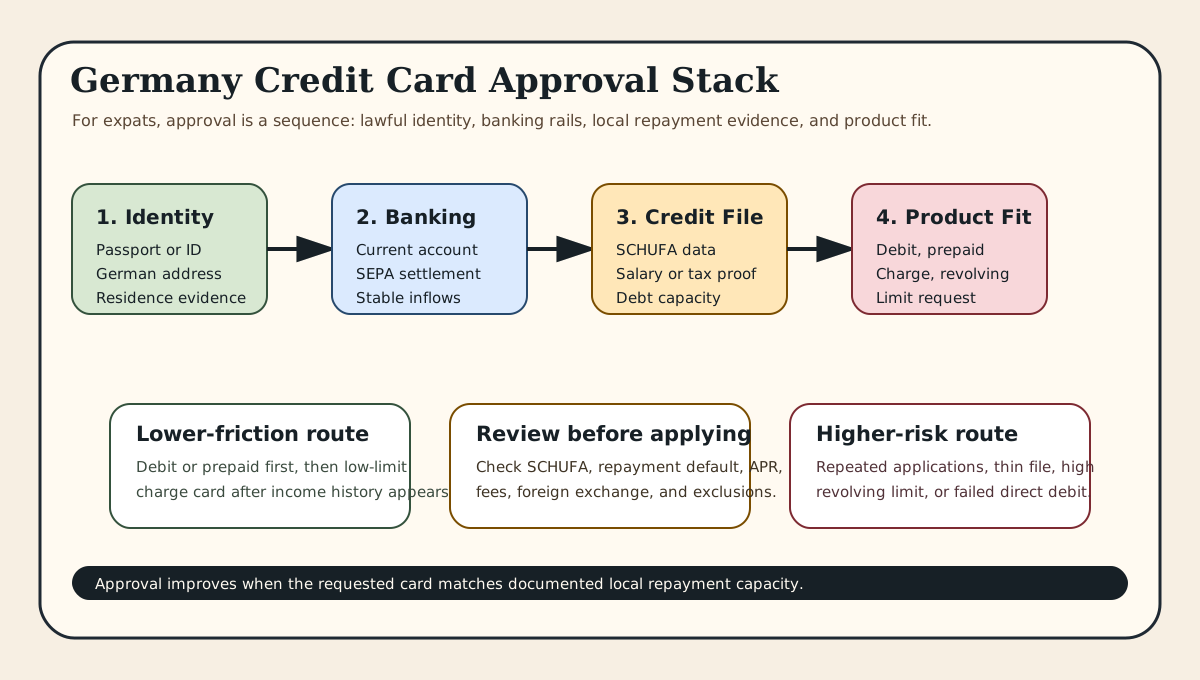
A credit card for expats in Germany is not a single product decision. It is a regulated credit, payment, identity, and evidence problem. Germany has broad access rules for payment accounts, but a bank can still decline an unsecured credit line when the applicant has a thin local file, unstable income, unclear residence documentation, or a weak repayment signal. The practical question is therefore not "Which German credit card is easiest?" The better question is: "Which card type fits my legal residence, income evidence, SCHUFA file, banking footprint, and settlement behavior right now?"
This guide is written for foreign residents, new arrivals, EU movers, Blue Card holders, students, freelancers, employees, and long-term visitors converting into German residence. It does not promise approval and it is not legal or financial advice. It gives a reviewer-grade framework for choosing between debit, prepaid, charge, and revolving products; preparing an application file; reading rejection risk; and avoiding expensive card terms.
Decision matrix
Most unsuccessful applications fail because the applicant treats the card as a shopping feature rather than a credit-risk decision. German issuers usually need to answer four questions before approval.
| Decision layer | What the issuer is testing | Evidence that usually helps | Common expat failure point |
|---|---|---|---|
| Identity and lawful presence | Can the customer be identified and onboarded? | Passport or national ID, residence permit when applicable, German address registration, tax ID if available | Address or residence evidence does not match the application profile |
| Payment account access | Can settlement and direct debit operate reliably? | German or SEPA current account, IBAN, account history, salary inflows | Applicant applies for credit before banking infrastructure is stable |
| Creditworthiness | Is repayment likely under the requested terms? | Salary slips, employment contract, tax assessments, business accounts, low debt burden, clean SCHUFA data | Thin German credit file or unverified foreign income |
| Product fit | Is the requested card type proportionate? | Lower initial limit, charge card instead of revolving card, secured or debit alternative | Applicant requests a high-limit revolving card too early |
The fastest route is often staged: open a current account, receive salary or business income there, stabilize direct debits, verify SCHUFA data, then apply for the least complex card that solves the use case.
Germany Distinguishes Account Access From Credit Approval
Germany and the EU recognize access to basic payment accounts for legally resident consumers. That access helps people receive salary, pay rent, and use core payment services. It does not create an entitlement to a revolving credit facility, a premium charge card, travel insurance, rental-car excess cover, or a high unsecured limit.
For expats, this distinction is central. A bank may be willing to provide a payment account or debit card but unwilling to grant a credit card until it sees local income, residence stability, and repayment behavior. Conversely, a foreign-issued card may work for online purchases but may not solve German direct-debit, landlord, salary, or SCHUFA-history needs.
Primary references:
- BaFin: basic payment account
- Your Europe: opening a basic bank account in the EU
- Directive 2014/92/EU on payment accounts
Card Types Matter More Than Brand Names
Many applicants compare rewards, airport lounges, or foreign exchange fees before they understand settlement type. In Germany, the difference between a debit card, charge card, revolving credit card, and prepaid card changes risk, cost, and approval probability.
| Product type | Credit exposure | Typical settlement | Approval difficulty for new expats | Best use case | Main risk |
|---|---|---|---|---|---|
| Debit card | Usually none | Immediate or near-immediate account debit | Low to medium | Daily spending, online payments, travel backup | May not work for every rental car or hotel deposit |
| Prepaid card | None if funded in advance | Spend only loaded balance | Low | Budget control, thin-file applicants | Fees, limited acceptance, weak credit-building value |
| Charge card | Short-term credit until statement due | Full monthly repayment | Medium | Stable employee with predictable income | Failed direct debit can damage relationship quickly |
| Revolving credit card | Yes | Minimum or flexible repayment | Medium to high | Borrowing flexibility for established residents | High interest, debt persistence, lower approval odds |
BaFin explains that credit institutions issuing credit cards in Germany require authorization and that card products can differ materially in function and cost. Its German consumer guidance on "real credit cards" also highlights that charge and revolving structures are not the same. A charge card requires full settlement at due date. A revolving card can carry balances, often at materially higher effective annual rates than ordinary installment credit. That makes APR, repayment default setting, and cash-advance treatment more important than the marketing name.
Primary references:
SCHUFA: What It Can and Cannot Do
SCHUFA is a major German credit bureau. It does not approve your application. It provides creditworthiness data and scores to contracting partners under applicable data-protection and credit-assessment rules. The issuer then combines that data with its own policy, income checks, fraud controls, and risk appetite.
For expats, there are three recurring SCHUFA situations.
| SCHUFA situation | What it means operationally | Approval implication | Practical response |
|---|---|---|---|
| No file or very thin file | Little German repayment history is visible | Issuer may approve only debit, prepaid, or low-limit products | Build account history before applying for unsecured credit |
| Clean but young file | Few or no negative entries, but limited depth | Charge card or low limit may be possible | Keep applications spaced and documents consistent |
| Negative or disputed data | Late payment, collection, unresolved contract, or incorrect entry | Approval risk is high | Request data copy, correct errors, resolve debts before applying |
SCHUFA states that its score assesses consumer creditworthiness and is based on data consumers can also find through their data access channels. BaFin also notes that many German credit institutions are connected to SCHUFA, while SCHUFA itself is not supervised by BaFin. This matters because a complaint about a bank decision and a data-correction request to a credit bureau are different tracks.
Primary references:
Evidence Engineering For Employees
Employees normally have the simplest path, but not automatically. A German employment contract is helpful, yet issuers often care more about probation status, payroll continuity, net disposable income, and whether income lands in an account they can evaluate.
Prepare a card file before applying.
| Evidence | Why it matters | Strong version | Weak version |
|---|---|---|---|
| Employment contract | Shows legal income source and continuity | Permanent or long fixed-term contract, role, salary, start date | Offer letter without start date or probation detail |
| Salary slips | Confirms actual payment | Last three salary slips matching bank inflows | One partial payslip or foreign payroll only |
| Bank statements | Shows cash-flow stability | Rent, utilities, salary, tax, and recurring payments visible | New account with no inflows |
| Residence evidence | Confirms address and lawful stay | Registration certificate plus residence permit where relevant | Hotel, temporary address, or mismatch across documents |
| Tax ID or payroll record | Connects resident financial life | German tax ID, payroll deductions, employer data | No local tax linkage |
Applicants still in probation should consider a debit or low-limit card first. Applying for an ambitious revolving card during probation can create an unnecessary refusal record and may encourage repeated applications.
Freelancers, Founders, And Self-Employed Expats
Freelancers often face more scrutiny because income volatility is harder to underwrite than salary. A strong self-employed application is not just a high revenue number. It shows repeatable income, tax compliance, expense discipline, and enough liquidity to absorb client delays.
| Document | Useful when | Reviewer note |
|---|---|---|
| Recent tax assessment | You have at least one German filing cycle | Stronger than projections because it is assessed history |
| Profit and loss statement | Your business is active but tax assessment is not current | Should reconcile to business account inflows |
| VAT returns or advance tax payments | You have regular German tax obligations | Shows ongoing tax visibility |
| Client contracts | Revenue is concentrated or project-based | Long-term contracts reduce volatility concerns |
| Separate business account | Personal and business cash flows are otherwise mixed | Cleaner statements reduce manual review friction |
Do not overstate revenue by ignoring tax, health insurance, pension, and professional costs. Issuers are interested in repayment capacity, not gross invoices.
Students, Job Seekers, And Recent Arrivals
Students and job seekers can still obtain useful payment tools, but the product path is different. A prepaid card, debit card attached to a current account, or low-limit student card may be more realistic than an unsecured revolving product. If the purpose is travel booking, online shopping, or subscription payments, a debit or prepaid product may solve most needs without creating debt risk.
| Profile | Sensible first product | Upgrade trigger |
|---|---|---|
| Student with blocked account or scholarship | Debit or prepaid card | Stable part-time income, longer residence, clean payment record |
| Job seeker with savings | Debit card and basic account | Signed employment contract and salary inflows |
| Recent Blue Card employee | Current account plus charge or low-limit card | Three to six months of payroll and no failed direct debits |
| EU mover with foreign income | Debit first, then issuer that accepts cross-border evidence | German address, SEPA account behavior, tax clarity |
The key is to match the card to actual need. If the need is a hotel deposit or car rental, check acceptance before assuming any card with a card-network logo will be treated as a credit card.
How German Credit Card Approval Differs From Some Expat Expectations
Many expats arrive from markets where credit cards are used early, frequently, and aggressively for credit-score building. Germany can feel different. Giro accounts, debit cards, SEPA direct debit, invoice payment, and charge-style settlement remain important parts of daily financial life. A person can function well without a revolving credit card, especially inside Germany, but may still need a card for travel, online services, hotels, rental cars, or emergency liquidity.
That distinction changes the approval strategy. If the problem is everyday spending, a debit card attached to a current account may solve it. If the problem is hotel deposits or car rental, the acceptance policy of the merchant matters more than reward points. If the problem is emergency borrowing, a revolving card may be one of the more expensive options and should be compared with overdraft, installment credit, employer advances, or savings.
| Expat assumption | German-market reality | Practical response |
|---|---|---|
| I need a credit card immediately to live normally | Many daily payments can be handled by current account, debit card, SEPA, and bank transfer | Open the account first and choose the card type after the actual use case is clear |
| Rewards should drive the choice | Acceptance, repayment, fees, insurance exclusions, and approval odds often matter more | Compare the cost stack before the benefits |
| A foreign card solves everything | It may work for purchases but not for local banking history or German settlement needs | Keep it as backup while building local infrastructure |
| A rejection means no bank will accept me | It may reflect product mismatch, thin file, or issuer policy | Fix evidence and apply for a more suitable product |
| A higher limit is Usually better | Higher limits can increase approval friction and spending risk | Start with the limit that solves the use case |
Costs That Expats Often Miss
Fees matter because a premium card can be poor value if the expat cannot use the benefits, travels mainly inside the euro area, or carries revolving balances. Review the full cost stack before applying.
| Cost item | Why it matters | Review question |
|---|---|---|
| Annual fee | Fixed cost regardless of use | Does the benefit exceed the fee after exclusions? |
| Effective annual interest | Applies when balances revolve | Is full repayment the default or must it be selected? |
| Cash advance fee | Often expensive immediately | Will you ever withdraw cash with the card? |
| Foreign exchange markup | Important outside the euro area | Is markup charged on card-network conversion? |
| ATM operator fee | May apply even if issuer says withdrawals are free | Are local ATM fees reimbursed? |
| Insurance exclusions | Benefits often depend on paying the trip with the card | Are residence, age, trip length, and claim limits acceptable? |
| Replacement and emergency cash fees | Important for expats without local backup | Is there a local backup card or account? |
For revolving cards, the safest default is full automatic repayment unless the borrower deliberately wants credit and has compared cheaper alternatives. Consumer credit regulation increasingly emphasizes creditworthiness assessment and clear explanations of decisions, especially where automated processing is used. The updated EU Consumer Credit Directive applies from November 20, 2026, but it is already relevant for understanding the direction of travel: affordability, transparency, and explainability are not optional concepts.
Primary references:
- Directive (EU) 2023/2225 on consumer credit
- European Commission: consumer protection in financial services
Building A Local Financial Footprint Without Over-Borrowing
An expat can improve practical bankability without taking unnecessary debt. The objective is to make ordinary financial behavior visible, consistent, and low risk.
| Action | Why it helps | What to avoid |
|---|---|---|
| Use one main current account for salary or business income | Makes income regularity easier to verify | Splitting small inflows across many accounts too early |
| Keep rent, utilities, insurance, and phone payments current | Avoids negative payment patterns and failed direct debits | Letting small contract disputes become collection entries |
| Maintain a stable registered address | Reduces identity and contact-risk friction | Applying while address registration is pending or inconsistent |
| Review data copies and correct errors | Prevents incorrect negative data from shaping decisions | Assuming a bank rejection means the bureau file is accurate |
| Apply selectively | Reduces avoidable rejection noise | Submitting many applications in a short period |
| Prefer full repayment settings | Prevents revolving interest and missed-payment cycles | Treating the card as income replacement |
For freelancers, the footprint should also include tax-compliant business records. Issuers may be more cautious with self-employed applicants because income can vary. A freelancer with clean invoices, tax assessments, business bank statements, and conservative requested limits is easier to underwrite than a freelancer with platform screenshots and no coherent accounting.
Choosing Between Debit, Charge, And Revolving Credit
The best card type depends on the job the card must do.
| Need | Usually sensible product | Reason |
|---|---|---|
| Groceries, transport, online subscriptions | Debit card | Low credit risk and simpler approval |
| Hotel bookings and business travel | Charge card or accepted debit card | Full monthly repayment can match expense reimbursement |
| Rental cars | Confirmed credit or charge product accepted by the rental company | Deposit rules can be stricter than ordinary purchase acceptance |
| Budget control | Prepaid or debit | Spending is limited to available funds |
| Emergency borrowing | Revolving credit only after APR comparison | It can be expensive and should not replace an emergency fund |
| Building a relationship with a bank | Low-limit card from the main account provider | The issuer may already see income and account behavior |
Do not let the card label do the thinking. Some products marketed as credit cards behave like charge cards. Some debit cards work online but fail for specific deposits. Some premium cards include insurance that is useful only when the trip was paid with the card and the policy exclusions fit the customer. Read the fee schedule, repayment setting, and insurance terms before applying.
Application Sequence That Reduces Rejection Risk
Use a staged process rather than applying repeatedly.
| Step | Action | Pass condition | Stop condition |
|---|---|---|---|
| 1 | Confirm lawful residence and address documentation | Documents match exactly across application fields | Address, name, or status mismatch |
| 2 | Establish current account and income route | Regular salary or business inflows appear | Account is newly opened with no activity |
| 3 | Check SCHUFA data | Data copy has no incorrect negative entries | Disputed or incorrect data appears |
| 4 | Select product class | Card type fits evidence strength | Revolving card requested without repayment signal |
| 5 | Apply once with complete file | Issuer can verify identity, income, and settlement account | Missing payroll, tax, or residence proof |
| 6 | Use conservatively after approval | Full repayment, low utilization, no failed debits | Minimum payments, late fees, cash advances |
If refused, do not immediately apply to several other issuers. First identify the likely reason: identity, residence, income, SCHUFA, product mismatch, or internal policy. Then correct the cause.
Rejection Reasons And Fixes
| Rejection signal | Likely cause | Practical fix |
|---|---|---|
| "Cannot verify identity" | Document, address, or video-ID mismatch | Re-apply only after registration and document consistency are fixed |
| "Credit criteria not met" | Thin file, weak income, probation, negative entry | Wait, build account history, lower requested product complexity |
| "Income insufficient" | Gross income does not translate to repayment capacity | Provide net salary, reduce limit request, avoid revolving product |
| "Residence status unclear" | Permit expiry or temporary stay risk | Provide renewal evidence or choose debit/prepaid alternative |
| "Internal policy" | Issuer does not serve the profile | Try a bank aligned with your account, employer, or residence type |
Data Protection, Explanations, And Complaint Routing
An expat should separate three rights conversations that are often confused. First, there is the relationship with the card issuer. The issuer decides whether to grant credit, what limit to offer, and whether internal fraud or affordability rules prevent approval. Second, there is the relationship with a credit bureau such as SCHUFA. If the bureau file contains incorrect data, the practical task is to request access, identify the entry, and pursue correction through the data controller process. Third, there is the regulated complaint route. A consumer complaint about fees, failed direct debit handling, unauthorized transactions, or misleading card terms should be documented with dates, statements, screenshots, and contract terms.
For applications involving automated decisioning, keep records of the application date, the product requested, declared income, residence status, and any rejection text. The updated EU consumer-credit framework emphasizes meaningful explanations and review rights where creditworthiness assessment uses automated processing. Even where a specific right depends on implementation timing and national law, the practical habit is the same: preserve evidence and ask a precise question instead of sending a generic complaint.
| Problem | First route | Evidence to attach |
|---|---|---|
| Incorrect SCHUFA or bureau data | Data access and correction process | Data copy, contract closure proof, payment proof |
| Card fee or APR dispute | Issuer complaint channel | Terms, statement, fee schedule, correspondence |
| Unauthorized card transaction | Immediate issuer notification | Transaction ID, card status, police report if relevant |
| Repeated identity failure | Onboarding support | ID image, address certificate, residence permit, tax ID |
| Unclear rejection | Issuer request for explanation | Application reference, declared facts, requested product |
Practical Recommendations By Use Case
| Use case | Best fit | Why |
|---|---|---|
| Daily German spending | Debit card with current account | Low cost, easier onboarding, no credit risk |
| Online subscriptions and travel backup | Debit plus prepaid backup | Reduces reliance on one issuer |
| Business travel employee | Charge card with full repayment | Matches expense reimbursement cycles |
| Car rental heavy user | True credit or charge card accepted by rental firms | Deposit acceptance matters more than rewards |
| Emergency borrowing | Revolving credit only after APR comparison | Card debt may be more expensive than installment credit |
| Thin-file newcomer | Secured, prepaid, debit, or low-limit starter product | Builds operational history without overreaching |
Thirty-Day Approval Preparation Plan
New arrivals often apply too early. A short preparation window can make the application cleaner even when it does not create a deep German credit history.
| Week | Action | Why it helps |
|---|---|---|
| Week 1 | Confirm Anmeldung, residence document status, tax ID, and spelling consistency across documents | Identity mismatches can cause automated or manual onboarding failures |
| Week 1 | Open or stabilize the current account that will receive income | Issuers prefer a clear settlement account and direct-debit path |
| Week 2 | Route salary, scholarship, pension, or business revenue through the account | Visible inflows make repayment capacity easier to assess |
| Week 2 | Request or review SCHUFA data access if timing allows | Incorrect negative data should be addressed before a credit application |
| Week 3 | Choose product class conservatively: debit, prepaid, charge, or low-limit credit | Product fit reduces the chance of refusal caused by overreaching |
| Week 4 | Apply once with a complete file and preserve the application record | Multiple rushed applications can create noise without fixing the underlying issue |
This plan does not guarantee approval. Its value is discipline. It turns the application from a product click into a coherent evidence file: lawful residence, stable address, visible income, clean or explainable credit data, and a card type that matches the applicant's current profile.
Final Checklist
Before applying, answer these questions.
| Question | Evidence you should have |
|---|---|
| Do my name, address, and birth data match across documents? | Passport or ID, registration certificate, residence permit if applicable |
| Can the issuer see stable repayment capacity? | Salary slips, contract, tax assessment, business accounts, bank statements |
| Is my SCHUFA data clean or explainable? | Recent data copy and corrected errors |
| Have I chosen the least risky product that solves my need? | Debit, prepaid, charge, or low-limit credit comparison |
| Do I understand total cost? | Annual fee, APR, FX, ATM, cash advance, insurance exclusions |
| Can I repay in full automatically? | Direct debit mandate and sufficient current-account balance |
Source Quality Notes
This article prioritizes public authorities and primary regulatory materials because card approval advice can become misleading when based only on anecdotal expat experience. BaFin sources are used for German payment-card and banking supervision context. EUR-Lex and European Commission sources are used for EU-level payment-account and consumer-credit rules. SCHUFA's own scoring explanation is used only for the limited proposition that SCHUFA scores assess creditworthiness and draw on data visible to consumers through SCHUFA channels; it is not treated as independent consumer advocacy. Where issuer-specific policies differ, the issuer's current product terms should override any general market observation in this guide.
Bottom Line
The best credit card for expats in Germany is the card that fits the applicant's current evidence, not the most advertised product. New arrivals should usually prioritize account stability, salary or business-income visibility, clean SCHUFA data, and conservative product selection. Once those foundations exist, approval odds improve and the applicant can compare rewards, insurance, and travel benefits without ignoring the regulated credit decision underneath.
Official source and decision check
Use this section as the practical checkpoint for Credit Card for Expats in Germany: SCHUFA, Income, Residence, and Approval Rules. The reader decision is whether the available evidence is strong enough to act now, or whether the file should first be confirmed with the competent authority. Rules can change by country, status and date, so treat this guide as orientation for the file and recheck the current rule before relying on an appointment, employer filing, permit change, payroll step or registration deadline.
For expats, foreigners, students, workers, founders, families and other mobile readers, record the reader category, country, residence status and deadline before comparing the official source with the article checklist.
Official sources to verify first
- Make it in Germany official portal
- Federal Foreign Office Germany
- Federal Employment Agency
- Federal Office for Migration and Refugees
- German laws online
| Decision point | What to check | Reader action |
|---|---|---|
| Administrative decision | Confirm that the case is really about administrative decision, not a different category that follows another rule. | Write down the country, authority, dates, status and document number before asking for a decision. |
| File for competent authority | Keep the identity, residence and document evidence in one dated file, with originals, translations where required and proof of submission. | Save receipts, emails, appointment confirmations, payment records and authority replies in the same order as the checklist. |
| Credit Card for Expats in Germany: SCHUFA, Income, Residence, and Approval Rules fallback | If the answer is refused, delayed or unclear, identify the competent authority, review window, complaint route or regulated provider escalation path. | Ask for the reason in writing and compare it with the official source before paying again, travelling, closing an account or resubmitting. |
| When the answer is unclear | What to do next |
|---|---|
| The authority, bank, insurer, employer or provider gives a verbal answer only. | Ask for the answer in writing, save the name of the office or provider, and compare it with the official source before changing travel, payroll, residence or payment plans. |
| The file depends on a deadline, appointment, payment, address or status change. | Keep the dated receipt, note the next deadline, and avoid closing the old route until the replacement document, account, policy or registration is confirmed. |
Related guides to cross-check
- First month in Europe checklist
- Living in one European country and working in another
- EU remote working guide
- Cross-border worker benefits in the EU
- Private health insurance documents in Europe
For legal, tax, medical, immigration or financial consequences, confirm the position with the competent authority or a qualified adviser. This page is designed to organize the decision, source checks and next steps; it is not a substitute for case-specific professional advice.