Last updated
Direct answer
If you are a foreigner applying for a credit card in Europe, the practical starting rule is to get the simplest product that matches your legal status, income pattern, and local history, then upgrade later. For many new arrivals, that means a basic or standard current account first, then a debit, secured, or low-limit credit product after local payment behavior is visible.
The answer changes when you are a student, a temporary-permit worker, a founder mixing business and personal flows, or a cross-border earner with rotating payers. Banks usually underwrite continuity, not just one document set, so short permits, unstable income, or unclear purpose can move you down the product ladder.
Next step: choose your profile from the table, gather one clean identity package, one legal-status package, one income package, and one purpose note, then apply for the lowest-complexity product that fits that evidence.
| Profile | Recommended opening route | Why this works | First escalation trigger |
|---|---|---|---|
| New EU resident employee | Basic current account first, then local-credit product with payroll history | Employment is the strongest local proof in the first 3 months | If payroll is delayed, move to debit-secured alternatives before credit renewal |
| Non-EU worker with temporary permit | Standard account matching legal stay window | Valid status and direct wage link give clearer underwriting | If stay window is short, reduce requested credit exposure |
| Student | Debit or basic account, then small unsecured card after term activity | Students often have predictable income rhythm but limited credit history | If tuition or scholarship schedule is uncertain, avoid unsecured credit at first |
| Founder with mixed transactions | Business/sole-proprietor first, then personal secured or co-borrowed route | Mixed personal/business flows are treated as a risk signal | If transactions are business-heavy, avoid personal credit claims |
| Retiree | Pension-linked account then conservative card class | Stable pensions are easier to model than volatile transfers | If pension channel changes, pause card upgrades |
| Remote cross-border consultant | Income pattern document-first application | Card issuers want observable monthly pattern and stable payer evidence | If payer is rotating, request low-limit alternative first |
7-day, 30-day, and 60-day readiness checkpoints
Use one checklist before you submit:
- 7 days: passport/ID valid, residence status confirmed, one local address method available, one clean income proof for the full last month.
- 30 days: one statement showing stable account behavior, translation quality checked, consistent name/address format.
- 60 days: one successful practical use test (direct debit + card payment + one transfer) after approval.
If any checkpoint is red, reduce target product complexity.
What banks usually reject that can be fixed immediately
Mistake 1: Asking for a premium card without a local behavioral history
This often triggers instant policy declines. A fix is to define a "starter stack": debit or secured card, low-limit revolving card, and one payroll history cycle. The idea is to make the file legible.
Mistake 2: Submitting too many documents with no narrative
Issuers do not reward bulk. They reward clarity. Replace ten unrelated scans with:
- one verified identity package,
- one legal status package,
- one purpose/use-case package,
- one money-profile package.
Mistake 3: Mixing card purpose and account purpose
A travel card plan and local rent-card plan cannot be bundled as one application without explicit purpose differentiation. Keep one use-case statement for each line item.
Mistake 4: Ignoring post-approval behavior
The first three cards rejected? Not always about your income; often about earlier transaction pattern. Missing or odd behavior in the first months becomes a hard constraint for future upgrades.
Worked examples: how the same profile succeeds and fails
Example A: New arrival, salary in six months
- Application profile: non-EU newcomer with language-school admission and short-term room contract.
- Initial attempt: asked for premium rewards card based on future salary.
- Reject reason: insufficient local behavior and policy mismatch.
- Fix: open debit-first account, gather one payroll month, then request lower-limit unsecured card with same bank.
- Likely outcome: better completion speed than immediate full underwriting.
Example B: Freelancer with multi-country clients
- Application profile: invoices in three currencies across two banks.
- Initial attempt: direct unsecured card with only contract copy.
- Reject reason: unclear source-of-funds pattern and mixed payer geography.
- Fix: add invoice cadence chart, 3 months of statements, payer confirmations, and tax return extract.
- Likely outcome: either policy-approved low-limit card or reduced risk with alternative.
Example C: EU remote worker moving into country
- Application profile: EU passport holder, legal residence in country, new local account not yet opened.
- Initial attempt: single application with full folder of legal documents but no local utility/statement.
- Reject reason: no local conduct profile.
- Fix: submit a minimal account purpose with direct debit and transfer simulation plan.
- Likely outcome: faster access route with standard account.
Refusal recovery framework for card applications
Use the same sequence each time:
- Save refusal language exactly as sent.
- Categorize reason into one of five buckets: identity, residence, income, source of funds, product policy.
- Repair only one bucket per cycle.
- Resubmit with short changes and keep channel constant if possible.
- If no improvement after two cycles, request a policy alternative.
This reduces retry fatigue and preserves a clean evidence trail if you later need escalation.
Product architecture: card stacks that survive real use
A practical stack for most arrivals:
- Layer 1: debit card with local payments and controlled cash function.
- Layer 2: low-limit revolving/secured card tied to verified payroll.
- Layer 3: backup card with different issuer/network for airport/temporary network disruptions.
- Layer 4 (optional): premium card after local behavior and payment history.
This is not advice to buy less. It is advice to keep underwriting risk bounded.
Europe-by-scenario card strategy
| Goal | First action | Second action after 30 days | Third action after 90 days |
|---|---|---|---|
| Move in for rent and relocation | Get a local payment account + debit | Add low-limit card for controlled travel and utilities | Upgrade with stronger income proof |
| Travel-heavy six-month resident | Keep one card with predictable no-FX fee profile | Test airport, rental, supermarket acceptance | Add backup in different network |
| Business-heavy cardholder | Clarify whether card is personal or company | Separate business spend channels | Add alternative depending on transaction geography |
| Student/freelancer overlap | Start with one conservative product | Document stipend/contract consistency | Apply for broader feature card if cashflow is visible |
90-day execution calendar
Days 1–30
- Finalize profile-specific route.
- Build a one-page purpose statement.
- Keep all names, dates, and addresses identical across files.
Days 31–60
- Reclassify and repair only one rejection bucket at a time.
- Ask for exact missing-document class each cycle.
- Confirm payroll or invoice schedule before card replacement.
Days 61–90
- Run operational tests: travel, rent, subscription, transfer, direct debit.
- Resolve recurring discrepancy in statement descriptors.
- Decide if upgrade is justified by behavior and stability.
Common "false security" assumptions
-
"I have enough savings, so rejection won't happen."
Without continuity and purpose fit, large savings may not help. -
"No one cares about card conversion choice."
For foreign transactions, small errors on cash and exchange settings create larger long-term costs. -
"One approved card means all cards will approve."
Issuer policies differ. One acceptance is only one policy outcome. -
"I can fix everything after approval."
Most approval risk sits in onboarding. Some problems are easier when corrected before first issue.
Minimal document pack template by profile
Use this as an actual file name set:
2026-06-01-identity-profile.pdf2026-06-01-income-verification.xlsx2026-06-01-purpose-and-flow.md2026-06-01-source-of-funds-summary.pdf
Naming by date and category lowers internal confusion for banks and your own records.
Internal follow-on routes
- Best credit card for foreign transactions in Europe
- Credit cards for expats in Europe
- Checking account requirements for expats in Europe
- How to open a bank account as a foreigner in Europe
Post-approval control checklist
- Keep utilization conservative for 90 days.
- Update address and tax status immediately when changed.
- Keep statement retention for dispute windows.
- Separate personal and business spending when possible.
- Revisit upgrade timing every 60 days, not weekly.
A card decision should improve execution, not create a new source of uncertainty.
Credit Card Requirements for Foreigners in Europe: Residence, Income and KYC
Credit-card approval evidence map
Credit Card Requirements for Foreigners in Europe: Residence, Income and KYC helps expats separate mandatory cover from useful optional protection and residence-proof evidence. It explains separating health, liability, car, residence-proof, and private-policy evidence so the right cover supports the right obligation, then shows how to separate compulsory health cover, liability, car insurance, residence-proof evidence, cancellation rights, and claims records. The later sections connect 7-day, 30-day, and 60-day readiness checkpoints, what banks usually reject that can be fixed immediately, and mistake 1: asking for a premium card without a local behavioral history so the next step is easier to judge. Read it before choosing policies so compulsory cover, optional protection, residence proof, claims, and cancellation evidence do not get mixed together.
| Approval layer | Evidence to prepare | Problem prevented |
|---|---|---|
| Identity and residence | Passport or national ID, residence card or registration, local address and tax identifier. | The bank cannot confirm that the applicant is eligible in that market. |
| Income and risk | Payslips, contract, bank statements, existing account history and credit-bureau record if available. | The application is refused because repayment capacity is unclear. |
| KYC and alternatives | Source-of-funds evidence, refusal note, secured-card option, debit-card fallback and review date. | The reader keeps applying without fixing the underlying evidence gap. |
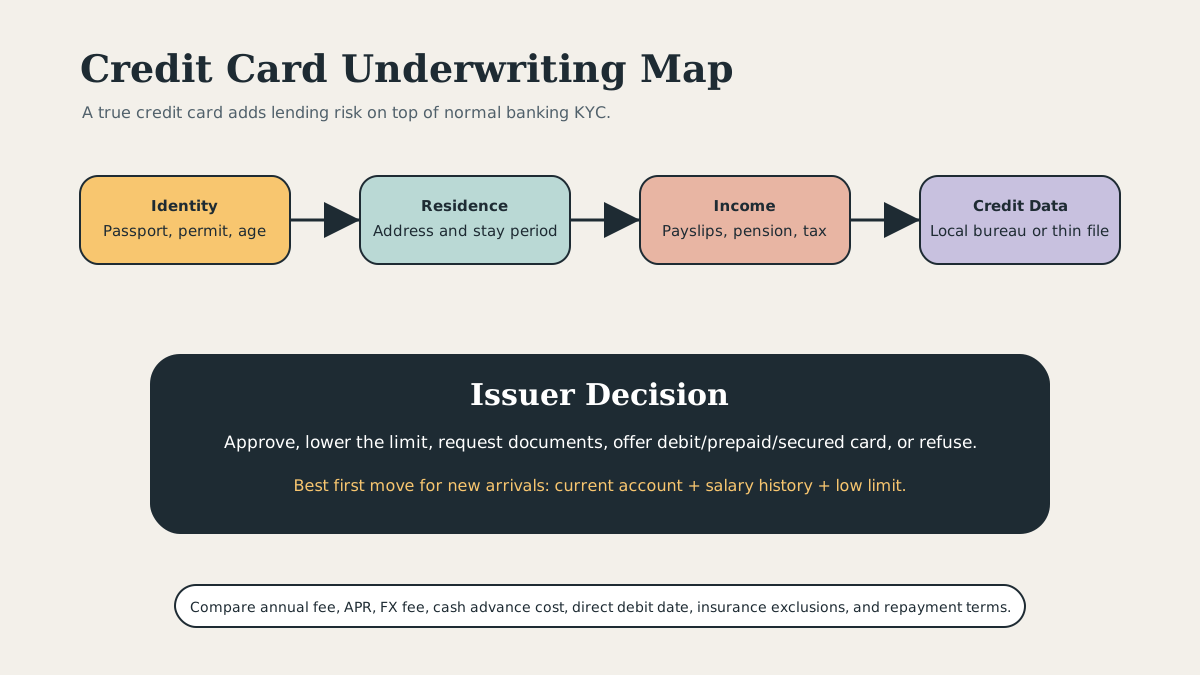
Credit card requirements for foreigners in Europe are stricter than basic bank account requirements because a true credit card is usually a lending product. A bank may be willing to open a payment account but refuse a credit line until you have local residence, stable income, a local bank account, and enough credit history.
The word "credit card" also causes confusion. In Europe, some products marketed as cards are debit cards, prepaid cards, deferred-debit cards, charge cards, or cards linked to e-money accounts. They may look similar at a hotel desk or online checkout, but the underwriting rules are different.
Source-check date: May 14, 2026. This article is informational and does not replace bank-specific eligibility rules, credit advice, legal advice, or tax advice.
Quick Answer
Foreigners applying for a European credit card usually need valid identification, legal residence in an accepted country, a local or SEPA bank account for repayment, proof of income, tax-residency information, and a satisfactory creditworthiness assessment. New arrivals often have no local credit file, so they may need a lower-limit card, charge card, secured card, debit card, prepaid card, or several months of salary history before approval.
EU basic payment account rules do not create a right to a credit card. Your Europe explains that basic payment accounts do not always have to include an overdraft or credit facility. See Your Europe: basic payment accounts.
First Distinction: Card Type
| Card type | Is it credit? | Typical approval logic |
|---|---|---|
| Debit card | No | Linked to current account balance |
| Prepaid card | No or limited | Load funds first; lighter affordability review |
| E-money card | Usually no credit | Provider verifies identity and account eligibility |
| Deferred-debit card | Short delay, often no revolving debt | Bank assesses account behavior and income |
| Charge card | Full balance due monthly | Income and repayment capacity matter |
| Revolving credit card | Yes | Full creditworthiness assessment |
| Secured credit card | Credit backed by deposit | Deposit reduces issuer risk |
| Premium travel card | Usually credit or charge | Higher income, history, and residency requirements |
Before applying, confirm whether the product allows revolving balances, cash advances, installment repayment, or overdraft-like use. Those features usually increase underwriting requirements.
Core Requirements
| Requirement | Why it matters | Evidence examples |
|---|---|---|
| Identity | Legal identification and sanctions screening | Passport, EU ID card, residence permit |
| Age | Consumer credit eligibility | Date of birth on ID |
| Residence | Product jurisdiction and collections risk | Residence card, registration certificate, lease |
| Address | Contactability and fraud prevention | Utility bill, municipal certificate, bank statement |
| Income | Repayment capacity | Employment contract, payslips, pension, tax return |
| Bank account | Repayment direct debit | Local IBAN or accepted SEPA IBAN |
| Credit history | Default risk | Local bureau record, internal bank history |
| Tax status | CRS/FATCA reporting | Tax residency and TIN self-certification |
| AML/KYC | Legal compliance | Source of funds, purpose, PEP screening |
A foreign passport is rarely the main issue by itself. The bigger problems are unsupported residence country, no local income evidence, no credit file, short visa duration, missing local bank account, or inability to verify address.
Creditworthiness Assessment
Credit cards with borrowing features fall under consumer credit logic. The European Commission explains that EU consumer credit rules require lenders to assess the consumer's creditworthiness and were revised in 2023 to broaden protection, including for smaller credit and buy-now-pay-later schemes. See European Commission: Consumer Credit.
A card issuer may assess:
| Factor | What the issuer is testing |
|---|---|
| Employment status | Stable repayment source |
| Net income | Ability to pay monthly balance |
| Existing debts | Available affordability |
| Rent or mortgage | Fixed expense burden |
| Local credit record | Past repayment behavior |
| Account conduct | Salary inflows, overdrafts, returned direct debits |
| Residence duration | Stability and collections practicality |
| Visa or permit expiry | Whether future residence is uncertain |
| Credit limit requested | Exposure size relative to income |
If you are new to Europe, the absence of negative credit history is not the same as positive credit history. A thin file can still lead to a low limit or refusal.
KYC, AML, And Tax Reporting
Card issuers are not only assessing credit risk. They also need to satisfy customer due diligence, sanctions screening, tax reporting, and fraud controls.
The European Banking Authority's ML/TF risk-factor guidelines cover customer due diligence and risk-based controls for financial institutions. See EBA: ML/TF risk-factor guidelines. The European Commission explains that EU AML rules require customer due diligence when entering into a business relationship. See European Commission: AML/CFT at EU level.
Tax residency also matters. The OECD Common Reporting Standard requires participating jurisdictions to obtain and exchange financial-account information. U.S. persons may face FATCA documentation. See IRS: FATCA.
| Question on application | Reason |
|---|---|
| Country of birth | Identity, FATCA indicia, risk screening |
| Nationality | Sanctions and legal eligibility |
| Tax residence | CRS/FATCA reporting |
| Occupation | Income and AML risk |
| Employer | Income verification |
| Source of funds | AML review |
| Political exposure | Enhanced due diligence |
| Intended use | Fraud and risk classification |
Country And Bureau Differences
Europe does not have one credit-bureau system. Credit data is national or provider-specific, and cross-border portability is limited.
| Country issue | Practical consequence for foreigners |
|---|---|
| Netherlands BKR | Credit providers may check existing loans and arrears |
| Germany SCHUFA-style checks | New arrivals may have thin files |
| France banking history | Income and account conduct often matter |
| Spain CIRBE/ASNEF-style ecosystem | Local debts and defaults can matter |
| Italy CRIF-style checks | Local credit record may be relevant |
| United Kingdom credit-reference agencies | Address history and electoral roll can matter, though the UK is outside the EU |
| Nordics | Local ID and digital identity systems can be central |
For the Netherlands specifically, lenders may check domestic credit and arrears records before issuing revolving credit. Use De Nederlandsche Bank as an official starting point for Dutch financial-sector context, then confirm the exact credit-register rule with the lender before applying.
Do not assume your U.S., Canadian, Indian, Brazilian, or Australian credit score will transfer. Some premium issuers may consider global customer history internally, but that is product-specific and not a general right.
Standard Application File
| Document | Employee | Freelancer | Student | Retiree |
|---|---|---|---|---|
| Passport or ID | Required | Required | Required | Required |
| Residence permit | If non-EU | If non-EU | If non-EU | If non-EU |
| Proof of address | Required | Required | Required | Required |
| Local bank account | Usually | Usually | Usually | Usually |
| Payslips | Required | Not applicable | Sometimes | Not applicable |
| Employment contract | Useful | Not applicable | Sometimes | Not applicable |
| Tax return | Sometimes | Often | Rare | Sometimes |
| Business accounts | No | Often | No | No |
| University enrollment | No | No | Often | No |
| Pension statement | No | No | No | Often |
| Existing debt list | Often | Often | Sometimes | Often |
If you cannot document stable income, apply for a debit, prepaid, secured, or lower-limit product first.
Approval Strategy For New Arrivals
- Open a current account or basic payment account first.
- Route salary or regular income through that account for several months.
- Avoid overdrafts, returned direct debits, and late bills.
- Register locally where required and keep your address updated.
- Build a clean paper trail for income and rent.
- Start with a low credit limit or charge card if available.
- Avoid multiple card applications in a short period.
- Reapply after documented income history improves.
- Ask whether secured or deposit-backed options exist.
- Keep credit utilization low and pay in full.
The fastest route is not always the best route. A rejected application can leave an internal record with the issuer and may complicate repeated attempts.
Common Reasons Foreigners Are Refused
| Reason | Explanation |
|---|---|
| No accepted residence | Product only available to residents of certain countries |
| Short residence permit | Issuer sees repayment and collections risk |
| No local bank account | Repayment direct debit cannot be set up |
| No local credit history | Thin file makes risk hard to price |
| Insufficient income | Limit requested exceeds affordability |
| Variable freelance income | Issuer wants longer tax or account history |
| Address mismatch | Documents do not match application |
| FATCA complexity | U.S. person onboarding requires extra handling |
| AML concerns | Source of funds or profile cannot be explained |
| Too many recent applications | Looks like credit stress |
Credit Card Versus Debit Card For Expat Use
| Use case | Debit card | Credit card |
|---|---|---|
| Online purchases | Usually works | Usually works |
| Hotels and car rental | Sometimes less accepted | Often preferred |
| Chargebacks | Scheme-dependent | Often stronger protections |
| Borrowing | No | Possible |
| Credit history building | Limited | Can help if reported locally |
| Approval difficulty | Lower | Higher |
| Overspending risk | Lower | Higher |
| Annual fee | Often lower | Varies widely |
| Travel insurance | Less common | More common on premium cards |
For many new expats, the practical first card is a debit card attached to a current account, followed by a low-limit credit card after income and address stability are established.
What To Compare Before Accepting A Card
| Cost or term | Why it matters |
|---|---|
| Annual fee | Recurring baseline cost |
| APR or borrowing rate | Critical if you ever revolve balances |
| Cash advance fee | Usually expensive |
| Foreign-currency fee | Important for cross-border expats |
| ATM withdrawal rules | Credit-card cash withdrawals can be costly |
| Grace period | Determines interest-free repayment window |
| Direct debit date | Must match salary and rent timing |
| Minimum payment | Low minimums can create long debt cycles |
| Late payment fee | Can damage credit and increase cost |
| Insurance exclusions | Premium card benefits may be narrower than advertised |
EU consumer credit rules require pre-contract information and creditworthiness assessment for many credit products, but you still need to read the product terms.
Alternatives If Refused
| Alternative | Best for | Limitation |
|---|---|---|
| Debit card | Daily spending | No borrowing or credit history effect |
| Prepaid card | Budgeting and travel | May not work for all deposits or rentals |
| Secured card | Building local record | Requires cash collateral |
| Charge card | Full monthly repayment | Still requires income review |
| Lower-limit card | First approval | Limited emergency capacity |
| Employer travel card | Business expenses | Not personal credit |
| Additional cardholder | Family use | Main cardholder remains liable |
| Foreign home-country card | Transitional use | FX fees and acceptance issues |
Avoid informal borrowing, account sharing, or using another person's card as a workaround. That can create fraud, tax, and liability problems.
FAQ
Can foreigners get credit cards in Europe?
Yes, but approval depends on residence, income, local bank account access, creditworthiness, and provider policy. New arrivals often need to start with debit, prepaid, secured, or low-limit products.
Does EU law give me a right to a credit card?
No. EU basic payment account rights do not create a right to credit. A credit card with borrowing features is underwritten separately.
Do I need local credit history?
Often yes, or at least local account history. Some banks may approve based on income and internal account conduct, but a thin file usually means lower limits or refusal.
Can I use my foreign credit score?
Usually not directly. A foreign score may help only if the issuer has a global relationship or special expat process. Most European credit checks rely on local or national data.
Is a charge card easier than a credit card?
Sometimes. Because the full balance is due monthly, some charge-card products differ from revolving credit cards. But issuers still assess income, identity, residence, and repayment risk.
Should I apply for many cards at once?
No. Multiple applications can look risky and may create internal or bureau footprints. Build a clean account history and apply selectively.
Source Risks And Factual Uncertainty
Credit card underwriting is issuer-specific and changes with market risk, regulation, internal policy, residence country, nationality, income type, and credit-bureau access. This article describes common European patterns and official EU-level consumer-credit principles, not a guaranteed approval checklist.
Official And Primary Sources
- European Commission: Consumer Credit
- Your Europe: bank accounts in the EU
- European Commission: AML/CFT at EU level
- EBA: ML/TF risk-factor guidelines
- IRS: FATCA
- De Nederlandsche Bank
Related Reading
- Checking Account Requirements For Expats In Europe
- Bank Account In The Netherlands For Non-Residents
- Credit Cards For Expats In Europe
Underwriting Model For Foreign Applicants
Credit card approval in Europe is not only about income. Issuers usually evaluate identity, residence stability, repayment capacity, local credit data, account history, regulatory reporting, and product risk. A foreign applicant can be financially strong and still be refused if the issuer cannot verify the profile inside its local system.
Requirement layer 1: identity and residence
The issuer must identify the applicant and understand where they live. Prepare:
- passport or national ID,
- residence permit where relevant,
- local address proof,
- foreign address history if newly arrived,
- tax-residence declaration where requested.
Address inconsistency is a common cause of friction. If the bank account, residence permit, employer letter, and utility bill show different addresses, correct the record before applying.
Requirement layer 2: local banking relationship
Many European issuers prefer applicants who already hold a current account with the bank or a local payment account. The account gives the issuer:
- identity history,
- salary or income pattern,
- account conduct,
- direct-debit setup,
- fraud and AML context.
New arrivals should often build three to six months of clean account activity before applying for unsecured revolving credit.
Requirement layer 3: income and repayment capacity
Income evidence can include:
- employment contract,
- payslips,
- pension statement,
- tax return,
- freelancer accounts,
- bank statements showing regular income.
Freelancers, contractors, and founders may need more evidence because income is less predictable. A high annual amount is weaker than a stable, documented cash-flow pattern.
Requirement layer 4: local credit data
Some countries rely heavily on national credit bureaus or bank-internal history. A foreign credit score usually does not transfer automatically. If a score cannot be imported, the issuer may start with:
- lower limit,
- secured product,
- debit or prepaid card,
- charge card,
- relationship-based approval after account history.
This is not personal judgment; it is a data-availability issue.
Product Ladder For New Arrivals
| Product | Best use | Approval pressure |
|---|---|---|
| debit card | daily payments from current account | identity and account opening |
| prepaid card | limited spending without credit | lower underwriting but fewer protections |
| secured credit card | credit-building where available | deposit or collateral |
| charge card | monthly full repayment | income and account conduct |
| low-limit credit card | first unsecured credit | local history and stable income |
| premium/rewards card | established borrowers | stronger income and credit profile |
The right product is the one the applicant can maintain cleanly, not the highest limit available.
Applicant Scenario Matrix
| Applicant | Main issue | Better route |
|---|---|---|
| EU citizen recently moved country | thin local file | open current account first and build salary history |
| non-EU resident with permit | residence and income verification | align permit, address, and employer proof |
| freelancer | variable income | provide tax returns and bank-flow evidence |
| student | limited income | student card, debit, prepaid, or guarantor route where available |
| high-net-worth newcomer | foreign wealth not equal to local credit | private banking or secured route |
| U.S. person | FATCA and tax documentation | prepare status forms early |
Rejection Recovery Workflow
If refused, classify the refusal:
- identity or address mismatch,
- residence status unsupported,
- income too low or unstable,
- no local credit history,
- policy excludes foreign applicants,
- AML or tax documentation issue,
- too many recent applications.
Then respond with a targeted correction. Do not apply to five issuers at once without fixing the underlying class of problem.
Approval Readiness Scorecard
| Factor | Score 0-5 | Ready-state meaning |
|---|---|---|
| identity consistency | 0-5 | names and addresses match |
| residence status | 0-5 | local legal stay is clear |
| income stability | 0-5 | repayment capacity is documented |
| local account history | 0-5 | issuer can see clean conduct |
| product fit | 0-5 | requested card matches risk profile |
Below 18, start with debit, prepaid, secured, or account-history building. Between 18 and 22, apply selectively. Above 22, an unsecured application is more defensible, though never guaranteed.
Controls After Approval
Foreign applicants should protect the new credit relationship:
- pay on time,
- keep utilization moderate,
- update address and tax details,
- avoid cash-like transactions unless necessary,
- do not use personal cards for business expenses without checking terms,
- keep direct debit active where possible.
Early misuse or missed payments can make future credit harder than the first approval.
Internal Links For Credit And Banking Setup
- Credit cards for expats in Europe
- Best credit card for foreign transactions in Europe
- Checking account requirements for expats in Europe
- Salary account requirements for expats in Europe
- How to open a bank account as a foreigner in Europe
Document Pack Before Applying
A foreign applicant should prepare the credit-card file before submitting the form. The core pack is passport or national ID, residence permit or registration certificate where applicable, local tax number if issued, address proof, employment contract, recent payslips, bank statements, and current account details. Self-employed applicants should add business registration, recent invoices, tax returns, accountant letters, VAT evidence if relevant, and business-bank statements showing recurring income.
The documents should tell one consistent story. The name format should match across passport, residence card, bank account, payslip, and tax record. The address should match the bank profile and any official registration. The income should be visible in statements, not only asserted in an employment contract. If income is foreign-currency income, the applicant should provide enough history for the issuer to understand conversion and stability.
Applicants should also choose the application channel carefully. Branch banks can be better when the file needs explanation, such as foreign payslips, cross-border employment, or self-employment. Digital issuers can be faster for straightforward resident employees with clean local records. Premium or travel-card issuers can be attractive, but they may reject thin-file applicants who would have been accepted for a lower-limit card at their salary bank.
If the applicant has just arrived, the better sequence is often bank account first, salary inflow second, address stabilization third, low-risk card fourth, and premium card later. This sequence may feel slower, but it produces the evidence issuers actually use. Applying too early can create avoidable declines and may leave traces in local credit-search systems.
After approval, the applicant should treat the first six to twelve months as a probation period. Keep payments automatic, avoid missed direct debits, do not max out the limit, update address and tax data promptly, and avoid using the card for unexplained high-risk transactions. The objective is not only to keep the first card. It is to make the next limit increase, mortgage file, rental application, or premium-card application easier.
Final Operating Standard
A foreign applicant is credit-card ready when the issuer can verify identity, residence, income, repayment behavior, and product fit from current documents. If one layer is missing, start with a lower-risk product and build evidence before applying again.
Practical Readiness Framework
For foreign applicants, readiness is less about documents owned and more about whether each document tells a coherent, low-risk story.
Use this 7-part readiness framework before submitting the first application:
- Legal status clarity: Confirm you are applying under the right legal profile (resident, legal worker, student, or temporary arrangement).
- Document completeness: Identity, residence, income, tax, and purpose documents are prepared in one consistent bundle.
- Purpose specificity: State clearly why the card is needed (e.g., salary payments, deposits, travel, emergencies).
- Income observability: Show regular inflows, not only annual projections.
- Behavioral predictability: Explain how the card will be used and why usage is routine, not volatile.
- Identity trail consistency: Ensure name, date of birth, address, and nationality format are consistent across all records.
- Evidence of address stability: Show where official notices can be delivered and where the account is practically managed.
If you cannot complete all seven items, the application is still possible, but it is likely more expensive in time and friction.
Pre-Submission Evidence Pack (Profile-Specific)
This is an example of a stronger evidence set than a generic scan folder.
| Profile | Core documents | Extra evidence for this profile |
|---|---|---|
| Employed resident | Passport, residence evidence, contract, latest payslips, statement, lease (or employer accommodation proof) | Employer confirmation of salary timing and expected deposit timing |
| Freelancer | Passport, residence evidence, contract/engagements, tax returns, bank statements, invoices | 3-6 months of invoice and payment history and one year of invoice trend |
| Student | Passport, residence evidence, enrollment letter, visa status, student funds proof | School billing details, scholarship proof, tuition payment trail |
| Retiree | Passport, residence evidence, pension documentation, health status if needed, account history | Pension schedule and expected payout dates |
| Temporary transfer worker | Passport, residence permit, assignment letter, housing/return plan | Travel plans, expected return date, and alternate payment access plan |
| Business founder | Passport, residence permit if any, corporate documents, tax number, expected transaction profile | Signed proof of capital source and expected transaction type by month |
The best pack is short in number of file types and long in explanatory value. Banks process contradictions much slower than clarity.
Common Mistakes and Fast Repairs
The same profile can be blocked repeatedly for the same three reasons:
| Mistake | Why it triggers decline risk | Fast fix |
|---|---|---|
| Submitting for a premium card with no routine income trail | The issuer cannot model short-cycle repayment behavior | Switch to lower-risk product and submit recent salary or invoice history |
| Mixing local and foreign address formats inconsistently | Identity and risk systems compare identity fields across files | Normalize address and name spelling across every uploaded document |
| Asking for a card with no local banking context | Issuers cannot reconcile expected flows | Explain card purpose and submit stable payment-history evidence first |
| Using incomplete tax self-certification where required | Reporting risk and sanctions checks become inconclusive | Complete CRS/FATCA self-certification and request confirmation if needed |
| Applying when legal purpose is still undefined | The use-case filter is weak for underwritten products | State the first 3 use cases and remove unsupported ones |
Scenario Matrix: Which Product to Start With
This matrix keeps new arrivals from over-requesting credit.
| Scenario | Best start | Why |
|---|---|---|
| New arrival without local income proof | Debit or prepaid card + current account | Builds low-risk activity and account conduct record |
| Salary account available but short history | Low-limit secured or debit-linked structure | Minimizes underwriting friction while keeping spending utility |
| Frequent cross-border remittance needs | Debit-first or local cash-like workflow + later card upgrade | Keeps compliance burden lower during onboarding |
| High debt-to-income profile in home country | No immediate unsecured credit card | Reduces circular negative checks and allows controlled rebuilding |
| Strong employment with 6+ months stable income | Low-limit revolving credit | Gives room without forcing a large credit decision |
8-Week Application and Recovery Plan
Week 1-2: Evidence normalization
- Build one naming convention for all files.
- Confirm exact product type at each target bank.
- Verify that all income proof aligns to the same period.
Week 3-4: First routing
- Submit with one primary document pack.
- Keep one issue-only channel open with one follow-up person.
- Log every answer, timestamp, and requirement.
Week 5: Refusal classification
- If declined, classify reason as identity, income, residence, residence duration, AML, or policy.
- Do not apply again before classifying the refusal into one class.
Week 6-7: Evidence correction loop
- Add only the missing class of documents.
- Keep every supporting element tied to the rejection class.
- Avoid broad re-submission with no correction.
Week 8 onward: Upgrade path
- Apply again only when one layer materially improved.
- Keep account behavior clean for first six months and reapply gradually if needed.
Rejection Recovery Checklist
- Keep the exact refusal language and evidence IDs.
- Rebuild one missing class of evidence, not all classes.
- Ask whether a lower-risk product path is available.
- Keep existing clean accounts active before applying again.
- If policy-based, request alternative account categories and compare refusal classes across institutions.
Post-Approval Controls for Twelve Months
If approved, keep behavior intentionally simple:
- Match payment timing with salary and rent.
- Keep utilization low during first 90 days.
- Preserve full statement detail for dispute and proof trail.
- Update address and tax status changes quickly.
- Remove ambiguity from card use (keep personal and business spending separate).
Violations of any of these are common reasons long-term limits become difficult to increase.
Internal Routes for Related Questions
- Checking account requirements for expats in Europe
- Best credit card for foreign transactions in Europe
- Credit cards for expats in Europe
- How to open a bank account as a foreigner in Europe
- Salary account requirements for expats in Europe
Example Cover Note Structure (Practical)
Use this format when the bank asks for proof explanation:
Applicant: [full legal name]
Profile: [resident / employee / student / freelancer]
Product requested: [current account with card / secured card / debit card]
Purpose: [salary transfer, rent, local utility, card payment]
Evidence included:
- Identity and residence proof
- Income and payroll or freelance history
- Source-of-funds continuity
- Account purpose and usage plan
Evidence classification:
- Identity: [complete]
- Residence: [complete]
- Income: [complete]
- Purpose: [clear]
The point of structure is not to make the application “longer”; it makes it interpretable.
Practical Evidence Matrix Across Common European Profiles
Use this matrix when you are unsure which card route to open first:
| Profile | Immediate objective | Preferred card route | Minimum evidence that should be ready | Recovery rule if refused |
|---|---|---|---|---|
| New EU employee in first 2 months | Salary access and monthly transfer | Debit-first product, then low-limit card | Employment letter, contract date, bank details, employer contact | Keep a clean payroll-use account active and retry one category lower |
| Remote contractor paid in EUR+USD | Predictable transfer and conversion control | Debit-first + one no-fee card for conversion-sensitive spend | Two payer sources and expected cadence, invoice cadence summary, transfer method log | Reduce channels and remove variable payers before reapplying |
| Student in host country | Rent and subscription onboarding | Basic card first, with strict monthly budget controls | Enrollment, residence documents, housing route, scholarship/funds schedule | Convert to one smaller card variant and retry within 30 days after correcting purpose note |
| Retiree with pension flow | Expense stability and dispute clarity | Conservative card and local utility compatibility | Pension schedule, beneficiary details, stable mailing details | If rejected, ask for statement of reason class before next file |
Error correction playbook for refusal text
Most rejection messages can be translated into one of four classes.
Class 1: Identity and status is unclear
You see this when wording mentions address, passport, visa validity, or date mismatch.
- Confirm one legal identity set (passport + permit/status document set).
- Keep one document naming format across all uploads (date, name, reference number order).
- Retain the exact residency status and do not use older residence versions if expired.
- Retry only after alignment, not after adding unrelated references.
Class 2: Income and purpose mismatch
Appears when your profile says "salary" but your monthly plan shows business-heavy transfers.
- Separate personal and business purpose into different account narratives.
- Add a purpose map for first 10 recurring transactions: rent, salary, subscription, insurance.
- If the bank needs stability, request a starter route before unsecured growth.
Class 3: Compliance or behavioral risk signal
Usually triggered by mixed naming, unusual card behavior, or inconsistent transaction rhythm.
- Remove all unresolved “open loops” for first 4–6 weeks (unused cards, odd reversal behavior, multiple wallets).
- Keep one repayment and one cash-flow plan, then reapply when behavior is coherent.
- Ask for specific reason code rather than a generic decline.
Class 4: Purely commercial policy decline
Sometimes your case is valid but declined by policy.
- Ask for alternative product classes and written explanation from the same institution.
- Move to a different provider only after capturing a clean reason and corrected packet.
- Keep all history so your next application can show the same facts with lower policy friction.
Document pack as reusable workflow
Set up this one-page bundle before each submission:
- Proof identity set
- Proof legal route (visa/permanent residence/student route)
- Proof of income or funds continuity
- Proof of intended use with dates and counterparty names
- One statement of why this card path is chosen (one paragraph)
Then use one version of this bundle per submission and avoid re-uploading documents that do not map to one of the five objectives.
If a case gets delayed, you can rebuild in less than one hour by editing only the target objective and keeping the rest untouched.
5-minute pre-submission checklist for foreigners without prior EU account history
- Is your profile description in your own language and in one official language version?
- Is your purpose list date-aligned to upcoming payments?
- Are residence proof and legal route documents from the same date window?
- Does the card requested match your spend and risk profile?
- Is one fallback card route documented and ready?
- Are you able to explain, in one paragraph, what changes after approval?
If any answer is negative, do not submit in full. Fix one evidence class and resubmit.
Practical script examples for faster bank communication
Use these before calling:
For a bank
I am applying as a [profile]. I have not used credit products in this country before.
My immediate objective is [salary/rent/utility]. Please confirm:
1) the exact documents accepted for this purpose,
2) the reason class expected if the request is declined,
3) the acceptable alternate route if the primary card cannot be issued.
For a follow-up after decline
Thanks for your response. The decline reference is [ref]. The gap appears to be [class].
I can update: [document/file]. Please confirm if this specific update is sufficient before I reapply.
Keep calls short and written responses structured this way. Short, evidence-first communication reduces repeated interpretation issues.
Internal sequencing for multi-country movers
For expats moving between 2+ countries, build country sequence first:
- Country A: short-term compliance and account access
- Country B: salary and recurring payment routing
- Country C (if needed): travel stack and backup liquidity
Use the related pages to move from this article to execution layers:
- How to open a bank account as a foreigner in Europe
- How to open a bank account as a foreigner in Europe
- Germany bank account before anmeldung for expats
Final approval-readiness rule for foreigners
Do not treat a credit card application as a form-filling exercise. Treat it as a risk explanation exercise. The provider needs to understand who you are, why the product fits your current legal and financial situation, and how repayment will remain predictable after approval. If your documents answer those three questions in different ways, the application may fail even when every individual document is technically valid.
Before submitting, write one short approval narrative and compare every uploaded file against it. The narrative should say your residence basis, your income or funds source, the card purpose, and the repayment path. Remove documents that introduce a second purpose unless the provider specifically requested them. A cleaner, narrower packet is often stronger than a larger packet with conflicting signals.
Keep one correction path ready
Prepare a fallback correction before applying. If the issuer declines, you should already know whether you will fix address proof, income proof, legal status wording, or product choice first. This prevents repeated applications with the same weak evidence.