Last updated
Best Credit Card for Foreign Transactions in Europe: Practical Selection Guide
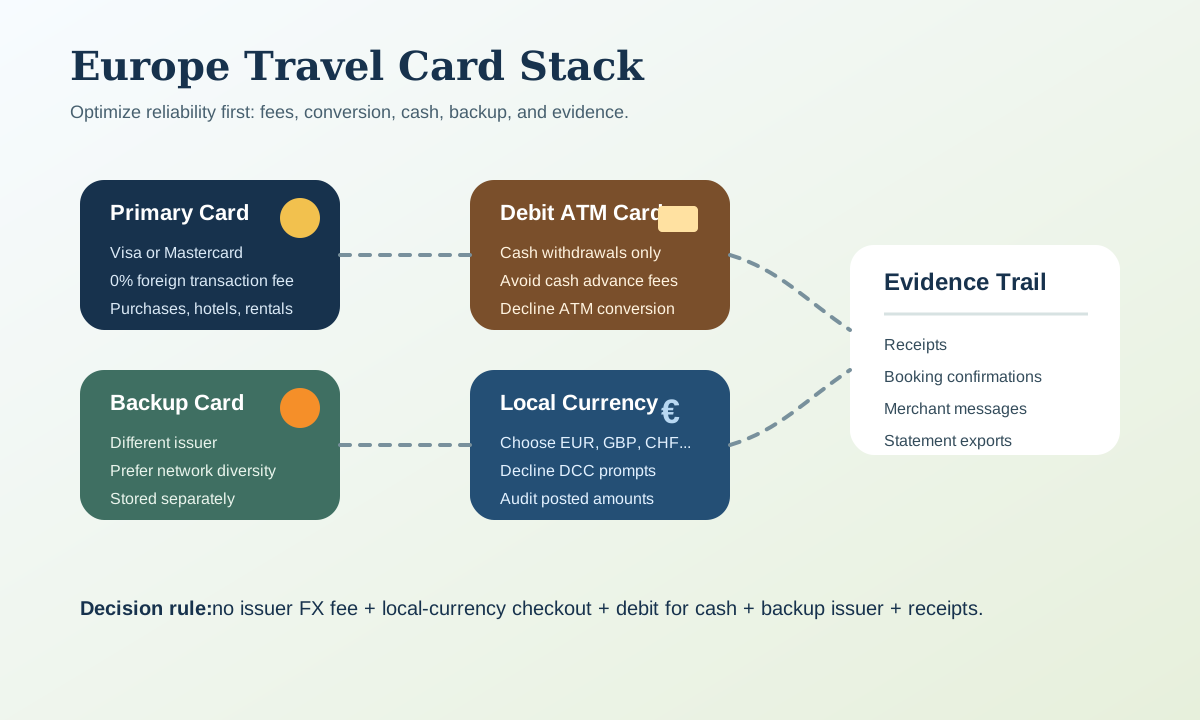
The best credit card for foreign transactions in Europe is rarely the one with the loudest marketing. What matters more is how the card handles foreign exchange fees, dynamic currency conversion, ATM use, merchant acceptance, fraud controls, and travel protections once a transaction moves from authorization to settlement. This page helps readers compare cards in a more practical way, including why a card stack can work better than a single product. It is useful for travelers and expats who want fewer surprises on statements and at the point of payment.
For most U.S.-based travelers, the strongest Europe setup is a no-foreign-transaction-fee Visa or Mastercard credit card for purchases, a backup credit card from a different issuer, a debit card for cash withdrawals, and a strict rule to pay in the local currency at terminals and ATMs.
This guide is general consumer information, not individualized financial, legal, or tax advice. Card terms change, issuer practices differ, and travel insurance benefits depend on the exact card agreement.
Direct answer
If you are a U.S.-based traveler spending in Europe, the practical default is one no-foreign-transaction-fee Visa or Mastercard credit card for purchases, one backup credit card from a different issuer or network, and a separate debit card for ATM withdrawals.
The answer changes if you need car-rental coverage, depend on cash, have weak backup access, or hold a card that waives issuer foreign transaction fees but still exposes you to dynamic currency conversion at the terminal. Paying in U.S. dollars at the merchant can still make the transaction expensive.
Next step: build a three-card travel stack before departure, verify wallet access and card controls, and keep the rule simple at payment terminals and ATMs: choose the local currency.
| Wallet role | Best-fit product | Europe-specific reason |
|---|---|---|
| Primary purchase card | No-foreign-transaction-fee Visa or Mastercard credit card | Broad acceptance and cleaner handling for hotels, transport, restaurants, online bookings, and car-rental holds |
| Backup purchase card | No-fee card from a different issuer, preferably with a second network | Reduces lockout risk if one issuer flags travel behavior or one network has terminal friction |
| ATM card | Debit card with low ATM costs and no avoidable currency markup | Keeps cash withdrawals out of cash-advance treatment |
| Emergency reserve | Digital wallet plus one physical card stored separately | Protects against lost wallet, damaged card, pickpocketing, or terminal failure |
| Evidence layer | Receipts, booking confirmations, and statement exports | Supports disputes, reimbursements, insurance claims, and fraud review |
The controlling rule is simple: choose a card with no issuer foreign transaction fee, but still decline dynamic currency conversion. A 0% foreign transaction fee does not protect you if a terminal offers to convert euros, pounds, francs, zloty, or koruna into U.S. dollars at a poor merchant-controlled rate.
What "Best" Really Means
Card comparisons often over-weight rewards and under-weight failure modes. In Europe, the better question is: what card setup minimizes total loss across fees, exchange-rate spread, failed authorizations, ATM mistakes, hotel holds, merchant disputes, and emergency replacement?
| Selection factor | Minimum standard | Why it matters in Europe |
|---|---|---|
| Foreign transaction fee | 0% issuer fee | A 3% fee can erase ordinary rewards on every foreign-currency purchase |
| Network acceptance | Visa or Mastercard as the primary network | Acceptance is usually broadest across transport, hotels, restaurants, grocery stores, and online booking systems |
| Dynamic currency conversion control | User can reliably choose local currency | Merchant conversion can embed a significant markup even when the card has no issuer FX fee |
| Dispute process | Clear written billing-error workflow and usable app/phone support | Travel disputes depend on fast evidence capture and strict timelines |
| Cash policy | Debit card for ATMs; credit-card cash advance only in emergencies | Credit-card ATM withdrawals can trigger cash-advance fees and interest |
| Fraud controls | App lock/unlock, alerts, international support, emergency replacement | Multi-country spend patterns can trigger issuer risk models |
| Statement clarity | Original currency, converted amount, merchant name, and date are visible | Necessary for reimbursements, tax records, and billing disputes |
The Two Conversion Costs Travelers Confuse
There are two separate costs in a European card transaction.
| Cost layer | Who controls it | How to reduce it |
|---|---|---|
| Issuer foreign transaction fee | Your card issuer | Choose a card whose agreement says there is no foreign transaction fee |
| Dynamic currency conversion markup | Merchant, ATM operator, or payment processor offering to bill you in your home currency | Decline conversion and pay in the local currency |
EU Regulation 2019/518 requires currency conversion charges for card-based transactions at ATMs and points of sale to be expressed as a percentage markup over the latest available European Central Bank euro foreign exchange reference rates where the rule applies. See Regulation (EU) 2019/518 and the ECB euro foreign exchange reference rates.
That transparency is useful, but it does not make the offer attractive. In ordinary travel purchases, the practical rule remains: pay in the local currency and let the network/issuer conversion path apply.
The Local-Currency Rule
European terminals and ATMs can phrase dynamic currency conversion in confusing ways.
| Terminal prompt | Stronger choice |
|---|---|
| Pay in USD or EUR? | EUR |
| Accept guaranteed exchange rate? | Decline |
| Convert now? | No |
| Continue without conversion? | Yes |
| Charge card currency? | No, choose the merchant's local currency |
| Pay in dollars at a fixed rate? | Decline |
The same principle applies outside the euro area: use pounds in the United Kingdom, francs in Switzerland, zloty in Poland, koruna in Czechia, forint in Hungary, krone in Denmark or Norway, and so on. The exact currency changes; the decision rule does not.
Visa, Mastercard, and American Express in Europe
Visa and Mastercard usually make the strongest primary-card choices for Europe because they are broadly accepted across routine merchant categories. American Express can be valuable for airlines, premium hotels, large retailers, and some restaurants, but it is a poor single-card strategy for smaller merchants, transit kiosks, rural areas, unattended terminals, and budget travel.
Use network calculators to audit posted conversion math:
| Network resource | Use |
|---|---|
| Visa exchange rate calculator | Check Visa network conversion assumptions for posted transactions |
| Mastercard currency converter | Check Mastercard conversion assumptions |
| ECB reference rates | Compare against official euro reference-rate context, not as a card-network promise |
These tools do not override the issuer agreement. Issuers may add fees, classify cash transactions differently, or apply terms that affect the final statement amount.
Credit Card vs. Debit Card
Use credit cards for purchases and debit cards for cash.
| Use case | Better tool | Why |
|---|---|---|
| Hotels | Credit card | Preauthorizations and deposits are easier to segregate from checking funds |
| Car rentals | Credit card | Rental agencies often prefer credit-card holds, and some card benefits require credit-card payment |
| Restaurants | Credit card | Easier fraud and billing-error path than debit in many cases |
| Train, metro, and transit | Credit card or mobile wallet | Contactless support is common, but backup matters for offline terminals |
| ATMs | Debit card | Avoids credit-card cash-advance treatment |
| Small markets, toilets, rural buses, local festivals | Cash from debit card | Some small merchants remain cash-first |
Credit-card cash advances can carry immediate interest, cash-advance fees, and separate limits. Do not use a credit card at an ATM unless it is an emergency and you understand the cost.
Europe Card Selection Matrix
| Criterion | Weight | Excellent | Acceptable | Weak |
|---|---|---|---|---|
| Foreign transaction fee | 25% | 0% | 1% with strong compensating value | 2.5% to 3% or more |
| Acceptance | 20% | Visa or Mastercard, contactless and chip support | Amex plus Visa/Mastercard backup | Single limited network |
| DCC control | 15% | Clear local-currency behavior and user discipline | Some terminal friction but manageable | User frequently accepts home-currency conversion |
| Dispute process | 15% | Written process, app upload, strong documentation path | Phone-first process but rules are clear | Unclear or slow escalation |
| Travel resilience | 10% | Emergency replacement, digital wallet, alerts, lock/unlock | Some emergency support | No useful travel controls |
| ATM strategy | 10% | Separate debit card with low ATM cost | Debit available but expensive | Credit-card ATM reliance |
| Rewards after fees | 5% | Rewards remain valuable after all fees | Rewards neutral | Rewards erased by fees and conversion |
Rewards should be evaluated after costs. A 3x travel card with a 3% foreign transaction fee can be weaker than a plain 0% fee card for ordinary spending.
Card Stack by Traveler Type
| Traveler type | Recommended architecture | Critical control |
|---|---|---|
| First Europe trip | One no-fee Visa or Mastercard, one backup card, one debit ATM card | Save issuer support numbers offline |
| Frequent business traveler | Two no-fee credit cards from different issuers, expense-friendly statements, and receipt capture | Keep original-currency receipts for reimbursement |
| Remote worker in Europe | Primary card, backup card, debit ATM card, and a separate recurring-bill card | Separate daily spend from subscriptions and work expenses |
| Family trip | Each adult carries a different issuer card plus shared debit fallback | Avoid one wallet containing every payment method |
| Premium traveler | Premium card only if credits, insurance, lounge access, and protections are actually used | Verify benefit eligibility before relying on coverage |
| Budget traveler | No-annual-fee, no-foreign-transaction-fee card plus low-cost debit account | Avoid ATM operator conversion and DCC |
Dispute Readiness
A strong travel card is not only cheap. It is defensible when a merchant, hotel, airline, train operator, rental agency, or ATM transaction goes wrong.
The CFPB explains that to protect billing-error rights, a consumer should send written notice within 60 days after the statement showing the error was sent; the card company generally must acknowledge the notice within 30 days and resolve the matter within two billing cycles, subject to the detailed rules. See CFPB: how to fix mistakes in your credit card bill and Regulation Z Section 1026.13. The FTC provides a similar consumer-facing overview at Using Credit Cards and Disputing Charges.
| Transaction type | Evidence to keep |
|---|---|
| Hotel | Booking confirmation, check-in terms, checkout invoice, deposit release record |
| Car rental | Rental agreement, photos, fuel receipt, return confirmation, final invoice |
| Restaurant | Itemized receipt and card receipt |
| Train or airline | Ticket, cancellation notice, delay notice, refund correspondence |
| ATM | ATM receipt, app screenshot, machine location, accepted/declined conversion screen if visible |
| Dynamic currency conversion mistake | Receipt showing home-currency quote, local-currency amount, and exchange rate |
| Online booking | Confirmation email, cancellation policy, support transcript, merchant country |
Disputes are usually lost on evidence, not on outrage. The best routine is to photograph or save every high-value receipt before leaving the merchant.
Common Europe Failure Modes
| Problem | Why it happens | Control |
|---|---|---|
| Terminal offers USD | Dynamic currency conversion | Choose local currency |
| Card fails at transit gate | Offline terminal, risk scoring, or delayed authorization | Try mobile wallet or backup card |
| Hotel hold seems excessive | Deposit plus delayed settlement | Ask for hold amount and release timing in writing |
| Merchant name looks unfamiliar | Processor name differs from storefront | Keep receipt and location note |
| ATM adds a surcharge | Local ATM operator fee | Decline bad ATM offers and use bank-owned machines where possible |
| Gas station or toll booth rejects card | Unattended terminal rules | Keep backup card and modest cash |
| Issuer locks card after small purchases | Fraud model sees unusual multi-country spend | Use app controls, alerts, or issuer travel settings if available |
| Rewards are lower than expected | Merchant category coding differs | Do not rely on category bonuses for core affordability |
Pre-Trip Test Protocol
Before a long trip, run this checklist:
- Confirm the issuer foreign transaction fee in the card agreement.
- Confirm whether the card charges cash-advance fees for ATM use.
- Add the card to Apple Pay, Google Pay, or another supported wallet.
- Verify PIN availability if the issuer supports one.
- Save issuer support numbers offline.
- Confirm the billing-dispute process and mailing or upload path.
- Test a small foreign-currency online purchase if practical.
- Carry a physical backup card in a separate bag.
- Set transaction alerts.
- Keep a modest amount of cash for low-card-acceptance moments.
Visa describes lost/stolen and emergency assistance resources at Visa lost or stolen card support. Your issuer still controls whether replacement, emergency cash, or other services are available for your account.
Decision Framework
Use this sequence before selecting cards:
| Step | Question | Output |
|---|---|---|
| 1 | Which countries and currencies will you use? | Currency and acceptance map |
| 2 | Which spend categories dominate? | Purchase, hotel, car rental, transit, cash, business expense profile |
| 3 | Which card has no foreign transaction fee? | Primary card shortlist |
| 4 | Which backup avoids the same failure point? | Different issuer and, if practical, different network |
| 5 | How will you get cash? | Debit ATM plan |
| 6 | How will you preserve evidence? | Receipt and statement workflow |
| 7 | What happens if the wallet is lost? | Emergency card, digital wallet, and support plan |
FAQ
What is the best credit card for foreign transactions in Europe?
For most travelers, it is a no-foreign-transaction-fee Visa or Mastercard credit card with strong fraud controls, mobile-wallet support, clear dispute procedures, and a backup card from a different issuer. The best choice is a wallet architecture, not a single brand name.
Should I pay in euros or dollars?
Pay in the local currency. In the euro area, that means euros. In the United Kingdom, pounds. In Switzerland, francs. Choosing dollars usually means accepting dynamic currency conversion.
Is American Express good in Europe?
It can be useful in premium travel categories, but it should not be your only card. Carry Visa or Mastercard as the primary acceptance tool.
Are no-foreign-transaction-fee cards always free abroad?
No. They avoid the issuer's foreign transaction fee, but you can still face dynamic currency conversion, ATM operator fees, cash-advance fees, annual fees, interest, or unfavorable merchant practices.
Is a debit card safer than a credit card in Europe?
Debit is useful for cash. Credit is usually better for purchases because it does not immediately expose your checking balance and usually gives a cleaner billing-dispute pathway.
Do I still need cash?
Yes, but less than in the past. Keep enough cash for small merchants, toilets, markets, rural buses, tips, emergencies, or card outages.
Card-stack design for Europe
The best card for foreign transactions is rarely a single card. It is a payment stack that keeps working when one issuer blocks a transaction, one network is not accepted, a wallet fails, or an ATM offers poor conversion. A resilient setup normally includes a primary no-foreign-transaction-fee Visa or Mastercard credit card, a backup card from a different issuer, a debit card for ATM withdrawals, and a mobile wallet copy of at least one card.
The primary card should be used for hotels, restaurants, rail tickets, car rentals, online bookings, and higher-value purchases because credit-card dispute processes are cleaner than debit disputes. The backup card should not share the same failure point. If the primary is issued by a US bank on Visa, the backup could be a different issuer, and ideally a different network if acceptance remains practical. The debit card should be reserved for cash, not routine purchases, because ATM withdrawals on credit cards can trigger cash-advance fees and immediate interest.
Travelers staying in Europe for months should also consider local account access. A foreign credit card can work well for travel, but rent, utilities, local taxes, government fees, and some subscriptions may require SEPA transfer, direct debit, or a local IBAN. A card strategy does not replace a banking strategy for residents or long-stay expats. For broader expat card eligibility, compare credit cards for expats in Europe and credit card requirements for foreigners in Europe.
Cost model beyond the foreign transaction fee
A zero foreign transaction fee is only the first filter. The real cost includes exchange-rate spread, dynamic currency conversion, annual fee, interest, ATM fee, cash-advance fee, late fee, card-replacement cost, travel-insurance conditions, and reward redemption value. A card with no foreign transaction fee can still be expensive if the traveler carries a balance or uses it for cash withdrawals.
Dynamic currency conversion is the most common avoidable cost. When a terminal or ATM asks whether to pay in home currency or local currency, local currency is usually the better choice because the card network or issuer handles conversion instead of the merchant's conversion provider. The traveler should train themselves to reject home-currency conversion even when the screen says the home-currency amount is guaranteed.
Rewards should be valued conservatively. A card that earns points abroad is useful only if the redemption value exceeds annual fees and friction. If the traveler mainly wants predictable low-cost spending, no-fee, no-FX cards may beat premium travel cards. If the traveler uses lounges, rental-car protection, trip delay coverage, or hotel benefits, a premium card can be worth it, but only if the benefits apply in the countries and booking channels used.
Acceptance patterns by transaction type
Card acceptance in Europe is broad but uneven. Hotels, airlines, major rail operators, restaurants in tourist zones, online platforms, and large retailers usually accept cards. Small cafes, market stalls, taxis, rural businesses, public toilets, local buses, municipal offices, and some medical providers may prefer local cards, cash, or bank transfer. American Express acceptance can be strong in premium travel segments but weak in ordinary daily spending.
Contactless payments and mobile wallets are common, but they are not a full fallback. Some terminals require chip-and-PIN, some offline machines need a PIN, and some transit or parking systems may reject foreign-issued cards. Travelers should know their card PIN, carry a physical card, and keep a small cash reserve.
Car rentals and hotels deserve special treatment. They may place large holds, require the cardholder name to match the reservation, reject debit or prepaid cards, or require embossed or physical cards in edge cases. The card used to reserve should be available at check-in. Travelers should preserve rental agreements, fuel receipts, inspection photos, hotel folios, and hold-release evidence.
Fraud, disputes, and evidence
Foreign transactions create more false declines and more dispute friction. Before travel, enable alerts, update contact details, confirm travel-notice practices if the issuer uses them, and ensure two-factor authentication works abroad. If the bank requires SMS codes, the traveler needs roaming or an alternative authentication method.
For disputes, evidence matters. Keep receipts, screenshots, booking confirmations, cancellation policies, merchant messages, photos of damaged goods or rental cars, and proof of attempted resolution. Dispute rights are time-limited and issuer procedures vary. A traveler who waits until after returning home may lose evidence or miss a deadline.
If a card is lost, the traveler should know how to freeze it from the app, call the issuer, access emergency support, and continue paying. This is why backup cards should be stored separately. A backup card in the same stolen wallet is not a backup.
Expat and long-stay considerations
Long-stay residents should review tax residence, address, and issuer terms. Some issuers restrict accounts when the cardholder moves abroad permanently or changes mailing address. Others allow foreign addresses but require additional identity checks. If the card is tied to a home-country bank account, maintain that account in good standing.
Credit history usually does not transfer automatically into Europe. A person who becomes resident in Germany, Spain, France, the Netherlands, Portugal, or another country may need to build local banking and credit history. A home-country travel card can bridge the first months, but it may not help with local credit approval, rental proof, or salary-bank relationships.
Transaction-by-transaction rules
Use credit for purchases where a dispute, hold, refund, or warranty issue is possible. Hotels, airlines, rail passes, rental cars, electronics, tours, and online bookings are better on credit than debit because the money does not leave the checking account immediately. Use debit for ATM withdrawals and only at bank-operated ATMs where possible. Avoid using credit cards for cash unless it is an emergency and the cost is understood.
At every terminal, choose the local currency. In the euro area, choose euros. In Poland, choose zloty. In Denmark, choose kroner. In Switzerland, choose francs. In the United Kingdom, choose pounds. If the terminal presents a home-currency amount with a percentage markup or an "accept conversion" button, decline that conversion unless there is a specific reason not to.
For subscriptions and online purchases, check whether the merchant bills from a different country than expected. A European-looking website may process payments in another currency or through a foreign merchant. Keep screenshots of checkout currency and final confirmation for higher-value purchases.
Business travelers and expense reimbursement
Business travelers need a stricter evidence process. Preserve receipts showing merchant name, date, currency, VAT if relevant, tip, and payment method. For hotels, keep the full folio, not only the card slip. For meals, keep attendee and business-purpose notes where employer policy requires them. For taxis and rideshares, keep route evidence.
If the employer reimburses in a different currency from the charge, the worker should understand which exchange rate applies: card posting rate, accounting rate, central-bank rate, or company policy rate. Differences can create small losses across a long trip. Corporate cards may solve reimbursement friction but can have weaker personal rewards or different insurance terms.
Self-employed travelers should separate personal and business transactions. A travel card used for both can still work, but bookkeeping categories and receipts must be clean. For freelancer tax context, see income tax rules for freelancers in Europe.
Security controls while abroad
Enable instant alerts for every transaction. Review pending charges daily during active travel, especially after hotels, rentals, restaurants, fuel stations, and ATMs. A small fraudulent authorization is easier to challenge quickly than a series of charges discovered weeks later.
Use contactless where available, but protect the physical card. Do not hand over the card out of sight unless local practice makes it unavoidable and the merchant is trusted. Cover PIN entry. Avoid standalone ATMs in nightlife areas or tourist corridors when a bank-branch ATM is available.
Keep issuer phone numbers, card last four digits, and app access available offline. If a phone is lost, the traveler should still be able to freeze cards or contact issuers from another device. A password manager and backup authentication method can be more important than the card itself.
Country and network edge cases
Europe is not one payment market in practice. The euro area reduces currency friction, but acceptance patterns still differ by country, merchant size, and sector. Germany, the Netherlands, and parts of Central Europe have historically had pockets where local debit schemes or cash were more common. Nordic countries can be highly card-friendly, but some services may expect local identification or domestic payment apps. Tourist zones generally accept international cards more readily than municipal offices or small local services.
Visa and Mastercard are the baseline. American Express and premium networks can add benefits but should be treated as secondary unless the traveler knows the merchant profile. Prepaid and debit products can be rejected for deposits because merchants want a credit line for holds. If a trip depends on car rental, confirm the rental company's card type rules before booking.
Post-trip reconciliation
After returning, reconcile statements against receipts. Look for duplicate restaurant charges, unreturned hotel deposits, rental-car damage claims, ATM conversion charges, and subscriptions started during travel. Keep the card active until refunds and disputes are complete. Closing or replacing a card too early can complicate refunds.
For long trips, reconcile weekly instead of waiting until the end. This keeps evidence fresh and catches dynamic currency conversion mistakes while the merchant can still correct them.
Source Stack
- Regulation (EU) 2019/518 on cross-border payments and currency conversion charges
- European Central Bank euro foreign exchange reference rates
- Visa exchange rate calculator
- Mastercard currency converter
- CFPB credit-card billing-error guidance
- CFPB Regulation Z billing error resolution rule
- FTC credit-card dispute guidance
Final Checklist
- Choose a primary Visa or Mastercard with no foreign transaction fee.
- Carry a backup card from a different issuer.
- Use a debit card, not a credit card, for ATM withdrawals.
- Choose local currency at every terminal and ATM.
- Keep receipts for hotels, rentals, transit, and high-value meals.
- Save issuer emergency numbers offline.
- Add cards to a mobile wallet before departure.
- Review posted transactions during the first 72 hours of the trip.
- Preserve dispute evidence for at least two billing cycles after returning.
The strongest Europe payment setup is a system: primary no-fee credit card, separate backup credit card, debit ATM card, local-currency discipline, and a clean evidence trail.
Practical stack examples by traveler profile
Use this as a starting template, not a fixed recommendation.
| Profile | Primary card | Backup card | ATM/debit strategy | One mistake to avoid |
|---|---|---|---|---|
| Weekend tourist | One no-FX Visa or Mastercard card + one backup from different issuer | Keep backup in separate wallet | Use debit for cash, preferably one with low fee ATM network | Paying home currency because checkout is fast |
| 2–8 week business trip | Primary card with better dispute clarity + second card with broader acceptance | Keep proof folder for reservations and preauthorizations | Use debit or partner card only for required local cash | Ignoring hotel preauthorizations and deposit reversals |
| Long-stay remote worker | Primary low-friction card + secondary card for network diversity | Keep reserve card in luggage or office bag | Use local debit for predictable cash and ATM fees | Using one card for every category without category rules |
| Budget backpack trip | No-FX primary + no-fee backup + emergency prepaid only if needed | Keep backup and virtual card controls separated | Limit ATM withdrawals and avoid credit-cash-advance use | Choosing the card with the most rewards and highest fees |
Card setup checklist before departure
- Confirm your expected card mix for the full trip by category (lodging, transport, food, transfers, cash).
- Update contact numbers and app recovery options before leaving.
- Save screenshots or copies of card agreements showing fee and dispute terms.
- Create a one-page cash-and-card fallback route with your emergency contacts.
- Predefine a local-currency policy and apply it at every POS and ATM.
- Register online accounts with stable communication channels for the duration of travel.
Error patterns that create avoidable losses
Error: Ignoring the bank’s statement formatting
Fix: use statement fields (merchant, converted value, posting date, settlement date) for reconciliation and reimbursement.
Error: Carrying one card only
Fix: carry a different issuer backup that can handle holds and non-ideal merchant acceptance.
Error: Overusing cash withdrawals
Fix: replace routine withdrawals with debit/transfer methods where possible and keep emergency cash only.
Error: Failing to keep evidence
Fix: store receipts, booking confirmations, card slips, and support-thread numbers in one folder.
Error: Waiting too long to reconcile disputes
Fix: review transactions daily when abroad and weekly during long trips.
Related practical pages
- How to open a bank account as a foreigner in Europe
- Credit card requirements for foreigners in Europe
- Cheapest countries in Europe for expats
- Bank account in Belgium for non-residents
End-to-end evidence bundle for Europe travel
Keep one folder with:
- itinerary and reservation proofs,
- cardholder name and mailing consistency notes,
- boarding and pickup confirmations where used for transfers,
- utility and parking proofs if high-use transactions occur,
- screenshots of disputed or odd conversions,
- bank/issuer support references for final resolution.
The card decision that performs best in Europe is less about rewards than about controlled failure paths.
Country stack and practical card behavior by region
Europe has multiple practical friction layers. A working setup should reflect currency area and acceptance reality.
| Region | Currency logic | What usually works | What usually breaks |
|---|---|---|---|
| Euro Area urban travel | EUR local-currency rule is strongest | Standard no-FX Visa/Mastercard + mobile wallet | Home-currency selection and late charge disputes |
| UK + non-EEA gateways | GBP/alternative settlement paths | Strong card controls and fallback debit | Mixed terminal types and card-holder mismatch |
| Non-EU tourist hubs | Local and mixed settlement | Keep backup issuer and one cash channel | Overreliance on one processor and weak offline coverage |
| Multi-country itineraries | Multiple currencies and card networks | Predefined fallback order and emergency contacts | Random card priority and no contingency |
Use this matrix with your itinerary, not just your passport.
72-hour Europe trip operations template
Use this compact template on your first travel week:
- Day 0: confirm one primary card and one backup card login and emergency contact.
- Day 1–2: complete one transaction at supermarket, one restaurant, one transport, one online merchant.
- Day 3: verify statement shows local currency entries and no obvious conversion anomalies.
- Day 4: run one low-value ATM check in a bank branch if possible.
- Day 5: reconcile first transactions and flag anything with ambiguous currency origin.
- Day 6–7: keep local-currency policy and no-home-currency conversions.
If any transaction class fails repeatedly, switch from optimization to continuity:
- Keep only the working card path for daily spending.
- Move disputed or unsupported purchases to alternate card family.
- Do not add third-party card complexity until the dispute path is clean.
Practical examples for common itineraries
4–8 week digital worker trip
Prioritize one high-dispute-control card, one backup from another issuer, and one debit card for ATM.
Family relocation with temporary home stays
Prioritize card controls for child tickets, local transport, and school-related payments, and validate local recurring payments early.
Frequent weekend travel
Prioritize one low-fee backup, one wallet with backup internet, and documented emergency route if one app drops.
Evidence standard for card friction claims
Every claim in your personal notes should link to either a receipt, a platform transaction line, or an issuer message. If you cannot reproduce the claim with one of these, remove the claim from decision logic.
That keeps your card setup trustworthy when it needs to survive both disputes and long moves.
Expanded decision framework by trip pattern
The practical choice depends on how the card will actually be used, not on card marketing labels.
Pattern A: Short-trip explorer (less than 2 weeks)
- Prioritize: conversion reliability and backup coverage at transport, lodging, and food merchants.
- Minimum setup: one primary card with clear local-currency settings, one backup card from a second issuer.
- Common risk: first-time terminal preauthorizations at high season locations.
Pattern B: 2–8 week relocation support trip
- Prioritize: statement clarity and quick merchant support.
- Minimum setup: one travel-optimized card, one backup with strong card support, one local debit channel.
- Common risk: overusing one card for both commuting and incidentals.
Pattern C: 3+ month remote-stay itinerary
- Prioritize: repeat spend predictability and transfer-aware reconciliation.
- Minimum setup: layered card strategy + emergency local access.
- Common risk: long-term fatigue from one rigid stack and no monthly maintenance.
Pattern D: Family itinerary
- Prioritize: predictable child-related transactions and transit coverage.
- Minimum setup: two independent primary cards if accounts are separate.
- Common risk: one-family profile trying to use one control policy for two wallets.
Card architecture, translated into operational rules
Think in modules, not slogans:
- Acquisition module: how quickly the card starts and what happens on first transactions.
- Conversion module: local-currency behavior versus hidden markups.
- Support module: how fast disputes and reversals are handled.
- Recovery module: fallback card behavior when terminals fail.
- Cost module: where hidden transfer and service costs appear later.
A strong stack balances all five modules.
If one module is weak (for example, support takes too long), the whole stack becomes fragile.
Practical evidence log template for card audits
Keep a recurring log from the first week.
| Date | Card | Transaction type | Merchant | Currency result | Fee note | Dispute status |
|---|---|---|---|---|---|---|
| 2026-01-01 | Card A | Lodging | Hotel | EUR conversion | 0% | Cleared |
| 2026-01-02 | Card A | Transport | Rail | Converted locally | normal fee | Cleared |
| 2026-01-03 | Card B | Retail | Store | Unexpected conversion | pending review | Under review |
| 2026-01-04 | Card C | ATM | Local machine | DCC attempt | declined | Closed |
Review the log every 72 hours for two reasons:
- detect conversion drift,
- detect behavior that will trigger dispute complexity later.
Failure case library (Europe-ready)
Case 1: Frequent small conversions with hidden markup
A traveler relies on one card with dynamic-currency ambiguity and assumes card language settings are enough.
Fix:
- move all test spends to a local-currency primary card for first two days,
- keep backup for deposits and odd terminals,
- keep transaction log with exact merchant descriptors.
Case 2: Repeated declines with one backup
Backups can fail in clusters, especially on transport gates and utility-like payment points.
Fix:
- predefine a second backup from a different issuer,
- store backup physical location and security settings,
- avoid changing all transaction types to one fallback at once.
Case 3: Dispute delay in transit-heavy itinerary
Long travel weeks can create many temporary holds.
Fix:
- keep proof bundle per booking,
- classify each hold versus final settlement,
- escalate only when pattern repeats more than 2 cycles.
Europe-wide acceptance risk matrix
| Transaction type | High acceptance path | Backup path | Typical control action |
|---|---|---|---|
| Hotel deposit and preauthorizations | Issuer with stronger merchant routing clarity | Secondary card with different risk score profile | Keep deposit proof and split card usage |
| Transport gates | Card with reliable contactless profile | Debit card or secondary credit | Avoid last-minute issuer switches |
| Retail high conversion points | Local-currency configured primary card | Local debit for routine purchases | Match transaction amounts with expected cash envelope |
| ATM cash-out | Local debit where supported | Preloaded cash reserve | Avoid full withdrawal on first stop |
| Travel subscriptions | Issuer with reliable recurring controls | Secondary card reserved for critical services | Set reminder for recurring test reconciliation |
Step-by-step setup model (pre-trip)
- Choose a single primary card and backup by category, not by brand.
- Configure local currency once and lock it for primary channels.
- Prepare a dispute folder with:
- booking proof,
- card statement snapshots,
- conversion timestamps.
- Create a route list by city with expected acceptance channels.
- Run your first-week operations plan and mark any failure pattern by transaction type.
Practical post-trip review process
Week 1 post-return
- Verify all statement entries and fees.
- Reconcile pending holds.
- Note conversion differences above normal tolerance.
Week 2
- Compare each card against intended category performance.
- Keep one stable card and one reserve card for the next itinerary if needed.
Week 3
- Update card stack based on evidence, not loyalty points.
- Remove any card causing recurring merchant friction.
Advanced card selection by risk appetite
Low-risk stack
- One simple no-FX card for high-frequency spend
- One conservative backup with strong support
- No-premium debit where possible for emergency cash
Medium-risk stack
- One high-control primary,
- One specialist backup for specific card categories,
- One emergency local-cash tool.
High-performance stack
- Multi-layer stack with preconfigured category fallback.
- Requires disciplined reconciliation and stronger documentation standards.
Do not confuse reward focus with reliability. Reliability is what preserves mobility.
Rebalancing checks after major card updates
Each card update should include:
- new card fee schedule,
- changed app behavior,
- changed support flow or claim channel,
- altered local-currency defaults,
- revised merchant acceptance behavior.
Rebuild your stack only after all five checks are clear.
FAQ: operationally useful questions
If I only need one card, what should I prioritize?
Prioritize local-currency discipline, statement clarity, and support responsiveness before rewards.
Can I use one card for everything?
In principle yes for simple trips. In practice no if your itinerary includes cash-intensive transport, repeated deposits, and multiple currencies.
Should I choose different cards by itinerary segment?
Usually yes if segment includes different risk patterns (city travel, countryside transit, family logistics, long-stay routine).
How should I document failures?
Use a transaction log with merchant, currency, and final settlement status. Claims become stronger with objective records.
Internal and adjacent pages for execution
- Credit card requirements for foreigners in Europe
- Best credit cards for expats in Europe
- How to open a bank account as a foreigner in Europe
- Cheapest countries in Europe for expats
- Best credit card for foreign transactions in Europe
- Bank account in Belgium for non-residents
30-day reliability framework for Europe card stacks
A practical card stack should be proven in 30 days, not only set at signup.
Day 0 to Day 3: minimum viable stack
Set only two payment routes in this period:
- Primary card for non-cash recurring spend.
- One backup card from a different issuer and network.
Use all test transactions inside one spend band, for example €20–€80, in three categories:
- merchant-present card terminal,
- contactless transport,
- online reservation or booking.
If one category is unstable, isolate it as a separate class and avoid expanding the stack until the class stabilizes.
Day 4 to Day 10: acceptance and conversion hardening
For each route and class, confirm:
- whether the terminal accepts local currency,
- whether a DCC prompt appears,
- whether settlement is expected in the home currency,
- whether pending to completed latency is normal for that merchant class.
Keep a one-line log per merchant with one outcome column: declined, approved, pending, offline, reversed.
If the same card + class appears as unstable twice, do not keep testing that combination without a change in settings.
Day 11 to Day 30: stability gates
The stack becomes resilient when each class has:
- at least 3 consecutive successful transactions,
- no unresolved DCC warning in the class,
- consistent descriptor format in statements,
- no card control action needed for non-critical use.
If one class is stable and another is unstable, keep one route only for the unstable class and continue normal operations on the stable class.
Acceptance matrix by trip archetype
Different trip patterns need different stack logic.
| Trip archetype | Highest failure risk | Primary card rule | Backup card rule |
|---|---|---|---|
| Short city trip (2-10 days) | transport and parking declines | keep one known-primary travel card | keep one backup card for transit/parking |
| Family visit (short to medium) | card security blocks from new spending spike | keep conservative settings until 4 stable transactions | activate backup only for repeatable merchants |
| 2-8 week relocation support trip | rent deposits and temporary utilities | use a card known for card-present reliability | keep secondary for e-commerce and travel-only |
| Long remote stay (30+ days) | reimbursement friction and statement disputes | keep one card with clear settlement pattern | keep backup for one dedicated class only |
For each profile, avoid carrying more cards than the number of classes you can maintain.
Detailed country behavior notes with operational implications
Europe behaves unevenly by country and merchant class. Two practical observations are stable over time:
- Terminal behavior differs more by business chain than country.
- Statement language and descriptor consistency differs more by acquirer and card product than by country.
That means operational control should be based on classes and merchant class behavior, not country reputation alone.
Example country behavior layer (practical view)
For each profile, evaluate card performance with three tests per country group:
- card-present acceptance in low-value transport and parking,
- e-commerce tokenized payment behavior,
- card-present hospitality deposit handling.
Document whether each test returns one of four outcomes: clean approval, conditional approval, temporary decline, or repeated decline after one retry.
Operational error library (what causes avoidable losses)
Error: using one stack for every class before evidence is stable
When a stable class is not identified, new cards create ambiguity and increase fallback delay.
Fix: create class boundaries first (card-present, online, ATM, subscription, transport) and keep each card in one primary class until stable.
Error: never recording rejected attempts
If every decline is logged only in memory, you lose your evidence path during travel stress.
Fix: export a weekly CSV or save text logs with timestamp, merchant category, terminal response, card in use, and settlement method.
Error: accepting merchant side prompts blindly
Some prompts ask for a conversion option in USD/EUR or local conversion under unclear margin.
Fix: if prompted, check the card app conversion indicator and merchant app settings before completing the transaction.
Error: changing multiple settings during one trip
When card settings, card priority, and merchant classification are changed simultaneously, any decline cause becomes hard to isolate.
Fix: change exactly one control per week: card priority, then fallback routing, then DCC rule.
Trip and invoice workflow templates
Template 1: class test plan
Trip class: [card-present / online / ATM / transport]
Primary card: [name]
Backup card: [name]
Test size: [low / medium]
Test count target: [number]
Success criteria: [3 consecutive successes without decline]
Template 2: decline response
Date:
Merchant class:
Terminal country:
Primary card result:
Prompt shown:
Next action:
Fallback card result:
Disposition after retry:
Template 3: reimbursement request evidence pack
Transaction IDs:
Original currency and amount:
Settlement currency and amount:
Expected merchant category:
Charge descriptor:
Bank statement reference:
Dispute status:
90-day card governance after activation
Week 1–2
- Keep one destination country at a time.
- Lock DCC preferences.
- Record every failure once and fix one variable each day.
Week 3–6
- Reduce backup-card complexity.
- Confirm recurring payments for one stable class first.
- Verify all deposit and security hold behavior on one fixed merchant type.
Week 7–12
- Review statement quality, not just approvals.
- Remove one card if it adds no unique stable class.
- Keep one written escalation rule for any future decline pattern.
If a card still fails after week 12 in the same class, replace it, then run the week 1–2 protocol again with the replacement.
Post-trip reconciliation blueprint
Within 7 days of returning from a trip:
- Export all card statements.
- Map every settlement against your pre-trip card matrix.
- Remove any card from a class where disputes took longer than 7 days to normalize.
- Record one "what worked" and one "what failed" entry by class.
This is where most users lose optimization because they stop reviewing exactly when issues become visible.
Compliance, evidence, and insurance readiness
This part is not optional for long stays, business travel, and card-driven reimbursements.
- Save card terms if your issuer changes card policy.
- Keep statements in the same language folder for your tax or employer records.
- Keep one version of identity and address used for issuer verification.
- Keep one folder for card incident evidence only (declines, disputes, replacement, chargeback).
For claims and reimbursement, evidence quality is usually more important than card features.
Advanced card stack by risk appetite
Low-risk setup
- one primary card with strong stability pattern,
- one secondary card for one high-risk class,
- one cash fallback policy documented separately from card profile.
Medium-risk setup
- two primary class cards for travel and home spend,
- one backup per high-risk recurring flow,
- one emergency card and one emergency process for offline merchant failure.
High-performance setup
- three-card matrix with pre-defined role per class,
- class-specific dispute protocol and weekly audit,
- periodic revalidation of merchant conversion behavior.
Use this only when your travel schedule is repetitive and you can maintain strict logs.
Advanced examples for common Europe itineraries
4 to 8 week digital worker trip
Use a predictable direct debit for home subscriptions and one hospitality deposit policy.
Keep ATM usage low and test one offline-to-online fallback class only after your primary routes stabilize.
Frequent weekend travel
Keep class boundaries very simple: one transport class, one hospitality class, one online class.
Avoid adding a second backup for each class because weekend profiles often generate inconsistent spending rhythms.
Relocation plus temporary lease
Keep rental deposit, moving costs, and essential transport in one controlled route.
Do not add travel-only spending before utility and salary verification settle in statements.
Evidence standards for card friction claims
For each unresolved issue that may become a claim, capture in one place:
- timestamp,
- exact merchant category,
- amount in both currencies,
- expected settlement timing,
- rejection/hold/partial settlement code where shown,
- card settings at time of issue.
This standard should be identical to your invoice and reimbursement evidence format if you are reimbursed by employer.
Rebalancing checklist (quarterly)
Rebalance stack every quarter:
- Remove one class from each unstable card.
- Keep the smallest card count that supports all required classes.
- Replace any card with repeated unresolved merchant friction.
- Refresh security settings before first-trip planning.
- Rewrite class rules if spending rhythm changed.
Do not rebalance during travel stress; do it before or after a major trip.
Extended error correction path
If one card-class combination continues failing after four attempts:
- classify the issue (
network,settings,merchant risk,insufficient security), - switch one variable,
- run the same transaction once more after 24 hours,
- if still failing, remove that card from the class and move the flow to backup.
Do not continue with repeated same-transaction retries across multiple days with no variable change.
Final deployment plan for your stack
Choose a stack and apply a 14-day stabilization window before first upgrade:
- Week 1: lock class map and test only baseline spend.
- Week 2: introduce recurring spend in one stable class.
- Week 3: add transport class if stable.
- Week 4: decide if one backup can be removed.
When the map is stable, keep one audit cycle every 30 days and one dispute review every 90 days.
Full trip architecture and risk management
You do not choose one card for every trip; you choose behavior paths for your route.
Recommended stack layers
- Layer 1: primary card for most recurring spend.
- Layer 2: backup card for specific merchant class mismatches.
- Layer 3: one local fallback path for urgent cash or card outages.
If only one of your three layers remains stable, simplify rather than expand.
Class-based acceptance matrix
| Class | Typical failure mode | What to monitor | Recovery rule |
|---|---|---|---|
| Transit and parking | intermittent declines | acceptance logs | switch class-specific backup for 7 days |
| Hotel deposits | delayed holds | deposit reversal timing | test with smaller deposit or alternate backup |
| Utilities | statement mismatch | billing cycle and descriptor | reconcile currency and descriptor labels |
| E-commerce | online decline | AVS/merchant code behavior | isolate and retest on small value |
| Dining and transport cards | settlement variance | statement conversion entries | verify local-currency mode |
| ATM withdrawal | payout fee mismatch | withdrawal fee pattern | reduce frequency and rotate ATM chain |
Use this matrix on the first 14 days and keep two rows in action at a time.
Pre-departure control plan
7-day plan
- Validate card settings (currency, alerts, app recovery, online access).
- Build one class map with one expected route per card.
- Prepare one dispute folder with receipts and references.
Departure day plan
- start with the smallest recurring class on your primary card.
- keep backup path off for one day unless needed.
- keep all labels in the transaction log.
Week 2 plan
- Compare settlement quality.
- Keep only stable cards per class.
- Retire unstable routes before adding new ones.
Practical dispute evidence protocol
For each claim, capture:
- transaction time,
- merchant descriptor,
- settlement status,
- card class,
- correction attempt.
This structure is more important than loyalty rate when you need correction action in travel stress.
Common operational mistakes in advanced setups
Mistake: mixing too many cards before stable behavior
When class behavior is unknown, extra cards add confusion and increase resolution time.
Fix: stabilize by class first; optimize later.
Mistake: no local-currency discipline for deposits
A single unstable conversion can turn one route into repeated hold/cancel loops.
Fix: standardize local-currency and apply one weekly reconciliation.
Mistake: building a stack around promotions
Promotions expire, but transaction reliability does not.
Fix: keep promotions as additive, never foundational.
High-confidence templates for trip adjustments
Template: class downgrade
Primary route for [class] is currently unstable.
I am moving [class] to backup for the next 72 hours.
I will keep evidence for all affected transactions in one folder.
Template: class restoration
[class] is now stable for 7 transactions.
I am returning to primary for this class.
I will run one additional verification transaction and resume normal stack.
Template: claim preparation
Transaction: [id]
Class: [class]
Expected outcome:
Observed outcome:
Evidence set:
Advanced checklist for card stack maturity
- Keep at most one card per class until a class is stable.
- Keep your logs weekly for the first 30 days.
- Rotate backup only after one class proves stable for 14 days.
- Archive every failed and successful correction attempt.
- Use one fallback policy for all itineraries, not country-specific improvisation.
Internal links for next implementation layer
- Credit card requirements for foreigners in Europe
- How to open a bank account as a foreigner in Europe
- Cheapest countries in Europe for expats
- Bank account in Belgium for non-residents
Final governance rule for choosing the card
When two cards look equal, choose the one that produces clearer evidence, not the one with the more complex reward promise. Foreign transactions create disputes around merchant descriptors, currency conversion, refund timing, ATM coding, hotel deposits, and airline reversals. The best card is the one that lets you explain those events quickly with statements, notifications, and support records.
Before making a card primary, run a seven-day evidence trial. Use one online purchase, one local-currency in-person purchase, one refund or cancellation where practical, and one low-value transfer-linked payment. Save screenshots and statements. If the card gives unclear settlement data, weak notifications, or slow support answers, keep it as backup even if its rewards look better. A card that is easy to prove is usually cheaper than a card that is difficult to defend.
Final fallback rule
Keep one fallback card outside the same issuer group and outside the same mobile wallet dependency. If the primary card fails while travelling, the replacement must work even when the primary issuer, app, or authentication method is unavailable.
Review the fallback quarterly, because issuer rules, wallet behavior, and travel merchant coding can change without warning.
Document the review date, backup issuer, authentication method, and last successful test transaction before every major trip.