Last updated
Bank Account in Belgium for Non-Residents: Basic Banking, KYC and Refusal Evidence
Direct answer
Opening a Belgian bank account as a non-resident is less about finding a friendly product page and more about presenting a file a bank can actually review. This guide explains how KYC, address, tax residence, source of funds, expected use, and your Belgian connection shape the outcome, and why a basic banking route is different from a standard account request. It also covers refusal evidence, branch versus remote onboarding, and when the practical issue may be documentation rather than the idea of non-residency itself.
Belgium non-resident account workflow
Non-residents should treat Belgian bank onboarding as a compliance file. The goal is to show why the account is needed in Belgium, who the customer is, and how the bank can manage the risk.
| Bank question | Evidence | Practical answer |
|---|---|---|
| Why Belgium? | Employment, rent, study, family, business, pension, or Belgian payment obligation. | Shows the account request is connected to a real Belgian need. |
| Who is the customer? | Passport, residence or home-country address, tax residency, and contact details. | Separates identity from local-address proof. |
| Where does money come from? | Payslips, contract, invoices, bank statements, or pension documents. | Turns AML review into a verifiable source-of-funds story. |
| What if refused? | Written refusal reason and complaint or basic banking path. | Creates an escalation file instead of repeated unsupported applications. |
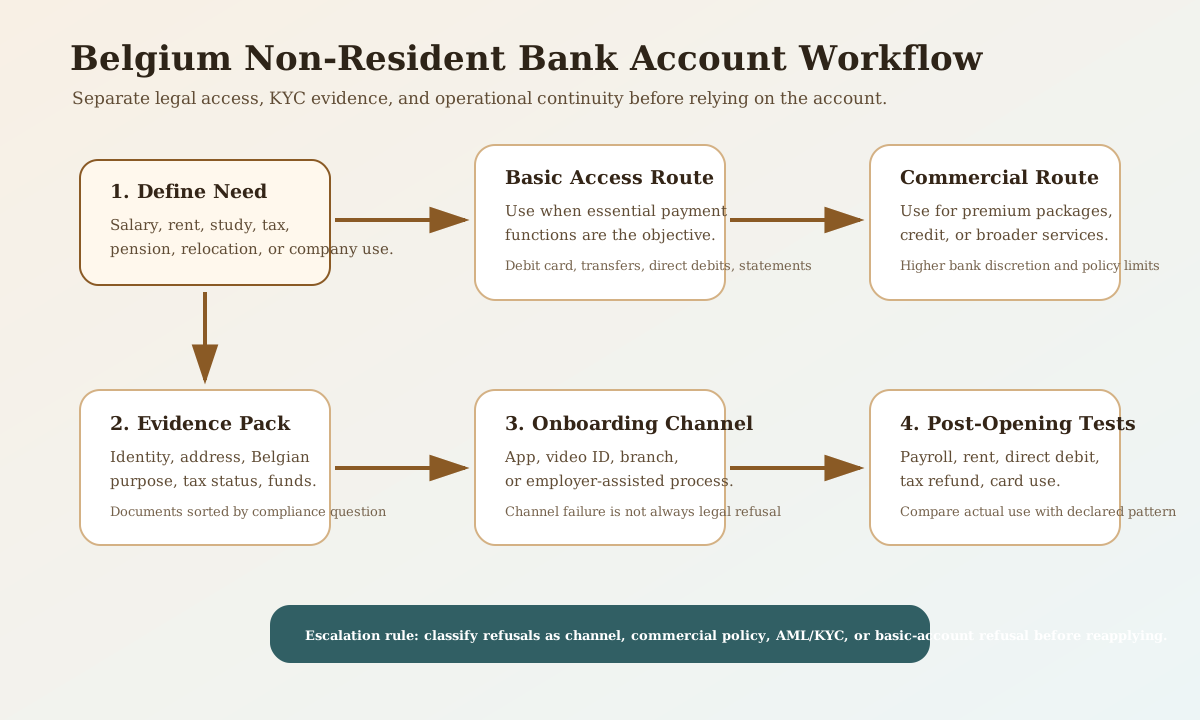
Opening a bank account in Belgium as a non-resident is not one question. It is three questions asked in sequence: do you have a legal route to basic payment services, can a bank identify and risk-assess you under anti-money-laundering rules, and will the account actually work for payroll, rent, utilities, tax refunds, and direct debits after it is opened?
Most failed applications are not rejected because non-residents are categorically impossible. They fail because the applicant asks for the wrong product, submits an incoherent evidence pack, or cannot explain the Belgian function of the account. A basic payment account and a full commercial current-account relationship are different products with different legal leverage.
This article is written for non-resident employees, future residents, students, cross-border workers, pensioners, founders, and advisers who need an audit-ready approach. It is not legal or banking advice. Banks may apply institution-specific policies, and identity requirements can vary by nationality, residence country, risk profile, channel, and account type.
Legal Context: Basic Access Is Not Universal Banking
Belgium operates within the EU framework for payment-account access. Under EU consumer rules, a person legally resident in an EU country is entitled to open a basic payment account, and banks cannot refuse the basic account merely because the person does not live in the Member State where the bank is established. That right is limited: it does not require a bank to offer credit, overdrafts, investment products, premium bundles, or every digital onboarding channel.
Belgian official guidance explains that the basic banking service exists to prevent payment exclusion and applies to credit institutions in Belgium that offer current accounts. Treat it as an essential-payment route, not as a right to credit, premium bundles, investment access, or every digital onboarding feature.
The distinction matters:
| Route | Legal character | Typical services | Bank discretion |
|---|---|---|---|
| Basic payment account/basic banking service | Minimum access route for essential payment functions | Current account, debit card, transfers, direct debits, statements | Refusal grounds are more limited but AML still applies |
| Standard current account | Commercial account relationship | Broader digital banking, packages, optional cards | Bank can apply product policy and risk appetite |
| Salary or premium account | Commercial relationship linked to payroll or package benefits | Salary handling, credit-card options, overdraft, bundled insurance | Higher evidence and risk review |
| Business account | Separate commercial and AML review | Company payments, merchant activity, payroll, tax payments | Stronger source-of-funds and beneficial-owner review |
Useful official and primary references:
Your Europe: Bank accounts in the EU Directive 2014/92/EU on payment accounts Belgium.be: basic banking service European Commission: IBAN discrimination FSMA: how to make a complaint Ombudsfin Belgium National Bank of Belgium: financial supervision and resolution
Non-Resident Profiles and Their Evidence Burden
Belgian banks are not only asking "who are you?" They are asking why Belgium, why now, how the account will be used, and whether the expected transaction pattern is consistent with the documents. The answer differs by profile.
| Profile | Belgian link | Best evidence | Main weakness to avoid |
|---|---|---|---|
| Cross-border worker | Employment in Belgium while living elsewhere | Employment contract, payroll start date, employer letter, residence proof | Applying before the employment link is documented |
| Future resident | Relocation already underway | Lease, job offer, residence registration appointment, moving timeline | Relying on vague relocation intent |
| International student | Study in Belgium | University admission, tuition/payment proof, housing document | Requesting premium products before arrival |
| Pensioner or benefit recipient | Belgian pension, tax refund, or recurring payment | Pension letter, tax correspondence, payment mandate | Weak identity/address continuity |
| Founder or director | Belgian company function | Company extract, UBO evidence, mandate, business plan | Confusing personal and business account needs |
| Temporary assignee | Short-term professional assignment | Assignment letter, employer support, expected payments | No explanation of account use after assignment ends |
The strongest file combines an EU-law access argument with a practical Belgian use case. The weakest file says only: "I want a Belgian IBAN." A Belgian IBAN may be convenient, but convenience alone is rarely a strong onboarding narrative.
Evidence Pack: Build It Like a Compliance Dossier
Prepare documents in layers, not as an unsorted upload folder. Each document should answer one compliance question.
| Evidence layer | Examples | What the bank can verify |
|---|---|---|
| Identity | Passport, national ID, residence permit, birth-name explanation if names differ | Legal identity, nationality, document validity |
| Address and contactability | Residence certificate, utility bill, tax notice, lease, employer address confirmation | Where you can be contacted and where notices can be served |
| Belgian purpose | Employment contract, admission letter, lease, pension file, tax file, family relocation evidence | Why the account is needed in Belgium |
| Tax transparency | Tax identification numbers, self-certification, FATCA/CRS forms where required | Reportable tax residence and financial transparency |
| Source of funds | Payslips, employment letter, invoices, pension statements, sale documentation | Whether expected money flows are lawful and coherent |
| Transaction plan | Expected monthly credits, rent, utilities, salary, card use, transfers | Whether account activity will match the onboarding declaration |
For a non-resident, the transaction plan is not cosmetic. It prevents later monitoring alerts. If you declare that the account is for salary and rent but immediately use it for high-volume crypto proceeds, third-country trade payments, or unexplained third-party transfers, the bank may freeze, restrict, or close the relationship pending review.
Basic Banking Service Strategy
If the real need is essential payment access, state that clearly. Do not let the application drift into a premium current-account request if the legal objective is a basic banking service.
Belgian basic banking service guidance describes the route as a statutory protection against payment exclusion. It is still limited by product scope, eligibility conditions, and AML/KYC controls, so applicants should ask specifically for the basic banking service when that is the legal need.
Practical route selection:
| If your need is... | Start with... | Do not lead with... |
|---|---|---|
| Receiving salary from a Belgian employer | Basic or standard current account with employment proof | Credit card, overdraft, investment access |
| Paying Belgian rent and utilities | Basic payment account with lease or housing proof | "I prefer a Belgian IBAN" only |
| Belgian tax refund or administration | Basic payment account with tax correspondence | High-value savings account |
| Full banking package after relocation | Standard account, after identity and residence evidence are ready | Remote premium onboarding without residence proof |
If a bank refuses a basic-account request, ask for the refusal reason in writing, preserve the application record, and classify the refusal. A commercial-product refusal may be lawful even when a basic-account refusal would be questionable. This classification determines whether you reapply, escalate, or change product scope.
IBAN Discrimination and Operational Reality
SEPA rules reduce the need for country-specific IBANs, and the European Commission maintains guidance on IBAN discrimination. In principle, creditors and payers should not reject an IBAN merely because it is from another SEPA country. In practice, some payroll systems, landlords, utilities, insurers, or public portals still create operational friction.
This creates a two-track strategy:
| Track | Question | Control |
|---|---|---|
| Legal acceptance | Is the counterparty allowed to reject a non-Belgian SEPA IBAN? | Cite SEPA/IBAN-discrimination guidance and request written justification |
| Operational continuity | Will payroll, rent, utilities, and tax systems actually process it on time? | Test low-risk payments before relying on the account for critical obligations |
Do not assume that opening a Belgian account is Usually better than defending a valid SEPA IBAN. But if your Belgian employer, landlord, or public process cannot reliably handle a foreign IBAN in time, a Belgian account may still be the pragmatic solution.
Remote Onboarding Versus Branch Onboarding
Non-resident applicants often prefer remote onboarding. That is sensible, but it is not necessarily available for every nationality, document type, phone number, address country, or risk profile. Video identification, eID workflows, and app-based onboarding may fail even when the applicant is legally eligible.
| Onboarding channel | Strength | Weakness |
|---|---|---|
| App-based onboarding | Fast, good for standard low-risk profiles | May reject foreign documents or non-supported residence countries |
| Video identification | Useful when document scanning fails | Scheduling and language constraints |
| Branch appointment | Better for complex evidence and basic-service framing | Requires physical presence and appointment availability |
| Employer-assisted route | Strong purpose proof and payroll alignment | Not all employers can sponsor or coordinate bank onboarding |
When onboarding fails technically, do not interpret that as a legal refusal. Ask whether the bank rejects the application or whether the channel cannot process the document. Those are different problems.
Refusal Taxonomy and Escalation
Refusal handling should be methodical. Do not simply submit the same package to five institutions without learning why the first one failed.
| Refusal type | Likely meaning | Next action |
|---|---|---|
| Technical channel failure | App or verification provider cannot process document/profile | Request branch or alternative identification |
| Commercial policy refusal | Product not available to your residence country or profile | Reframe as basic service or choose another institution |
| AML/KYC concern | Identity, funds, sanctions, or transaction purpose is unclear | Improve source-of-funds and purpose evidence |
| Basic-account refusal | Bank asserts a listed legal refusal ground | Request written reason and consider complaint route |
| Account closure after opening | Activity deviated from declared pattern or updated documents missing | Provide reconciliation and update documents promptly |
Belgium has formal complaint pathways. Start with the bank's internal complaint service. If unresolved, the Financial Services and Markets Authority provides consumer complaint guidance, and Ombudsfin is the financial ombudsman for disputes with financial institutions. Keep dates, documents, names, and written responses.
Risk Matrix for Non-Resident Applicants
| Risk | Probability | Impact | Mitigation |
|---|---|---|---|
| Applying for the wrong product | 5 | High | Decide basic versus commercial route before contacting banks |
| Weak Belgian purpose evidence | 4 | High | Provide objective link: work, lease, study, tax, pension, or relocation |
| Identity channel failure | 4 | Medium | Confirm accepted documents and alternative onboarding channels |
| Source-of-funds ambiguity | 3 | High | Reconcile salary, invoices, pensions, and bank deposits |
| IBAN friction after opening | 3 | Medium | Test payroll, rent, and direct debits early |
| Post-opening monitoring alert | 3 | High | Keep actual transactions aligned with declared use |
| Poor refusal documentation | 4 | Medium | Request written reasons and maintain a dated file |
Decision matrix
- Define the account function: salary, rent, study, tax, pension, relocation, or business.
- Choose the route: basic payment access or standard commercial account.
- Confirm whether your legal residence and identity documents can be processed by the bank's channel.
- Build evidence in six layers: identity, address, Belgian purpose, tax transparency, source of funds, transaction plan.
- Submit a concise cover note explaining why Belgium is functionally necessary.
- If rejected, classify the refusal before reapplying.
- If the issue is basic-account access, escalate through the bank complaint process and then appropriate Belgian complaint channels.
- After opening, test salary, rent, utilities, tax refunds, card payments, and direct debits before depending on the account fully.
Belgian Use Case Evidence
The best Belgian file explains a practical need. Cross-border workers should attach the employment contract and payroll timing. Future residents should attach lease, relocation plan, or municipal registration appointment where available. Students should attach admission, housing, and tuition information. Property owners should attach property or utility evidence. Pensioners should attach pension or tax correspondence.
Do not over-document randomly. Use documents that prove the Belgian payment function. A concise file is easier to review than a large upload folder with no explanation.
After Opening: Test the Account
After a Belgian account is opened, test the important flows before relying on it. Confirm salary receipt, rent transfer, utility direct debit, card payment, online banking login, and statement access. If the account is meant to solve an IBAN discrimination or payroll issue, confirm the counterparty has updated the details correctly.
If direct debits fail, preserve evidence. If salary is delayed because of incorrect account details, correct the payroll file quickly. Account opening is only useful if the account works operationally.
Fees and Account Packages
Belgian accounts may involve package fees, card fees, ATM charges, branch-service fees, paper statements, international transfer fees, and FX costs. A basic banking service and a standard package may have different economics. Ask for the fee information document and tariff before choosing.
For cross-border workers, ATM use and card payments across borders matter. For students, low monthly fees and digital access may matter more. For pensioners, paper statements or branch access may matter. Compare fees against behaviour, not marketing.
Complaint File for Belgium
If refused or closed, keep:
| Evidence | Use |
|---|---|
| Application and product requested | Shows route. |
| Belgian link evidence | Shows account purpose. |
| Documents supplied | Shows completeness. |
| Refusal or closure notice | Shows bank position. |
| Internal complaint | Required before many external routes. |
| Response from bank | Shows unresolved issue. |
| Impact evidence | Salary, rent, tax, utility, or benefit disruption. |
Then consider the bank complaint process, Ombudsfin, FSMA consumer guidance, or other appropriate Belgian route depending on facts.
Final Practical Test
Before applying, check whether the file proves legal identity, reliable address, Belgian purpose, tax profile, source of funds, and expected transaction pattern. If one of those elements is missing, fix it before submitting. Belgian onboarding is easier when the account purpose is obvious.
If the account is for work, attach the employment contract. If it is for study, attach admission and housing evidence. If it is for tax or property, attach the official notice or property document. The Belgian link should be visible, not implied.
After approval, verify the Belgian use case before depending on the account. Ask the employer or payer to test the IBAN if payroll is involved, check whether rent and utility direct debits are accepted, make one outgoing SEPA transfer, and download the account terms. If a Belgian counterparty rejects a valid SEPA IBAN from another country, keep the written refusal and compare it with the European Commission's IBAN discrimination guidance before escalating.
Practical Cover Note Model
Use a short cover note that reduces ambiguity:
| Section | Content |
|---|---|
| Identity | Full legal name, nationality, current residence, document type |
| Belgian link | Employer, lease, university, tax file, pension, or relocation event |
| Product requested | Basic banking service or specified current account |
| Expected activity | Monthly salary, rent payment, utilities, card use, transfers |
| Source of funds | Employer/pension/client income with supporting documents |
| Contact details | Postal address, email, phone, preferred language |
The tone should be factual. Do not oversell. Banks want clarity, consistency, and a low-surprise transaction pattern.
First 60 Days After Opening
Once a Belgian account is open, use the first 60 days to confirm that it works for the purpose stated in the application. If the account was opened for salary, rent, study, tax, property, or relocation, keep activity aligned with that purpose. Avoid immediate unexplained international transfers, business receipts, third-party collections, or high-risk flows that were not part of the onboarding file.
Run a practical account test:
| Test | Why it matters |
|---|---|
| Receive a small incoming payment | Confirms routing and account activation |
| Send one domestic or SEPA transfer | Confirms payment limits and authentication |
| Set up one direct debit | Tests utilities, rent-related services, insurance, or subscriptions |
| Use the card in Belgium | Confirms card and PIN setup |
| Download a bank statement | Creates proof for housing, tax, employer, or administration files |
| Check fee postings | Confirms whether package costs match the tariff |
| Contact support once if needed | Tests language, channel, and response time |
If salary or rent depends on the account, do not wait until the deadline to test it. Ask payroll, landlord, or the relevant counterparty to confirm the IBAN format and account-holder name early. Keep written evidence if a SEPA IBAN is rejected for a reason that appears to be country-code discrimination.
Stabilizing the Account Profile
After local registration, employment start, university enrollment, property purchase, or tax registration, update the bank if the documents improve the file or if the bank requires refreshed information. Address changes, tax-residence changes, new employer details, and changes in expected account activity should not be left stale.
For non-residents, the safest banking profile is predictable: clear Belgian purpose, clear source of funds, reliable contact details, and account use that matches the documents. If your situation changes from personal use to freelance, company, or investment activity, ask for the correct product instead of stretching a personal account beyond its terms.
FAQ
Can a non-resident open a bank account in Belgium?
Yes, in many cases. The legal route and practical evidence depend on whether you request a basic payment account or a broader commercial product. Banks still must complete identity, AML, sanctions, and tax-residence checks.
Do I need a Belgian address?
not necessarily for the legal right to basic payment services, but a Belgian address, lease, employer letter, or other Belgian link can materially improve the practical application. The bank still needs a reliable address and contact channel.
Can the bank refuse me because I live outside Belgium?
For a basic payment account, EU guidance says banks cannot refuse merely because you do not live in the country where the bank is established, provided you are legally resident in the EU and satisfy AML rules. Commercial products are different and may be limited by bank policy.
Is a Belgian IBAN required for Belgian salary?
A SEPA IBAN from another SEPA country should often work, and IBAN discrimination rules may apply. But operational systems can still create friction. Test the employer payroll process early and ask for written reasons if a valid SEPA IBAN is refused.
What should I do if a bank refuses?
Ask whether the refusal concerns the product, the onboarding channel, KYC/AML, or basic-account eligibility. Request written reasons, improve the file where appropriate, and use the bank complaint process before escalating to external complaint bodies.
Final Checklist
- Decide whether the request is for basic payment access or a commercial product.
- Prepare identity, address, Belgian purpose, tax, source-of-funds, and transaction-plan evidence.
- Confirm the bank's supported documents and residence countries before relying on app onboarding.
- State the Belgian purpose clearly and avoid vague convenience-based reasoning.
- Keep a written record of submission dates, documents, refusals, and follow-up requests.
- Test payroll, rent, utilities, direct debits, and tax payments after opening.
- Update the bank immediately after changes in address, residence, employment, tax residence, or account use.
References
Your Europe: Bank accounts in the EU EUR-Lex: Directive 2014/92/EU Belgium.be: basic banking service European Commission: IBAN discrimination European Commission: Access to bank accounts FSMA Belgium: how to make a complaint Ombudsfin Belgium National Bank of Belgium: financial supervision and resolution
Evidence Strategy and Escalation by Profile
Different non-resident stories need different sequencing. Use the matrix, not generic advice.
| Profile | First move | Common blocker | Corrective move |
|---|---|---|---|
| Cross-border worker | Ask for payroll-compatible account route first | Missing payroll timing proof | Add contract date, payroll frequency, and payer email |
| Student in Belgium transition | Use student-admission route with proof of enrollment | Housing and fee documentation mismatch | Add lease + registration appointment evidence |
| Retirement migration case | Open with pension-linked purpose | Local payment use not explained | Add pension statement, receiving institution, and transfer pattern |
| Short-assignment expatriate | Select temporary income route if available | Overly long-term assumption in documents | Add assignment end date and return plan |
| Family relocation | Use family and housing-based purpose | Inconsistent occupant/address data | Normalize address list across all household docs |
Practical Non-Resident Account Test Plan (First 45 Days)
Week 1: Setup
- Get written scope of account type and fee model.
- Capture onboarding screenshots, reference numbers, and applicant ID used in system.
- Validate all uploaded documents display correctly in your language and country context.
Week 2: Functionality smoke test
- Make one incoming payment and one outgoing SEPA payment.
- Confirm card use at two in-person merchants and one online merchant.
- Set up and verify one low-value direct debit.
Week 3-4: Stability validation
- Confirm payroll, rent, and utility systems accept the account details.
- Verify tax-linked correspondence path and statement retrieval.
- Reconcile charges against the published fee schedule.
Week 5-6: Policy alignment
- If declined for no clear reason, ask for refusal basis in writing.
- Correct only one missing layer (documents, purpose, channel, or profile) before retrying.
- Re-test high-priority use-case once the blocker is corrected.
If there is a refusal at any point, preserve the timeline and open external complaint paths only after internal completion.
Common Error Patterns (and direct fixes)
-
No concrete local purpose Fix by attaching one official link and one practical flow (salary, housing, tuition, pension, or invoice sequence).
-
Too many weak documents Fix by reducing the pack to one decisive narrative per requirement layer.
-
Misclassifying commercial versus basic service Fix by asking clearly whether the bank can process basic-payment access for your status.
-
Applying through unsupported channels repeatedly Fix by switching to a known supported channel and preserving correspondence.
-
Treating refusals as random Fix by classifying the refusal reason and correcting only that class.
Referral Links for Follow-on Research
- How to open a bank account as a foreigner in Europe
- Bank account in Luxembourg for non-residents
- Bank account in the Netherlands for non-residents
- How to open a bank account in Germany for non-residents
Internal Cover Note Template
Subject: Clarification request for Belgium onboarding route

Applicant: [full legal name]
Status: [residence path and current docs]
Requested route: [basic payment account / standard account]
Belgian purpose: [employment, lease, enrollment, pension, etc.]
Attached evidence:
- identity
- residence context
- income or pension continuity
- address and contact confirmation

Requested response:
1) eligible route
2) missing items by document class
3) expected correction deadline
The goal is speed, not volume: one concise, testable request usually resolves more than repeated uploads.
What usually fails first (and the practical fix)
These are the three failure clusters that appear most often in Belgium onboarding:
| Failure cluster | Why it fails | Fix that usually works |
|---|---|---|
| Weak Belgian use-case narrative | The file says only "I am moving" without proving why Belgium is needed for payment flows | Use one concrete flow (salary, tuition fee, pension, housing, invoice collection) and name date, payer, and recurring amount |
| Incoherent document chain | Identity, address, and transaction purpose are documented in separate styles or with mismatched dates | Rebuild around one timeline with names, dates, and authorities aligned |
| Over-applying a commercial-account narrative | The application requests a standard account before evidence for basic access has been accepted | Ask first for basic-payment route and upgrade only if policy allows and documents are ready |
Three practical pre-decision tests
Before you submit to a Belgian bank, run these checks:
- Product test: Can you explain in one sentence whether you need a basic-payment service, commercial current account, or another account type?
- Purpose test: Can you explain the first five transactions you expect to make in the next 30 days, with date, currency, and counterparty?
- Consistency test: Do identity, address, tax residence, and income details match across every uploaded document and your application form?
If any test fails, do not submit yet. Fix the evidence layer first.
Internal links for the decision sequence
- How to open a bank account as a foreigner in Europe
- Cheapest countries in Europe for expats
- German bank account before Anmeldung for expats
- Bank account in Germany for non-residents
Example evidence checklist by intent
Primary wage income in Belgium
- Passport or ID plus supporting identity continuity
- Employment contract and first payroll date
- Employer confirmation of wage payer details
- Lease or employer-provided local address proxy
- Planned SEPA creditor details for rent and utilities
Tuition or study-related account
- University admission and enrollment confirmation
- Student enrollment timeline and payment deadlines
- Host or short-term housing confirmation
- Insurance proof where required for enrollment phase
- Monthly funds continuity plan (scholarship, family transfer, work-part-time income)
Pension or recurring transfer case
- Pension determination document and payer reference
- Tax status continuity note (especially for cross-border pension routes)
- Address and mail-channel confirmation
- Planned recurring payout schedule and receiving institution details
Avoiding post-opening regressions
Account opening is not the finish line. The first eight weeks are usually where failures appear:
- A rent transfer is rejected because the creditor expected different account references.
- A statement format update changes posting labels in ways your employer or insurer cannot reconcile.
- A card PIN or security flow fails because the phone number and legal contact are stale.
- A card is deactivated after unusual transaction patterns that were never explained in your first file.
Use this sequence if problems appear:
- confirm the exact error or block message with reference,
- classify the issue by root cause (documents, profile, channel, activity),
- correct only that cause,
- retest the same core transaction(s),
- document every submission and reply in one folder.
If the same institution repeatedly blocks the same corrected file, escalate through the formal complaint process before trying another unrelated workaround.
Operational scoring model (before you stop trying one bank)
Create a yes/no score before deciding your next step:
- Is the legal route documented with a stable citation or official reference?
- Is your account purpose linked to one concrete transaction sequence?
- Are identity and residency documents consistent across all files?
- Are payroll and rent details the exact amount and cycle used in the bank file?
- Is the bank acceptance reason clearly evidence-based or clearly policy-based?
If three or more answers are weak, do not repeat the same submission path.
If you are blocked, move to the next action:
- Request a written reason code and map it to one of the four refusal classes.
- Fix only the missing class.
- Re-submit with a clean file index and timeline.
- Keep the same bank for one corrected attempt if policy is unclear.
- If policy remains blocked, shift to a known-accepted institution while preserving the same evidence pack quality.
For non-residents, this model usually saves days because it removes emotional decisions.
Belgium-specific file matrix by objective
| Objective | First preferred bank-contact artifact | Most common missing detail |
|---|---|---|
| Regular salary into Belgium | Employer confirmation + payroll schedule | Salary date and payment route are not explicit |
| Student fee support | Admission and fee schedule + student housing evidence | Enrollment type and fee deadline are separated from account purpose |
| Pension continuation | Pension authority notice + payer identity | Payer continuity and legal recipient identity are not linked |
| Utility setup without local support | Lease, contact person, and utility reference fields | Utility onboarding reference code not included in core file |
| Family move with shared income | One household profile and household routing logic | Household use-case is mixed and undocumented |
The objective is not to have more documents. The objective is to have the right proof-class alignment for the first use-case.
Pre-decision file quality audit (before first submission)
Many rejections in Belgium happen because the first file passes “document presence” but fails “document fit.” Run this audit once:
Audit A: Legal fit
- Is the non-resident status clearly stated in one sentence?
- Is there one legal route reference (admission, consular route, residence pathway)?
- Are names, dates, and IDs internally consistent?
Audit B: Banking fit
- Is the requested account type clear (basic-payments, salary, or wider current account)?
- Is the first transaction chain defined with payer, amount, and timing?
- Is the card and security contact method clear and current?
Audit C: Operations fit
- Can rent, salary, and utilities run with the same onboarding proof set?
- Can the same proof explain both arrival and first 30 days operations?
- Are address updates and support channels pre-defined?
If any question is answered “no,” do not apply yet. One clear missing class is better than a larger weak package.
Belgium onboarding path map by timeline
Before departure
- Confirm legal category and expected route.
- Ask whether temporary address acceptance is possible and get a written answer.
- Prepare a one-page narrative with your first 90-day financial flows.
Within first 2 weeks in Belgium
- Keep all evidence in one folder with one naming convention.
- Submit only one core bank route with the minimum supporting set.
- Test one low-risk payment flow as a capability test.
- If you get a refusal, classify it and refile.
30-day checkpoint
- A clean file has consistent identity + legal status + account purpose.
- A weak file has mixed purposes and unverified address.
- A weak bank route gets corrected with one class update only.
Common Belgium-specific mistakes, with exact repair
-
Mistake: using a full migration narrative as “bank purpose.” Repair: reduce to one operational use-case and one payer map.
-
Mistake: expecting one institution’s policy to transfer to another. Repair: re-run “fit” tests with the target institution’s own checklist.
-
Mistake: using non-matching dates across lease, payroll, and utility documents. Repair: rebuild all core documents to one start date ladder.
-
Mistake: ignoring temporary address alternatives allowed in local onboarding. Repair: ask directly which temporary proof format is accepted and save the answer.
Advanced scripts for Belgium communications
Script to clarify temporary evidence
I need Belgium bank account access before full registration is complete.
My category is [status].
Can you confirm whether [address proxy/document type] is accepted now and until which date?
If not, what exact alternative is accepted for first onboarding?
Script after refusal
Reference [###]. I understand the decision was declined.
Please confirm the exact category: identity, legal route, account purpose, or operational suitability.
I can correct one class now if you confirm the required evidence for that category.
Practical counterparty matrix (who can support which document)
| Need | Primary counterpart | Best document source | Practical output |
|---|---|---|---|
| Employment flow | Employer | Contract + payroll confirmation | Stable salary proof with date cadence |
| Rental flow | Landlord/host | Lease or authorization | Address continuity and handover log |
| Fee flow | Bank or service provider | Invoice/fee note with deadline | Payment route and required reference |
| Student flow | Institution | Admission and enrollment schedule | Timebox for first 30-day setup |
| Pension flow | Pension authority | Beneficiary statement | Recurring transfer proof |
This matrix is not about speed; it is about reducing mismatch between legal and payment reality.
Post-opening governance (first 90 days)
Belgium onboarding often succeeds after opening and fails in operations. Keep this protocol:
- Confirm rent, salary, and utility transactions once each week.
- Keep all statements from day one and export with stable naming.
- Match card and app alerts with expected spending patterns.
- Update mailing, address, and legal route changes within 72 hours.
- Keep your first alternative route open until your primary workflow is stable.
If a recurring flow keeps failing, do not switch products first. Verify whether the failure is due to routing details, not card limits.
Checklist for switching from Belgium-only option to continental backup
- Confirm why Belgium route stalls (identity, legal fit, or operations).
- Keep one clean export file of the full evidence chain.
- Ask if the issue is policy-based and recoverable in writing.
- If not recoverable, move to a backup route but keep the same evidence discipline.
- Preserve all prior attempts in case of complaint escalation.
Internal linking for execution sequence
- How to open a bank account as a foreigner in Europe
- Cheapest countries in Europe for expats
- Best credit card for foreign transactions in Europe
- Bank account in Germany for non-residents
- Bank account in the Netherlands for non-residents
Expanded evidence control before first critical transfer
Keep this short card open on desk for seven days after account activation.
Day 1
- Verify that your legal route, address label, and account product are exactly the ones written in the file.
- Confirm there are no temporary warnings in the onboarding portal.
- If a warning exists, classify it as identity, legal route, or payment scope.
Day 2–3
- Run one salary or tuition flow with a known amount and note the reference.
- Run one direct debit or utility payment only after confirming recipient details.
- Export the statement and verify the post-transaction description.
Day 4–5
- If the same failure repeats, do not resubmit immediately.
- Ask for reason class and requested change once.
- Correct only one class and retry.
Day 6–7
- Keep records of every contact attempt.
- Compare expected spending pattern and actual transaction labels.
- Preserve the full paper trail before moving to account upgrades.
Belgium-specific mistake matrix by phase
| Phase | Common block | Why it happens | Fastest practical fix |
|---|---|---|---|
| Before approval | Non-conforming objective language | Mixed account purpose | Define one primary objective and one backup |
| Early approval | Misaligned payer sequence | Timeline mismatch | Build and confirm transaction sequence |
| Week 2–3 | Unsupported direct debit route | Wrong reference or contact mismatch | Reconcile recipient and reference details |
| Week 4+ | Sudden support drop | One unclosed mismatch across documents | Correct one class and archive updates |
The matrix is designed to force one correction at a time.
Complaint-precheck checklist for escalation
Before asking a regulator or complaint channel for help:
- one reason code in hand,
- full list of all uploads and versions,
- one corrected file path and evidence class,
- one explicit request to review the same class against written requirements.
If any item is missing, keep working in the same route and close the gap first.
Practical template pack (Belgium)
Template: legal clarification
To: [office/authority]
Reference: [ID/reference]
Issue: [exact mismatch]
Required legal category: [category]
Requested answer format: [written acknowledgment + required substitute]
Template: bank correction
To: [bank]
Reference: [decision ID]
Requested correction class: [identity / payer / purpose / legal route / address]
What I am correcting now: [single item]
Expected outcome requested: [review under same category]
Profile-specific post-opening operating rules
Non-resident employee
Use payroll-first sequence, keep contract details aligned each week, and test recurring flows before any card upgrades.
Student
Use tuition-first flow and keep enrollment deadlines in the same operational file as rent and utility setup.
Freelancer
Separate contract categories and keep invoicing cadence explicit in your post-approval controls.
Family relocation
Keep one household evidence sheet and do not merge household and individual purposes in one message.
Belgium + Germany handoff notes
If your move includes Germany later, keep one shared folder with:
- German route assumptions,
- Belgium onboarding outcomes,
- shared timeline for address, bank changes, and complaints.
Do not force a clean-slate migration while still under review in Belgium.
Internal links for staged execution
- How to open a bank account as a foreigner in Europe
- Germany bank account before anmeldung for expats
- Cheapest countries in Europe for expats
- Best credit card for foreign transactions in Europe
Belgium post-opening risk control for real-life operations
For Belgium non-resident and cross-border profiles, the first week after activation is where most avoidable issues appear.
Week 1 stability gate
Use this strict order in the first seven days:
- Do not add salary and rent to the same day if both depend on the same evidence packet.
- Confirm payer identity appears on one official account reference and stays consistent across bank and payroll messages.
- Keep one standing order test only and verify that the beneficiary name and reason stay visible in the bank response.
- Run one direct debit test only after you have one clean confirmation of beneficiary details and exact amount.
- Export the first transaction statement and compare every reference field against your written evidence file.
Week 2 continuity gate
Do not change your objective for the account before both the following are true:
- First transfer is accepted without extra compliance requests,
- Card and internet banking sessions show the same legal purpose and identity fields,
- No unexplained support restriction appears in two consecutive days.
If any condition fails, classify and fix only one class at a time (identity, purpose, payer sequence, or address continuity) before opening more flows.
Common Belgium-specific correction sequence
- If Belgium support says "income rhythm mismatch", send one clean weekly payroll or scholarship summary and avoid adding card or transfer changes.
- If support says "address confirmation needed", use one temporary address reference consistently across all forms and avoid sending different versions to the same team.
- If support says "purpose mismatch", state exactly one use case in one email: rent, salary, tuition, or family remittance.
- If support says "compliance review", stop adding new recipients for 3 to 5 working days, fix one unresolved document class, then retry.
The fastest way to destroy a profile is adding variables while still under review; the safest way is to remove variables and stabilize the evidence class chain.
Final non-resident readiness check before relying on the account
Before you treat the Belgian account as operationally ready, run one final readiness check that separates approval from usability. Approval means the bank opened access. Usability means salary, rent, card, transfer, and compliance behavior work without creating repeated support tickets. Many non-residents confuse the two and move too much financial activity into a new account before the evidence chain has settled.
Minimum safe operating pattern
Keep the first month simple. Use one incoming source, one rent or housing-related outgoing flow, and one small card or transfer test. Avoid adding investment transfers, family remittances, business payments, crypto-related flows, or high-value international transfers until the ordinary pattern is stable. If the bank questions the account, a simple pattern is easier to explain and much easier to correct.
Evidence archive for future moves
Export your opening confirmation, first accepted transfer, first statement, and any bank message that explains account limits. Store them with your lease, identity document, residence evidence, and tax correspondence. This archive becomes useful if you later move from Belgium to Germany, France, Luxembourg, or the Netherlands and need to show continuity of financial behavior. A clean Belgian account history can reduce friction elsewhere, but only if the documents are organized and consistent.
Do not over-expand the first use case
Keep the first account purpose narrow until it works. Salary, rent, and routine living payments are easier to defend than a mixed profile with business, savings, investment, and family transfers appearing at once.
Expand only after the bank history is stable.
If a second purpose is unavoidable, document it separately and wait until the first purpose has two clean statement cycles.
Source Review Status
Reviewed on June 4, 2026 against the official and institutional source URLs listed in this article. This article update excludes articles with cited source URLs that returned a non-200 HTTP status during the source check.