Last updated
How to Open a Bank Account as a Foreigner in Europe: EU Rules, Documents and Refusal Risks
Direct answer
Opening a bank account in Europe as a foreigner usually becomes easier once you separate the legal minimum from ordinary bank preferences. This page explains the difference between a basic payment account and a standard current account, the documents banks commonly request, and why non-resident or higher-risk profiles often face extra KYC questions or refusals. It is written for readers who want a practical account-opening strategy, not just a list of banks, so they can prepare their proof pack and know what to do after a rejection.
The answer changes when you are outside the EU residence framework, need a business account, or want a discretionary product such as an overdraft or premium package. Banks can still apply identity checks, anti-money-laundering controls, sanctions screening, and national implementation rules even where the basic-account framework helps you.
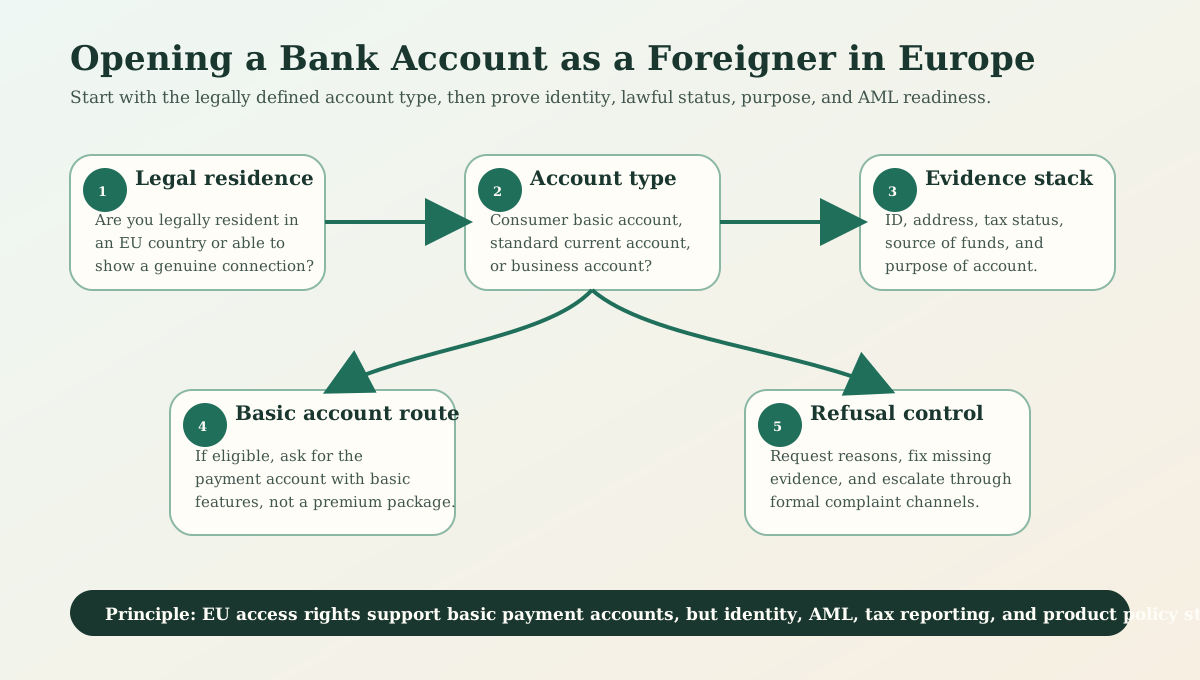
Next step: decide whether you need a consumer basic account, a normal retail account, or a business account, then ask the bank which exact product you are applying for and which missing document would block onboarding.
Source-check date: 2026-06-01. This guide is general information, not legal, banking, tax, immigration, or financial advice.
Opening a bank account as a foreigner in Europe is possible in many situations, but the correct route depends on a narrow legal distinction: a consumer payment account is not the same product as a premium current account, a credit account, an investment account, or a business account. The strongest EU-level right is the right to apply for a payment account with basic features if you are legally resident in the European Union. The European Commission describes this framework as part of the Payment Accounts Directive, which covers access to basic accounts, fee transparency, and account switching. See the Commission's official access page at European Commission: access to bank accounts and the consumer guidance at Your Europe: bank accounts in the EU.
The practical conclusion is not "every bank must accept every foreigner." The useful conclusion is narrower and more powerful: if your profile fits the EU basic-payment-account route, a bank should not reject you only because you do not live in the country where the bank is established, but the bank can still apply identity checks, anti-money-laundering controls, sanctions screening, and national implementation rules. If the account you want is a normal retail package, an online-only product, a salary account, or a company account, the legal and operational requirements can be stricter.
Executive Answer
Use this decision model before comparing brands:
| Question | Why it matters | Best next action |
|---|---|---|
| Are you legally resident in an EU country? | The EU basic-account right is built around legal residence in the EU. | Keep residence evidence, registration, visa, or other lawful-stay proof ready. |
| Are you applying as a consumer or a business? | The basic payment account framework is a consumer framework, not a company onboarding shortcut. | If the account is for a company, prepare incorporation and beneficial-owner documents. |
| Do you need a basic account or a premium account? | Banks have stronger duties around basic accounts than around discretionary packages. | Ask specifically for the payment account with basic features if a standard product is refused. |
| Can you pass identity and AML checks? | EU access rights do not override anti-money-laundering and counter-terrorist-financing rules. | Prepare passport or national ID, address proof, tax details, source-of-funds context, and purpose of account. |
| Do you have a genuine connection to the country? | Some national systems can ask for a genuine interest, such as work, study, property, family, or regular payments. | Keep employment, lease, school, relocation, or invoice evidence if applying cross-border. |
What EU Law Actually Gives You
The EU right that matters most is a "payment account with basic features." Directive 2014/92/EU is the core legal instrument. EUR-Lex summarizes it at EUR-Lex summary of Directive 2014/92/EU, and the full directive is available at Directive 2014/92/EU. The directive's policy design is simple: consumers should have access to a basic payment account, fee information should be comparable, and switching should be easier.
A basic account is designed for ordinary payment life. It usually covers deposits, cash withdrawals, payment transactions, direct debits, credit transfers, and a payment card. It is not a promise of credit, overdraft, investment access, multi-currency services, crypto access, or business banking. That distinction protects you from a common mistake: if a bank rejects a premium package, the next move is not always to argue. The better move is to ask whether the bank offers the legally defined basic-account route and what evidence is missing.
Who Counts as a Foreigner?
"Foreigner" is not a legal category for bank onboarding. Banks usually segment applicants by residence, identity document, tax status, nationality, risk profile, and product type. The same person can be low risk for one account and high friction for another.
| Profile | Typical account route | Friction points |
|---|---|---|
| EU citizen moving to another EU country | Basic or standard current account | Address proof, local tax number, employment or registration evidence |
| Non-EU citizen legally resident in an EU country | Basic account if eligible; standard account if bank policy allows | Residence permit, visa conditions, tax information, source of funds |
| Cross-border worker | Basic account or salary account in work country | Proof of work, employer letter, home-country address, genuine interest |
| Student or trainee | Student package or basic account | Enrollment letter, residence evidence, parental funding or scholarship records |
| Digital nomad or remote worker | Basic account, fintech account, or local current account | Visa status, address reliability, tax residence, expected payment flows |
| Company founder | Business account, not consumer basic account | Company register extract, articles, beneficial ownership, tax registration, business plan |
Documents Banks Commonly Ask For
The exact list varies by country and institution, but the underlying logic is consistent. Banks must identify the customer, understand where the customer lives, understand tax-reporting status, and screen transaction risk. The EU anti-money-laundering framework is separate from the Payment Accounts Directive. The Commission's anti-money-laundering policy hub is at European Commission: anti-money laundering and countering terrorist financing.
| Evidence category | Examples | Why the bank asks |
|---|---|---|
| Identity | Passport, national ID card, residence card | Customer identification and sanctions screening |
| Legal stay or residence | Residence permit, registration certificate, visa, rental contract | Eligibility and country-risk review |
| Address | Utility bill, lease, municipal registration, bank statement from another institution | Contactability, tax reporting, fraud prevention |
| Tax information | Tax identification number, tax residence declaration, CRS/FATCA self-certification | Automatic exchange of information and account reporting |
| Economic purpose | Employment contract, enrollment letter, relocation letter, invoices, pension evidence | Source-of-funds and expected transaction profile |
| Existing banking history | Recent statements, salary proof, reference letter if requested | Risk assessment and practical onboarding |
Basic Account vs Standard Current Account
The most important strategy is to name the product correctly. A bank employee may first route you to a standard account. If that fails because of no local address, weak credit history, or product policy, ask whether the institution has a payment account with basic features.
| Feature | Basic payment account | Standard retail current account |
|---|---|---|
| Legal anchor | EU access framework for eligible consumers | Bank product policy and national law |
| Credit or overdraft | Not required | May be available after credit checks |
| Debit card and transfers | Core feature set usually included | Usually included, often with more options |
| Cross-border residence | Rejection solely for living elsewhere should not be the basis | Bank may apply stricter internal rules |
| Fees | Must be transparent and comparable | Fees depend on package and bank |
| Best for | New arrivals, cross-border workers, people needing essential payments | Residents with stable documents and broader needs |
Fees: Do Not Compare Accounts by Marketing Name
EU rules require fee transparency tools. Banks should provide a fee information document before contract conclusion and a statement of fees later. The point is to make core charges comparable rather than buried in product language. Before opening the account, compare maintenance fees, debit-card fees, ATM fees, SEPA transfer pricing, direct-debit support, cash-deposit restrictions, foreign-currency costs, and closure conditions.
For foreigners, two hidden cost categories are especially important. First, foreign-currency conversion can be expensive if you receive income or savings outside the euro area. Second, a "free" account may be free only if salary or minimum monthly inflow conditions are met. If your first months in Europe are irregular, a basic paid account can be cheaper than a free account whose conditions you fail.
When a Bank Can Still Refuse You
A refusal is not automatically illegal. A bank can refuse where anti-money-laundering obligations are not satisfied, where identification is incomplete, where sanctions screening raises a concern, or where national basic-account rules allow refusal because the applicant already has an equivalent account in the same country. Your Europe also notes that some countries may require a genuine interest in opening an account there. Official guidance is at Your Europe: opening a bank account in the EU.
If refused, ask for the reason in writing or through the bank's formal complaint route. Do not send scattered documents repeatedly through informal channels. Build a clean case file: application date, product requested, documents supplied, refusal text, missing-document list, and the bank's complaint reference. If the issue is a basic account and the refusal appears inconsistent with national implementation rules, escalate through the country's consumer protection or financial dispute body.
The Correct Application Sequence
- Define the product: consumer basic account, standard current account, salary account, online account, or business account.
- Confirm legal residence or genuine connection if applying outside your residence country.
- Prepare identity, address, tax, and source-of-funds evidence before starting the form.
- Ask for the fee information document, not just the marketing page.
- Keep copies of every document uploaded and every message received.
- If rejected, ask whether the basic-account route is available and what exact condition failed.
- Escalate only after you can show a complete document trail.
Special Cases
Non-resident Applicants
Non-resident applications are possible in some countries and institutions, but "possible" is not the same as frictionless. Banks may require a genuine interest, local income, property purchase, study, family reasons, or repeated payments in the country. If your purpose is purely convenience, the bank may route you to a narrower account or decline a standard product.
Online Banks and Fintechs
Digital banks can be easier when they support your country of residence and identity document, but they still perform regulated onboarding. A mobile app does not remove AML, tax, and sanctions obligations. If you need a local IBAN for salary, rent, or public benefits, confirm the account's IBAN country and acceptance in your target country.
US Persons and Other Tax-Reportable Customers
Some customers face extra tax-reporting documentation. US citizens and US tax residents commonly encounter FATCA forms or self-certifications. Other applicants may face CRS self-certification. This is not usually a refusal reason by itself, but incomplete tax self-certification can block onboarding.
Business Founders
A consumer basic account does not solve company onboarding. Business accounts require a separate evidence stack: company register extract, articles of association, registered office, shareholders, directors, beneficial owners, tax numbers, business model, expected transaction volumes, and sometimes proof of capital source.
Country Differences Inside the Same EU Framework
The EU framework gives a common baseline, but national implementation and bank practice still matter. A person who can open an account smoothly in one country may face more friction in another because identity channels, accepted address documents, local tax identifiers, language, branch availability, and bank risk appetite differ.
| Country factor | Why it matters |
|---|---|
| National implementation | The basic-account right is implemented through national law and procedures. |
| Identity infrastructure | Some banks depend on national eID, video identification, postal checks, or branch visits. |
| Local address conventions | A bank may expect municipal registration, lease, utility bill, or tax letter. |
| Tax identifiers | Some countries ask for local tax numbers earlier than others. |
| Complaint bodies | Escalation routes differ by country. |
| Product naming | Basic accounts may be called different names, such as Basiskonto in Germany. |
The correct strategy is to combine EU-level rights with country-specific evidence. Do not quote EU rules alone when the bank is asking for a missing address document, tax self-certification, or source-of-funds record.
How to Build a Cross-Border Account File
A cross-border account file should tell a coherent story. Use a one-page cover note plus attachments:
| Section | What to include |
|---|---|
| Identity | Full legal name, nationality, date of birth, ID document. |
| Residence | Current address, legal residence status, expected move if any. |
| Account purpose | Salary, rent, study, pension, property, relocation, or family payments. |
| Country link | Employer, university, lease, tax notice, property, family, or recurring payments. |
| Tax profile | Tax residence and TINs. |
| Funds | Expected inflows and evidence. |
| Use limits | State whether the account is personal and not for business or third-party funds. |
This file makes the bank's review easier and gives you evidence if a refusal needs to be challenged.
What to Do After Opening
Opening the account is not the end of onboarding. Test the account before relying on it for critical payments. Receive a small transfer, make a SEPA transfer, set up a direct debit where needed, test card use, confirm online banking access, and verify statements. If salary, rent, tax, or visa compliance depends on the account, do not wait until the deadline to discover a limitation.
Keep fee documents and monitor the first annual statement of fees. If charges differ from expectations, compare them with the fee information document and tariff.
Refusal Evidence and Escalation
If refused, classify the refusal:
| Refusal type | Response |
|---|---|
| Missing document | Provide the exact missing evidence. |
| Unsupported onboarding channel | Ask for branch, postal, or alternative verification. |
| Standard account policy | Ask whether the basic payment account route is available. |
| AML/CFT concern | Clarify source of funds, purpose, and identity. |
| Tax self-certification issue | Provide complete TIN and residence information. |
| Basic account refusal | Request written reason and complaint instructions. |
Escalate only with a clean timeline. Include application date, product requested, documents supplied, bank response, missing-document requests, refusal reason, internal complaint, and desired remedy.
Common Cross-Border Mistakes
| Mistake | Better approach |
|---|---|
| Asking for "any European account" | Explain the specific country and payment need. |
| Treating fintech app approval as equivalent to local banking | Check IBAN, direct debit, salary acceptance, and protection. |
| Refusing tax forms | Complete CRS/FATCA self-certification where required. |
| Using personal account for business activity | Open the correct business route. |
| Moving large funds immediately | Build relationship and prepare source-of-funds evidence. |
| Ignoring fee documents | Compare annual cost before choosing. |
The best application is specific, documented, and consistent.
Final Practical Test
Before applying, ask whether a bank employee could understand your identity, residence, tax status, account purpose, source of funds, and expected transactions from the file without a phone call. If not, write a short cover note and label the documents. A clear file does not guarantee approval, but it reduces avoidable refusal risk.
Also test the account after approval. Send a small incoming transfer, make one SEPA credit transfer, try the debit card, verify direct-debit setup, download the fee schedule, and confirm how statements are issued. Many account problems are operational rather than legal. Finding them in the first week is easier than discovering them when rent, salary, tax, or insurance payments are already due.
Evidence Pack Template
| File | Keep it because | Refresh cycle |
|---|---|---|
| Passport or national ID scan | Core identity proof | On expiry or document change |
| Residence permit or registration certificate | Shows lawful stay or residence status | On renewal or address change |
| Lease, utility bill, or municipal registration | Address evidence | Every 3 to 6 months while applying |
| Employment, enrollment, or relocation letter | Shows genuine account purpose | When job, school, or relocation plan changes |
| Tax identification and self-certification | Supports reporting classification | When tax residence changes |
| Source-of-funds explanation | Reduces AML friction | When income source changes |
First 30 Days After Approval
The first 30 days are a controlled test period. Keep account activity close to the purpose described in the application. If you applied for a personal salary or relocation account, do not immediately use it for business receipts, client funds, unexplained cash, crypto exchange flows, or third-party pass-through payments. Sudden mismatch can trigger review even when the account was opened correctly.
Use the first month to confirm the essentials:
| Test | Why it matters |
|---|---|
| Receive a small incoming transfer | Confirms inbound payment routing |
| Send a domestic SEPA transfer | Confirms basic outgoing payment function |
| Set up one direct debit | Tests rent, utility, insurance, or tax compatibility |
| Pay with the card in person and online | Confirms card activation and security rules |
| Download a statement | Confirms proof-of-account access |
| Confirm support channel | Shows how urgent problems will be handled |
| Check fee postings | Compares actual fees with tariff documents |
If a payment fails, save the error message and ask for the precise reason. Many early failures come from missing activation steps, payment limits, name mismatch, unsupported country, unverified address, or incomplete tax data. Fix these while the account is still new and before relying on it for salary, rent, visa proof, or tax payments.
When to Use a Specialist Adviser
Most ordinary consumer accounts do not need a lawyer or adviser. But specialist help can be useful when the file involves complex immigration status, sanctions exposure, multiple tax residences, unusual source of funds, rejected basic-account access, business activity, crypto-assets, trusts, high-value transfers, or regulated professional activity.
Use advisers for classification, documentation, and escalation. Do not use them to hide facts from the bank. A stronger file is transparent and organized, not disguised.
FAQ
Can a foreigner open a bank account in Europe without local citizenship?
Yes, citizenship is not usually the deciding factor. Residence status, identity verification, tax information, product type, and bank risk policy matter more.
Can I open an account before I move?
Sometimes. A cross-border basic-account application may be possible if you are legally resident in the EU and can show a genuine interest, but many standard accounts still require a local address or local onboarding process.
Does EU law force every bank to give me a free account?
No. EU rules concern access and fee transparency, not a universal free premium account. Basic accounts may be free or reasonably priced depending on national implementation.
What should I do if a bank says "non-residents are not accepted"?
Ask whether that statement applies to all products or only to the standard product you selected. Then ask specifically about the payment account with basic features and the bank's required evidence.
Is a basic account enough for salary and rent?
Usually it is designed for essential payment operations such as receiving funds, making transfers, direct debits, cash withdrawals, and card payments. Confirm employer and landlord acceptance before relying on it.
Is this advice valid outside the EU?
This article focuses on the EU framework. EEA countries and Switzerland have related financial-market and residence arrangements, but the exact account-access rules should be checked locally.
Official References
- Your Europe: bank accounts in the EU
- European Commission: access to bank accounts
- Directive 2014/92/EU on payment accounts
- EUR-Lex summary: payment accounts directive
- European Commission: anti-money laundering and countering terrorist financing
Related Reading
- Bank Account in Germany for Non-Residents
- Bank Account in Luxembourg for Non-Residents
- Salary Account Requirements for Expats in Europe
Bottom Line
The safest route is to separate the legal right from the bank product. EU rules give eligible legally resident consumers a strong route to a basic payment account, but they do not cancel identity checks, AML controls, tax self-certification, or business-account requirements. Apply with a complete evidence pack, ask for the basic-account route if a standard product fails, and preserve a written trail if you need to challenge a refusal.
Expanded Application Blueprint
Use one blueprint to avoid the most common non-resident account errors:
- separate legal entitlement from product choice,
- align each document with one claim,
- prove channel compatibility before submitting all files,
- test operational readiness after approval.
Case-by-Case Pathways
1) EU resident relocating into another EU country
Best practice:
- Prepare a narrow file for legal residence + income.
- Ask whether basic-payment access is available for this status.
- If yes, request bank-specific confirmation on residence documents and channel compatibility.
- Apply with purpose-specific supporting documents.
- Test one critical payment flow before dependency.
Typical blockers:
- cross-border address proof that does not match document language,
- outdated source-of-funds assumptions,
- misunderstanding between “legal right” and actual account product.
2) Non-EU national with residence permit
The process is usually closer to:
- Confirm residence category and local legal stay.
- Ask for the bank-specific onboarding channel.
- Align tax-residency evidence and source-of-funds statement.
- Build one practical purpose for the account and avoid unrelated use-cases.
If residency rules are short-term, use the smallest account class first and scale gradually.
3) Freelancer or contractor
Freelancer files are delayed when:
- invoice history is sparse,
- payer identity is unclear,
- payment routing is mixed across clients.
Fix by submitting:
- contract summary,
- recent invoices and bank deposits,
- expected monthly volume and customer geography,
- explicit statement of expected transaction type.
4) Cross-border worker with employer sponsorship
Use employer confirmation as one strong filter:
- payroll timing,
- account holder identity consistency,
- employer name and payment channel.
This reduces refusal by clarifying legal and operational purpose in one file.
Failure Taxonomy With Remedies
Use this compact list during submission:
| Refusal type | What changed | Fix before next submission |
|---|---|---|
| Missing document | Incomplete official file | Add only the missing evidence class |
| Channel failure | Verification provider rejected format | Try supported document format, then branch channel |
| Genuine interest mismatch | Purpose too vague or unsupported | Attach a one-paragraph use-case explanation |
| AML/tax mismatch | Unclear source or reporting trail | Add self-certification and source documents |
| Policy refusal | Product not offered in policy set | Request alternative route or comparable account type |
Pre-Submission Evidence Pack (Operational)
For speed and interpretability, use four folders:
- Identity and legal status: passport or national ID, residence permit, official residence timeline.
- Account purpose: employment, study, family housing, or business routing.
- Money profile: payroll, invoices, proof of funds and periodicity.
- Support chain: employer/landlord/university contact and official request evidence.
Inside each folder, prefer fewer files with clear naming and fewer scans.
60-Day Readiness and Retry Plan
Days 1-15: Build and submit
- Finalize evidence pack.
- Confirm channel and upload format.
- Save submission screenshots.
Days 16-30: Track and classify
- Record response type and missing item list.
- Do not re-upload unchanged documents.
- Ask for written refusal language when declined.
Days 31-45: Targeted correction
- Fix only the missing evidence class.
- Remove unrelated documents from the immediate resubmission.
- Request one alternate channel if classification is unchanged.
Days 46-60: Re-test operations
- If approved, run income, rent, and utility tests.
- Confirm direct-debit behavior and statement access.
- Keep one clean backup payment method.
Internal Coordination Script
When communicating with institutions, keep replies short:
Purpose: [country] account opening request
Status: [resident/work/student/freelancer]
Account type requested: [basic payment account / salary account / business support route]
Issue observed: [decline reason or specific block]
Evidence added: [specific docs added this cycle]
Request: [exact confirmation needed from your side]
Practical Checklists
Before submission
- Is the exact product name written in the form?
- Are all names consistent across legal and payment files?
- Are the tax fields complete and consistent with residence status?
- Are the payment flows described in the first three months?
After approval
- Test one SEPA transfer in each direction.
- Confirm landlord/employer acceptance.
- Check statement date and fee posting.
- Keep statements for complaint windows and tax proof.
Regional Friction Pattern Notes
Cross-country implementation is not uniform. In many countries:
- eID requirements differ in acceptance sequence,
- address proofs have different hierarchy (municipal > tax > lease),
- verification speed varies between branch and digital channels,
- some banks prioritize local address or local employment first.
Use the same evidence logic, but map the local channel before expanding the file.
Internal Links for Next Actions
- How to open a bank account as a foreigner in Europe
- Bank account in Belgium for non-residents
- German bank account before anmeldung
- Salary account requirements for expats in Europe
Example Cover Letter for Refusal Follow-up
Dear [Bank Name],

Applicant: [full legal name]
Account request: [product]
Application date: [date and reference]

Additional documents submitted:
- Identity and residence
- Income and payment proof
- Purpose and use-case breakdown

I request written confirmation of the exact refusal reason or missing document class so I can submit a corrected package in one step.

Thank you,
[Name]
A precise follow-up usually shortens escalation and reduces repetitive loops.
10-step readiness framework
Most failures happen because people start by choosing a bank and only later confirm fit. Use this sequence first:
- Legal status checkpoint: map the exact lawful-stay category and country.
- Purpose declaration: define primary account use (salary, rent, business, school, savings).
- Product split: choose basic payment account route first, then compare premium/current routes.
- Channel compatibility: test upload channels and identity document acceptance before full submission.
- Evidence mapping: align each document to a specific required fact.
- First filing: submit one coherent bundle, not a full archive.
- Response capture: save refusal reasons, timestamps, and request IDs.
- Refusal triage: classify reason into legal, procedural, evidentiary, or policy class.
- Single-loop correction: repair only one class before reapplying.
- Operational test: run one transfer, one direct debit, one card/payment test after approval.
If step 1 or 2 fails, keep the same bank but reduce product complexity. Most successful applicants stop fighting the first layer and fix the first missing fact.
Country and account-type decision tree
Use the matrix below before opening a new form.
| Situation | Best first account type | Why |
|---|---|---|
| You are an EU citizen with stable residence route | Basic payment account with local functionality | Strong legal basis for basic account access |
| You are a non-EU worker with employer contract | Salary-linked or standard account with payroll visibility | Income path is often strongest evidence point |
| You are a student with admission | Admission-tied temporary route then standard upgrade | Temporary administrative rhythm is more predictable |
| You have no local address yet | Basic functionality route plus backup fintech bridge | Avoids overfitting a product you cannot yet operate |
| You need company onboarding for business | Business route or separate enterprise account | Consumer onboarding logic and business onboarding logic differ |
| You need fastest migration administration | Temporary practical route plus document readiness | Priority is functionality, not product richness |
Common errors and practical fixes
Error 1: confusing residency rights with full product rights
Legal right to a basic payment account does not create access to every premium product.
Fix: request the lowest legal route first, then test eligibility for larger routes.
Error 2: poor document sequencing
Applicants often upload documents randomly.
Fix: pair each document to one fact. For example:
- residence card -> legal status,
- employment contract -> expected income,
- utility proof -> channel reachability,
- tax number -> reporting status.
Error 3: waiting for one perfect bank
Different institutions optimize for different flows.
Fix: if the first institution declines for policy/commercial reasons, test one alternate institution with the same evidence class.
Error 4: no written refusal basis
Verbal denial leaves high ambiguity.
Fix: request exact reason class and missing document categories before retrying.
Error 5: changing profile during retry
If profile changes (e.g., employer change) between submissions, previous evidence becomes stale.
Fix: rebuild only once with a synchronized profile timestamp.
Practical refusal-response script
When rejected, use this exact structure:
Subject: Clarification for bank account request

Profile:
- Residence status:
- Country and category:
- Account type requested:
- Purpose of account:

Current request status:
- Submission date:
- Applicant ID/reference:
- Refusal language received:

Request:
Please confirm in writing the exact document class required for approval in my category.
This template keeps the follow-up short and auditable.
Evidence pack blueprint by profile
EU resident employee
- Passport or national ID
- Residence registration evidence
- Employment contract and expected payroll
- Current utility/municipal contactability proof
- One supporting letter from employer
Non-EU worker
- Residence permit and supporting legal route documents
- Employment offer/contract and duration
- Tax and identity continuity
- Address document if available
- Payer and payroll timing evidence
Student
- Admission/acceptance
- Housing support
- Enrollment and insurance documents
- Proof of funds and financial obligations
- Address and institutional communication chain
Freelancer
- Existing contract pattern and expected monthly payouts
- Invoice history and payer confirmation
- Tax registration and compliance records
- Banking/receivable continuity plan
Family
- Spousal and dependent records if relevant to registration
- School readiness documents
- Housing capacity and occupancy details
- Insurance continuity and emergency contacts
45-day operational test
After approval, run this short test before relying on the account for core payments:
Day 1-10
- Confirm login, security, and beneficiary profile.
- Verify no unexpected identity restrictions.
Day 11-20
- Make one small incoming and one outgoing transfer.
- Run one bill direct debit.
Day 21-30
- Add one recurring payment setup.
- Test card payment where most everyday spending occurs.
Day 31-45
- Compare actual fees against published terms.
- Confirm statement access and dispute channels.
Document mismatches even if small. Small mismatches create large monthly costs later.
What to compare before choosing a bank route
- Processing behavior: rejection reason granularity and clarity.
- Channel behavior: digital onboarding reliability, branch support, and identity capture.
- Support behavior: response time and written clarifications.
- Control behavior: fee visibility, transfer testing, direct debit configuration.
- Escalation behavior: existence of complaint route.
Banks with fast acceptance and weak clarity can still fail you later in operations. Banks with slower onboarding can still be acceptable if they are consistent and transparent.
Integration with banking strategy and country choice
Article decisions are stronger when bank strategy is coordinated with country strategy.
- If legal stay is temporary, avoid opening high-friction products immediately.
- If residency is stable but relocation is still in progress, prioritize predictability over premium features.
- If income is remote and cross-currency, include transfer and compliance review in first month.
- If family is involved, test card, payroll, child-related, and utility flows before final relocation steps.
For local strategy by country, review bank account in Belgium for non-residents and Germany bank account before anmeldung before the final bank submit.
Common examples
Example 1: cross-border worker with legal residence and no local history
The worker had stable legal status and wage offer but no existing local account behavior. They submitted multiple documents to one bank and were rejected as non-preferred.
Fix applied: switched to basic payment route, clarified payroll path, and requested one documented refusal class before retry.
Result: faster approval and cleaner payroll testing.
Example 2: student with delayed address registration
The student uploaded mixed lease drafts and provisional documents. The first application failed.
Fix applied: submitted clear timeline documents and separated legal admission from housing onboarding steps.
Result: fewer rejections and a clearer timeline.
Example 3: founder with mixed personal/business flow
Personal account request included invoicing and founder activity in the same narrative.
Fix applied: separated personal and business payment needs, and shifted non-personal flows to appropriate account type.
Result: stronger match between account purpose and policy.
Checklist before submitting your final application
- Is the legal stay status explicit and current?
- Is the account request exactly one of: basic account / salary account / business account?
- Does each evidence file answer one verification objective?
- Is the purpose statement consistent with at least one practical payment flow?
- Did you map how rent, salary, utilities, and taxes will run after approval?
- Do you have written complaint and escalation contacts in case of refusal?
- Do you have a post-approval 45-day test plan?
If one answer is uncertain, submit the same day after correction, not after collecting random new evidence.
Quick post-approval controls (first 60 days)
- Run one core payment in each required flow.
- Keep statements synced and preserved from day one.
- Reconcile bank charges weekly.
- Update address and status details if they change.
- Do not replace account product category until usage evidence is stable.
Your first 60 days are not the end of onboarding. They are the first operational audit. Keep it short, consistent, and documented.
Extended pre-departure framework (from application decision to first payroll)
This section is for people who want fewer unknowns after arrival.
Step 1: Define the one legal objective
Do not start with 10 institutions. Start with one legal objective and one emergency backup objective.
Common legal objectives:
- Residence route underway and waiting for formal proof
- Student admission complete but pending first tuition cycle
- Employment contract signed with salary date
- Family move with mixed income and housing coordination
For each objective, define one operational target that must work in the first 30 days.
Step 2: Freeze your evidence language
Every document title and file name should share the same pattern:
- Document type
- Date
- Identity key
- Category (income, residence, housing, purpose)
This avoids common “wrong version” confusion.
Step 3: Set one correction policy
On first decline, do exactly one correction class:
- status proof,
- purpose proof,
- or source-of-funds proof.
Do not reopen unresolved classes with unrelated edits.
Step 4: Run a dry run before real spending
Before switching salary or rent to the new account:
- Verify login and security recovery.
- Perform one inbound and one outbound transfer.
- Run one direct debit on controlled expense.
- Confirm statement is understandable in one language and one format.
Practical decision map by migration profile
Fast mover profile
If your relocation is time-compressed, prioritize:
- banks with clear status-based onboarding,
- one fallback route with shorter escalation path,
- and explicit written confirmation channels.
Stable planner profile
If your move has buffer time, prioritize:
- documentation quality over speed,
- one provider with stable post-onboarding support,
- and clear complaint/escalation route.
Family profile
If dependents are involved, prioritize:
- emergency support coverage,
- recurring payment reliability,
- and clear shared-address update protocol.
Remote worker profile
If income is partly cross-border, prioritize:
- clear payer mapping,
- transfer timing proof,
- and strict post-onboarding reconciliation discipline.
90-day operational test plan (beyond the initial 60-day controls)
Days 61–75
- Compare actual bank behavior to your expected transaction map.
- Verify one disputed transaction path and one successful correction path.
Days 76–90
- Confirm recurring costs are automated and traceable.
- Ensure all critical documents and updates are versioned by date.
- If one workflow is weak, keep the account, fix that workflow, and retest in parallel.
Days 91+
- Reassess whether your current card and account mix matches your daily spending rhythm.
- Decide whether to request account upgrades or maintain the current conservative stack.
Common error patterns and practical fixes in execution
Error: Starting with too broad a bank strategy
You submit to 5 banks in one day and lose track of requirements.
Fix: choose one primary and one secondary, with predefined wait windows.
Error: Ignoring support path until decline
You ask only at the end and lose time.
Fix: confirm support and complaint channels before submission.
Error: Treating residency uncertainty as a blocker for all action
You wait for every proof before acting.
Fix: split tasks into what can be done now vs what depends on a later official step.
Structured templates for written communication
Template 1: First outreach
Subject: Account onboarding clarification request

I am applying as a foreign newcomer with [status].
Current evidence ready: [list]
My objective is [salary/rent/utilities] and this is the first planned payment [date].
Please confirm:
- required documents for this category,
- whether temporary evidence is acceptable,
- and the reason code used for rejections.
Template 2: After refusal
Subject: Request for reason class and correction checklist

Reference [application ID].
Please confirm the exact reason class for decline and one accepted correction path.
I will correct only the missing class and reapply once ready.
Cross-country bridge checklist (before changing country again)
- Reconcile legal path versus account path.
- Check whether salary and residence documents remain valid if country changes.
- Keep one clean archive of all references and reasons.
- Verify transfer and support channels before starting a move.
- Keep one local backup bank route mapped.
The most reliable onboarding plan is not the one with all options open; it is the one with all options tested in sequence.
Internal sequencing and related articles
- Bank account in Belgium for non-residents
- Cheapest countries in Europe for expats
- Germany bank account before anmeldung for expats
- Credit card requirements for foreigners in Europe
Extended operational playbook for bank readiness
The final result depends on how you process feedback during the first 30 days.
Day 0: Pre-application lock
- Lock one legal route and one backup route.
- Lock one account type and one purpose.
- Prepare one written folder with identity, legal, and financial evidence.
Day 1: Controlled submission
- Use one institution for your first complete submission.
- Keep a single correction objective visible.
- Avoid creating parallel files until the first reason code is clear.
Day 2–4: First response cycle
- If approved, move directly to first-payment protocol.
- If declined, classify decline into one of the correction classes.
Day 5–10: Correction sprint
- Correct only one class.
- Keep all other files unchanged.
- Preserve original and updated versions.
Day 11–14: Re-test + verify
- Re-run one controlled low-risk payment.
- Verify whether direct debit, transfer, and statement visibility are stable.
- If not stable, identify the exact point of failure before changing anything else.
Day 15–21: Route choice checkpoint
- If two attempts fail with no class clarity, shift to secondary route only after written reason review.
- Do not switch routes on assumption.
Error-to-response map
Error: I am ready but not selected in sequence
This usually means the submission included too many optional ambitions.
Response:
- Reduce objective to one first task.
- Keep one channel open and one support address.
- Request one written reason and one written class before retry.
Error: I have approval but no operational stability
Common when onboarding documents exist but operational behavior is inconsistent.
Response:
- Keep minimal transaction set for the first month.
- Verify each failed item and classify root cause.
- Repair only the root class and keep timeline evidence.
Error: I have recurring denials on the same question
This is often non-actionable if you are changing documents without changing the reason class.
Response:
- map reason class history,
- request a direct substitute list,
- re-prepare one corrected file.
Bank route decision grid
| Use case | First route | Secondary route | Early warning sign | Corrective action |
|---|---|---|---|---|
| Student move | One digital-first bank with student/education support | One institution with fast clarification support | enrollment mismatch | freeze objective, provide one corrected timeline |
| Worker move | Payroll-focused account | Branch-supported route | missing payroll rhythm | include expected payroll cadence and duration |
| Family move | Stability route + billing support | Backup with robust service channel | conflicting household evidence | separate household and personal purposes |
| Founder remote | Proof-first route and conservative card model | One local route for operational liquidity | mixed activity flow | split personal/business proof classes |
Evidence pack naming protocol (copy/paste ready)
Use ISO-like naming; it prevents confusion during escalations.
2026-06-01-identity-passport.pdf
2026-06-01-legal-route-employment.pdf
2026-06-01-bank-submission-v1.txt
2026-06-04-classification-income-mismatch.txt
2026-06-07-support-request-clarification.txt
Internal execution sequence across countries
If Belgium is in your plan
Use Belgium-specific document clarity and keep a rental/payment compatibility checkpoint before applying to other routes.
If Germany is in your plan
Keep a legal-route-first workflow and preserve written class requests before broad retries.
If remote-working across borders
Set one transfer cadence map and align payer rhythm before account upgrades.
Practical scripts for recurring situations
Follow-up after long silence
Reference: [ID]
Date since submission: [days]
Current status: [pending reason]
I am requesting a written update to the current class and next required correction.
Clarification before adding a bank
Before I send new documents, please confirm:
- required account category,
- required legal proof set,
- whether temporary evidence is accepted.
I need one class-based response before I correct again.
Final sequencing checklist before month end
- Has the legal route been kept static for at least one correction cycle?
- Is the objective still the one used in your first submission?
- Are all updates in one folder by date and class?
- Is one direct debit and one core transfer currently stable?
- Have support contacts been confirmed in writing?
If the answer is “no” to any question, maintain correction mode before account upgrades.