Last updated
Income Tax Rules for Freelancers in Europe
Income Tax Rules for Freelancers in Europe brings the main checks together so you can see the issue, the evidence, and the safer next step in one place. It explains checking tax position, payroll evidence, social-security exposure, net pay, and cross-border filing questions across Europe, then shows how to separate residence, treaty, payroll, contribution, withholding, and filing questions before signing or moving money. The later sections connect the freelancer tax stack, 1. tax residence: the starting point, and 2. source taxation: where the work is actually performed so the next step is easier to judge. Read it before submitting forms, moving money, choosing a provider, or assuming that a rule from another country applies.
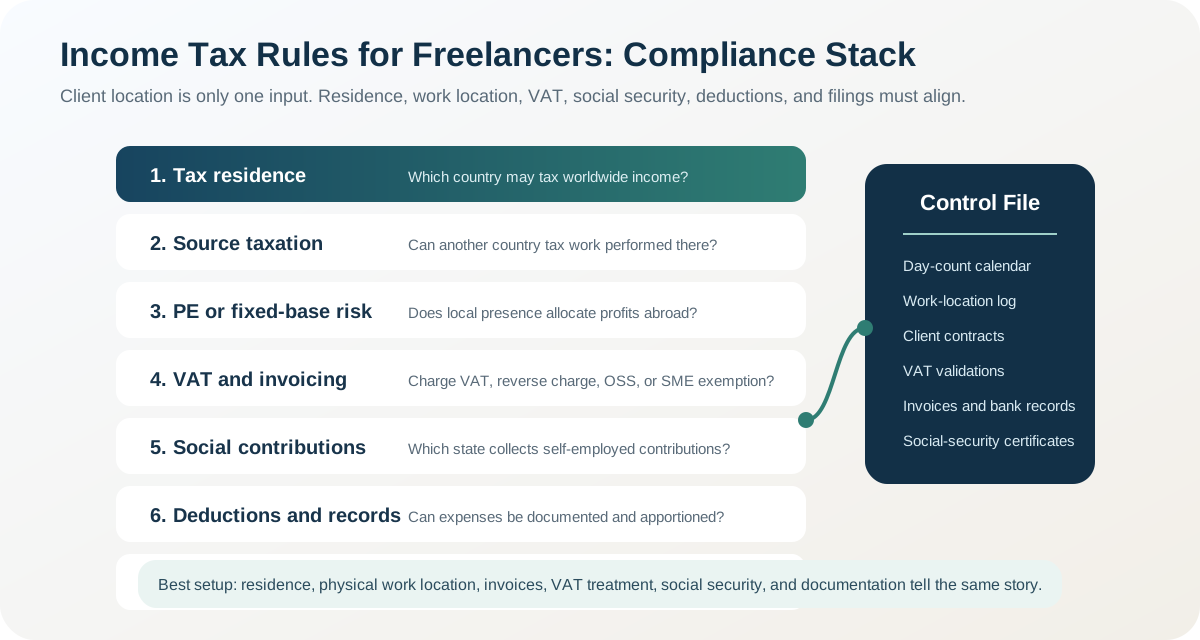
Freelancer tax in Europe is not determined by where your client is located, where your bank account is held, or where your company is incorporated alone. The analysis usually requires seven separate layers: tax residence, source taxation, permanent establishment or fixed base risk, VAT, social contributions, deductible expenses, advance payments, and cross-border reporting. A freelancer can be compliant for immigration and business registration while still being wrong on tax.
Direct answer
If you are a freelancer in Europe, start by assuming that income tax is decided mainly by your tax residence and where the work is physically performed, not just by your client location or bank account. Your Europe states that there are no EU-wide rules determining how EU nationals living, working, or spending time outside their home countries are taxed on income.
The answer changes when you move country midyear, work on site in another country, use a company, trigger local source taxation or permanent-establishment risk, or fall under different VAT, social-security, treaty, or advance-payment rules.
Next step: map one tax year on one page with your residence country, travel and work days, client countries, invoicing method, VAT status, and social-security country. Then test that map against the residence-country rules and any host-country filing trigger.
The Freelancer Tax Stack
| Layer | Main question | Why it matters |
|---|---|---|
| Tax residence | Which country can tax your worldwide income? | Determines annual return, rates, allowances, and treaty residence |
| Source taxation | Can another country tax income earned from work performed there? | Creates nonresident filings or withholding |
| Permanent establishment or fixed base | Does your activity create a taxable business presence outside your residence country? | Can allocate business profits to another country |
| VAT | Should you charge VAT, reverse charge, use OSS, or apply an SME exemption? | VAT is separate from income tax |
| Social contributions | Which country collects self-employed social-security contributions? | Often a major cost and not the same as income tax |
| Deductions | Which business expenses reduce taxable income? | Rules vary widely and require evidence |
| Advance payments | Must you prepay income tax during the year? | Late prepayments can trigger interest or penalties |
| Cross-border reporting | Must platforms, banks, clients, or tax offices exchange information? | Non-reporting is increasingly visible |
1. Tax Residence: The Starting Point
Your tax residence is usually the first question because the residence country can generally tax worldwide income. Your Europe explains that you are usually considered tax-resident in the country where you spend more than six months a year, and normally remain tax-resident in your home country if you spend less than six months in another EU country. It also warns that countries have their own definitions and that double-residence cases may require treaty analysis. See Your Europe: Tax residence and income taxes abroad.
For freelancers, day count is not the only factor. Countries may also examine permanent home, center of vital interests, habitual abode, economic interests, family location, registered address, business premises, and nationality. Digital nomads are especially exposed because they may have clients in one country, a company in another, and physical presence in a third.
2. Source Taxation: Where the Work Is Actually Performed
A freelancer's client can be in one country while the work is performed in another. Income-tax systems often care about where the professional activity is physically carried out, not merely where the client pays from. If you travel to deliver consulting, training, performance, installation, medical, technical, or creative services, the host country may claim taxing rights under domestic law unless a treaty prevents or limits taxation.
The OECD Model Tax Convention is not itself a domestic law, but it strongly influences bilateral tax treaties. Its business-profits framework generally limits taxation of enterprise profits by another state unless a permanent establishment exists there, while older or specific treaties may contain provisions for independent personal services, entertainers, directors, or technical services. See OECD: Model Tax Convention.
3. VAT Is Separate From Income Tax
Many freelancers confuse VAT with income tax. VAT is a consumption tax charged on supplies of goods or services; income tax is charged on profit or income. A freelancer can owe no income tax yet still have VAT duties, or be VAT-exempt but still owe income tax and social contributions.
Your Europe explains that EU VAT obligations vary depending on whether you sell goods or services, whether customers are businesses or final consumers, and whether transactions are domestic, intra-EU, or outside the EU. See Your Europe: Cross-border VAT.
VAT Scenarios for Freelancers
| Client or sale type | Typical VAT issue | Evidence to keep |
|---|---|---|
| Domestic B2C services | Local VAT rate or small-business exemption | Invoice, customer location, exemption basis |
| Domestic B2B services | Local VAT unless exempt or reverse-charge domestic rule applies | Client tax ID, contract, invoice |
| EU B2B services | Reverse charge may apply for many services | Valid VAT number, VIES check, reverse-charge wording |
| EU B2C digital services | Customer-location VAT may apply | Two pieces of customer-location evidence |
| Non-EU business clients | Often outside EU VAT, but exceptions exist | Client establishment evidence, use-and-enjoyment analysis |
| Platform income | Marketplace, platform reporting, deemed-supplier rules may matter | Platform statements, fee invoices, tax reports |
| Low turnover | SME VAT exemption may apply | Threshold calculation and approval where required |
Since January 1, 2025, the EU SME VAT scheme has allowed eligible small enterprises to apply for VAT exemption in domestic and cross-border contexts if they meet the EU-wide and national thresholds. The Commission states that eligible small enterprises must not exceed EUR 100,000 total annual turnover in the EU, while national exemption thresholds cannot exceed EUR 85,000, subject to Member State implementation. See European Commission: SME VAT scheme and European Commission: Cross-border SME scheme.
4. Social Contributions Are Not Optional Tax Extras
Self-employed social contributions often fund health insurance, pensions, maternity, sickness, disability, unemployment-like benefits, or occupational coverage. They can equal or exceed income tax for low and middle-income freelancers.
EU coordination rules determine which country's social-security legislation applies when work crosses borders. The Commission states that people moving within the EU, Iceland, Liechtenstein, Norway, or Switzerland are subject to the legislation of only one country at a time, and that a self-employed person working in one country is generally subject to that country's legislation. See European Commission: Social-security coordination.
Do not assume that tax residence and social-security coverage always match. A freelancer may be tax-resident in one country but socially insured in another under cross-border-worker, posting, or multi-state rules.
5. Deductions: What Freelancers Usually Need to Prove
Deductibility is national, but the evidence logic is similar across Europe: the expense must be business-related, properly documented, allocated between private and business use where mixed, and recorded in the correct period.
| Expense category | Deduction issue | Documentation |
|---|---|---|
| Home office | Strict rules often apply to exclusive or principal business use | Floor plan, lease, utility allocation, photos, policy |
| Internet and phone | Mixed personal/business use must be apportioned | Bills, usage percentage, business rationale |
| Equipment | Immediate deduction or depreciation depends on value and life | Invoice, asset register, depreciation schedule |
| Travel | Business purpose, itinerary, and private element must be clear | Tickets, hotel invoices, meeting agenda |
| Meals | Often limited or only deductible in business-travel contexts | Receipt, attendees, purpose |
| Training | Must relate to current or qualifying business activity | Course invoice, syllabus, business reason |
| Professional insurance | Usually business-related if required or relevant | Policy, premium invoice |
| Coworking | Usually easier than home-office deduction | Contract, invoices |
| Software subscriptions | VAT and reverse-charge may matter for foreign suppliers | Supplier invoice, VAT treatment |
| Professional fees | Accountant, lawyer, chamber, tax filing | Engagement letter, invoice |
6. Advance Payments and Withholding
Many European countries require self-employed people to prepay income tax during the year. The mechanics differ: quarterly installments, monthly payments, prior-year-based advances, current-year estimates, or withholding by clients in certain professions.
Spain provides a clear example. The Agencia Tributaria's Modelo 130 procedure covers installment payments for entrepreneurs and professionals under direct estimation, and its instructions state quarterly filing windows for the first three quarters and January filing for the fourth quarter. See Agencia Tributaria: Modelo 130 and Agencia Tributaria: Modelo 130 instructions.
Other countries use different systems. The safe approach is to ask three questions immediately after registration:
| Question | Why it matters |
|---|---|
| Are income-tax prepayments automatic or must I apply? | Avoids missing the first payment cycle |
| Are prepayments based on expected current-year profit or prior-year income? | New freelancers may need estimates |
| Do clients withhold tax from invoices? | Prevents double payment or underpayment |
7. Cross-Border Clients: What Changes and What Does Not
Cross-border clients create invoicing and reporting complexity, but they do not automatically move your income-tax residence.
| Situation | Income-tax point | VAT point | Social-security point |
|---|---|---|---|
| Freelancer lives and works in France for a German client | France may tax worldwide income if resident | EU B2B service reverse-charge may apply | France likely competent if work performed there |
| Freelancer lives in Portugal but performs on-site work in Spain | Portugal residence plus possible Spanish source issue | Service place-of-supply must be checked | Spain may matter if work is physically performed there |
| Freelancer invoices U.S. clients from the Netherlands | Dutch tax residence may tax worldwide income | Non-EU service VAT treatment must be checked | Dutch social-security and health rules may apply |
| Freelancer spends 4 months in Italy, 4 in Germany, 4 in Spain | Residence and treaty tie-breakers become fact-intensive | VAT establishment and customer rules must be checked | Multi-state work rules may assign one country |
| Freelancer uses a foreign limited company | Corporate residence, permanent establishment, payroll, and dividend rules arise | VAT registration may belong to the company | Director/shareholder social-security status must be assessed |
8. Permanent Establishment and Fixed-Base Risk
Freelancers often assume permanent establishment is only a corporate issue. It is broader than that. A nonresident business can create a taxable presence by having a fixed place of business, dependent agent, office, workshop, or recurring local presence, depending on treaty and domestic law. For individuals, some treaties historically used independent-personal-services tests, while modern treaties may fold professional services into business profits.
High-risk patterns include:
| Pattern | Why it matters |
|---|---|
| Renting an office in another country | Can create a fixed place of business |
| Regularly working from a client's premises | Could create taxable presence depending on control and duration |
| Hiring local staff or agents | May create employer, payroll, and PE issues |
| Storing goods abroad | Can trigger VAT, customs, or PE analysis |
| Selling through local representatives | Dependent-agent PE risk |
| Long on-site projects | Source-country tax or PE exposure |
9. Records Freelancers Should Keep
| Record | Retention purpose |
|---|---|
| Day-count calendar by country | Tax residence and social-security evidence |
| Work-location log | Source taxation and A1/multi-state work analysis |
| Client contracts | Place of supply, withholding, PE risk |
| Invoices issued | Income, VAT, reverse charge, exchange rates |
| Supplier invoices | Deductions and input VAT |
| Bank statements | Revenue reconciliation |
| VAT-number validations | EU B2B reverse-charge support |
| Platform statements | Marketplace income and fees |
| Travel documents | Business travel evidence |
| Home-office calculations | Mixed-use deduction support |
| Social-security certificates | Avoiding duplicate contributions |
| Tax-residence certificates | Treaty relief and client withholding |
10. Common Mistakes
| Mistake | Consequence |
|---|---|
| Treating client country as the only tax country | Missed residence-country worldwide income reporting |
| Ignoring VAT because income is low | VAT registration or exemption rules may still apply |
| Using travel days casually | Day-count errors can change residence analysis |
| Forgetting social contributions | Large arrears and loss of benefits |
| Claiming home-office deductions without evidence | Audit adjustment and penalties |
| Failing to register prepayments | Interest or penalties |
| Assuming a foreign company prevents personal tax | Management, PE, salary, dividends, and CFC rules may still apply |
| Treating all cross-border B2B invoices the same | VAT place-of-supply exceptions exist |
| Not checking treaty withholding forms | Client may withhold unnecessarily or incorrectly |
| Mixing personal and business accounts | Harder audit defense and accounting errors |
Practical Workflow
- Confirm immigration and right-to-work status.
- Determine tax residence under domestic law and treaty if needed.
- Register self-employment or company form.
- Register income tax and determine advance-payment schedule.
- Determine VAT status, including domestic threshold, SME scheme, OSS, and reverse charge.
- Register social security and health insurance.
- Build invoice templates for domestic, EU B2B, EU B2C, and non-EU clients.
- Track days, work locations, and client countries monthly.
- Reconcile platform, bank, and invoice income quarterly.
- Review residency, VAT thresholds, and contribution bases before year-end.
FAQ
Is there one income tax rule for all freelancers in Europe?
No. Income tax remains national. EU rules can affect VAT, social-security coordination, reporting, and cross-border administration, but each country sets its own residence tests, tax rates, deductions, filing deadlines, and prepayment rules.
Does my client country decide where I pay freelancer tax?
Not by itself. Client location matters for VAT, withholding, platform reporting, and source-tax questions, but tax residence and the place where work is physically performed are usually more important for income tax.
Do freelancers in Europe always need a VAT number?
No. VAT registration depends on the country, activity, turnover, customer type, and cross-border sales. Small-business exemptions may apply, but B2B EU services, digital services, imports, or platform activity can still create VAT obligations.
Are social contributions included in income tax?
Usually no. Social contributions are a separate cost and can be due even when income tax is low. Cross-border freelancers should confirm which country's social-security legislation applies before assuming tax residence controls the answer.
Annual freelancer tax operating model
Freelancers should run tax as a monthly operating process, not a once-a-year scramble. Each month, close invoices issued, cash received, platform income, expenses, VAT category, work location, client country, and social-contribution reserve. This creates the evidence needed for income tax, VAT, social security, treaty claims, and business registration reviews.
Start with a country-of-residence file. It should include residence registration, tax number, business registration, health-insurance or social-security status, bank account, invoice template, bookkeeping method, and adviser contact if used. Then add a client-country file for each country where withholding, VAT, platform reporting, or local registration may arise. The freelancer should know which country taxes worldwide income and which countries may tax source income.
Quarterly, reconcile invoices to bank deposits. Differences can come from platform fees, refunds, chargebacks, withholding tax, foreign-exchange conversion, payment processor fees, or unpaid invoices. If the freelancer reports only bank deposits, gross income and VAT thresholds can be wrong. If the freelancer reports only invoices, cash-basis rules or bad debts may be mishandled depending on the country.
Before year end, check whether residence, VAT thresholds, social-contribution bases, and advance-payment assumptions still hold. A freelancer who moved country, added a major client, crossed a VAT threshold, hired subcontractors, or changed legal form should not wait until the tax return to correct the setup.
Client-country and withholding controls
Client location can affect VAT, withholding, reporting, and treaty paperwork. Some clients request a tax-residence certificate before paying without withholding. Others withhold by default unless the freelancer provides local forms. A freelancer should identify withholding risk before signing the contract, because reclaiming tax later can be slow.
Contracts should state the service, supplier legal name, tax residence, VAT status, payment currency, gross or net amount, withholding responsibility, and whether taxes can be added if VAT registration becomes required. For cross-border B2B services, the invoice should include the correct VAT treatment and client VAT number where relevant. For B2C services, place-of-supply rules can be more complex.
If the freelancer works physically in a country different from the residence country, keep travel and workday evidence. The place where services are performed can matter for income tax, social security, permanent establishment, immigration, and local registration. For remote-work overlaps, use remote work Europe tax alongside this guide.
Deductions and home-office evidence
Deduction rules vary, but evidence discipline is universal. Keep invoices in the business name where possible, payment proof, business purpose, allocation method for mixed-use costs, and retention by tax year. Common categories include software, professional insurance, accounting, coworking, equipment, telecoms, travel, training, bank fees, payment processing, and professional memberships.
Home-office claims need extra care. Some countries allow simplified deductions, some require exclusive or regular business use, and some restrict deductions for mixed household costs. The freelancer should document floor area, use pattern, rent or mortgage rules, utilities, internet allocation, and whether the home address is legally usable for business. For the registration side of that issue, compare register a home business in Europe as a foreigner.
Equipment should be tracked separately from ordinary expenses where depreciation or capitalization rules apply. Laptops, cameras, phones, furniture, and professional tools may need asset records, purchase invoices, business-use percentage, and disposal records.
Social-contribution cash-flow planning
Social contributions can be the largest surprise for freelancers. Some systems charge based on current profit, some on prior-year income, some on minimum bases, and some on estimates later adjusted. A low first year can be followed by higher assessments once actual income is known. The freelancer should reserve for both tax and contributions from every payment.
Cross-border freelancers should document the competent social-security country. If they live in one country, work in several, or combine employment and self-employment, coordination rules may apply. Keep A1 certificates or decisions where relevant. Do not assume that paying income tax in one country automatically settles social security.
Country setup checklist
Before freelancing in a European country, identify the authority sequence. The freelancer may need residence permission, self-employment registration, tax number, VAT number, social-security registration, health-insurance enrollment, chamber registration, professional license, municipal notification, or statistical registration. These steps can be separate even when a portal bundles them.
The setup file should include the legal form, business start date, activity codes, expected turnover, client countries, invoice currency, bank account, accounting method, VAT status, social-security status, and filing deadlines. If the freelancer is foreign, add immigration status and whether the permit authorizes self-employment. A tax registration that conflicts with immigration status can create larger problems than a late filing.
For home-based freelancers, the business address should be checked against lease, zoning, privacy, and insurance constraints. A home office used only for desk work is different from a home business with clients, stock, or regulated services. The operational requirements are covered in register a home business in Europe as a foreigner.
Legal form and income character
Freelancers should know whether they are taxed as self-employed individuals, sole traders, professionals, micro-entrepreneurs, partnerships, or company owners. The label affects deductions, social contributions, VAT, accounting, liability, and how money can be withdrawn. A company can separate business assets, but it may create payroll, dividend, corporate-tax, and accounting obligations.
Income character matters too. Professional fees, royalties, platform income, affiliate income, rental income, director fees, salary, and dividends can follow different rules. A freelancer who forms a foreign company but continues to manage and perform services from a European country may still have personal tax, company tax residence, or permanent-establishment issues. Do not assume incorporation solves freelancer taxation.
If the freelancer has one dominant client, fixed hours, client equipment, manager control, and no real business risk, employment-status scrutiny can arise. Tax authorities and labor authorities may not accept self-employment labels that do not match the working relationship.
VAT decision tree
VAT analysis should start with the supply, not the freelancer's income level. Identify whether the supply is goods or services, B2B or B2C, domestic or cross-border, digital or non-digital, exempt or taxable, and whether the customer has a valid VAT number. Then test domestic thresholds, small-business schemes, reverse charge, OSS, import/export rules, and marketplace rules.
A freelancer below a domestic VAT threshold may still need a VAT number for intra-EU B2B services, reverse-charge reporting, or purchases from abroad. A freelancer selling digital services to consumers may face place-of-supply rules that are not solved by ordinary domestic thresholds. A freelancer using platforms should understand whether the platform collects tax, reports income, or acts as deemed supplier.
Keep VAT-number validation evidence for EU B2B clients. Save the date, client number, result, invoice, and contract. If the client number is invalid or missing, the invoice treatment may need to change.
Advance payments and reserves
Many countries require advance income-tax payments or social-contribution installments. The first year may be based on estimates, the second on prior-year income, and later years on actual assessments. Freelancers should not treat gross client receipts as spendable cash. A practical reserve separates VAT collected, income tax, social contributions, pension or insurance, and business expenses.
The reserve percentage should be reviewed when income changes. A freelancer who doubles revenue midyear can underpay advances and face a large catch-up bill. A freelancer whose income drops should check whether advance payments can be adjusted. The cash-flow process is as important as the legal rate.
Cross-border move year
Move years are high-risk. The freelancer may be resident in one country for part of the year, resident in another for the rest, or dual resident under domestic rules. Income may need allocation by date, work location, invoice period, or treaty position. Social security may change on a different date from tax residence. VAT registration may need to continue in one country while new registration begins in another.
Keep a move-year file with travel dates, deregistration and registration documents, leases, invoices, client work periods, bank statements, tax-residence certificates, and social-security decisions. Do not wait until both countries request filings to reconstruct the timeline.
Year-end review questions
At year end, ask: Did tax residence change? Did turnover cross a VAT or simplified-regime threshold? Did client countries change? Did platform income match bank deposits? Were social contributions paid to the right country? Were home-office deductions documented? Did any client withhold tax? Did any invoice use the wrong VAT wording? Did the business become regulated or hire help?
If the answer to any question is yes or uncertain, correct before filing. A freelancer's tax position is strongest when invoices, bank records, VAT returns, social-security records, and residence evidence all reconcile.
Source Risks and Factual Uncertainty
This article uses official EU, OECD, and national examples checked on May 14, 2026. Income-tax rates, VAT thresholds, social-security bases, filing deadlines, and treaty interpretation can change by country and year. Freelancers with multi-country work, foreign companies, employees, regulated professions, or substantial revenue should obtain country-specific advice before relying on a general Europe-wide framework.
Official and Primary Sources
- Your Europe: Income taxes abroad
- OECD: Model Tax Convention on Income and on Capital
- Your Europe: Cross-border VAT
- European Commission: SME VAT scheme
- European Commission: Cross-border SME scheme
- European Commission: Social-security coordination
- Agencia Tributaria: Modelo 130
Related Reading
- Do Freelancers Charge VAT In Europe
- Freelance Tax Thresholds In Europe
- Register A Home Business In Europe As A Foreigner
Bottom Line
European freelancer taxation is layered. Tax residence decides where worldwide income is reported; source rules and treaties decide whether another country can tax work performed there; VAT follows supply rules; social contributions follow coordination and national law; deductions depend on evidence; and advance payments require calendar discipline. The safest freelancer setup is not the one with the lowest nominal tax rate, but the one where residence, work location, invoices, VAT, social security, and documentation all tell the same story.