Last updated
Do Freelancers Charge VAT in Europe? EU VAT Rules for Freelancers, Consultants, and Digital Service Providers
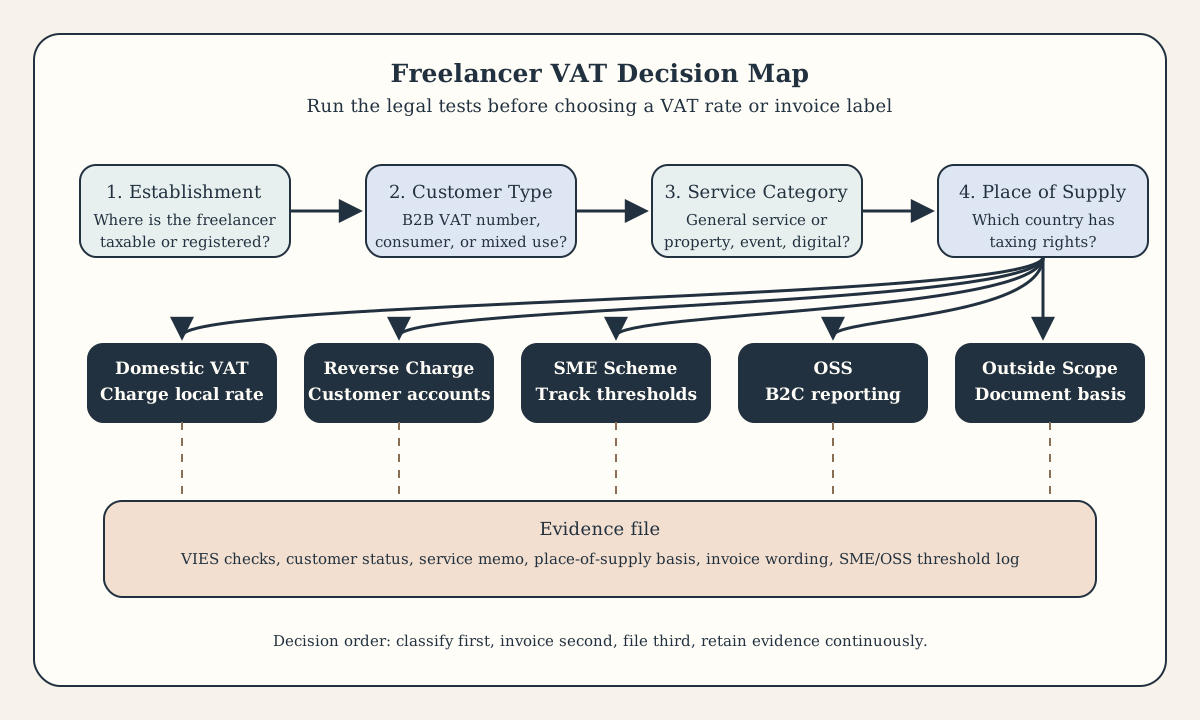
Use Do Freelancers Charge VAT in Europe? EU VAT Rules for Freelancers, Consultants, and Digital Service Providers to understand the moving parts before you pay, apply, sign, book, or rely on a third-party summary. It explains checking tax position, payroll evidence, social-security exposure, net pay, and cross-border filing questions across Europe, then shows how to separate residence, treaty, payroll, contribution, withholding, and filing questions before signing or moving money. The later sections connect official sources to check first, how to use the matrix, and checklist before you act so the next step is easier to judge. Read it before submitting forms, moving money, choosing a provider, or assuming that a rule from another country applies.
Direct answer
The practical answer is: classify the customer and service before choosing the invoice treatment. For many B2B services, the customer's country and VAT status drive a reverse-charge result. For many B2C services, especially digital services, the customer's location can require consumer-country VAT treatment or OSS reporting. Domestic invoices, exempt activities, small-business schemes, and country invoicing rules still matter.
Do not decide from a template invoice. Decide from evidence: contract, customer status, VIES check where relevant, service description, delivery location, customer billing country, and your own VAT registration or SME-scheme position.
Official sources to check first
- EU VAT Directive 2006/112/EC
- European Commission: place of taxation
- European Commission: VAT invoicing
- VIES VAT number validation
- European Commission: VAT One Stop Shop
- European Commission: SME VAT rules
Use these sources as orientation, then confirm the current national procedure or provider rule before acting. This guide is general information, not legal, tax, financial, immigration, telecoms, energy, banking, or consumer-dispute advice.
Decision matrix
| Scenario | Documents or evidence | Who to contact | Risk | Fallback |
|---|---|---|---|---|
| Domestic client in your country | Contract, invoice details, national VAT registration or exemption record | Your national tax authority or accountant | Charging the wrong rate or omitting mandatory invoice text | Use national guidance and correct the invoice before payment if possible |
| EU B2B client in another Member State | Customer VAT number, VIES validation, contract showing business use | Client finance team and your tax adviser | Treating an invalid VAT number as enough proof | Hold the invoice, request corrected business details, or use domestic treatment if advised |
| EU consumer buying digital services | Customer location evidence, checkout records, service category | OSS portal or national tax authority | Missing consumer-country VAT or OSS reporting | Pause sales to that country until registration/reporting is clear |
| Freelancer using a small-business scheme | Scheme confirmation, turnover records, invoice wording | National tax authority | Assuming the scheme covers every cross-border service | Get written professional advice before cross-border B2C or platform sales |
How to use the matrix
Pick the row that matches the immediate blockage, not the row that sounds most serious. If two rows fit, handle the one with the shortest real-world consequence first: loss of service, missed filing, blocked bank account, disputed bill, or inability to prove address. Write down the scenario, the evidence you already have, the missing document, and the person or institution that can actually change the result.
The matrix is also a communication tool. When you contact a provider, authority, landlord, bank, accountant, or adviser, do not send a long narrative first. Send a short summary, attach the evidence, ask for the specific decision, and request the reason in writing if they refuse. That makes later escalation clearer and reduces the chance that a support agent treats the case as a generic enquiry.
Checklist before you act
- Identify whether the customer is a business, private consumer, public body, or mixed-use customer.
- Describe the service accurately; consulting, design, training, digital downloads, and property-related services can be treated differently.
- Validate EU VAT numbers through VIES when relying on B2B evidence, and keep the validation result.
- Check whether your national SME or exemption scheme changes the invoice wording but not the place-of-supply analysis.
- Keep proof for refunds, credit notes, cancellations, and corrected invoices.
Common mistakes to avoid
- Using the document wanted by the next institution as proof that the original decision was correct.
- Letting phone calls replace written confirmation, complaint references, or official receipts.
- Mixing identity, address, tax, residence, contract, payment, and complaint evidence in one unlabelled folder.
- Waiting for a perfect document when a temporary written confirmation, receipt, or escalation note would reduce immediate risk.
- Assuming that a rule from one EU country, bank, supplier, or office automatically applies in another.
Next steps
- Create a one-page VAT decision note for each recurring client type.
- Ask your accountant to review the note before issuing high-value cross-border invoices.
- Use a standard file name for evidence: client, country, VAT number check, contract, invoice, and advice.
- Re-check rules when you add digital products, subscriptions, marketplaces, or consumers in new countries.
Deadline and escalation discipline
Use real deadlines from the contract, official checklist, appointment receipt, provider notice, or authority letter. Do not invent a legal deadline because a blog, forum, or support agent mentioned one informally. If no deadline is stated, choose a practical response date for your own follow-up and say that it is your requested reply date, not an official rule.
When escalation is needed, keep it narrow. State what happened, what evidence proves it, what remedy you want, and what fallback you will use if the first institution cannot help. If the case affects health, housing, energy access, immigration status, tax compliance, banking, payroll, or family safety, ask for specialist advice or local support before relying only on a standard complaint form.
Evidence file to keep
- Signed contract or purchase order with customer identity and address.
- VIES screenshot or validation reference where used.
- Invoice copy, credit notes, payment records, and correspondence about VAT treatment.
- Records supporting customer location for digital services.
- Written advice for uncertain cases, especially B2C, platforms, exemptions, and non-EU clients.
Risk and fallback notes
This page deliberately avoids universal rate tables and country thresholds because they change and depend on national law. It also avoids saying that reverse charge is an exemption; it is a mechanism for accounting for VAT in the right place.
If the amount is material, if the client is in another country, or if a platform is involved, treat the issue as tax compliance and obtain advice before sending or correcting invoices.
Related guides
- Freelancer Germany VAT: Kleinunternehmer, invoices, reverse charge and OSS
- Income tax rules for freelancers in Europe
- Health insurance for freelancers in Europe
Official source and decision check
Use this section as the practical checkpoint for Do Freelancers Charge VAT in Europe? EU VAT Rules for Freelancers, Consultants, and Digital Service Providers. The reader decision is whether the available evidence is strong enough to act now, or whether the file should first be confirmed with the competent authority. Rules can change by country, status and date, so treat this guide as orientation for the file and recheck the current rule before relying on a company-registration filing, tax setup, business-bank onboarding or founder evidence deadline.
For expats, foreigners, students, workers, founders, families and other mobile readers, record the reader category, country, residence status and deadline before comparing the official source with the article checklist.
Official sources to verify first
- Your Europe starting a business
- Your Europe company registration
- European Commission single market and industry
- European e-Justice business registers
- EUR-Lex EU law access
| Decision point | What to check | Reader action |
|---|---|---|
| Administrative decision | Confirm that the case is really about administrative decision, not a different category that follows another rule. | Write down the country, authority, dates, status and document number before asking for a decision. |
| File for competent authority | Keep the identity, residence and document evidence in one dated file, with originals, translations where required and proof of submission. | Save receipts, emails, appointment confirmations, payment records and authority replies in the same order as the checklist. |
| Do Freelancers Charge VAT in Europe? EU VAT Rules for Freelancers, Consultants, and Digital Service Providers fallback | If the answer is refused, delayed or unclear, identify the competent authority, review window, complaint route or regulated provider escalation path. | Ask for the reason in writing and compare it with the official source before paying again, travelling, closing an account or resubmitting. |
| When the answer is unclear | What to do next |
|---|---|
| The authority, bank, insurer, employer or provider gives a verbal answer only. | Ask for the answer in writing, save the name of the office or provider, and compare it with the official source before changing travel, payroll, residence or payment plans. |
| The file depends on a deadline, appointment, payment, address or status change. | Keep the dated receipt, note the next deadline, and avoid closing the old route until the replacement document, account, policy or registration is confirmed. |
Related guides to cross-check
- First month in Europe checklist
- Living in one European country and working in another
- EU remote working guide
- Cross-border worker benefits in the EU
- Private health insurance documents in Europe
For legal, tax, medical, immigration or financial consequences, confirm the position with the competent authority or a qualified adviser. This page is designed to organize the decision, source checks and next steps; it is not a substitute for case-specific professional advice.