Last updated
Live in One European Country and Work in Another: Cross-Border Work Guide
Live in One European Country and Work in Another: Cross-Border Work Guide is for new arrivals, expats, remote workers, and cross-border households who need to turn a broad search result into a concrete decision. It explains checking tax position, payroll evidence, social-security exposure, net pay, and cross-border filing questions across Europe, then shows how to separate residence, treaty, payroll, contribution, withholding, and filing questions before signing or moving money. The later sections connect start by classifying the arrangement, separate the five legal systems, and residence rights so the next step is easier to judge. Read it before submitting forms, moving money, choosing a provider, or assuming that a rule from another country applies.
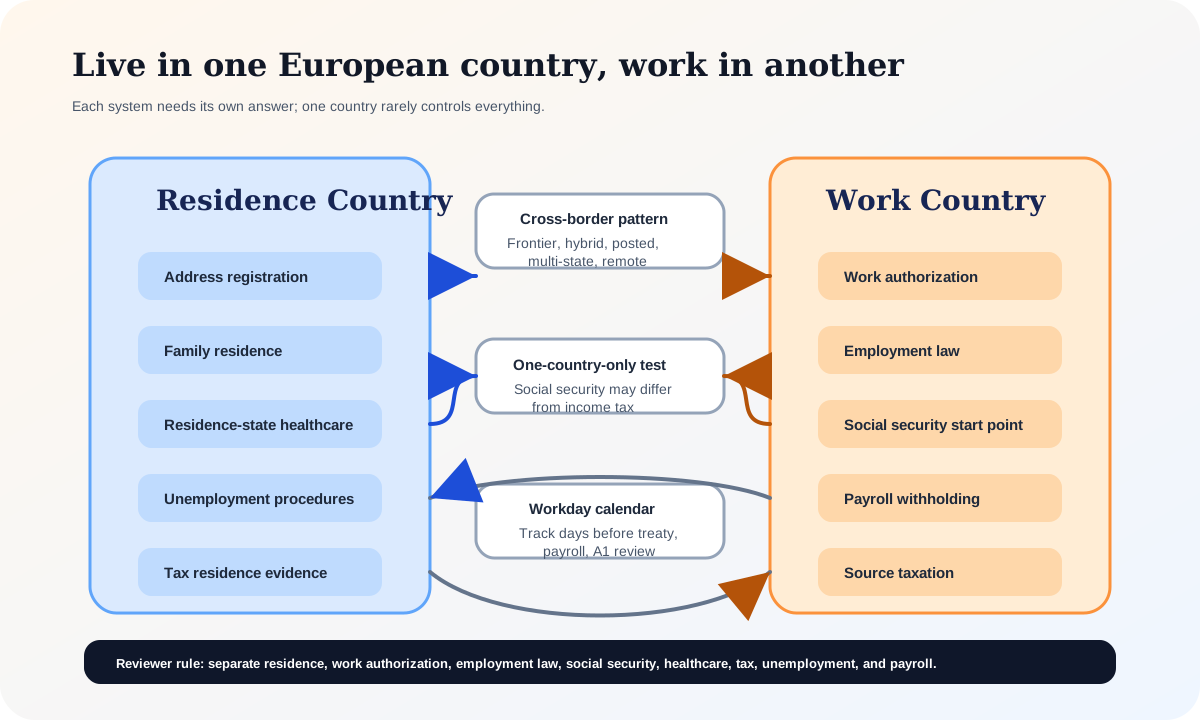
You can live in one European country and work in another, but the arrangement is not governed by one simple rule. Residence, work rights, employment law, social security, healthcare, unemployment, tax, payroll, and local registration can point to different authorities.
This is the core mistake: people ask "Which country am I under?" In cross-border work, the better question is: which country is responsible for each system?
A person may be a daily frontier worker, a weekly commuter, a hybrid employee working partly from home, a posted worker, a multi-state worker, a self-employed contractor, or a non-EU national whose residence permit in one country does not automatically authorize work in another. The correct answer depends on the actual work pattern, nationality, employer location, residence country, work country, and treaty pair.
This guide is educational information, not legal, tax, immigration, employment, or social-security advice.
Direct answer
If you live in one European country and work in another, expect different systems to point to different countries. Residence usually follows where you live, work authorization follows where you work, social security is assigned to one competent country under coordination rules, and tax can follow domestic law plus the treaty pair.
The answer changes when you are a daily or weekly frontier worker, a hybrid worker spending days at home, a posted worker, a multi-state worker, a self-employed contractor, or a non-EU national whose permit in one country does not authorize work in another. Your Europe explains the classic commuter pattern, but many real cases are more complex.
Next step: classify your arrangement before you sign or move. Write down where you live, where you physically work, how often you cross the border, who the employer is, and what nationality or permit status controls your work rights.
| System | Usually connected to | Why it matters |
|---|---|---|
| Residence | Country where you live | Registration, address, family residence, local obligations |
| Work authorization | Country where you work | Especially important for non-EU nationals |
| Employment law | Country where work is performed | Working conditions, dismissal, workplace protections |
| Social security | One competent country under coordination rules | Healthcare, pensions, unemployment, family benefits |
| Tax | Domestic law plus double-tax treaty | May differ from social-security result |
| Healthcare access | Competent state plus residence-state procedures | Forms and registration may be needed |
| Unemployment | Often residence-country procedures for frontier workers | Must be checked before job loss, not after |
| Payroll | Employer obligations in relevant country or countries | Withholding, registration, contributions, reporting |
Start by Classifying the Arrangement
| Pattern | Description | Main risk |
|---|---|---|
| Frontier or cross-border commuter | You work in one country and return to your residence country daily or at least weekly | Assuming the work country controls everything |
| Hybrid cross-border employee | You work in the employer country and also from home in your residence country | Social-security and payroll position may change |
| Multi-state worker | You regularly work in two or more countries | Competent social-security state must be determined |
| Posted worker | Employer sends you temporarily to another country | Posting rules and certificates may apply |
| Cross-border self-employed person | You live in one country and serve clients or perform work in another | Tax, VAT, establishment, and social-security analysis may be needed |
| Non-EU resident with foreign job | You hold residence in one country but work in another | Residence permission may not equal work permission |
| Remote worker for foreign employer | You live in one country while employed abroad | Employer registration, payroll, tax, and labor-law exposure can arise |
Your Europe's general working-abroad pages are a useful starting point for EU citizens: European Commission working in another EU country.
Separate the Five Legal Systems
| Question | Do not confuse it with | Example |
|---|---|---|
| Where may I live? | Where income is taxed | You may reside in Country A but pay tax on salary in Country B |
| Where may I work? | Where you are registered as resident | A non-EU residence permit in one country may not authorize employment in another |
| Where do I pay social security? | Where I pay income tax | EU coordination and tax treaties use different logic |
| Which labor law protects me? | Which country pays healthcare | Workplace law often follows the place of work |
| Which healthcare system covers me? | Where my doctor is located | Competent state and treatment location can be different |
The European Commission explains that EU social-security coordination helps determine which country's social-security legislation applies when people move or work across borders: EU social security coordination.
Residence Rights
For EU citizens, free movement makes cross-border living easier, but not paperwork-free. Your Europe explains that EU citizens may live in another EU country as workers, students, pensioners, jobseekers, or economically inactive people, and that stays beyond three months may require registration depending on the country: Your Europe residence rights. Residence document formalities are summarized here: Your Europe residence documents and formalities.
For non-EU nationals, the position is more restrictive. A residence permit issued by one European country usually does not automatically authorize employment in another country. The worker may need a work permit, labor-market authorization, employer sponsorship, frontier-worker status, or a specific bilateral route.
| Person | Residence question | Work question |
|---|---|---|
| EU citizen living in Country A and working in Country B | Must comply with Country A residence registration rules | Generally no work permit needed in another EU country |
| Non-EU citizen with Country A residence permit | Can they reside long-term in Country A? | Does Country B authorize work? |
| Family member of EU citizen | Residence rights may derive from EU family rules | Work access must be checked by host-country status |
| Digital nomad in Country A | Visa may allow residence and remote work for foreign employer | It may not allow local employment in Country B |
| Student in Country A | Student residence may limit work hours or work type | Cross-border employment may require separate authorization |
Social Security: One Competent Country, Complex Facts
EU coordination rules generally aim to avoid double social-security coverage and gaps. A person should normally be subject to one country's social-security legislation at a time. For a classic cross-border commuter who works in one country and lives in another, the work country is often the starting point for social-security contributions. Your Europe states that cross-border commuters are covered under one national social-security system only, in the country where they work: Your Europe social security cover when living or working abroad.
But the rule can change when work is performed in more than one country.
| Work pattern | Social-security issue |
|---|---|
| 100 percent work in employer country | Work-country coverage is usually the starting analysis |
| One or two home-office days in residence country | Multi-state work analysis may be triggered |
| Regular work travel across several countries | Competent state must be formally assessed |
| Temporary assignment | Posting rules and A1 certificate may apply |
| Self-employment in one country plus employment in another | Special coordination analysis needed |
| Multiple employers in different countries | Employer location and work pattern both matter |
The A1 certificate is commonly used to prove which country's social-security legislation applies in cross-border or posted-worker situations. Employers and workers should not treat it as an afterthought. Without clear social-security determination, payroll can be wrong, healthcare access can be delayed, and pension or unemployment records can become fragmented.
Healthcare Access
Healthcare can involve both the country where you are insured and the country where you live. A cross-border worker may pay contributions in the work country but need medical treatment in the residence country. Special forms and national procedures may be required.
| Healthcare issue | Why it matters |
|---|---|
| Competent state | Determines which institution is responsible for coverage |
| Residence-state treatment | Determines how you access local doctors and hospitals |
| Emergency treatment during temporary stays | EHIC may help, but only within its limits |
| Planned treatment abroad | Prior authorization and reimbursement rules may apply |
| Private insurance | May be needed for gaps, visa proof, dependents, or top-up coverage |
Your Europe explains temporary healthcare rights and EHIC limits here: Your Europe health cover for temporary stays. Planned treatment abroad is a separate topic: Your Europe planned medical treatment abroad.
Tax: Separate From Social Security
Tax does not automatically follow social security. Your Europe warns that if you live in one EU country and work in another, income tax rules depend on national laws and double-taxation agreements between the two countries, and those rules can differ from social-security rules: Your Europe double taxation.
| Tax concept | Practical meaning |
|---|---|
| Tax residence | Country that may tax worldwide income under domestic rules |
| Source taxation | Country where employment income may be taxed because work is performed there |
| Double-tax treaty | Agreement that allocates taxing rights and relief methods |
| Payroll withholding | Employer may need to withhold in one or more countries |
| Permanent establishment | Remote or business activity can create employer or business exposure |
| Days worked | Workdays by location often matter |
| Special frontier-worker rules | Some border regions have treaty-specific arrangements |
The European Commission's tax overview for mobile and cross-border citizens is here: EU taxpayers and cross-border tax issues.
Employment Law and Employer Duties
Employment law often follows the place where the work is physically performed, but contracts, posting rules, mandatory protections, collective agreements, payroll rules, and employer registration can complicate the analysis.
| Employer issue | Why it matters |
|---|---|
| Local payroll registration | Required if salary is taxable or contributions are due locally |
| Workplace protections | Minimum wage, working time, leave, health and safety |
| Remote-work policy | Home office in another country can create compliance duties |
| Posted-worker rules | Temporary assignments may trigger notifications and host-country terms |
| Benefits | Pension, health, meal vouchers, transport, and family benefits vary |
| Data and equipment | Cross-border remote work raises security and employment-control issues |
Your Europe provides employer-focused guidance on cross-border and posted workers here: Your Europe cross-border and posted workers.
Practical Examples
| Scenario | Likely analysis |
|---|---|
| Live in France, work daily in Luxembourg | Classic frontier-worker analysis: residence in France, work in Luxembourg, tax treaty and social-security coordination must be checked |
| Live in Belgium, work three days in Netherlands and two days from home | Hybrid multi-state work analysis: home-office days may affect social security and payroll |
| Live in Germany, employed by Swiss company, commute weekly | EU-Switzerland coordination, tax treaty, healthcare, and residence formalities all need review |
| Live in Spain on a digital nomad visa, work remotely for U.S. employer | Visa, Spanish tax residence, social security, and employer obligations must be separated |
| Non-EU citizen resident in Portugal, offered job in France | Portuguese residence does not automatically grant French work authorization |
| Posted from Italy to Austria for six months | Posting, A1 certificate, host-country working conditions, and payroll must be reviewed |
Document Checklist
| Document | Who may ask for it |
|---|---|
| Passport or national ID | Residence authority, employer, bank, insurer |
| Residence registration certificate or permit | Employer, tax office, health insurer |
| Employment contract | Residence authority, bank, social-security institution |
| Employer confirmation of work location | Tax adviser, payroll, social-security institution |
| A1 certificate or social-security determination | Employer, labor inspectorate, social-security authority |
| Health insurance proof | Residence authority, healthcare provider, employer |
| Tax identification numbers | Payroll, tax office, bank |
| Workday calendar by country | Tax adviser, employer, social-security review |
| Lease or address certificate | Residence registration, bank, school |
| Family documents | Residence, healthcare, school, family benefits |
Workflow Before You Accept the Arrangement
| Step | Action |
|---|---|
| 1 | Identify nationality and immigration status for residence country and work country |
| 2 | Classify the work pattern: frontier, hybrid, posted, multi-state, self-employed, or remote |
| 3 | Confirm whether the work country authorizes the work |
| 4 | Determine the competent social-security country and whether A1 or another certificate is needed |
| 5 | Check healthcare access in both work and residence countries |
| 6 | Analyze tax residence, source taxation, treaty relief, and payroll withholding |
| 7 | Confirm employer registration, labor-law, and benefits obligations |
| 8 | Build a workday tracking system by country |
| 9 | Keep all official decisions, certificates, and filings in one file |
| 10 | Re-check after any schedule, employer, address, or family-status change |
Common Mistakes
| Mistake | Consequence |
|---|---|
| Assuming residence country controls tax, social security, and work rights | Wrong filings, wrong contributions, or illegal work |
| Treating remote work as invisible | Home-office days can change tax and social-security analysis |
| Ignoring non-EU work authorization | Residence in one country may not permit employment in another |
| Relying on EHIC for ordinary healthcare | EHIC is for temporary stays, not a full cross-border residence plan |
| Not tracking workdays | Tax treaty claims and payroll corrections become difficult |
| Forgetting unemployment rules | Frontier-worker unemployment claims may involve residence-country procedures |
| Skipping employer review | Employer may create registration or compliance exposure |
| Confusing posted worker with frontier worker | Different documentation and legal logic may apply |
Where to Get Help
| Issue | Best starting point |
|---|---|
| EU residence rights | Your Europe residence rights |
| Cross-border commuter status | Your Europe cross-border commuters |
| Social-security coordination | European Commission social security coordination |
| Double taxation | Your Europe double taxation |
| Cross-border tax overview | European Commission cross-border tax issues |
| Problems with public authorities and EU rights | SOLVIT |
Cross-border arrangement types
The first control is to name the arrangement correctly. A frontier worker normally lives in one country and works regularly in another, often returning home daily or weekly. A posted worker is temporarily sent by an employer to work in another country while remaining connected to the sending employer. A remote worker lives in one country and performs work from there for an employer or clients elsewhere. A multi-state worker performs substantial work in more than one country on a recurring basis. A self-employed person may have a different social-security and tax analysis from an employee even when the travel pattern looks similar.
These labels matter because they point to different documents. A frontier worker may need tax treaty analysis, payroll allocation, healthcare coordination, and residence-country filing. A posted worker may need an A1 certificate, posting declaration, host-country labor protections, and assignment letter. A remote employee may need employer approval, payroll review, social-security analysis, and immigration clearance. A contractor may need business registration, VAT review, and social-security registration in the competent country.
Do not let the employer, worker, and tax adviser use different labels. If HR calls the person remote, payroll calls the person a commuter, and the tax return treats the person as posted, the file will be weak. The arrangement type should be stated in a short memo before work begins.
Work authorization and residence sequencing
EU citizens can usually live and work across EU borders more easily than non-EU citizens, but sequencing still matters. Residence registration, local address evidence, healthcare enrollment, tax numbers, and employer onboarding may be needed before the arrangement runs smoothly. Free movement does not remove tax, social-security, or payroll duties.
Non-EU citizens need a stricter review. A residence permit in Portugal does not automatically authorize employment in France. A digital nomad visa in Spain does not necessarily permit local employment for a German employer's French branch. A student residence card, family permit, refugee status, long-term resident status, Blue Card, ICT permit, or national work permit may each carry different rights and restrictions. The first legal question is not "Can I live there?" but "Can I perform this work for this employer from this location?"
If the worker is moving with family, add dependants, school registration, healthcare access, and housing to the sequence. These facts can strengthen residence ties and affect tax-residence analysis. A person who signs a long lease, enrolls children in school, and spends most nights in the residence country is building a different profile from someone commuting temporarily.
Payroll and tax operating model
The employer should decide how salary will be reported before the first cross-border workday. The model may involve home-country payroll only, work-country payroll, split payroll, shadow payroll, withholding adjustments, or local employer registration. The right model depends on workdays, treaty rules, employment relationship, economic employer concepts, and whether a local entity benefits from the work.
Employees need a day ledger that can support salary allocation. It should record the country where work was performed, not only the country of residence or the employer's office. Business trips, training, client visits, remote-work days, and office days should be classified separately. The same ledger should support payroll, tax return, and social-security analysis.
Tax treaties can reduce double taxation, but they do not remove the need for filing evidence. A worker may need to file in the residence country, the work country, or both. The employer may need to provide annual salary statements showing workdays and withholding. For more detailed tax treatment, use remote work Europe tax and income tax for non-residents in Europe.
Social security and healthcare controls
Social security should be documented separately from tax. In EU coordination, the competent country can depend on where the person works, where the employer is located, whether the person works substantially in the residence country, and whether the work is temporary or regular. The A1 certificate or equivalent decision is the key evidence that the worker remains covered by a specific system.
Healthcare follows from the social-security result but may require practical enrollment steps. Frontier workers and dependants may need forms, local registration, or proof of coverage to access care in both countries. Private insurance may be useful during transitions, but it should not be assumed to replace statutory healthcare rights or obligations.
If the worker changes schedule, adds home-office days, changes employer, or starts freelancing on the side, the social-security analysis should be reopened. Small changes can move the person from one category to another.
Employer policy for cross-border work
Employers should create a preapproval process rather than discovering cross-border work after it starts. The request form should ask for residence country, work country, nationality, permit status, job duties, customer-facing work, authority to sign contracts, expected schedule, home-office days, travel days, and whether dependants are moving. It should require payroll, legal, tax, and social-security review for recurring arrangements.
The approval should set limits. It should say which country is approved, how many days are permitted, whether the worker may serve local clients, whether contract negotiation is allowed, what evidence must be kept, and when reapproval is required. Automatic reapproval should not apply after role changes, address changes, permit expiration, or increased workdays in the residence country.
The policy should also protect employee privacy. Location tracking should be proportionate, transparent, and limited to what is needed for payroll, tax, social-security, and compliance. Employees should know which records are collected, who uses them, and how long they are retained.
Annual reconciliation
At year end, reconcile the employee's day ledger with payroll, travel expenses, manager approvals, social-security certificates, residence records, and tax filings. If the worker exceeded a treaty or social-security threshold, make corrections before filings are due. If the worker stayed within the planned pattern, archive the evidence anyway.
Luxembourg frontier-worker cases show why reconciliation matters: day thresholds, payroll withholding, residence-country tax, and social-security coordination must be tracked together but not confused. For Luxembourg-specific rules, see cross-border workers Luxembourg tax.
Change events that require a fresh review
The original analysis should not be treated as permanent. Reopen the file when the worker changes employer, moves address, changes nationality or permit status, adds a second job, starts freelancing, changes the number of home-office days, receives promotion to a managerial role, begins serving local clients, or spends more time in the residence country than planned. These events can change tax, social-security, payroll, immigration, and employment-law results.
Family changes can also matter. Marriage, separation, dependants moving countries, school enrollment, or a spouse starting work can strengthen residence ties and affect practical healthcare or benefits access. Housing changes matter too: a short rental, registered lease, owned home, or employer-provided accommodation may carry different administrative consequences.
Employers should require an annual attestation from cross-border workers confirming residence country, work pattern, permit status, side activities, and expected schedule for the next year. The attestation should not replace legal review, but it helps detect hidden changes before payroll and tax filings are wrong.
Personal cash-flow planning
Cross-border workers should budget for timing mismatches. Tax may be withheld in the work country while a return is also due in the residence country. Refunds, credits, or exemptions can arrive months later. Social-security contributions, healthcare premiums, commuter costs, currency exchange, and adviser fees can create cash-flow pressure even when the final tax result is fair.
Keep a reserve for the first filing year. The first year is usually the hardest because tax numbers, certificates, payroll settings, healthcare registration, and residence records are still being established. Once the pattern is stable and the first annual reconciliation is complete, budgeting becomes easier.
Bottom Line
Living in one European country and working in another can be legal and efficient, but only if you separate the systems. Residence, work authorization, employment law, social security, healthcare, tax, unemployment, and payroll each need their own answer.
The safest setup is documented before the work pattern starts: competent social-security country confirmed, tax treaty reviewed, employer obligations mapped, healthcare access understood, residence formalities completed, and workdays tracked by country.