Last updated
Income Tax for Non-Residents in Europe: Source Rules, Treaty Relief, Withholding, and Filing Triggers
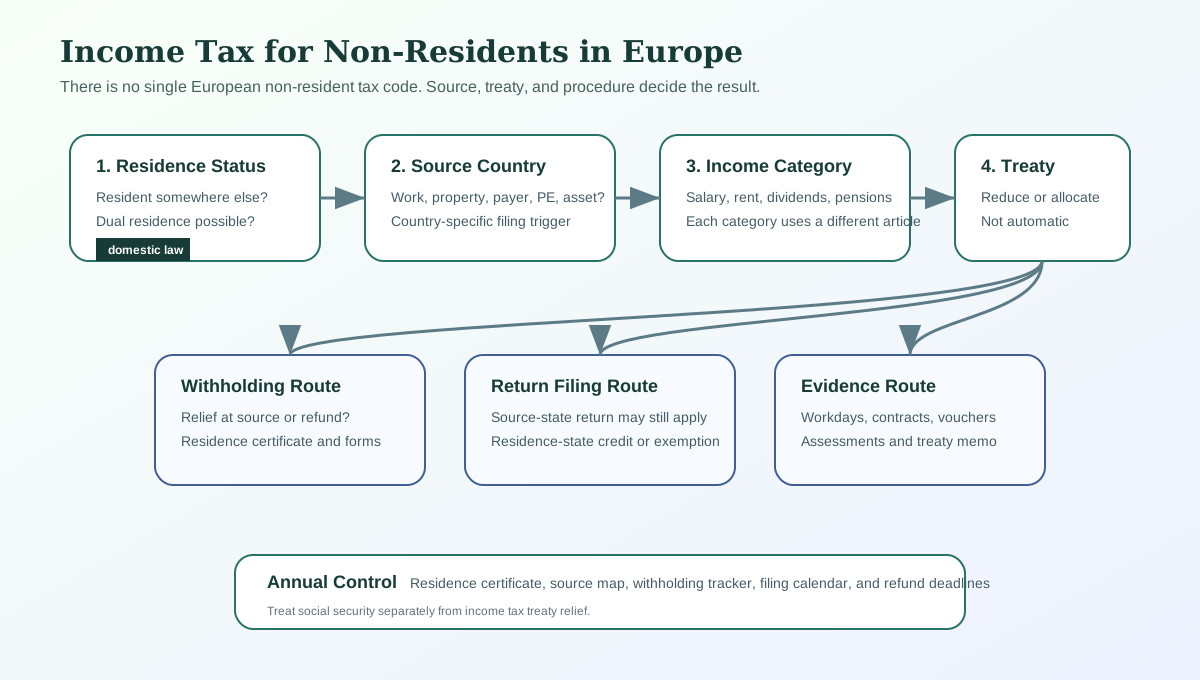
Use Income Tax for Non-Residents in Europe: Source Rules, Treaty Relief, Withholding, and Filing Triggers to understand the moving parts before you pay, apply, sign, book, or rely on a third-party summary. It explains checking tax position, payroll evidence, social-security exposure, net pay, and cross-border filing questions across Europe, then shows how to separate residence, treaty, payroll, contribution, withholding, and filing questions before signing or moving money. The later sections connect quick answer, non-resident does not mean non-taxable, and step 1: determine your tax residence so the next step is easier to judge. Read it before submitting forms, moving money, choosing a provider, or assuming that a rule from another country applies.
For non-residents, the key question is usually not "Do I pay tax in Europe?" It is "Which country has source taxing rights over this exact income, and does a treaty reduce or remove that tax?"
Source check date: May 14, 2026. This guide is general tax information, not legal, tax, immigration, payroll, or investment advice.
Quick Answer
A non-resident can owe income tax in a European country if that country treats the income as sourced there. Common triggers include work physically performed in the country, rental income from local real estate, local business profits through a permanent establishment, dividends or royalties paid from the country, pensions under national rules, or capital gains linked to local real estate.
| Income type | Non-resident tax risk |
|---|---|
| Employment income | Tax where work is physically performed, subject to treaty exceptions |
| Rental income | Usually taxable where the property is located |
| Dividends | Often subject to source-country withholding |
| Interest | Depends on domestic law and treaty |
| Royalties | Often withholding unless treaty relief applies |
| Business profits | Usually taxable only if there is a permanent establishment |
| Pensions | Highly treaty-specific |
| Capital gains | Local real estate gains often taxable in the property country |
Your Europe explains that if you live in one EU country and work in another, taxation depends on national laws and double tax agreements, and the rules can differ from social security rules. See Your Europe: Double taxation.
Non-Resident Does Not Mean Non-Taxable
Non-residence usually means a country taxes only domestic-source income rather than worldwide income. But domestic-source income can be broad.
| Term | Meaning |
|---|---|
| Residence country | Country that treats you as tax resident and may tax worldwide income |
| Source country | Country where income arises and may tax non-residents |
| Limited tax liability | Common concept where non-residents are taxed only on local-source income |
| Withholding tax | Tax deducted at payment before the non-resident receives net income |
| Treaty relief | Reduction or exemption under a bilateral double taxation agreement |
| Residence certificate | Official proof used to claim treaty benefits |
The European Commission explains that double taxation conventions are bilateral agreements aimed at avoiding double taxation of income or capital, while EU member states retain power to conclude treaties subject to EU law. See European Commission: Double taxation conventions.
Step 1: Determine Your Tax Residence
A person may be non-resident in one country but resident in another. Residence usually depends on national law.
Common residence factors include:
| Factor | Why it matters |
|---|---|
| Number of days present | Many countries use day-count rules or six-month indicators |
| Permanent home | Available accommodation can support residence |
| Center of vital interests | Family, economic, and personal ties matter |
| Habitual abode | Pattern of living can override formal labels |
| Nationality | Usually secondary, but relevant in some treaty tie-breakers |
| Immigration status | Useful context, but not the same as tax residence |
Your Europe notes that EU countries define tax residence nationally and that a person living and working abroad for more than six months will probably be tax resident there. See Your Europe: Income taxes abroad.
Step 2: Classify The Income
Non-resident taxation depends heavily on income category.
| Income category | Typical source-country analysis |
|---|---|
| Salary | Where the employee physically performs work |
| Director fees | Where the company is resident or managed, depending on treaty |
| Freelance services | Where services are performed and whether fixed base or permanent establishment exists |
| Business profits | Whether a permanent establishment exists |
| Rental income | Where the real estate is located |
| Dividends | Residence of paying company |
| Interest | Residence of payer or domestic withholding rule |
| Royalties | Residence of payer, use location, and treaty article |
| Pensions | Treaty-specific; public and private pensions may differ |
| Capital gains | Asset location, real estate status, residence, and treaty article |
The OECD Model Tax Convention is often used as the structure for treaty articles, including residence, permanent establishment, dividends, interest, royalties, employment income, pensions, and methods for eliminating double taxation. See OECD Model Tax Convention condensed version.
Step 3: Check The Treaty, Not Just Domestic Law
Domestic law may tax non-residents broadly. A treaty may reduce that tax.
| Treaty article type | Practical question |
|---|---|
| Residence | Which country is treaty residence if both claim residence? |
| Immovable property | Can the property country tax rents or gains? |
| Business profits | Is there a permanent establishment? |
| Dividends | What withholding rate is allowed? |
| Interest | Is source withholding limited or eliminated? |
| Royalties | Is withholding allowed and at what rate? |
| Employment | Where was work performed, and does the 183-day exception apply? |
| Directors' fees | Can the company-residence country tax? |
| Pensions | Which country taxes private, public, or social security pensions? |
| Elimination of double taxation | Does the residence country use exemption or credit? |
A treaty does not usually file itself. The taxpayer often needs a residence certificate, withholding relief form, refund claim, or tax return.
Employment Income For Non-Residents
Employment income is one of the most misunderstood areas. The usual treaty starting point is that employment income may be taxed where the work is physically performed. A short assignment may be exempt from source-country tax only if all treaty conditions are met.
Typical treaty employment conditions include:
| Condition | Practical meaning |
|---|---|
| Days test | Presence in the work country stays below the treaty threshold |
| Employer test | Salary is paid by, or on behalf of, an employer not resident in the work country |
| Permanent establishment test | Salary is not borne by a permanent establishment or fixed base in the work country |
| Treaty-specific wording | Exact language differs by treaty |
Common mistakes include counting only business days, ignoring travel days, assuming payroll location controls source, or treating remote work as if it happened in the employer's country rather than the worker's physical location.
Cross-Border Workers
Cross-border workers can be taxed under special rules in some country pairs, especially border regions. Do not assume all EU cross-border workers have the same treatment.
| Cross-border issue | Why it matters |
|---|---|
| Frontier-worker treaty clause | Some treaties have special rules; many do not |
| Work-from-home days | Can shift taxing rights |
| Employer payroll withholding | May need correction if workdays change |
| Local municipality or cantonal tax | Some systems add local layers |
| Social security | Governed separately from income tax |
| Residence-country declaration | Worldwide reporting may still be required |
The European Commission notes that cross-border tax problems include double taxation and double compliance costs, and that not all problems have binding EU-level remedies. See European Commission: EU taxpayers and cross-border tax issues.
Real Estate Income
Rental income from European real estate is commonly taxable in the country where the property is located, even when the owner is non-resident.
| Real estate item | Non-resident filing issue |
|---|---|
| Gross rent | Usually reportable in property country |
| Deductible expenses | Country-specific rules for interest, repairs, depreciation, fees |
| Local property taxes | Separate from income tax |
| Short-term rental | May trigger VAT, tourism tax, or registration |
| Sale of property | Capital gains tax may apply in property country |
| Inheritance or wealth tax | Separate national rules may apply |
Non-residents should check whether a local tax number, fiscal representative, electronic filing account, or withholding mechanism is required before rental income starts.
Investment Income
Investment income can create withholding tax in the source country and reporting in the residence country.
| Income | Source-country issue | Residence-country issue |
|---|---|---|
| Dividends | Withholding tax, treaty rate, refund procedure | Report worldwide income and claim credit if allowed |
| Interest | Domestic withholding or exemption | Report and claim treaty or credit treatment |
| Royalties | Withholding and treaty forms | Report and credit or exemption |
| Fund distributions | Complex classification | Residence-country fund tax regime |
| Capital gains | Usually residence-taxed, but real estate exceptions are common | Report and apply treaty |
Withholding tax refunds can be slow. Keep original tax vouchers, broker statements, residence certificates, and treaty forms.
Business Profits And Permanent Establishment
A non-resident business is often taxed in a European country only if it has a permanent establishment there, but domestic rules and treaty wording must be checked.
Potential permanent establishment indicators include:
| Indicator | Why it matters |
|---|---|
| Fixed office or workspace | May be a fixed place of business |
| Dependent agent | Person habitually concluding contracts can create PE risk |
| Construction site | Many treaties have time thresholds |
| Local inventory or warehouse | Can create taxable presence depending on facts |
| Repeated service presence | Some treaties include service PE clauses |
| Home office | Risk depends on employer/business control and factual use |
A freelancer or remote founder should not assume that being paid from another country eliminates source-country tax exposure.
Pensions And Social Security Payments
Pension taxation is treaty-specific. Some treaties tax private pensions only in the residence country. Others allow source-country taxation, especially for public service pensions or social security payments.
| Pension type | Treaty caution |
|---|---|
| Private occupational pension | Often residence-country focused, but verify |
| Government pension | Public-service articles may apply |
| Social security | May have a special article |
| Lump sum | May be treated differently from periodic payments |
| Annuity | Treaty definitions matter |
| Tax-free local pension wrapper | May not be tax-free in another country |
Non-residents receiving European pensions should check both the paying country and residence country before assuming withholding is final.
Equal Treatment And EU/EEA Residents
EU law can affect non-resident taxation when a non-resident earns almost all income in the source country. Your Europe states that if you live in one EU country but earn all or almost all income in another and pay tax there, the income country should treat you as it would treat a resident for reliefs and allowances. See Your Europe: Double taxation and equal treatment.
| Situation | Potential consequence |
|---|---|
| Most income earned in one source country | Resident-like allowances may be available |
| Low income in residence country | Source country may need to consider personal circumstances |
| EU/EEA residence | Some countries offer optional resident-like assessment |
| Non-EU residence | Relief may be narrower and treaty-dependent |
This area is technical and country-specific. It should be checked with the national tax authority.
Filing And Withholding Workflow
Use this sequence before the first payment:
- Identify your residence country.
- Identify the source country for each income type.
- Classify income under domestic law.
- Check whether a treaty applies.
- Obtain a tax residence certificate if treaty relief is needed.
- Confirm whether withholding applies at source.
- File relief-at-source forms before payment where possible.
- If overwithheld, file a refund claim with evidence.
- Report the income in the residence country.
- Claim exemption or foreign tax credit under residence-country rules.
Evidence Checklist
| Evidence | Use |
|---|---|
| Passport and immigration records | Supports day counts and location |
| Residence certificate | Supports treaty claims |
| Employment contract | Shows employer, duties, work location, and pay |
| Workday calendar | Supports salary allocation |
| Payslips and withholding statements | Proves tax withheld |
| Rental contracts | Supports property income |
| Broker tax vouchers | Supports withholding refund or credit |
| Pension statements | Supports classification |
| Invoices and client contracts | Supports business-profit analysis |
| Permanent establishment review | Supports no-source-tax position |
| Foreign tax assessments | Supports residence-country credit |
Practical Country Cautions
| Country pattern | Non-resident caution |
|---|---|
| Germany | Limited tax liability can apply to German-source income; BZSt handles certain withholding relief and refund procedures |
| France | Non-resident withholding, rental income, and social charges require careful classification |
| Spain | Non-resident income tax rules differ from resident IRPF rules; EU/EEA residents may have specific options |
| Italy | Non-residents can owe tax on Italian-source income and real estate |
| Netherlands | Wage tax, investment classification, and treaty relief should be checked by box/category |
| Portugal | Non-resident rates and treaty relief differ by income type |
| Switzerland | Not EU; cantonal and treaty rules must be reviewed separately |
| United Kingdom | Not EU; statutory residence test and non-resident rules require separate analysis |
This table is a risk map, not a substitute for local filing rules.
Common Mistakes
| Mistake | Better approach |
|---|---|
| Assuming no local tax because you are non-resident | Check source-country rules |
| Applying one country's 183-day rule across Europe | Read the specific treaty and domestic law |
| Ignoring withholding tax | Relief may require forms before payment |
| Treating social security as income tax | Analyze separately |
| Not getting a residence certificate | Many treaty claims require it |
| Forgetting residence-country reporting | Treaty relief at source does not necessarily end reporting |
| Assuming rental withholding is final | A return may still be required |
| Treating remote work as employer-country work | Physical work location often matters |
| Missing refund deadlines | Withholding refunds can have strict time limits |
FAQ
Do non-residents pay income tax in Europe?
Yes, if they have income that a European country treats as locally sourced. Common examples include salary for work performed there, rent from local property, dividends from local companies, and local business profits through a permanent establishment.
Is there one EU non-resident income tax rate?
No. Income tax remains national. The EU affects discrimination and coordination issues but does not impose one non-resident income tax code.
Does a tax treaty mean no withholding tax?
Not automatically. A treaty may reduce withholding, but the payer may need forms before applying the treaty rate. Otherwise, the taxpayer may need a refund claim.
Does the 183-day rule protect all short-term workers?
No. It is treaty-specific and usually has employer and permanent-establishment conditions. Failing one condition can make the income taxable in the work country.
Can the residence country also tax the income?
Often yes. The residence country may tax worldwide income and then provide exemption or a foreign tax credit to reduce double taxation.
Are social security contributions covered by income tax treaties?
Usually no. Social security follows EU coordination rules or bilateral social security agreements, not ordinary income tax treaty articles.
Non-resident income category matrix
A non-resident analysis should begin by listing income by category and country. Employment income depends heavily on where work is physically performed, who the employer is, and whether a treaty short-stay article applies. Rental income usually follows the location of the property. Dividends, interest, and royalties can be subject to withholding in the payer country. Business profits often depend on whether the person or company has a permanent establishment. Pensions, director fees, and capital gains each need separate treaty review.
This category-first approach prevents overgeneralization. A person may be non-resident in France but owe tax on French rental income. A consultant may be non-resident in Germany but owe tax for days physically worked there. A shareholder may be non-resident in Spain but face withholding on Spanish dividends. Non-residence reduces scope; it does not eliminate source-country taxation.
Employment and short-stay work
Short work visits are not automatically tax-free. Many treaties have a 183-day style article for employment income, but the conditions normally include days, employer residence, and whether the salary is borne by a permanent establishment in the work country. Failing one condition can allow the work country to tax the salary even if the stay is short.
The worker should keep a calendar showing workdays, non-workdays, travel days, employer, client, and country. Employers should keep payroll allocation records and letters explaining who economically bore the salary. Remote work should be treated as work in the country where the person physically sits, not automatically as work in the employer's country.
If the worker is also dealing with broader remote-work planning, see remote work Europe tax and live in one European country and work in another.
Property owners and investors
Non-resident property owners often have ongoing filing duties even without full tax residence. Rental income, imputed income, local property taxes, capital gains, withholding on sale, and expense deduction rules vary by country. A property file should include purchase deed, cadastral or registry data, rental contracts, platform statements, expense invoices, mortgage records, insurance, local taxes, and sale documents.
Investors should separate withholding-tax recovery from residence-country reporting. A treaty may reduce withholding on dividends or interest, but the payer may withhold at the domestic rate unless relief forms are filed. Refund claims can require tax-residence certificates, payment vouchers, broker statements, and strict deadlines. The residence country may still require reporting and may give credit for withholding tax.
Permanent establishment and business profits
A non-resident freelancer or company owner may assume business income is taxable only at home. That assumption fails if the person has a fixed place of business, dependent agent, local office, recurring local service delivery, or authority to conclude contracts in the source country. Permanent establishment analysis is fact-specific and should be documented before invoices are issued.
For individuals, local business registration, VAT registration, professional licensing, or social-security registration may also be relevant. Tax treaties do not replace domestic registration rules. A consultant performing recurring work in a European country should not rely only on client location or payment location.
Residence certificate and refund workflow
Treaty relief usually requires a residence certificate from the country where the taxpayer is resident. Request it early. Some payers need the certificate before reducing withholding; others withhold first and require a refund claim. The certificate should cover the right tax year and taxpayer. If the taxpayer is an entity, beneficial ownership and limitation-on-benefits style questions may also arise depending on the treaty.
Build a refund file with the certificate, income statement, withholding voucher, treaty article, bank details, identification, and filing deadline. Refund claims can take months or years, so the taxpayer should budget for cash-flow delay.
Annual reconciliation for non-residents
At year end, reconcile every source country. For each country, list income type, gross amount, tax withheld, return filed, treaty relief claimed, refund requested, and residence-country reporting treatment. This prevents missed source income and duplicate credit claims.
If the person becomes resident partway through the year, split the file. The same country may tax the person as non-resident for part of the year and resident for another part, or apply domestic rules that classify the whole year differently. Move years deserve local advice.
Withholding agent controls
Many non-resident tax problems start with the payer. Employers, brokers, tenants, platforms, pension funds, and companies paying dividends may withhold tax at a domestic rate unless the taxpayer provides the right certificate or form. The taxpayer should identify the withholding agent before payment and ask what evidence is needed for treaty relief at source.
If relief at source is not available, preserve the refund path. The file should include the payer's tax voucher, gross income, tax withheld, payment date, treaty article, residence certificate, identification number, bank details, and refund deadline. Missing one item can turn a valid treaty claim into a delayed or denied refund.
For recurring income, create a calendar. Dividends, royalties, pensions, rent, and quarterly contractor payments may need forms renewed annually. A certificate that worked last year may not support this year's payment.
Rental and real-estate operating model
Non-resident real-estate owners should run a property-level tax file. For each property, track ownership percentage, acquisition cost, cadastral data, rental periods, personal-use periods, gross rent, platform fees, repairs, utilities, insurance, mortgage interest, local property tax, depreciation where allowed, and sale documents. Do not combine multiple properties without property-level evidence.
Short-term rentals add local registration, tourist tax, platform reporting, and VAT-style questions in some countries. Long-term rentals may have different deduction and withholding treatment. A non-rented second home can still create imputed income or local property taxes in some systems.
When selling property, check withholding before closing. Some countries require buyer withholding from non-resident sellers or special filings after sale. The seller should keep purchase deed, improvement invoices, sale deed, withholding proof, and residence evidence.
Directors, executives, and board fees
Director fees and executive income can be taxed differently from ordinary wages. A non-resident board member of a European company may face source-country tax even if meetings are partly remote. Senior executives can also create employer or company permanent-establishment questions if they work physically in a country where the company has no planned presence.
Board minutes, meeting location, role description, payment classification, and treaty article should be documented. Do not assume that labeling income as consulting fees avoids director-fee or employment analysis.
Non-resident filing calendar
A non-resident taxpayer should maintain a filing calendar by country and income type. Employment income, rental income, dividends, interest, royalties, real-estate gains, pensions, and business income may have different forms and deadlines. Some returns are annual; others are quarterly or transaction-based.
The calendar should also include residence-certificate requests, refund-claim deadlines, broker voucher download windows, and local tax payment dates. Many non-residents miss deadlines because they do not receive local mail reliably. Use digital portals where available and keep representative access current.
Move-year and dual-status caution
A person who spends part of the year in Europe may be non-resident for one period and resident for another, or may be treated as resident for the full year under domestic rules. The answer differs by country. A residence permit, address registration, or tax number is evidence but not necessarily decisive.
Move-year files should include entry and exit dates, leases, deregistration, employment dates, family location, school enrollment, bank records, and workday calendars. If two countries claim residence, treaty tie-breakers and foreign tax credit or exemption methods become central.
Adviser handoff pack
When seeking country-specific advice, provide a compact handoff pack. It should include passport, residence country, tax-residence certificate if available, dates in the source country, income type, payer, gross amount, tax withheld, contracts, property documents, broker vouchers, pension statements, workday calendar, and prior filings. The adviser should not have to reconstruct whether the issue is employment, rental, investment, pension, director fee, or business profit.
The question should also be specific. Better questions are: does this income have a source-country filing duty, which treaty article applies, can withholding be reduced at source, what refund deadline applies, or how should this income be reported in the residence country? A general question about "European non-resident tax" is too broad to produce a reliable filing answer.
Minimum annual record
At minimum, keep a one-page annual record listing every European country that paid income, held property, withheld tax, or received workdays. If a country is excluded from filing, write the reason and evidence. This prevents silent omissions and gives advisers a clear map before filing and refund deadlines reliably each year.
Source Risks And Factual Uncertainty
European non-resident taxation is country-specific and changes frequently. Treaty relief depends on the exact treaty in force, residence certificate procedures, domestic law, and income category. EU sources provide general principles, not full national filing instructions. Source check date: May 14, 2026.
Official And Primary Sources
- Your Europe: Double taxation
- Your Europe: Income taxes abroad
- Your Europe: Double taxation FAQs
- European Commission: Double taxation conventions
- European Commission: EU taxpayers and cross-border tax issues
- OECD Model Tax Convention condensed version
- Germany BMF: Double taxation agreements
- Germany BZSt: Withholding tax FAQs
Official source and decision check
Use this section as the practical checkpoint for Income Tax for Non-Residents in Europe: Source Rules, Treaty Relief, Withholding, and Filing Triggers. The reader decision is whether the available evidence is strong enough to act now, or whether the file should first be confirmed with the competent authority. Rules can change by country, status and date, so treat this guide as orientation for the file and recheck the current rule before relying on a payroll decision, treaty position, certificate request or filing deadline.
For expats, foreigners, students, workers, founders, families and other mobile readers, record the reader category, country, residence status and deadline before comparing the official source with the article checklist.
Official sources to verify first
- European Commission taxation and customs
- Your Europe taxes
- EUR-Lex EU law access
- European Commission information portal
- OECD tax treaties overview
| Decision point | What to check | Reader action |
|---|---|---|
| Administrative decision | Confirm that the case is really about administrative decision, not a different category that follows another rule. | Write down the country, authority, dates, status and document number before asking for a decision. |
| File for competent authority | Keep the identity, residence and document evidence in one dated file, with originals, translations where required and proof of submission. | Save receipts, emails, appointment confirmations, payment records and authority replies in the same order as the checklist. |
| Income Tax for Non-Residents in Europe: Source Rules, Treaty Relief, Withholding, and Filing Triggers fallback | If the answer is refused, delayed or unclear, identify the competent authority, review window, complaint route or regulated provider escalation path. | Ask for the reason in writing and compare it with the official source before paying again, travelling, closing an account or resubmitting. |
| When the answer is unclear | What to do next |
|---|---|
| The authority, bank, insurer, employer or provider gives a verbal answer only. | Ask for the answer in writing, save the name of the office or provider, and compare it with the official source before changing travel, payroll, residence or payment plans. |
| The file depends on a deadline, appointment, payment, address or status change. | Keep the dated receipt, note the next deadline, and avoid closing the old route until the replacement document, account, policy or registration is confirmed. |
Related guides to cross-check
- First month in Europe checklist
- Living in one European country and working in another
- EU remote working guide
- Cross-border worker benefits in the EU
- Private health insurance documents in Europe
For legal, tax, medical, immigration or financial consequences, confirm the position with the competent authority or a qualified adviser. This page is designed to organize the decision, source checks and next steps; it is not a substitute for case-specific professional advice.