Last updated
Mortgage Requirements for Non-EU Residents in Europe: Eligibility, Documents, and Costs
Direct answer
Mortgage Requirements for Non-EU Residents in Europe: Eligibility, Documents, and Costs brings the main checks together so you can see the issue, the evidence, and the safer next step in one place. It explains opening or using accounts, identity numbers, KYC evidence, cards, credit history, and payment access across Europe, then shows how to prepare identity, address, tax, income, source-of-funds, and card or credit evidence before an application is refused. The later sections connect quick answer, the core approval model, and eu mortgage rules: what they do and do not do so the next step is easier to judge. Read it before submitting forms, moving money, choosing a provider, or assuming that a rule from another country applies.
The answer changes when you already live or work in the country, buy as an owner-occupier instead of an investor, earn in a different currency from the loan, or cannot show a clean and traceable source of funds. A foreign national with local residence and local income is usually a different underwriting case from a pure non-resident buying a second home abroad.
Next step: ask a target bank or broker for its foreign-borrower document list and maximum loan-to-value range before you start offering on property.
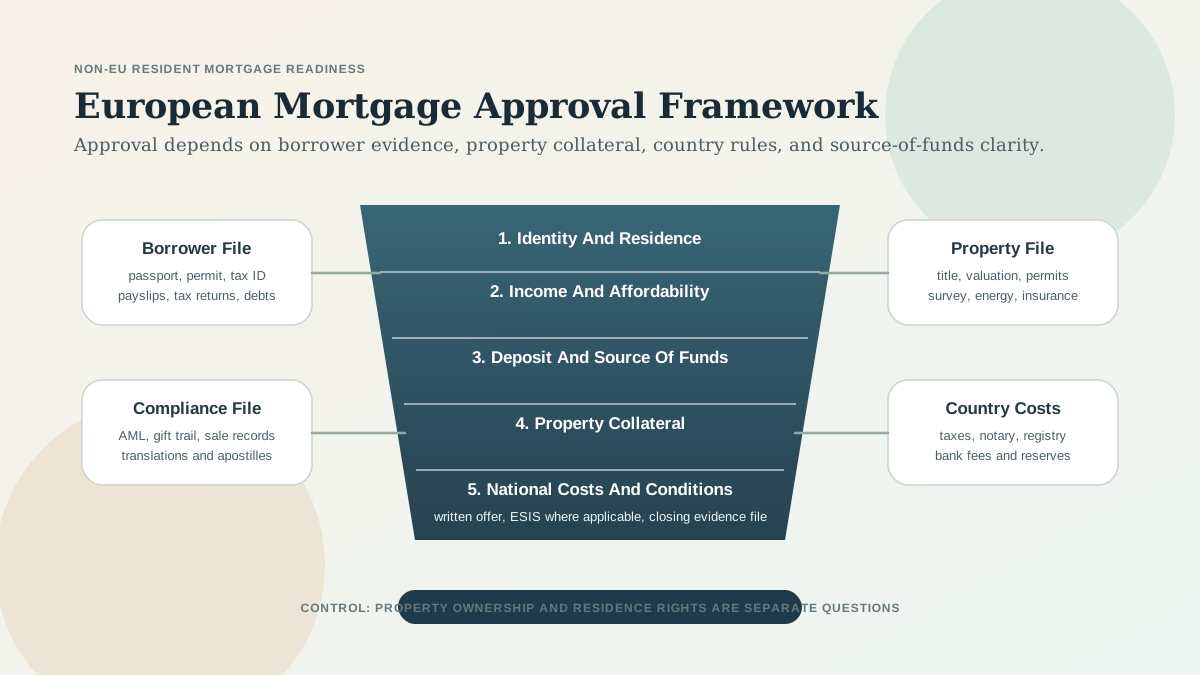
Getting a mortgage in Europe as a non-EU resident is possible in many markets, but there is no single European approval rule. A lender will assess the borrower, the property, the income source, the deposit, the currency, the legal residence position, and the source of funds under national law and internal risk policy.
The most important point is that "non-EU resident" is not one borrower type. A U.S. citizen legally resident in France, an Indian national working in Germany, a British resident buying a second home in Spain, a Turkish entrepreneur buying in Portugal, and a non-resident investor buying in Italy are different underwriting cases.
Sources checked for this review: May 14, 2026. This guide is informational and is not legal, tax, immigration, mortgage, or investment advice.
Quick Answer
Non-EU residents usually need a larger evidence file than local borrowers. Expect to provide a passport, residence permit or visa where relevant, proof of address, employment or business income evidence, tax returns or assessments, bank statements, credit information where available, proof of deposit, source-of-funds evidence, and property documents.
EU mortgage rules require consumer protections such as creditworthiness assessment and standardized pre-contract information for many residential mortgages, but they do not force banks to approve every foreign or cross-border applicant. Your Europe notes that a lender may consider the applicant's residence country, work country, and property location when assessing a mortgage application. See Your Europe: Mortgage loans and credit in the EU.
The Core Approval Model
A mortgage file for a non-EU resident usually has six pillars.
| Pillar | Lender question | Evidence usually requested |
|---|---|---|
| Identity and legal status | Who are you, and can you legally live or transact there? | Passport, visa, residence permit, tax number |
| Income and affordability | Can you repay sustainably? | Payslips, tax returns, accounts, bank statements |
| Deposit and liquidity | Do you have enough equity and reserves? | Savings statements, gift evidence, investment sale records |
| Property collateral | Is the property acceptable security? | Valuation, title, registry, survey, permits |
| Source of funds | Is the money legitimate and traceable? | Bank trail, sale contracts, inheritance, business-sale documents |
| Country compliance | Are national rules, taxes, and bank policy satisfied? | Local forms, translations, insurance, notary or lawyer documents |
Weakness in any pillar can delay or stop approval even if income is high.
EU Mortgage Rules: What They Do And Do Not Do
The EU Mortgage Credit Directive creates a framework for consumer credit agreements relating to residential immovable property. It covers areas such as creditworthiness assessment, pre-contract information, explanations, and standards for creditors and intermediaries. See EUR-Lex: Directive 2014/17/EU and European Commission: Mortgage Credit Directive.
For borrowers, the practical protections may include:
| Protection | Practical meaning |
|---|---|
| Creditworthiness assessment | The bank must assess ability to repay before granting credit |
| European Standardised Information Sheet | Borrowers receive standardized mortgage information for comparison |
| APRC disclosure | Total cost is presented in a comparable way |
| Explanation duty | Mortgage features and risks should be explained |
| Foreign-currency loan warnings | Currency mismatch risks must be addressed |
| Early repayment framework | Rights exist, subject to national rules and possible compensation |
| Intermediary standards | Mortgage intermediaries are regulated in many cases |
What EU rules do not provide:
- A right to mortgage approval.
- A single EU-wide down-payment percentage.
- A guarantee that foreign income will be accepted.
- A rule that buying property creates residence rights.
- Uniform property taxes or notary fees.
- Uniform treatment in non-EU European countries.
Borrower Profiles: Why The Label "Non-EU" Is Too Broad
| Borrower profile | Typical lender concern |
|---|---|
| Non-EU citizen legally resident in the purchase country | Length and stability of residence and income |
| Non-EU citizen resident in another EU country | Cross-border enforceability and income verification |
| Non-EU resident outside Europe | Non-resident policy, higher equity, AML review |
| Cross-border worker | Income country, tax residence, currency, employment stability |
| Recent arrival | Limited local credit history and short employment record |
| Self-employed applicant | Volatile income and document verification |
| Foreign-currency earner | Exchange-rate risk and affordability stress testing |
| Politically exposed or high-risk jurisdiction applicant | Enhanced due diligence |
The stronger the cross-border element, the more important the documentation trail becomes.
Residence Permit And Immigration Status
A residence permit is not always required to buy property, and some countries allow non-residents to purchase real estate. But mortgage underwriting is different from ownership permission. For a primary-home mortgage, a lender often wants evidence that the borrower can legally stay long enough to service the loan.
Documents may include:
- Residence permit.
- Long-stay visa.
- Work permit.
- EU Blue Card.
- Family reunification card.
- Student or researcher permit.
- Proof of pending renewal.
- Local tax number.
Buying property does not automatically create a right to live in an EU country. EU immigration information explains that visa and residence-permit applications are handled by the authorities of the EU country where the person plans to move. See European Union: Immigration to the EU.
Income Requirements
The lender's central question is whether repayment is sustainable. The EBA's loan origination and monitoring guidelines introduce expectations for creditworthiness assessment and prudent loan origination. See European Banking Authority: Guidelines on loan origination and monitoring.
Employees
Expect to provide:
- Employment contract.
- Employer letter.
- Recent payslips.
- Tax returns or tax assessments.
- Bank statements showing salary deposits.
- Evidence of probation completion if relevant.
- Details of bonuses, commissions, and allowances.
Self-Employed Applicants
Expect a deeper file:
- Business registration.
- Annual accounts.
- Tax returns and assessments.
- VAT returns where relevant.
- Accountant letter.
- Business bank statements.
- Client contracts or invoices.
- Debt schedule.
- Proof of retained earnings or dividends.
Other Income
Banks may discount or reject income that is volatile or hard to verify.
| Income type | Possible lender treatment |
|---|---|
| Rental income | Discounted for vacancy, tax, and maintenance |
| Dividends | Discounted unless stable and documented |
| Bonus income | Averaged or capped |
| Pension | Often acceptable if stable and transferable |
| Investment income | Reviewed for sustainability |
| Crypto gains | High source-of-funds scrutiny |
| Overseas business income | Translation, tax, and audit trail required |
Currency Risk
If income and mortgage payments are in different currencies, the bank may apply stricter affordability rules. A borrower paid in USD, GBP, CHF, INR, AED, or another currency may face a lower approved amount than a borrower paid in euros because exchange-rate changes can affect repayment capacity.
Ask lenders:
| Question | Why it matters |
|---|---|
| Do you accept my income currency? | Some banks restrict foreign-currency income |
| What exchange rate is used? | Approval may use conservative assumptions |
| Is income discounted? | The bank may haircut foreign income |
| Is the mortgage currency the same as the income currency? | Currency mismatch increases risk |
| Is there a stress test? | Exchange-rate changes may reduce affordability |
Down Payment And Loan-To-Value
There is no universal Europe-wide down-payment requirement for non-EU residents. Loan-to-value depends on the country, lender, property, borrower residence, income stability, currency, and intended use.
Prepare for four cash categories:
| Cash need | Description |
|---|---|
| Equity deposit | Your share of the purchase price |
| Acquisition costs | Taxes, notary, registry, legal, valuation, broker, and translation costs |
| Bank reserves | Savings left after completion |
| Currency buffer | Protection against exchange-rate movement before closing |
A headline LTV may not apply to non-resident or foreign-income borrowers. Ask for a written estimate based on your exact profile.
Source Of Funds And Anti-Money-Laundering Checks
European banks and real-estate professionals operate under anti-money-laundering rules. Directive 2015/849 includes customer due diligence, beneficial-ownership checks, ongoing monitoring, and source-of-funds considerations. See EUR-Lex: Directive 2015/849.
Prepare evidence for:
| Fund source | Evidence |
|---|---|
| Salary savings | Bank statements and payslips |
| Sale of property | Sale deed, completion statement, bank trail |
| Gift from family | Gift letter, donor identity, donor source of funds |
| Inheritance | Probate, estate documents, bank trail |
| Business sale | Sale contract, corporate documents, tax records |
| Investment liquidation | Broker statements and tax records |
| Crypto proceeds | Exchange records, wallet history, tax filings, bank acceptance |
Unexplained large deposits are a common delay source. Keep a clean paper trail before transferring money.
Property Requirements
The property itself must be acceptable collateral. Lenders may review:
- Purchase contract.
- Title or land-registry information.
- Valuation report.
- Planning permission.
- Building permits.
- Energy certificate.
- Survey or technical inspection.
- Condominium documents.
- Lease status if rented.
- Insurance requirements.
- Defects, illegal works, or encumbrances.
BaFin explains in its German consumer guidance that property loans are usually secured by a land charge or mortgage entered in the land register and that lenders review creditworthiness, mortgage lending value, and loan-to-value. See BaFin: Property loans at a glance.
Purchase Costs Beyond The Mortgage
Mortgage approval is not enough. A buyer must also fund national and local purchase costs.
| Cost type | Examples |
|---|---|
| Transfer taxes or stamp duty | Country and region specific |
| VAT on new builds | Applies in some new-property cases |
| Notary costs | Often mandatory in civil-law jurisdictions |
| Land-registry fees | Registration of ownership and mortgage security |
| Valuation fees | Required by many lenders |
| Legal fees | Especially useful for foreign buyers |
| Mortgage arrangement fees | Bank-specific |
| Broker fees | Depends on country and contract |
| Translation and apostille | Common for foreign documents |
| Insurance | Building, life, payment protection, or local required cover |
| Ongoing ownership costs | Property tax, service charges, repairs, municipal fees |
Your Europe notes that buyers may need a tax number in the property country to enter into a mortgage agreement and should check national websites for taxes payable when buying, selling, and owning property. See Your Europe: Buying a house.
Country Examples
Germany
Germany emphasizes affordability, collateral value, land-register security, and documentation. Non-EU borrowers should expect scrutiny of residence status, income stability, equity, property valuation, and existing debts. Acquisition costs can include notary, land-register, real-estate transfer tax, and broker costs depending on the transaction.
France
France uses a notarial conveyancing system. Acquisition costs are added to the purchase price and include taxes, notary remuneration, and disbursements. Notaires de France explains that acquisition costs are often incorrectly called "notary fees" and that much of the amount consists of taxes collected for the state. See Notaires de France: Property purchase acquisition costs.
Spain
Spain has a regulated mortgage and real-estate credit framework. Non-resident buyers should expect banks to verify identity, tax status, income, debts, deposit funds, and property value. A non-resident mortgage may have different LTV and documentation expectations from a resident salaried-borrower mortgage.
Portugal
Portugal allows many foreign buyers to apply for financing, but banks still underwrite income, debt, property, and source of funds. Banco de Portugal's bank-customer portal provides official consumer resources and mortgage-credit tools. See Banco de Portugal: Bank Customer Website.
Non-EU Europe
Switzerland, Norway, Iceland, the United Kingdom, and other non-EU European jurisdictions have separate mortgage, immigration, tax, and property-transfer systems. Do not assume EU consumer-credit rules apply outside their legal scope.
Document Checklist
Ask the lender for its exact list, but prepare:
- Passport.
- Residence permit, visa, or proof of lawful status where relevant.
- Local tax number if required.
- Proof of address.
- Employment contract or business registration.
- Payslips, pension statements, or benefit statements.
- Tax returns and tax assessments.
- Bank statements for current, savings, and investment accounts.
- Credit report where available.
- Existing debt schedule.
- Proof of deposit.
- Source-of-funds documents.
- Gift letter and donor evidence if applicable.
- Marriage certificate, divorce decree, prenuptial agreement, or dependent information if relevant.
- Property reservation contract or purchase agreement.
- Title, registry, valuation, survey, energy, and building documents.
- Insurance documents.
- Certified translations, notarized copies, or apostilles if required.
Application Workflow
- Define your borrower profile: resident, non-resident, cross-border worker, or recent arrival.
- Confirm whether property ownership and residence rights are separate in your target country.
- Ask lenders whether they accept your residence country, nationality, income country, and income currency.
- Build the income, tax, deposit, and source-of-funds file before making a binding commitment.
- Estimate total cash required, including acquisition costs and reserves.
- Request written mortgage simulations and the European Standardised Information Sheet where applicable.
- Review the property with local professional support.
- Confirm mortgage conditions, deadlines, and deposit risk before signing.
- Keep all bank, notary, lawyer, and transfer records in a dated evidence folder.
Decision Table: Is Your File Mortgage-Ready?
| Question | Green signal | Red signal |
|---|---|---|
| Legal status | Valid residence or accepted non-resident profile | Expiring or unclear status |
| Income | Stable, taxed, documented | Cash-heavy or inconsistent |
| Deposit | Traceable savings | Unexplained transfers |
| Currency | Income matches loan or is accepted | Unaccepted foreign currency |
| Property | Clean title and acceptable valuation | Defects, illegal works, title issues |
| Debt ratio | Affordable after stress testing | Existing debts too high |
| Documents | Translated and complete | Missing tax or bank records |
| Timeline | Conditions and deadlines understood | Binding contract signed too early |
Common Mistakes
- Assuming all non-EU citizens are treated the same.
- Confusing property ownership with residence rights.
- Applying before confirming the bank accepts foreign income.
- Underestimating taxes, notary costs, and registry costs.
- Moving funds without a source-of-funds trail.
- Using a personal loan for the deposit without telling the mortgage lender.
- Ignoring currency risk.
- Assuming an online mortgage calculator applies to non-residents.
- Signing a purchase contract before understanding mortgage contingencies.
FAQ
Can non-EU residents get a mortgage in Europe?
Often yes, but approval depends on the country, lender, residence status, income source, property, deposit, currency, and compliance checks.
Do I need a residence permit?
For a primary-residence mortgage, many lenders want lawful residence evidence. Some banks may lend to non-residents for second homes or investment properties, but usually under stricter conditions.
How much deposit do non-EU residents need?
There is no universal number. Non-resident and foreign-income borrowers often need more equity than local salaried residents, and acquisition costs may need to be paid from cash.
Does foreign income count?
It can, but the bank decides how to verify, convert, and discount it. Tax returns, salary statements, employer letters, business accounts, and bank statements are usually important.
Can buying property give me a visa or residence permit?
Not automatically. Some countries have investor or residence routes, while others do not. Mortgage approval and immigration permission are separate processes.
What if the bank refuses my application?
Ask for the reason in writing. Your Europe advises consumers to contact the bank's complaints office for an official written statement if a mortgage application is refused. Depending on the country, you may also have access to an ombudsman, regulator, or consumer-protection route.
Are property taxes the same across Europe?
No. Transfer tax, stamp duty, VAT, notary costs, municipal taxes, and ownership taxes vary by country and sometimes by region or municipality.
Underwriting profile for non-EU borrowers
Non-EU borrowers should expect lenders to test more than income. The bank will usually assess residence status, legal right to stay, income source, income country, currency, tax filing history, deposit origin, existing debts, property type, intended use, and exit risk. A borrower with strong income can still be declined if the bank cannot verify documents, enforce security comfortably, or understand the source of funds.
Residence status matters because it affects stability and enforcement risk. A permanent resident, long-term worker, cross-border commuter, student, investor, recent arrival, non-resident buyer, and second-home purchaser can each be treated differently. A mortgage for a primary residence is not the same product as a mortgage for an investment property or holiday home.
Income country also matters. A bank may accept local salary more easily than foreign salary. Foreign income may be discounted for exchange-rate, tax, employment-law, and documentation risk. Self-employed income usually needs more history than salaried income. Pension, dividends, rental income, and business-owner income may be accepted only after haircutting or averaging.
Deposit and source-of-funds controls
The deposit should be fully traceable before the purchase process begins. Keep savings statements, salary accumulation evidence, sale proceeds, inheritance documents, gift letters, loan agreements, investment liquidation records, and tax records. Large unexplained transfers near completion can delay bank approval or notary processes.
If family gifts are used, the lender may ask whether the gift is repayable, whether the donor's funds are legitimate, and whether gift tax or reporting applies. If the deposit comes from crypto, overseas business proceeds, cash-heavy activity, or several jurisdictions, prepare enhanced documentation early. AML questions are not personal criticism; they are part of mortgage underwriting.
Do not borrow the deposit secretly. Personal loans, employer loans, family loans, or credit-card borrowing can change affordability and bank risk. If the deposit is debt, disclose it and model repayment.
Property and country-risk review
The property must fit the bank's collateral rules. Some lenders are cautious with rural properties, short leases, illegal works, mixed-use buildings, co-ownership disputes, energy-inefficient homes, unfinished construction, leasehold structures, or properties in regions with weak resale liquidity. A foreign buyer should not assume that a property acceptable to the seller is acceptable to the lender.
Country-specific acquisition costs can be material. Transfer tax, stamp duty, VAT, notary costs, land registry fees, agent fees, valuation fees, legal fees, translation, insurance, and renovation reserves should be included. In some countries, the cash needed at completion is much higher than the deposit percentage suggests.
For non-resident or second-home buyers, lenders may require lower LTV, higher rates, local bank accounts, life insurance, property insurance, tax representation, or stronger reserves. Ask for these conditions before signing a binding purchase agreement.
Mortgage contingency and timing risk
Purchase contracts can create legal and deposit risk if mortgage approval is not secured in time. Non-EU buyers should understand whether the contract includes a financing condition, what evidence is needed to invoke it, what deadlines apply, and whether the deposit is refundable. Local legal advice is important before signing.
Mortgage approval can take longer when documents need translation, apostille, employer confirmation, foreign tax review, or source-of-funds checks. Build timeline buffers for valuation, legal review, bank committee approval, insurance, notary appointment, and international transfers.
Avoid moving money at the last minute. International transfers can trigger bank questions, exchange-rate slippage, or settlement delays. Keep funds in the expected account and preserve transfer records.
Currency and stress testing
A borrower earning in dollars, pounds, francs, kroner, dirham, rupees, or another non-loan currency should model exchange-rate stress. A monthly payment affordable at today's rate may become difficult after a 10 percent currency move. Some banks apply their own haircut to foreign income, but borrowers should run their own stress test too.
Interest-rate stress is separate. Fixed, variable, tracker, and mixed-rate loans behave differently. A low initial payment can reset. Non-EU borrowers should model payment at higher rates, income disruption, visa renewal risk, and property running costs. A mortgage is affordable only if it survives realistic stress, not only the bank's minimum test.
Mortgage-ready file
A strong file includes identity, residence status, employment contract, payslips, tax returns, bank statements, credit reports if available, savings history, source-of-funds documents, debt schedules, property documents, valuation, insurance quotes, and translated or legalized records where required. If self-employed, add accounts, invoices, contracts, tax assessments, business bank statements, and accountant letters.
The borrower should maintain one document index. Banks, brokers, lawyers, notaries, and insurers often ask for overlapping evidence. A controlled file prevents inconsistent versions and missed deadlines.
Borrower scenarios
A non-EU resident buying a primary home after relocation should focus on residence validity, probation period, local tax record, employment stability, and whether the bank accepts the visa category. A one-year residence card close to expiry may be weaker than a long-term permit. If renewal depends on employment, the lender may review job stability more closely.
A non-resident buying a second home should expect more equity and more documentation. The bank may ask how the property will be used, whether it will be rented, who will manage it, whether local tax registration is needed, and whether the borrower can service the loan from abroad. Rental projections may be discounted or ignored unless supported by contracts and local market evidence.
A cross-border worker should show income, tax, social-security, and commute stability. The lender may need payslips from one country, residence in another, tax filings in one or both, and bank statements showing regular income. For broader cross-border tax and workday issues, compare income tax for non-residents in Europe.
A self-employed borrower needs a stronger file than a salaried borrower. Two or three years of accounts, tax assessments, bank statements, client contracts, VAT filings, and accountant letters may be needed. The bank may average income, discount one-off revenue, exclude unpaid invoices, and stress business expenses.
Broker, lawyer, and notary coordination
Non-EU borrowers should coordinate broker, lawyer, notary, bank, and tax adviser early. The broker may understand lender appetite, but the lawyer or notary controls purchase-contract risk and title review. The tax adviser can estimate acquisition and ownership costs. These roles should not be confused.
Ask the broker which lenders accept the borrower's nationality, residence country, income currency, self-employment status, and property type. Ask the lawyer whether the purchase contract should include a mortgage condition, what deadlines apply, and what deposit can be lost. Ask the notary or local professional what documents need translation or legalization.
Communication should be documented. Keep written mortgage simulations, ESIS documents where applicable, broker emails, notary instructions, and bank conditions. Verbal reassurance is not enough when a binding purchase deadline is approaching.
Insurance and borrower protection
Mortgage approval may depend on property insurance, life insurance, borrower insurance, disability cover, or other protection depending on country and lender. Non-EU residents should ask whether foreign medical history, age, occupation, or residence status affects insurance availability. A loan offer can be delayed if insurance underwriting is unresolved.
Review exclusions and beneficiary wording. Insurance that satisfies a bank may not fully protect the household. If the buyer has dependants, variable income, or cross-border family assets, separate estate and protection planning may be needed.
Tax and residence consequences after purchase
Buying property does not automatically grant residence, but it can affect tax and practical ties. A buyer who spends substantial time in the property, moves family, registers utilities, and works remotely may create tax-residence facts. Non-resident owners may still owe local property tax, rental tax, imputed income tax, wealth tax, or capital-gains tax depending on country.
If the property will be rented, check registration, tourist-license rules, VAT or local taxes, platform reporting, insurance, and mortgage consent. A lender may price or approve a loan differently if the property is an investment rather than a primary residence.
Rejection recovery and reapplication
If declined, ask for the reason and classify it. Common reasons include insufficient deposit, unacceptable income country, unstable residence status, weak source-of-funds trail, high debt ratio, property valuation issue, unsupported property type, missing translations, or bank policy toward non-resident borrowers. The correction depends on the reason.
Do not immediately apply to many banks with the same weak file. Improve the evidence, increase deposit, change property, reduce loan amount, wait for longer income history, or use a specialist broker if appropriate. A stronger reapplication is better than repeated refusals.
Annual post-completion file
After purchase, keep mortgage statements, insurance, tax bills, proof of residence status, rental records if any, renovation invoices, and bank correspondence. If the borrower later refinances, sells, rents, or applies for residence renewal, this file becomes useful. Mortgage compliance continues after completion.
Minimum approval memo
Before making a binding offer, prepare a minimum approval memo. It should state borrower status, residence basis, income source, income currency, accepted deposit evidence, maximum loan, expected LTV, acquisition costs, financing condition deadline, and documents still outstanding. If any item is uncertain, treat the purchase as conditional rather than mortgage-ready.
The memo is useful because non-EU mortgage files often fail on timing rather than pure affordability. A borrower may have enough income but lack translations, source-of-funds proof, insurance, valuation clearance, or lender acceptance of residence status. The memo exposes those gaps before a deposit is at risk.
Source Risks And Factual Uncertainty
Lender policies for non-EU residents are often unpublished, change with market conditions, and vary by branch, broker, borrower profile, and property type. Public EU rules establish consumer-protection and creditworthiness frameworks, but national law and bank risk policy determine practical approval. Country examples are illustrative and must be verified locally before signing any binding purchase document.
Official And Primary Sources
- Your Europe: Mortgage loans and credit in the EU
- EUR-Lex: Directive 2014/17/EU
- European Commission: Mortgage Credit Directive
- EBA: Guidelines on loan origination and monitoring
- EUR-Lex: Directive 2015/849 on anti-money laundering
- European Union: Immigration to the EU
- Your Europe: Buying a house
- BaFin: Property loans at a glance
- Notaires de France: Acquisition costs
- Banco de Portugal: Bank Customer Website