Last updated
Buying Property As A Foreigner In Europe: Ownership, Residence, Taxes, And Financing
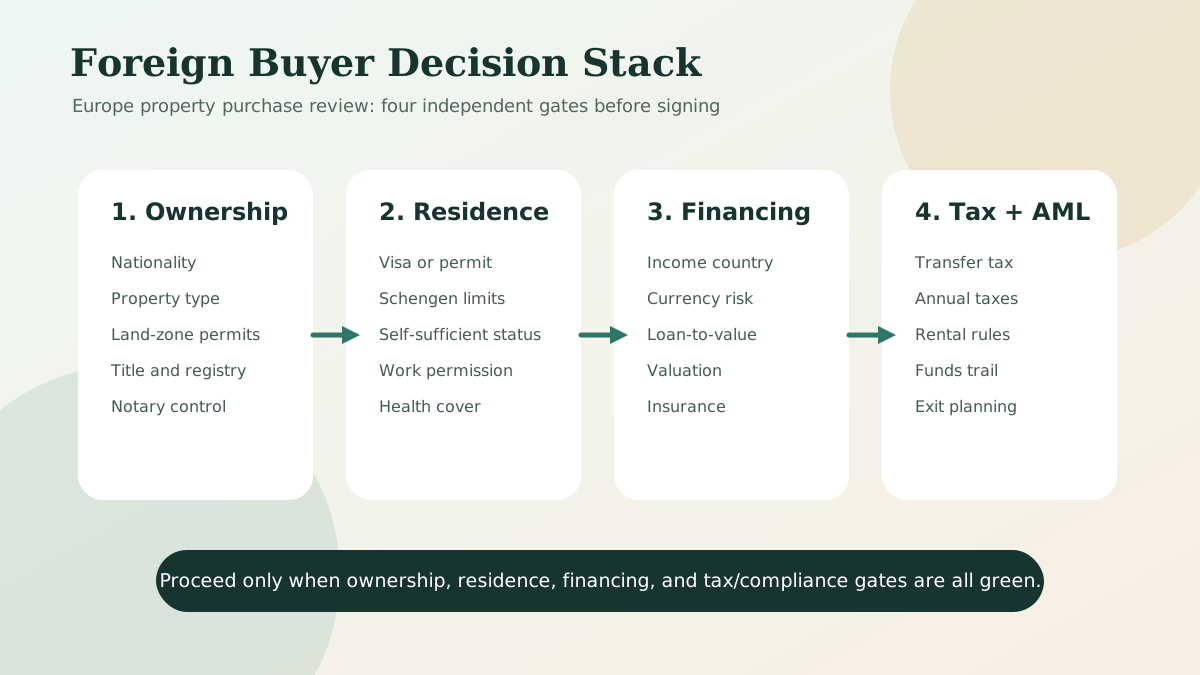
Use Buying Property As A Foreigner In Europe: Ownership, Residence, Taxes, And Financing when a property plan needs to connect ownership rules, financing, taxes, notary evidence, and registration. It explains checking whether a foreign buyer can purchase, finance, register, insure, and document a property transaction, then shows how to check ownership restrictions, mortgage access, purchase taxes, notary steps, registration, insurance, and residence myths before paying. The later sections connect quick answer, the four questions foreign buyers must keep separate, and step 1: confirm ownership permission so the next step is easier to judge. Read it before reserving, transferring money, or signing, because notary, tax, mortgage, and registration issues are hard to unwind later.
A foreign buyer may be allowed to purchase a home but still have no long-term residence right. A resident may be allowed to live in the country but still face stricter mortgage underwriting. A cash buyer may avoid lender approval but still face tax registration, anti-money-laundering checks, and source-of-funds documentation. An EU citizen may benefit from equal treatment inside the EU, while a non-EU buyer may face national restrictions, military-zone rules, reciprocity rules, or authorization requirements in specific countries.
Source check date: May 14, 2026. This guide is informational and is not legal, tax, immigration, mortgage, investment, or property advice.
Quick Answer
Foreigners can buy property in much of Europe, but there is no single European property-purchase rule. First confirm whether your nationality and residence status allow ownership of the specific property type in the target country. Then verify that buying property does not automatically grant residence rights, model purchase and annual taxes, prepare source-of-funds evidence, and ask lenders whether they accept your residence country, income country, and currency.
The European Union's Your Europe portal states that EU citizens have the same rights as nationals of another EU country when buying or selling property, including primary homes, holiday homes, and office properties. See Your Europe: Buying a house. That EU equal-treatment principle does not mean every non-EU buyer has the same treatment, and it does not replace national property, tax, planning, or immigration rules.
The Four Questions Foreign Buyers Must Keep Separate
| Question | Authority or counterparty | What it decides | Common mistake |
|---|---|---|---|
| Can I own this property? | Land registry, notary, lawyer, national authority | Whether you can acquire title | Assuming one country's rule applies across Europe |
| Can I live there? | Immigration authority | Whether you can reside beyond visa-free or short-stay limits | Assuming ownership creates residence rights |
| Can I finance it? | Bank or mortgage lender | Whether income, collateral, currency, and residence risk are acceptable | Assuming resident loan-to-value rules apply |
| What taxes apply? | Tax authority, municipality, notary | Purchase taxes, annual taxes, rental tax, capital gains, wealth tax | Looking only at the purchase price |
Do not sign a binding purchase contract until all four workstreams have been checked for the target country and property type.
Step 1: Confirm Ownership Permission
Ownership rules are national and sometimes regional. A foreign buyer should not ask, "Can foreigners buy in Europe?" The correct question is, "Can a person with my nationality and residence status buy this exact property in this location for this use?"
Key ownership variables include:
| Variable | Why it matters |
|---|---|
| EU, EEA, Swiss, or non-EU nationality | Equal-treatment rules are strongest for EU citizens inside the EU |
| Residence status | Some countries distinguish resident and non-resident buyers |
| Property type | Agricultural land, forest, coastal land, protected zones, and strategic areas may be restricted |
| Location | Border zones, military areas, islands, and rural land can have special rules |
| Use | Primary home, holiday home, rental investment, business premises, and land banking may be treated differently |
| Buyer type | Individual, company, trust, foundation, or investment vehicle can change disclosure and tax treatment |
For EU citizens buying in another EU country, the starting point is equal treatment. For non-EU citizens, the starting point is national law. Some countries are broadly open to foreign residential buyers; others require permits for certain land or impose conditions on non-residents.
Step 2: Do Not Confuse Ownership With Residence Rights
Owning a house does not automatically create a right to live in the country. This is the most expensive misunderstanding in cross-border property planning.
The European Union explains that non-EU nationals should apply for a visa or residence permit directly through the authorities of the EU country where they plan to move, and that EU countries take the final decision on individual migrant applications where national competence applies. See European Union: Immigration to the EU.
Practical consequences:
| Buyer situation | Property ownership result | Residence result |
|---|---|---|
| EU citizen buying in another EU country | Usually equal treatment for purchase | EU residence rights still require worker, self-employed, student, self-sufficient, or other qualifying status after the initial period |
| Non-EU tourist buying a holiday home | May be allowed to buy in many countries | Still limited by Schengen or national short-stay rules unless a residence permit is granted |
| Non-EU investor buying above a threshold | Ownership may be possible | Residence depends on the country's investor or residence-permit law, if any |
| Retiree buying with cash | Ownership may be possible | Residence usually requires income, health insurance, and immigration approval |
| Remote worker buying property | Ownership may be possible | Remote-work or self-employed permission is separate |
If you need the property for relocation, confirm the residence path before the purchase becomes binding.
Step 3: Check Short-Stay Limits Before Planning Use
A holiday home is not useful if you cannot legally spend the desired time in it. Non-EU nationals who benefit from Schengen visa-free travel are generally subject to short-stay limits unless they obtain a national long-stay visa or residence permit. Schengen presence and national residence rights must be checked separately.
Questions to ask before buying:
| Question | Why it matters |
|---|---|
| How many days per year can I legally stay? | Determines whether the property can be used as planned |
| Does the country offer a long-stay visitor, retiree, digital nomad, investor, or self-sufficient route? | Ownership alone may not be enough |
| Does the permit allow work or only residence? | Remote work and rental management can create legal issues |
| Does buying property help, harm, or not affect the residence application? | Country rules differ |
| What health insurance and income proof are required? | Residence approval often depends on these documents |
A real estate agent is not an immigration authority. Get official or legal confirmation before relying on a residence plan.
Step 4: Model Purchase Taxes And Closing Costs
The purchase price is only one part of the cash requirement. Foreign buyers should model total acquisition cost before making an offer.
| Cost type | Typical examples | Paid to |
|---|---|---|
| Transfer tax or stamp duty | Property-transfer tax, registration tax, land tax | State, region, or municipality |
| VAT | New-build property in some countries | Seller or tax authority |
| Notary fees | Deed preparation, authentication, tax collection | Notary |
| Land-registry fees | Registration of ownership and mortgage security | Land registry |
| Legal fees | Independent buyer counsel | Lawyer |
| Agent fees | Buyer-paid, seller-paid, or split depending on country | Real estate agent |
| Mortgage fees | Valuation, arrangement, broker, insurance | Bank or broker |
| Translation and legalization | Certified translations, apostilles, sworn interpreter | Translator or authority |
| Bank and FX costs | Currency conversion, transfer fees | Bank or payment provider |
Your Europe notes that buyers may need a tax number in the country where the property is located to enter into a mortgage loan agreement, and that purchase, sale, ownership, and capital-gains taxes should be checked on national websites. See Your Europe: Buying a house.
Step 5: Model Annual Ownership Costs
A foreign buyer should calculate the annual cost of holding the property even if there is no mortgage.
| Annual cost | Why it matters |
|---|---|
| Municipal property tax | Charged by many local authorities |
| Wealth tax or net-worth tax | Applies in some jurisdictions or to higher-value assets |
| Non-resident income tax | May apply to rental income and sometimes deemed income |
| Rental licensing and tourist-accommodation fees | Critical for short-term rental plans |
| Building insurance | Often required by lenders and prudent for all owners |
| Condominium or service charges | Common in apartments and managed developments |
| Utilities and standing charges | Electricity, water, heating, waste, telecoms |
| Maintenance reserve | Repairs, roof, facade, heating systems, appliances |
| Local accountant | Often needed for non-resident filings |
| Bank account fees | Required or useful for local payments |
If you plan to rent the property, add income tax, platform reporting, VAT or tourist-tax analysis, local registration, safety rules, and restrictions on short-term rentals.
Step 6: Mortgage Approval Is not assured
Banks are free to assess mortgage applications based on creditworthiness. Your Europe explains that lenders may consider the borrower's residence country, work country, and the location of the property, and that banks frequently refuse mortgages for properties located in another country or where the borrower's income source or residence is outside the bank's country. See Your Europe: Mortgage loans and credit in the EU.
Foreign buyers should expect lenders to ask for:
| Evidence | Purpose |
|---|---|
| Passport and residence documents | Identity and legal status |
| Tax identification number | Local compliance and loan onboarding |
| Proof of address | Know-your-customer checks |
| Employment contract or business accounts | Income verification |
| Tax returns or tax assessments | Sustainable income proof |
| Bank statements | Savings, salary flow, and affordability |
| Credit report where available | Debt behavior and liabilities |
| Deposit evidence | Equity and liquidity |
| Source-of-funds evidence | Anti-money-laundering review |
| Property valuation | Collateral adequacy |
| Insurance documents | Lender security conditions |
The lender may require a larger deposit from a non-resident borrower, discount foreign-currency income, or reject certain income types.
Step 7: Prepare Source-Of-Funds Evidence Before Moving Money
European real estate transactions involve anti-money-laundering checks. Banks, notaries, lawyers, real estate professionals, and other obliged entities may need to verify identity, beneficial ownership, and source of funds.
Directive 2015/849 sets out the EU anti-money-laundering framework, including customer due diligence and beneficial-ownership concepts. See EUR-Lex: Directive 2015/849.
Prepare a document trail for:
| Fund source | Evidence to keep |
|---|---|
| Salary savings | Payslips, tax returns, bank statements |
| Sale of previous property | Sale contract, notary statement, bank trail |
| Gift | Gift deed, donor ID, donor source of funds |
| Inheritance | Probate, estate accounts, transfer trail |
| Business sale | Share-purchase agreement, company records, tax evidence |
| Investment liquidation | Broker statement, capital-gains report, transfer record |
| Crypto proceeds | Exchange records, wallet history, tax reporting, bank acceptance confirmation |
Do not combine funds from multiple people without documenting each person's contribution and legal role in the purchase.
Step 8: Use Independent Buyer-Side Advice
In many European countries, the notary is central to the transaction, but the notary may not be your personal legal adviser. A foreign buyer should understand whether the notary represents the public function, both parties, or only one side, and whether separate buyer counsel is needed.
Use independent advice when:
| Risk factor | Why independent advice matters |
|---|---|
| You do not speak the contract language fluently | Legal meaning can differ from informal translation |
| The property is off-plan | Completion, guarantee, and insolvency risks are higher |
| There are tenants | Eviction, rent-control, and lease rules matter |
| You plan short-term rentals | Local restrictions can destroy the investment case |
| The seller is a company or estate | Authority to sell must be verified |
| The property has building works | Planning and permit compliance must be checked |
| You buy through a company | Tax, disclosure, and financing effects change |
| You need residence permission | Property and immigration strategy must align |
Country-Check Matrix
This table is not a substitute for national legal advice. It shows the questions to ask.
| Country issue | Spain | Germany | France | Portugal | Italy |
|---|---|---|---|---|---|
| Tax number before purchase | Often NIE | Tax ID may be needed for tax and banking | Fiscal identity may be required | NIF commonly required | Codice fiscale commonly required |
| Notary role | Central | Central | Central | Central | Central |
| Non-resident mortgage | Possible but bank-specific | Possible but underwriting can be strict | Possible but lender-specific | Possible but lender-specific | Possible but lender-specific |
| Short-term rental controls | Strong local variation | Strong city-level rules | Strong local variation | Strong municipal variation | Strong municipal variation |
| Residence from purchase alone | Do not assume | No general automatic right | No general automatic right | Depends on national residence route | No general automatic right |
Verify the current rule with the national land registry, tax office, notary, immigration authority, and local municipality.
Due Diligence Checklist
Before signing a reservation, preliminary, or purchase contract, confirm:
| Due diligence item | Evidence or action |
|---|---|
| Buyer eligibility | Written check from lawyer, notary, or authority |
| Foreign-buyer authorization | Permit decision or confirmation no permit is required |
| Seller authority | Registry extract, corporate authority, probate, or power of attorney |
| Land-registry status | Current title extract and encumbrance list |
| Planning and building status | Permits, habitation certificate, energy certificate |
| Condominium debts | Manager certificate or equivalent statement |
| Occupancy | Tenant file, vacant possession clause, or lease review |
| Purchase taxes | Tax estimate from notary, lawyer, or tax adviser |
| Short-term rental permission | Municipality and condominium review |
| Source of funds | Bank-ready document trail |
| Residence-permit implications | Immigration advice or official route check |
| Exit taxation | Capital-gains and inheritance planning |
Common Mistakes
| Mistake | Better approach |
|---|---|
| Assuming foreigners can buy everywhere on the same terms | Verify national, regional, and property-type rules |
| Treating a real estate purchase as a residence permit | Separate ownership from immigration |
| Comparing only advertised prices | Model purchase taxes, annual costs, and exit taxes |
| Relying on seller-side documents only | Obtain independent due diligence |
| Ignoring source-of-funds checks | Build the money trail before transferring funds |
| Assuming rental income is unrestricted | Check licensing, tax, and zoning rules |
| Signing before mortgage approval | Use proper financing conditions where available |
| Ignoring currency risk | Model exchange-rate movement before completion |
| Using informal translations | Use certified translation where required |
| Forgetting inheritance and estate planning | Ask how local succession law affects the property |
Decision Framework
A foreign buyer is ready to proceed only when all four gates are green.
| Gate | Green signal | Red signal |
|---|---|---|
| Ownership | Legal eligibility confirmed by local professional or authority | Buyer nationality or property type unresolved |
| Residence | Stay rights and immigration limits understood | Buyer assumes ownership grants residence |
| Financing | Written lender conditions and cash budget complete | Mortgage calculator used without bank confirmation |
| Tax and compliance | Purchase, annual, rental, and exit taxes modeled | Only purchase price considered |
If one gate is red, pause.
FAQ
Can foreigners buy property in Europe?
Often yes, but the rule depends on the country, buyer nationality, residence status, property type, location, and intended use. EU citizens generally benefit from equal treatment when buying in another EU country. Non-EU buyers must check national rules.
Does buying property in Europe give me residency?
Usually no. Property ownership and immigration permission are separate. Some countries have investor or residence routes connected to investment, but ownership alone should never be treated as automatic residence permission.
Can a non-resident get a European mortgage?
Sometimes. Banks assess income, assets, debts, property value, residence country, income country, and currency. Non-resident buyers may need a larger deposit and more documentation.
Do I need a local tax number?
Often yes, especially for mortgage, notary, land-registry, tax, and utility procedures. The exact name and process differ by country.
Is it safe to buy without a lawyer if there is a notary?
not necessarily. In many countries, the notary performs a public or transaction function but may not provide buyer-specific legal strategy. Independent counsel is especially important for foreign buyers, off-plan purchases, rentals, and residence-linked purchases.
Can I rent out the property?
Maybe, but rental law is local. Short-term rental rules can be strict and may require licenses, tax registration, safety compliance, platform reporting, or condominium permission.
Source Risks And Factual Uncertainty
European property rules change at national, regional, and municipal levels. Housing-affordability measures, foreign-buyer restrictions, short-term rental rules, mortgage policy, AML practice, and tax rates can change quickly. This article deliberately avoids claiming a single European rule because buyers must verify the specific country, municipality, property type, and immigration status before signing.
Official And Primary Sources
- Your Europe: Buying a house
- Your Europe: Mortgage loans and credit in the EU
- European Union: Immigration to the EU
- EUR-Lex: Directive 2015/849 on anti-money laundering
- European Commission: EU individuals' tax rights under EU law
- EUR-Lex: TFEU Article 63 on capital movement
Related Reading
- Bank account requirements for foreigners in Europe
- Mortgage requirements for non-EU residents in Europe
- Income tax for non-residents in Europe
Official source and decision check
Use this section as the practical checkpoint for Buying Property As A Foreigner In Europe: Ownership, Residence, Taxes, And Financing. The reader decision is whether the available evidence is strong enough to act now, or whether the file should first be confirmed with the competent authority. Rules can change by country, status and date, so treat this guide as orientation for the file and recheck the current rule before relying on an appointment, payment, journey or application deadline.
For expats, foreigners, students, workers, founders, families and other mobile readers, record the reader category, country, residence status and deadline before comparing the official source with the article checklist.
Official sources to verify first
- Your Europe citizen rights portal
- European Commission social security coordination
- EUR-Lex EU law access
- EURES mobility and work portal
- European Commission information portal
| Decision point | What to check | Reader action |
|---|---|---|
| Administrative decision | Confirm that the case is really about administrative decision, not a different category that follows another rule. | Write down the country, authority, dates, status and document number before asking for a decision. |
| File for competent authority | Keep the identity, residence and document evidence in one dated file, with originals, translations where required and proof of submission. | Save receipts, emails, appointment confirmations, payment records and authority replies in the same order as the checklist. |
| Buying Property As A Foreigner In Europe: Ownership, Residence, Taxes, And Financing fallback | If the answer is refused, delayed or unclear, identify the competent authority, review window, complaint route or regulated provider escalation path. | Ask for the reason in writing and compare it with the official source before paying again, travelling, closing an account or resubmitting. |
| When the answer is unclear | What to do next |
|---|---|
| The authority, bank, insurer, employer or provider gives a verbal answer only. | Ask for the answer in writing, save the name of the office or provider, and compare it with the official source before changing travel, payroll, residence or payment plans. |
| The file depends on a deadline, appointment, payment, address or status change. | Keep the dated receipt, note the next deadline, and avoid closing the old route until the replacement document, account, policy or registration is confirmed. |
Related guides to cross-check
- First month in Europe checklist
- Living in one European country and working in another
- EU remote working guide
- Cross-border worker benefits in the EU
- Private health insurance documents in Europe
For legal, tax, medical, immigration or financial consequences, confirm the position with the competent authority or a qualified adviser. This page is designed to organize the decision, source checks and next steps; it is not a substitute for case-specific professional advice.