Last updated
Register A Business in Europe as a Foreigner: Complete Guide
Direct answer
Register A Business in Europe as a Foreigner: Complete Guide is for new arrivals, expats, remote workers, and cross-border households who need to turn a broad search result into a concrete decision. It explains opening or using accounts, identity numbers, KYC evidence, cards, credit history, and payment access across Europe, then shows how to prepare identity, address, tax, income, source-of-funds, and card or credit evidence before an application is refused. Read it before submitting forms, moving money, choosing a provider, or assuming that a rule from another country applies.
The answer changes when you need to live in the country while running the business, hire local staff, open a business bank account quickly, or operate in a regulated sector. A founder can often own shares without much friction, while day-to-day management, payroll, VAT, and local trading rights may require extra steps that incorporation alone does not solve.
Next step: write a one-page operating model for the next 12 to 24 months covering who will manage the business, where customers are, whether staff or local premises are needed, and which country must support that model.
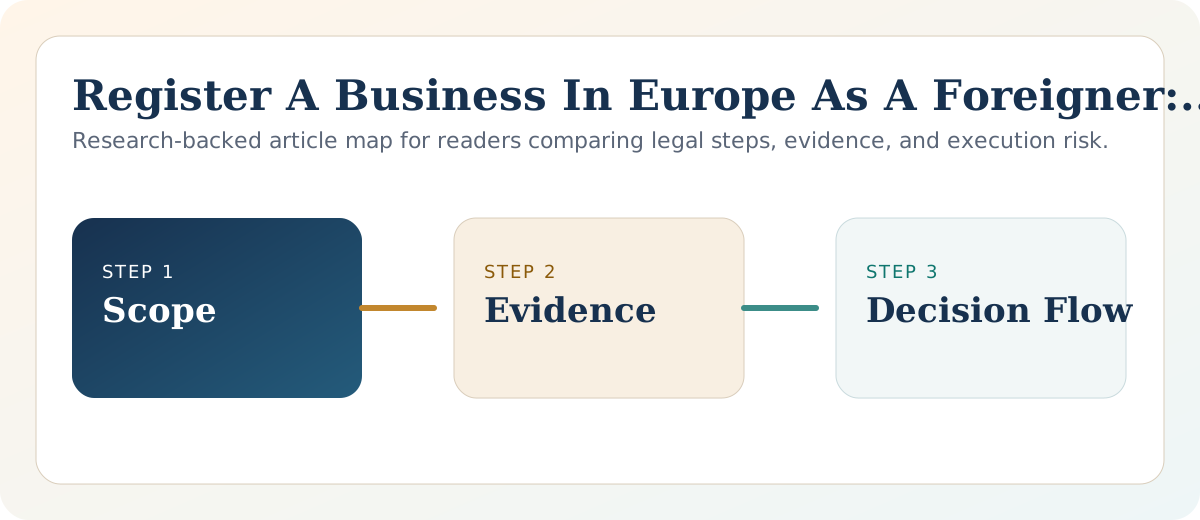
Registering a business in Europe as a foreigner is not mainly a paperwork problem. The real difficulty is choosing a structure that still works after the company exists: tax registration, banking, beneficial ownership disclosures, invoicing, residence status, and local operating rights all have to line up. Many foreign founders can complete an incorporation filing and still be blocked from trading, opening an account, hiring, or invoicing correctly.
This guide is written as an execution framework rather than a startup-promo summary. It explains how to choose between self-employment, a local company, or a branch-style setup; which documents usually control the process; where foreign founders get stuck; and how to sequence legal, tax, and banking steps so the business can actually operate.
This is editorial information, not legal, tax, immigration, or accounting advice. National rules vary by country, legal form, founder nationality, sector, and whether the business will have local staff, local customers, or a physical presence. Verify the current rule with the official authority before filing, paying, signing leases, hiring, or issuing invoices.
What registering a business in Europe as a foreigner actually means
The phrase can describe several different projects:
- registering as a sole trader or self-employed professional,
- creating a new local limited company,
- opening a branch of an existing foreign company,
- or creating a local subsidiary for a non-European parent business.
Those routes are not interchangeable. The best structure depends on what the business will do, where management decisions will be taken, where customers are located, whether the founder needs residence permission, and whether the business needs local staff, local banking, or regulated licenses.
| Route | Best fit | Main advantage | Main risk if chosen too quickly |
|---|---|---|---|
| Self-employed or sole-trader registration | One founder, low-complexity services, limited liability not essential | Fastest and often cheapest starting structure | Personal liability, tax-residence confusion, weak scaling path |
| Local limited company | Founder wants liability separation, staff, investors, or stronger bank credibility | Clear legal entity and better operating structure | More filings, governance, accounting, and UBO obligations |
| Branch of foreign company | Existing non-local company expanding into Europe | Keeps parent company alive without creating a fully separate structure | Local tax, payroll, and representation rules can be more complex than expected |
| Local subsidiary of foreign parent | Expansion with real local operations | Better separation of local risk and contracts | Highest setup and maintenance burden in many countries |
The first decision is not "Which country is fastest?" It is "What operating model am I trying to support for the next 12 to 24 months?"
Step 1: Separate business registration from immigration and tax assumptions
Foreign founders often combine three different questions into one:
- Can I legally create the business?
- Can I legally live in that country while running it?
- How will the business be taxed once it starts operating?
Those are related, but they are not the same test.
A country may allow a foreigner to own shares in a local company while still requiring separate residence permission to manage the company from inside the country. A country may let a company register quickly while still requiring separate VAT, tax-number, payroll, or sector-license approvals before business can start.
Use official European and national portals as the starting point for the legal map:
- Your Europe starting a business guide
- EU e-Justice business-register access
- BRIS register interoperability overview
- EU company law and corporate governance overview
If the founder also needs to relocate, add immigration review before assuming the company can be actively managed from the destination country.
Step 2: Choose the country by operating reality, not by startup marketing
Founders are often pushed toward countries marketed as "easy to incorporate." That can be a bad shortcut if the actual business will need local payroll, a regulated license, a resident director, a local address, or a bank that wants to see stronger substance than the marketing page suggests.
Compare countries using operational filters:
- Legal form fit: Is the country practical for a sole trader, private limited company, branch, or subsidiary?
- Tax interface: How quickly can the business obtain a tax number or VAT number where needed?
- Banking realism: Are banks in that jurisdiction comfortable with foreign-owned startups in your sector?
- Language and filing friction: Will the founder need notarized translations, apostilles, or local-language filings?
- Director and management rules: Does the structure require local directors, local representation, or a physical office?
- Sector regulation: Does the activity need licensing before registration is commercially useful?
- Ongoing compliance load: Annual accounts, bookkeeping, payroll filings, UBO maintenance, and local statutory records.
Country-screening table
| Screening factor | Low-friction sign | Higher-risk sign | Why it matters |
|---|---|---|---|
| Registry process | Online or streamlined filing with clear official checklist | Multiple local formalities with fragmented authority guidance | Determines setup speed and error rate |
| Tax onboarding | Clear post-registration tax sequence | Unclear timeline for tax IDs, VAT, or employer setup | Affects ability to invoice or hire |
| Banking | Banks routinely serve foreign-owned businesses in the sector | Frequent KYC rejections or slow onboarding | Controls whether operations can start |
| Governance | Straightforward director/UBO rules | Heavy beneficial-ownership or local-substance scrutiny | Affects documentation burden |
| Post-launch maintenance | Predictable recurring filings | High annual admin cost or rigid local formalities | Affects long-term viability |
Do not choose a country only because incorporation is fast if the business will actually be managed, taxed, staffed, or banked somewhere else.
Step 3: Build the document stack before filing
Most registration failures happen because the founder thinks in forms while the authorities and banks think in evidence. A clean evidence pack reduces both registry friction and later bank friction.
Typical founder-side documents include:
- passport or national ID,
- proof of address,
- articles of association or equivalent constitutional documents,
- shareholder and director details,
- powers of attorney if someone else files,
- business activity description,
- UBO or ownership map,
- and translations or legalization where required.
The operating side often needs its own file:
- business model summary,
- expected customer geography,
- source-of-funds narrative,
- projected transaction profile,
- tax or VAT registration plan,
- lease or registered-office documentation,
- and sector-specific permits where applicable.
Registration evidence matrix
| Evidence layer | What it proves | Typical examples | Who will care |
|---|---|---|---|
| Identity and authority | Who owns and controls the business | passport, proof of address, shareholder register, director appointment | registry, bank, notary |
| Legal structure | What is being created | articles, incorporation deed, branch resolution, parent-company extract | registry, tax authority |
| Business activity | What the company will actually do | business description, website, contracts, invoices, business plan | bank, tax authority, regulator |
| Tax readiness | How the business will invoice and report | VAT analysis, tax-number application, employer registration plan | tax authority, accountant |
| Beneficial ownership | Who ultimately controls the entity | UBO chart, ownership percentages, control rights | UBO register, bank |
| Operational substance | Whether the company can function after registration | office address, local contact, payroll plan, supplier/customer evidence | bank, regulator, tax authority |
Prepare this file before filing, not after.
Step 4: Treat tax and VAT setup as part of registration
In many cases, the business is not commercially ready when the company register accepts the filing. It becomes useful only when tax and invoicing logic are also clear.
Questions to answer early:
- Will the entity need a local tax number immediately?
- Does the business need VAT registration from day one?
- Are customers local, cross-border B2B, or cross-border B2C?
- Will the founder invoice as a company, as a sole trader, or through a foreign parent?
- Will the entity hire staff or pay the founder locally?
- Could management and control in one country create tax residence there even if the company is incorporated elsewhere?
Helpful starting references:
- European Commission VAT overview
- EU VAT identification numbers overview
- VIES VAT number validation
- OECD treaty framework reference
If you delay tax analysis until after registration, you risk building a legal shell that cannot invoice correctly, cannot justify its place of management, or cannot satisfy a bank reviewing its expected flows.
Step 5: Plan banking and UBO disclosures in parallel
Banks do not treat "company registered" as enough evidence. They usually want to understand who controls the company, what it will sell, where the money will come from, who the counterparties are, and why the business belongs in that jurisdiction.
That is why beneficial ownership and bank-readiness should be handled in parallel with registration.
Core UBO and banking references:
Common bank-onboarding weak points include:
- shareholder names that do not match other filings,
- missing explanation of source of funds or source of wealth,
- vague or inconsistent business activity description,
- no clear reason for using that country,
- and mismatch between expected transaction flows and the legal structure chosen.
Operational risks foreign founders underestimate
Fast incorporation, slow activation
A company can exist legally and still be unusable for weeks or months because the bank, VAT registration, or payroll setup is unresolved.
Founder residence versus company management
A foreign founder may create a company in one country but manage it from another. That can create a separate tax-residence or permanent-establishment analysis that the founder did not plan for.
Wrong structure for the first year
A one-person consulting business may not need the same structure as a hiring-focused startup or regulated marketplace. Choosing a heavy structure too early adds cost. Choosing an overly light structure can create liability or investor problems later.
Ignoring licensed activities
Registration alone does not authorize regulated activity in sectors such as financial services, healthcare, education, transport, or certain digital-risk categories.
Weak document continuity
If the registry, tax authority, UBO register, and bank all receive slightly different information, the founder creates preventable remediation work.
Advanced decision flow
Use this sequence before you commit to any filing:
- Define the real operating model. Write down whether the business is solo self-employment, a startup with hiring plans, a branch, or a local subsidiary. Add where management decisions will be taken and where customers are located.
- Test immigration and management assumptions separately. If the founder will live in the target country, confirm whether residence permission is needed to manage or work through the business.
- Choose structure only after tax and banking review. A branch, local company, or sole-trader route should be compared on liability, VAT logic, bank acceptance, and ongoing compliance load.
- Build one canonical evidence pack. Use one ownership map, one address standard, one activity description, and one director-authority record across all filings.
- Sequence registration into activation milestones. Registry filing, tax onboarding, VAT analysis, UBO disclosure, and bank submission should be planned as one workflow rather than isolated tasks.
Decision matrix: structure versus operational readiness
| Question | If the answer is yes | Preferred implication |
|---|---|---|
| Do you need liability separation from day one? | Personal exposure would be unacceptable | Lean toward a local limited company or subsidiary |
| Do you already have a foreign parent company? | The business already exists elsewhere | Compare branch versus subsidiary before forming a new local entity |
| Will you need local staff or payroll soon? | Hiring is part of the first-year plan | Favor structures that support local tax and employer setup cleanly |
| Will investors, partners, or banks expect formal governance? | Credibility and governance matter early | Avoid over-relying on sole-trader simplicity |
| Is the founder mainly testing a small service business? | Low complexity and low liability | A sole-trader or simple local structure may be enough initially |
Final checklist
- Confirm whether the founder needs separate residence or work permission in the target country.
- Choose the legal structure based on operating reality, not incorporation speed alone.
- Prepare identity, authority, ownership, and business-activity documents before filing.
- Check whether VAT, tax-number, payroll, or sector-license steps are needed immediately after registration.
- Keep registry, tax, UBO, and bank information aligned word-for-word where possible.
- Run bank onboarding in parallel with company setup, not weeks later.
- Validate who will manage the company and from which country those decisions will be taken.
- Build a first-year compliance calendar covering accounts, tax filings, UBO updates, and statutory changes.
Primary references
- Your Europe starting a business guide
- EU e-Justice business-register portal
- Business Registers Interconnection System overview
- EU company law and corporate governance
- European Commission VAT overview
- EU VAT identification numbers overview
- VIES VAT validation
- BORIS beneficial-ownership interconnection
- OECD treaty framework reference
Execution-grade blueprint for foreign founders
Foreign founders should treat registration as a staged operating program, not as a one-time filing. The registry accepts a legal form; the business becomes operational only when tax, VAT, banking, accounting, beneficial ownership, and management location all tell the same story.
Readiness gate 1: founder objective
Before comparing countries, write the operating model in one paragraph:
- what the business sells,
- where decisions are made,
- where customers are located,
- whether the founder needs residence permission,
- whether the company will hire, invoice, hold stock, or process regulated activity.
This paragraph becomes the baseline for the registry, bank, tax adviser, and first-year compliance calendar. If the paragraph changes later, registration assumptions should be reviewed again.
Readiness gate 2: legal form
The legal form should match risk and first-year execution:
| Business reality | Better structural bias | Why |
|---|---|---|
| one founder, low liability, service activity | sole trader or simple self-employed route | fast setup and lower maintenance |
| founder needs liability separation | limited company | separates personal and business risk |
| foreign parent already exists | branch or subsidiary analysis | avoids duplicating structure without purpose |
| regulated or high-trust activity | formal company plus licensing review | bank and regulator expectations are higher |
| investor or hiring path | company with governance capacity | easier to issue shares, hire, and contract |
Do not use an incorporation route only because it is fast. A fast structure that cannot open a bank account, register VAT, or pass sector rules is not actually fast.
Readiness gate 3: tax and VAT activation
Registration and tax activation should be planned together. Create an activation table:
- legal entity filing date,
- tax number request date,
- VAT decision and threshold logic,
- employer registration need,
- first invoice target date,
- first accounting close date.
The risk is not only late filing. The larger risk is issuing invoices from a structure that has not been fully classified for tax and VAT.
Readiness gate 4: beneficial ownership and banking
Banks and UBO registers usually ask different questions about the same control facts. Keep one ownership map that shows:
- direct shareholders,
- ultimate beneficial owners,
- percentage ownership,
- control rights,
- director/signatory authority,
- source of initial capital.
If this ownership map cannot be explained in one page, expect stronger bank due diligence.
Founder scenario analysis
Scenario A: non-EU founder wants to live and operate in Europe
The company route is not enough. The founder should separately test residence permission, right to work, management authority, tax residence, and whether local authorities expect economic substance. A person may own shares without being authorized to work through the company locally.
Scenario B: EU resident founder chooses another EU country for incorporation
The question becomes management and substance. If strategic decisions, client acquisition, bank control, and bookkeeping happen from the residence country, the company may create tax and compliance questions outside the incorporation country.
Scenario C: foreign parent opens a European sales unit
The branch-versus-subsidiary decision should be documented before filing. A branch can be faster but may expose the parent more directly. A subsidiary can isolate local risk but adds governance, accounting, capital, and reporting obligations.
Scenario D: online founder with no local staff
Country choice should still follow customer geography, VAT treatment, payment processor acceptance, and bank policy. A "digital" business still has management, contracts, tax reporting, and beneficial ownership.
Operating model scorecard
Use a 25-point pre-registration score:
| Factor | Score 0-5 | What a 5 means |
|---|---|---|
| legal form fit | 0-5 | structure supports first-year activity without avoidable conversion |
| tax/VAT readiness | 0-5 | tax sequence and invoicing logic are mapped |
| bankability | 0-5 | bank can understand owners, funds, activity, and country rationale |
| founder authorization | 0-5 | residence/work/management assumptions are separately checked |
| maintenance capacity | 0-5 | accounting, filings, UBO updates, and payroll controls have owners |
Treat anything below 18 as not ready for filing unless the risk is documented and intentionally accepted.
Ninety-day post-registration activation plan
Days 1-15: legal existence
- obtain registry confirmation,
- archive constitutional documents,
- confirm director and signatory authority,
- complete first UBO filing where required,
- open the tax onboarding workstream.
Days 16-45: commercial activation
- apply for or confirm tax numbers,
- finalize VAT treatment,
- start bank onboarding with one evidence packet,
- set invoice templates and accounting categories,
- record first contracts and payment flows.
Days 46-90: operating control
- reconcile first account transactions,
- confirm no bank KYC questions remain open,
- review first VAT and accounting obligations,
- update ownership or address records if changed,
- set annual compliance calendar.
This plan prevents a common failure: the company exists, but nobody owns the operational follow-through.
Internal links for adjacent setup work
- Business registration requirements in Europe
- Business registration for foreigners in Europe
- Foreign company registration requirements in Europe
- How to open a bank account as a foreigner in Europe
- Do freelancers charge VAT in Europe?
Final operating standard
A foreign-founder registration is production-ready when the same facts can survive four reviews: registry review, tax review, bank review, and first-year accounting review. If those facts do not align, fix the operating model before filing more forms.
Implementation controls for advisers and operators
For advisers, incorporation agents, and internal expansion teams, the best control is a pre-filing decision memo. Keep it short but explicit:
- selected country and rejected alternatives,
- selected legal form and reason,
- tax and VAT assumptions,
- banking route and backup institution,
- founder residence and management assumptions,
- first-year reporting owner.
This memo prevents a common operational failure: every specialist sees only their own piece and nobody owns the combined operating model.
Change-event checklist
Reopen the registration analysis whenever one of these events occurs:
- founder moves country,
- ownership percentage changes,
- first employee is hired,
- VATable sales begin in a new jurisdiction,
- business activity becomes regulated,
- bank refuses onboarding for structure or UBO reasons.
Each event can change the answer even if the original registration was correct.
Minimum production file
The final file should include:
- registry confirmation,
- tax and VAT status,
- UBO submission proof,
- bank application or account evidence,
- accounting calendar,
- responsibility matrix.
When those documents are present and consistent, the business is not merely incorporated. It is operationally traceable.
Final audit question
Before launch, ask one blunt question: could an external reviewer reconstruct why this country, this structure, this bank route, and this tax setup were chosen? If the answer is no, the registration file needs a clearer decision record before the business starts trading.