Last updated
How to Register a Home Business in Europe as a Foreigner
Direct answer
The practical question behind How to Register a Home Business in Europe as a Foreigner is which facts, documents, costs, and deadlines change the next step. It explains checking tax position, payroll evidence, social-security exposure, net pay, and cross-border filing questions across Europe, then shows how to separate residence, treaty, payroll, contribution, withholding, and filing questions before signing or moving money. The later sections connect core answer, 1. immigration permission comes before business registration, and immigration questions to answer in writing so the next step is easier to judge. Read it before submitting forms, moving money, choosing a provider, or assuming that a rule from another country applies.
Source-check date: May 14, 2026
Starting a home business in Europe is usually less about one "business license" and more about passing six separate gates: immigration permission, business registration, tax and VAT, home-use rules, social security, and activity-specific authorization. Foreigners often fail because they solve only the company-registration step while ignoring the residence permit, lease, zoning, professional-qualification, or social-insurance consequences.
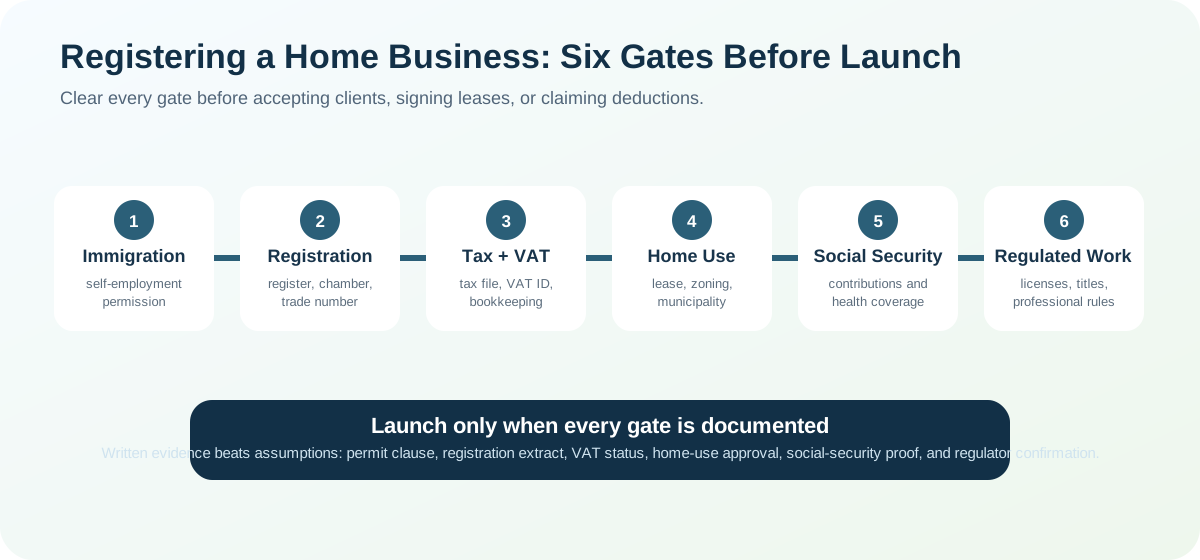
Core answer
If you are an EU, EEA, or Swiss citizen, you normally have the right to work as a self-employed person in another EU country, although you may need to register your residence and prove self-employed status after the first three months. If you are a non-EU citizen, you should not assume that a visitor visa, student residence card, dependent permit, remote-work visa, or passive-residence permit allows local self-employment. You need a residence status that explicitly permits the activity in the country where the business is operated.
After immigration permission, most home businesses must register with a national or local business register, tax authority, or chamber. Then you must test whether the home address can be used for business, whether your lease or mortgage allows it, whether customers, stock, equipment, signage, noise, food handling, or hazardous materials trigger a municipal permit, and whether your profession is regulated.
Official EU guidance is helpful for the framework, but the decisive rules are national and local. Your starting point should be the host country's Point of Single Contact, business portal, tax authority, social-security institution, municipality, and regulated-professions database.
Decision matrix
| Layer | Main question | Typical authority | What can go wrong |
|---|---|---|---|
| Immigration permission | Are you personally allowed to be self-employed in this country? | Immigration office, consulate, residence authority | Business is registered but the founder is not legally allowed to work |
| Business registration | Does the activity need registration, notification, chamber enrollment, or a trade number? | Business register, chamber, local municipality | Fines, inability to invoice, banking refusal |
| Tax and VAT | Do you need an income-tax file, VAT number, SME exemption, payroll account, or bookkeeping setup? | Tax authority | Late VAT, wrong reverse-charge treatment, no deductible expense trail |
| Home-use rules | Can this dwelling legally host this activity? | Municipality, planning office, landlord, mortgage lender | Lease breach, zoning enforcement, insurance denial |
| Social security | Which country collects self-employed contributions and provides health coverage? | Social-security institution, health insurer | Duplicate contributions, no health cover, invalid A1/S1 assumptions |
| Regulated activities | Is the profession or sector restricted? | Professional chamber, regulator, ministry | Unauthorized practice, invalid insurance, criminal or administrative penalties |
1. Immigration Permission Comes Before Business Registration
For EU citizens, the baseline rule is favorable: EU nationals are generally entitled to work in another EU country as employees or self-employed persons without a work permit. Your Europe states that EU nationals can work as self-employed persons in another EU country and may need to register residence after the first three months. See Your Europe: Working abroad and Your Europe: Workers' residence rights.
For non-EU citizens, the rule is different. EU immigration law is partly harmonized, but each Member State decides many admission conditions. The European Union's immigration portal explains that non-EU nationals should apply directly to the authorities of the EU country where they plan to move, because there is no EU institution that issues residence permits for individual countries. See European Union: Immigration to the EU.
Do not rely on the phrase "right to reside" unless it also includes the right to conduct the planned business. A dependent residence card may allow employment but not independent business. A student permit may restrict working hours or self-employment. A digital-nomad permit may allow services to foreign clients but restrict local clients. A passive-income visa may prohibit work. A single permit may cover residence and work, but the permitted work can be tied to the approved activity. The recast Single Permit Directive creates a common procedure and equal-treatment framework for many non-EU workers, but it does not replace national admission rules for every self-employed case. See EUR-Lex: Single permit for non-EU workers.
Immigration Questions to Answer in Writing
| Question | Why it matters |
|---|---|
| Does my residence status allow self-employment, not just residence? | A residence right is not necessarily a work right |
| Does it allow local clients, foreign clients, or both? | Some remote-work routes are designed for foreign-source clients |
| Does it allow the exact profession? | Regulated activities may need separate approval |
| Must the business plan, income level, insurance, or qualifications be approved before registration? | Some countries require pre-approval for self-employed permits |
| Can I change from employee, student, dependent, or visitor status to self-employed status inside the country? | In-country switching rules differ |
| Can I register before the permit is issued? | Some systems require a tax or business number first; others require immigration approval first |
2. Business Registration: Use the Host Country's Point of Single Contact
The EU Services Directive requires Member States to provide Points of Single Contact for many service providers. These portals help entrepreneurs find formalities and complete procedures online. The European Commission describes Points of Single Contact as national e-government portals covering permits, notifications, regulated professions, labor and social law, and other formalities. See European Commission: Points of Single Contact.
Your Europe's business guidance states that once you choose a legal structure, you will usually need to register the business and sometimes apply for permits or licenses. See Your Europe: Starting a business in the EU and Your Europe: Registration, permits and licences.
For a home business, the registration route depends on the country and the legal form. A sole proprietor may register with a tax office, municipality, commercial register, chamber of commerce, or professional register. A limited company may require articles of association, a notary, beneficial-owner reporting, share capital, director identification, and accounting obligations.
3. Legal Form: Sole Proprietor, Freelancer, or Company?
| Form | Best for | Main strengths | Main cautions |
|---|---|---|---|
| Sole proprietor or individual entrepreneur | Low-risk consulting, design, tutoring, digital services | Fast setup, simple bookkeeping, direct taxation | Unlimited liability, harder to separate personal and business risk |
| Registered freelancer or liberal profession | Professional services where national law recognizes liberal professions | May avoid some trade-register rules | Professional status can be narrow; some activities need chamber membership |
| Limited company | Higher liability risk, employees, investors, agency contracts, product sales | Legal separation, credibility, potential tax planning | Accounting, filings, director duties, bank onboarding |
| Branch of foreign company | Existing non-European business expanding locally | Continuity with existing entity | Permanent establishment, payroll, VAT, legal representative issues |
| Platform or marketplace seller | Online sales, creator economy, cross-border B2C services | Quick market access | VAT, consumer law, platform reporting, product compliance |
The simplest form is not necessarily the safest. If customers visit the home, inventory is stored there, regulated advice is provided, food or cosmetics are produced, or the activity creates safety risk, a limited company does not remove the need for permits, professional insurance, and home-use approval.
4. Tax and VAT: Register Early, Even if Revenue Is Small
Business registration does not automatically solve tax. You may need a personal tax number, business tax account, VAT identification number, local tax registration, bookkeeping setup, and e-invoicing capability. EU countries do not have a single income-tax regime for self-employed foreigners. Your Europe explains that there are no EU-wide rules determining how income of people living or working abroad is taxed; tax residence is determined by national law and tax treaties. See Your Europe: Income taxes abroad.
VAT is partly harmonized at EU level, but local registration thresholds, invoicing rules, returns, and exemptions differ. Your Europe explains that VAT obligations depend on whether you sell goods or services and whether customers are businesses or final consumers. See Your Europe: Cross-border VAT.
Since January 1, 2025, the EU SME VAT scheme allows eligible small enterprises established in an EU Member State to apply for domestic or cross-border VAT exemption if they meet the EU-wide and national thresholds. The EU VAT SME portal states that the Union annual turnover threshold is EUR 100,000 and that national exemption thresholds cannot exceed EUR 85,000, subject to Member State implementation. See European Commission: VAT rules for small enterprises and European Commission: Cross-border SME scheme.
5. VAT Scenarios for Home Businesses
| Scenario | VAT issue | Practical action |
|---|---|---|
| Local services to local consumers | Domestic VAT or exemption threshold | Check domestic VAT threshold and invoicing rules |
| B2B services to another EU country | Place-of-supply and reverse-charge treatment may apply | Validate client VAT number and invoice correctly |
| B2C digital services in the EU | Customer-location rules may apply | Assess OSS or SME scheme eligibility |
| Goods shipped from home to EU consumers | Distance-sales threshold and destination VAT rules | Track EU-wide B2C sales by country |
| Services to non-EU clients | Often outside EU VAT, but use-and-enjoyment exceptions can apply | Keep contracts, client location evidence, and tax advice |
| Buying foreign software or services | Reverse-charge VAT may apply | Record supplier invoices and self-account for VAT if required |
6. Home-Office, Lease, Zoning, and Municipal Constraints
A home business must be legal at the address. The address question has two separate parts: whether the business may use the home as its administrative address, and whether the activity may physically operate there.
France's public business portal explains that domiciliation gives an individual enterprise an administrative and legal address and is a prerequisite before registration. See Service-Public Entreprendre: Domiciling an individual enterprise. The Netherlands business portal states that anyone running a business from home should check the local environment plan, notify or apply to the municipality if needed, and comply with mortgage or rental agreements. See Business.gov.nl: Running a business from home. German chambers also warn that a trade registration does not replace building-use approval where residential zoning is affected. See IHK Cottbus: Trade registration does not replace building approval.
Home Business Risk Matrix
| Activity pattern | Usually lower risk | Usually higher risk |
|---|---|---|
| Desk-based services | Writing, consulting, coding, bookkeeping | Regulated legal, tax, investment, or medical advice |
| Client interaction | Online meetings only | Frequent client visits, waiting room, signage |
| Inventory | No stock or small office supplies | Product storage, flammables, food, cosmetics, medical items |
| Noise and traffic | Normal residential use | Deliveries, staff, equipment, neighbors affected |
| Property status | Owner-occupied with mortgage approval | Rental, social housing, condominium restrictions |
| Tax deduction | Small workspace, documented use | Claiming household costs without meeting strict local rules |
7. Social Security and Health Insurance
The EU coordination principle is that a mobile worker is generally covered by the legislation of only one country at a time. The European Commission states that, as a basic rule, employed or self-employed persons are subject to the legislation of the country where they actually work, and special rules apply for posting and work in multiple countries. See European Commission: Which social-security rules apply.
This matters because social-security registration is often the step that converts a "business number" into a real operating status. In Spain, for example, the official Social Security site describes the Special Regime for Self-Employed Workers and states that self-employed workers are responsible for affiliation and contributions. See Spanish Social Security: Special Regime for Self-Employed Workers. In France, the public business portal states that individual entrepreneurs obtain social protection by paying social contributions. See Service-Public Entreprendre: Social protection of the individual entrepreneur.
8. Regulated Activities: Check Before Advertising
A profession is regulated if access, title, or scope of practice is controlled by law. Your Europe explains that a person may need a specific degree, exam, or registration with a professional body before practicing. See Your Europe: Regulated professions. The European Commission also maintains a regulated-professions database covering EU, EEA, and Swiss access requirements. See European Commission: Database of regulated professions.
Common home-business activities that may trigger regulated rules include childcare, healthcare, psychotherapy, architecture, engineering, financial advice, insurance intermediation, legal advice, tax representation, food production, cosmetics, construction trades, passenger transport, and education for certified qualifications.
Registration Checklist
| Step | Evidence to keep |
|---|---|
| Confirm right to reside and work as self-employed | Residence card, permit clause, immigration-office confirmation |
| Choose legal form | Business plan, liability assessment, accountant memo |
| Check regulated-profession status | Database result, chamber reply, qualification recognition |
| Check home address legality | Lease or mortgage permission, municipal/zoning response |
| Register business | Registration extract, trade number, chamber number |
| Register tax and VAT | Tax number, VAT ID, SME exemption approval if applicable |
| Register social security and health insurance | Social-security number, insurer confirmation, A1/S1 if relevant |
| Set up invoices and accounting | Invoice template, bookkeeping categories, bank account |
| Buy insurance | Professional liability, product liability, home-business endorsement |
| Review annually | Turnover thresholds, permit renewals, residence renewals, activity changes |
FAQ
Can a foreigner run a business from home in Europe?
Often yes, but only if immigration status, business registration, tax/VAT setup, home-use rules, social security, and any regulated-profession rules all allow the activity. A valid residence card does not necessarily authorize self-employment.
Do I need a separate business address?
not necessarily. Some countries allow a home address as the administrative address, while others require consent, a registered office provider, or restrictions based on lease, zoning, condominium, mortgage, or activity type.
Is a home business easier than registering a company?
It can be simpler, especially for desk-based services, but it is not exempt from tax registration, VAT checks, social-security contributions, consumer law, professional rules, or insurance requirements.
Can I register before my residence permit is approved?
Sometimes, but the safe answer depends on the country and permit route. Some authorities want business-registration evidence before issuing a self-employed permit, while others require immigration approval before business activity starts.
Home-use approval workflow
Home-business registration should start with the property, not the tax form. Confirm whether the home can legally be used as a business address, client-facing workplace, storage location, or administrative office. The answer can come from a lease, condominium rules, mortgage terms, municipal zoning, building use, insurance policy, or professional chamber requirement. A tax registration does not override a lease or local planning restriction.
For a desk-based online service with no client visits, no stock, no signage, and no employees, the home-use risk is usually lower. For food, childcare, cosmetics, fitness, healthcare, repair work, storage, deliveries, or any activity involving clients at the home, the review becomes more serious. Noise, safety, fire, waste, neighbors, and consumer-protection rules can matter even for a small business.
Keep written evidence of permissions. A landlord email, municipal reply, condominium approval, insurer endorsement, or chamber confirmation is stronger than an assumption. If the home address will be public in a register, consider privacy and whether a registered-office provider is more appropriate.
Immigration and self-employment alignment
Foreigners should check whether their residence status permits self-employment before taking clients. A residence card may allow employment but not self-employment. A student status may allow limited work but not full-time business activity. A spouse or family permit may have its own rules. A digital nomad or entrepreneur route may require foreign clients, minimum income, business plan, insurance, or renewals tied to activity.
The immigration file should match the business file. If the permit application says the person will run an online consulting business from home, the tax registration, invoices, website, and bank activity should not describe a different activity. If the person changes activity, adds local clients, hires staff, or moves from side business to full-time work, the immigration position should be reviewed.
Non-EU citizens should be especially careful about timing. Some countries require business-registration evidence before issuing self-employment residence permission. Others require residence permission before business activity can begin. The safe sequence is country-specific and should be confirmed before advertising services or signing contracts.
Tax, VAT, and invoicing setup
A home business still needs a professional tax setup. Register the correct legal form, obtain the necessary tax number, determine VAT status, choose invoice numbering, and decide how to separate business and personal expenses. If the business sells to other EU countries, reverse charge, OSS, digital-service, and VAT-number validation rules may apply even when turnover is modest.
The invoice template should include legal name, business name if different, address or registered office, tax number or VAT ID where required, invoice number, date, service description, customer details, VAT treatment, payment terms, and bank details. If the business uses a home address but wants privacy, check whether another address solution is legally permitted before issuing invoices.
For deductions, keep a clear allocation method for home internet, phone, utilities, rent, equipment, and office supplies. Do not claim household costs without checking local rules. A small home office can still trigger audit questions if the deduction is large, unsupported, or inconsistent with the business activity.
Banking and insurance controls
A separate business bank account is usually cleaner even when not strictly mandatory. It helps prove income, expenses, tax reserves, VAT collected, and client payments. Mixing personal groceries, rent, business subscriptions, and client receipts creates avoidable accounting risk. If the business grows, a separate account also helps with loans, leases, and due diligence.
Insurance should be reviewed before the first client. Home insurance may exclude business activity, professional equipment, stock, client visits, or liability arising from services. Professional liability, product liability, cyber insurance, and home-business endorsements may be needed depending on the activity. A consultant, designer, food seller, tutor, therapist, and ecommerce seller do not have the same risk profile.
Growth triggers
Reassess the setup when revenue grows, VAT thresholds approach, clients visit the home, stock increases, deliveries become frequent, the business hires help, the activity becomes regulated, the person changes residence status, or the home address changes. A setup that works for a quiet side business may fail when the business becomes visible.
If the business outgrows the home, move before the home-use facts become indefensible. Coworking, registered-office services, storage units, commercial kitchens, workshops, or small offices can reduce zoning, insurance, and neighbor problems.
Practical registration sequence
A safe home-business sequence starts with eligibility. Confirm immigration permission, residence address, right to self-employ, and whether the activity is regulated. Then check whether the home address may be used for the business. Only after those steps should the person complete business, tax, VAT, social-security, and insurance registrations.
Next, build the public-facing identity. Decide whether to operate under a personal legal name, trade name, sole-trader name, company name, or registered brand. Check whether the name is available, whether it implies a regulated profession, whether it conflicts with trademarks, and whether the invoice name matches the tax registration. A mismatch between website, invoices, tax registration, and bank account can create onboarding problems.
Then prepare the first-client file. It should include contract template, invoice template, privacy notice if personal data is handled, terms and conditions for consumers where relevant, cancellation rights if selling online, payment method, bookkeeping category, and insurance. A person who registers before preparing these tools may take clients in a way that creates consumer-law or tax errors.
Address privacy and registered-office options
Using a home address can expose personal information if the register, invoices, website, or client contracts require an address. This is not only a privacy issue; it can affect safety, landlord approval, and professional perception. Some countries allow a service address, accountant address, registered-office provider, coworking address, or mailbox arrangement, but rules vary.
Do not assume a mailbox is acceptable. Tax authorities, banks, and registries may reject addresses that do not show real contact, business presence, or document service capability. If the business needs a non-home address, choose an option that is valid for registry, tax, bank, and invoice purposes.
If clients visit the home, privacy and safety risks increase. The business may need appointment rules, visitor insurance, accessibility checks, fire-safety review, or municipal permission. Many home businesses should avoid client visits entirely and use coworking rooms or rented meeting spaces when in-person meetings are necessary.
Consumer, data, and online-sales duties
A home business that sells to consumers may need more than registration. Consumer contracts can require clear pricing, cancellation rights, complaint procedures, delivery terms, refund rules, and business identity disclosure. Online sales can trigger platform rules, distance-selling requirements, VAT evidence, and data-protection obligations.
If the business collects personal data, it should maintain basic privacy controls: what data is collected, why, where it is stored, who can access it, how long it is retained, and how deletion or access requests are handled. A one-person business still has data obligations if it handles client records, mailing lists, payment details, health information, children's data, or employee/contractor information.
Digital businesses should separate personal and business systems. Use business email, business cloud storage, secure passwords, backups, invoicing software, and device security. A laptop used for household browsing and client files without backups is a business continuity risk.
When a home business should become a separate premises or company
A home business should consider moving to a commercial structure when revenue grows, liability rises, stock increases, clients visit, staff are hired, regulated activity expands, or personal assets need protection. A sole-trader home setup can be efficient at the start, but it may not be suitable for product sales, employees, larger contracts, or investor relationships.
Moving to a company can change tax, payroll, accounting, insurance, banking, and immigration. The founder may need a salary, dividends, director registration, corporate accounts, and separate contracts. The home address may still be used administratively, but the business may need a registered office or operating premises.
The decision should be planned before the original setup breaks. If a landlord complains, insurer refuses coverage, neighbor reports traffic, or tax authority questions deductions, the business is already reacting. A quarterly review of revenue, activity, risk, and property use keeps the structure ahead of the facts.
Evidence pack for inspections or audits
Keep a folder with residence permission, business registration, tax number, VAT status, social-security registration, home-use approval, insurance, regulated-profession checks, invoice samples, contracts, bookkeeping records, and annual reviews. If the business uses a home-office deduction, include the calculation and evidence. If the business does not receive clients at home, state that in the file and keep client-meeting evidence elsewhere.
An evidence pack is especially useful for foreigners because several authorities may ask overlapping questions. Immigration wants to know whether the activity is permitted. Tax wants to know whether income is reported. Social security wants the contribution basis. The municipality may care about home use. The bank wants to understand business activity. Consistent records keep those answers aligned.
Source Risks and Factual Uncertainty
This article uses EU-level guidance and selected national examples checked on May 14, 2026. Home-business rules are especially local: municipalities, leases, building-use rules, professional chambers, tax offices, and immigration offices can all change the answer. Readers should treat the framework as a sequencing tool and confirm the exact host-country process before taking clients.
Official and Primary Sources
- Your Europe: Working abroad
- Your Europe: Workers' residence rights
- European Union: Immigration to the EU
- European Commission: Points of Single Contact
- Your Europe: Starting a business in the EU
- Your Europe: Cross-border VAT
- European Commission: Social-security coordination
- Your Europe: Regulated professions
Related Reading
- Register A Business In Europe As A Foreigner
- Business Registration Requirements In Europe
- Income Tax Rules For Freelancers In Europe
Bottom Line
A foreigner can often register a home business in Europe, but the safe sequence is not "register first, fix permissions later." Confirm immigration permission, identify the correct legal form, use the national Point of Single Contact, check VAT and tax status, obtain home-use permission, register social security, and verify regulated activities before taking clients. The smaller the business, the easier the paperwork may be, but even a one-person home office can create tax, immigration, insurance, and zoning consequences.
Official source and decision check
Use this section as the practical checkpoint for How to Register a Home Business in Europe as a Foreigner. The reader decision is whether the available evidence is strong enough to act now, or whether the file should first be confirmed with the competent authority. Rules can change by country, status and date, so treat this guide as orientation for the file and recheck the current rule before relying on a company-registration filing, tax setup, business-bank onboarding or founder evidence deadline.
For expats, foreigners, students, workers, founders, families and other mobile readers, record the reader category, country, residence status and deadline before comparing the official source with the article checklist.
Official sources to verify first
- Your Europe starting a business
- Your Europe company registration
- European Commission single market and industry
- European e-Justice business registers
- EUR-Lex EU law access
| Decision point | What to check | Reader action |
|---|---|---|
| Administrative decision | Confirm that the case is really about administrative decision, not a different category that follows another rule. | Write down the country, authority, dates, status and document number before asking for a decision. |
| File for competent authority | Keep the identity, residence and document evidence in one dated file, with originals, translations where required and proof of submission. | Save receipts, emails, appointment confirmations, payment records and authority replies in the same order as the checklist. |
| How to Register a Home Business in Europe as a Foreigner fallback | If the answer is refused, delayed or unclear, identify the competent authority, review window, complaint route or regulated provider escalation path. | Ask for the reason in writing and compare it with the official source before paying again, travelling, closing an account or resubmitting. |
| When the answer is unclear | What to do next |
|---|---|
| The authority, bank, insurer, employer or provider gives a verbal answer only. | Ask for the answer in writing, save the name of the office or provider, and compare it with the official source before changing travel, payroll, residence or payment plans. |
| The file depends on a deadline, appointment, payment, address or status change. | Keep the dated receipt, note the next deadline, and avoid closing the old route until the replacement document, account, policy or registration is confirmed. |
Related guides to cross-check
- First month in Europe checklist
- Living in one European country and working in another
- EU remote working guide
- Cross-border worker benefits in the EU
- Private health insurance documents in Europe
For legal, tax, medical, immigration or financial consequences, confirm the position with the competent authority or a qualified adviser. This page is designed to organize the decision, source checks and next steps; it is not a substitute for case-specific professional advice.