Last updated
EU Remote Working: Visa, Payroll, Social Security, Tax and Employer Risk Controls
For new arrivals, expats, remote workers, and cross-border households, the hard part of EU Remote Working: Visa, Payroll, Social Security, Tax and Employer Risk Controls is knowing which fact changes the answer. It explains checking tax position, payroll evidence, social-security exposure, net pay, and cross-border filing questions across Europe, then shows how to separate residence, treaty, payroll, contribution, withholding, and filing questions before signing or moving money. The later sections connect eu remote-work approval workflow, executive summary, and immigration and residence so the next step is easier to judge. Read it before submitting forms, moving money, choosing a provider, or assuming that a rule from another country applies.
A policy that says "work from anywhere in Europe" is not a compliance model. The real model must answer harder questions: who has the right to work, where is the work physically performed, which country's social security system applies, where should tax be withheld, which mandatory employment protections apply, and whether the employer has accidentally created a local footprint.
This guide is for employees, founders, HR teams, mobility teams, payroll teams, and remote-first companies designing EU remote work before facts drift into liability. It is general information, not legal, tax, employment, immigration, payroll, or social security advice.
EU remote-work approval workflow
A remote-work approval should not be a simple manager preference. It needs a documented decision across immigration, payroll, social security, tax, data, and employer-presence risk.
| Control area | Evidence to collect | Stop condition |
|---|---|---|
| Residence and work rights | Nationality, visa or permit, host country, work location, and duration. | The worker has no clear right to perform the role from that country. |
| Payroll and social security | Payroll country, A1 or coordination evidence, employer registration, and contribution plan. | No owner can explain how contributions will be handled. |
| Tax and PE risk | Days, management authority, client contact, contract-signing powers, and local office pattern. | The worker may create employer tax presence or personal tax residence unexpectedly. |
| Governance record | Approval date, countries allowed, day cap, review cadence, data restrictions, and revocation rule. | The arrangement cannot be audited after a renewal, payroll review, or tax question. |
Executive Summary
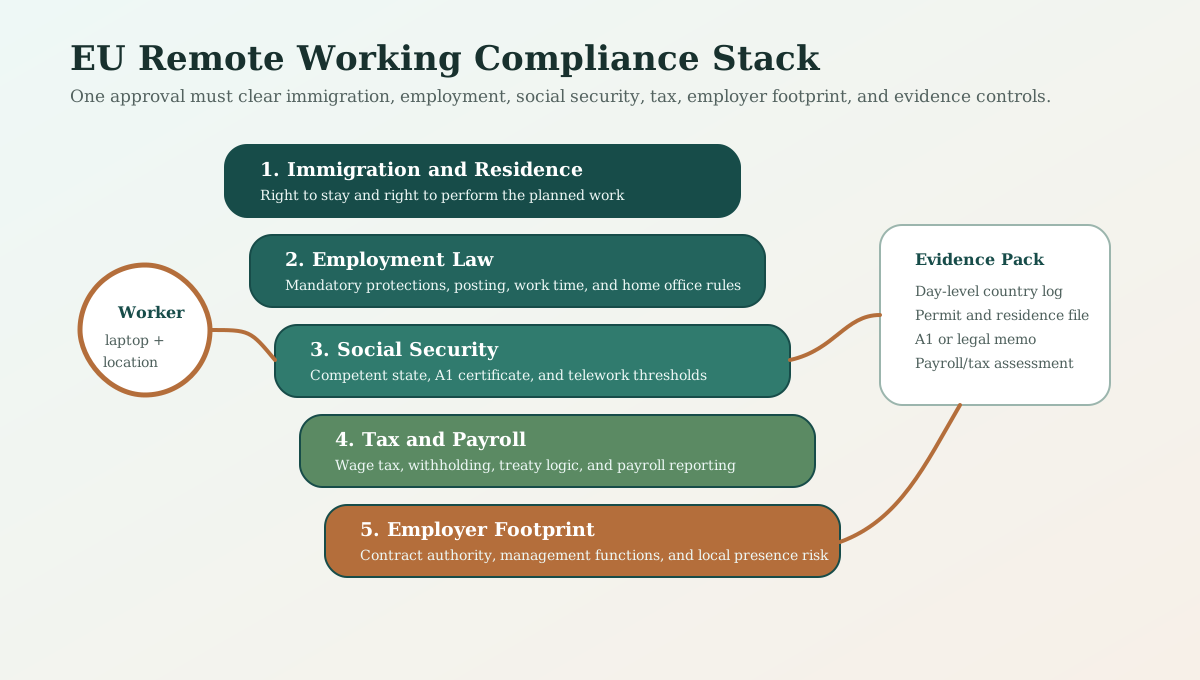
EU remote work must pass six gates before a worker starts. A favorable result in one gate does not clear the others.
| Layer | Key question | Why it matters |
|---|---|---|
| Immigration and residence | Is the person allowed to live and work in the host country? | A visa-free stay is not automatically work authorization. |
| Employment law | Which mandatory protections apply to the work? | Local working time, pay, leave, health and safety, and termination rules may apply. |
| Social security | Which country is competent for contributions and benefits? | EU rules generally allow only one applicable system at a time. |
| Tax and payroll | Where is employment income taxable and where must payroll report? | Tax rules differ from social security rules. |
| Employer presence | Does the worker create a taxable or legal presence for the employer? | Local registration, payroll, corporate tax, or labor obligations may arise. |
| Operational controls | Can the company prove where and how work was performed? | Without evidence, a policy is not defensible. |
Primary official references include Your Europe residence rights, Your Europe working abroad, European Commission Schengen visa guidance, Directive 2003/88/EC on working time, Rome I Regulation, Regulation (EC) No 883/2004, and the European Labour Authority page on posting of workers.
Immigration and Residence
EU citizens generally have the right to work in another EU country without a work permit, but residence formalities can still apply. Your Europe explains that EU citizens may stay in another EU country for up to three months without registering as residents, although some countries require presence reporting. Longer stays depend on status, such as worker, self-employed person, student, or person with sufficient resources.
For non-EU nationals, the answer is national and permit-specific. A Schengen short-stay visa or visa-free stay generally concerns a temporary visit of up to 90 days in any 180-day period, but it does not automatically authorize local employment or long-term residence. A national work permit, residence permit, digital-nomad route, intra-corporate assignment, or Blue Card may be required depending on the person's nationality, destination, employer, role, and duration.
The EU Blue Card is a work-and-residence route for highly qualified non-EU workers in a specific Member State. It is not a general permission to live anywhere in the EU while working remotely for any employer. See European Commission: EU Blue Card.
Immigration Decision Table
| Worker scenario | First question | Practical control |
|---|---|---|
| EU citizen working temporarily from another EU country | Are registration or residence formalities triggered? | Check host-state registration thresholds and local employment rules. |
| Non-EU employee with one Member State permit | Does that permit allow residence and work from the second state? | Review permit wording before any work starts. |
| Schengen visitor doing "incidental" work | Is the activity permitted under national rules? | Do not rely on 90/180-day travel permission as work authorization. |
| Digital nomad applicant | Does the route permit employee work, self-employment, local clients, or family members? | Match contract, income source, and insurance to official checklist. |
| EU Blue Card holder | Is mobility to another Member State allowed under the route and timing? | Confirm host-state notification or application duties. |
Employment Law
Remote work does not erase local labor law. EU law and national law interact through several frameworks, including working-time rules, posted-worker rules, occupational safety rules, and conflict-of-law rules.
The contract can choose a governing law, but Rome I does not necessarily remove mandatory worker protections in the country where the employee habitually works. The Working Time Directive sets EU-level minimum concepts, but implementation and enforcement remain national. For posted workers, host-state minimum terms may apply when an employee is sent temporarily to another Member State to provide services.
Important sources include European Labour Authority posting resources, the EU-OSHA page on the framework agreement on telework, and ELA's guidance on posting workers within the EU.
Employment-Law Risk Table
| Remote-work fact | Why it matters | Control |
|---|---|---|
| Worker habitually works from another country | Habitual place of work can affect mandatory protections. | Location-specific employment-law memo. |
| Employee is sent to client site abroad | Posted-worker rules may apply. | Posting assessment and host-country declaration check. |
| Contractor works full-time under company control | Misclassification risk rises. | Independence analysis and local-law review. |
| Remote worker manages local staff | Local management function can change risk profile. | Restrict authority or register appropriately. |
| Home office is required by employer | Occupational safety and expense rules may apply. | Written home-office assessment and equipment policy. |
Social Security
Social security is the most structured part of EU remote working because Regulations 883/2004 and 987/2009 coordinate applicable legislation.
The usual rule is that social security follows the country where work is performed. If a person habitually works in two or more Member States, Article 13 rules may apply. Where the person performs a substantial part of activity in the residence state, residence-state legislation may become competent.
The European Commission explains that a person moving within the EU, Iceland, Liechtenstein, Norway, or Switzerland is subject to the legislation of only one country and that the institutions decide which legislation applies. See which social security rules apply.
For cross-border telework, the 2023 multilateral framework agreement can, in participating countries and under conditions, allow certain employees to remain under the employer-state social security system while teleworking from the residence state for 25% to less than 50% of working time. EURES states that the agreement is based on Article 16 of Regulation 883/2004 and requires a request to the competent institution. It does not decide tax, employment law, or immigration. Official overview: EURES: cross-border telework and social security.
Social Security Scenarios
| Scenario | Main rule issue | Evidence |
|---|---|---|
| Employee lives in France and works for German employer with 20% home telework | Employer-state coverage may remain under ordinary logic depending on facts. | Workday log and A1 where needed. |
| Employee works 40% from residence state and 60% from employer state | Framework agreement may be available if both states participate. | Article 16 request, employer and employee consent, A1 result. |
| Employee works 60% from residence state | Residence-state coverage risk rises. | Competent-state determination before payroll continues. |
| Posted worker temporarily assigned abroad | Posting rules can keep home-state coverage temporarily. | A1 certificate and assignment documentation. |
| Freelancer serves clients across several states | Self-employed multi-state rules differ from employee rules. | Activity calendar, client locations, place-of-work evidence. |
Tax and Payroll
Tax does not follow the A1 certificate automatically. Social security state and tax state can diverge.
Your Europe explains that when a person lives in one EU country and works in another, taxation depends on national laws and bilateral double-tax agreements, and these rules can differ from social security rules. See Your Europe: double taxation.
The "183-day rule" is not a universal permission slip. It is treaty- and country-specific, and the details matter: employer residence, who bears salary cost, whether a permanent establishment exists, and where the work is physically performed.
Tax-treaty outcomes depend on the exact bilateral treaty and facts, so remote-work files should separate day count, employer location, and where the work is physically performed. See Your Europe: double taxation.
Payroll Decision Table
| Fact pattern | Payroll concern | Control |
|---|---|---|
| Employee works abroad for a few days | Policy limit, immigration permission, wage tax exposure | Pre-approval and day tracking |
| Employee works abroad for months | Wage withholding, social security, tax residence | Country tax memo and payroll assessment |
| Employer has no entity in host country | Employer registration or EOR risk | Local payroll feasibility analysis |
| Employee signs contracts abroad | Permanent establishment and authority risk | Contract-signing restrictions |
| Salary cost is recharged to local entity | Treaty employment-income exception may fail | Intercompany recharge review |
Employer Presence and Permanent Establishment Risk
Remote work can create employer risk when the employee's role is not merely internal support. Risk rises when the worker:
| Risk factor | Why it matters |
|---|---|
| Habitually negotiates or concludes contracts | May indicate local business presence. |
| Manages local staff or operations | Suggests operational substance in the host country. |
| Represents the company to customers or authorities | Can create local registration or labor obligations. |
| Works permanently from a home office required by the employer | May strengthen fixed-place arguments in tax analysis. |
| Performs regulated activities | Licensing and supervision may attach locally. |
This does not mean every remote employee creates a permanent establishment. It means the company needs a role-based assessment rather than a generic remote-work approval.
Scenario Matrix
| Scenario | Main risk | Minimum control |
|---|---|---|
| Employee spends two weeks working while visiting another EU country | Immigration/work authorization and tax-policy limits | Written approval, day count, no local customer authority |
| Employee lives in France and works partly from home for German employer | Social security, payroll, tax, employment law | A1/telework assessment, payroll memo, workday log |
| Non-EU worker with one Member State permit wants to work from another | Permit scope and residence legality | Immigration review before work starts |
| Contractor works full time for one company from another country | Misclassification, tax, social security | Contractor independence review and local tax analysis |
| Senior salesperson relocates abroad | Permanent establishment and payroll risk | Contract-authority restriction and tax counsel review |
| Posted employee sent to client site | Posted-worker obligations | Posting declaration, host minimum terms, A1 |
Evidence Pack
A remote-work arrangement should not begin until the evidence pack exists.
| Evidence | Owner | Update trigger |
|---|---|---|
| Passport, residence permit, right-to-work evidence | Worker and HR | New country, new permit, expiration |
| Employment contract and remote-work addendum | HR/legal | Role, location, schedule, or manager change |
| Day-level work-location calendar | Worker/manager | Monthly close |
| Social security certificate or assessment | Payroll/legal | Threshold change, new country, renewal |
| Tax and payroll memo | Finance/tax | More days, new duties, new country |
| Data and equipment controls | IT/security | New jurisdiction or device |
| Health and safety checklist | HR/OSH | New home-office location |
| Contract-authority matrix | Legal/sales ops | Customer-facing role change |
Approval Framework
Use a four-gate approval process.
| Gate | Question | Output |
|---|---|---|
| Gate 1: status | Can the person legally live and work there? | Immigration/residence clearance |
| Gate 2: worker classification | Is the person employee, posted worker, contractor, director, or self-employed? | Classification memo |
| Gate 3: contribution and tax | Which social security and payroll/tax rules apply? | A1/social security and tax workflow |
| Gate 4: employer footprint | Does the role create local presence risk? | Restrictions or registration plan |
If any gate is unresolved, the arrangement should be paused rather than treated as low risk.
Practical Policy Rules
A strong EU remote-work policy should say:
- Remote work abroad requires preapproval before travel or relocation.
- The employee must keep a day-level country log.
- Work from a country not listed in the approval is prohibited unless reapproved.
- Customer contract negotiation, signature, hiring, and local management authority are restricted unless separately cleared.
- The company may stop the arrangement if work authorization, social security, tax, or security evidence becomes stale.
- A1 and social security evidence are not tax clearance.
- Schengen day limits do not equal employment authorization.
- Approval expires automatically on role change, address change, permit expiration, or threshold breach.
FAQ
Can an EU citizen work remotely from any EU country?
An EU citizen has broad free-movement and work rights, but that does not eliminate tax, social security, payroll, employment-law, registration, or employer-presence obligations.
Can a non-EU citizen work remotely in the EU on a tourist stay?
A short-stay Schengen permission is not a general work permit. The answer depends on nationality, destination country, permit type, activity, employer, and duration.
Does an A1 certificate solve everything?
No. It supports the social security position. It does not settle income tax, immigration, labor law, data security, or permanent establishment risk.
Is remote work under 183 days always safe?
No. The 183-day concept is not a universal safe harbor. Tax treaties and national rules contain conditions, and payroll or employer-presence duties may arise earlier.
What is the best first control?
A country-by-country workday log. Without location evidence, social security, tax, immigration, and policy analysis become guesswork.
Final Checklist
- Confirm immigration and residence status before work begins.
- Classify the worker correctly: employee, contractor, posted worker, director, or self-employed.
- Track work location by day and country.
- Determine social security coverage and obtain A1 or equivalent evidence where needed.
- Analyze tax and payroll separately from social security.
- Restrict contract-signing and local authority for higher-risk roles.
- Check posted-worker obligations for temporary service assignments.
- Update health, safety, cybersecurity, and data controls for the remote workplace.
- Set a review date and automatic stop conditions.
- Reassess after every change in country, role, employer, residence, or work pattern.
Governance model for EU remote working
An EU remote-work program needs ownership. HR usually owns policy and employee experience, but legal, payroll, tax, social security, immigration, security, and finance all control parts of the answer. If ownership is unclear, approvals become inconsistent and employees learn to treat remote work as an informal benefit rather than a regulated work location.
The governance model should classify requests into low, medium, and high risk. Low-risk requests may include short temporary work by an EU citizen in a preapproved country with routine duties and no client authority. Medium-risk requests may include recurring cross-border work, longer stays, non-EU nationals with residence permits, or roles involving client delivery. High-risk requests include executives, sales authority, regulated work, local hiring, non-EU immigration uncertainty, sensitive data, or countries where the employer has no compliance model.
Each risk tier should have a different approval route. Low-risk requests can use a standardized form and automatic expiry. Medium-risk requests should trigger payroll and social-security review. High-risk requests should require legal and tax approval before travel. A single global yes-or-no policy is usually too blunt for European work patterns.
Remote-work day ledger
The day ledger is the practical backbone of EU remote working. It should capture the country where work is physically performed, the reason for the day, whether the day is work or leave, the employer or client served, and supporting evidence. The ledger should not rely only on self-declared totals at year end. Monthly closure is more defensible.
The ledger should distinguish home office, office work, client visits, business trips, training, conferences, work while travelling, and non-work days. This distinction matters because tax treaties, posted-worker rules, social-security coordination, labor-law obligations, and employer risk may treat categories differently. A calendar that says "remote" is not enough.
Employees should be told that work location is a compliance fact. It is not a minor preference like choosing a desk. If the employee works from a country not approved, the company may need to stop the arrangement or run a new review.
Country register and stop conditions
A company should maintain a country register for EU remote working. The register should list permitted countries, maximum default duration, roles excluded from automatic approval, evidence required, payroll assumptions, social-security assumptions, immigration notes, and security restrictions. The register should also identify countries where remote work is blocked unless counsel approves.
Stop conditions are as important as approval conditions. Approval should end automatically when the employee changes residence, changes role, changes manager, exceeds the day limit, loses work authorization, changes nationality or permit status, starts serving local clients, receives contract-signing authority, or asks to extend beyond the approved period. Automatic expiry protects both employer and employee because it forces review before facts drift.
The country register should be reviewed at least annually. EU and national rules change, and employer operations change. A country that was low risk for a short engineering workation may become high risk once the company has customers, staff, or regulated activity there.
Interaction with digital nomad and remote-work visas
Digital nomad visas can help with residence and immigration, but they are not complete remote-work clearance. A visa may require minimum income, foreign employer or foreign clients, health insurance, clean criminal record, accommodation proof, and local registration. It may also restrict local employment or local clients. The employer still needs tax, payroll, social-security, labor-law, security, and permanent-establishment review.
Workers should not apply for a visa without telling the employer if they will keep the same job. The visa application may describe the employer, income, work location, and duration. If that narrative conflicts with payroll or tax filings, it creates risk. For visa-specific route planning, compare digital nomad visa requirements in Europe and can I work remotely in Europe.
Internal audit questions
A remote-work program is mature when the company can answer basic audit questions quickly. Which employees worked outside their normal country this year? Which countries were used? How many days were worked in each country? Which employees were non-EU nationals? Which roles had customer authority? Which cases had A1 certificates? Which cases had tax memos? Which approvals expired? Which exceptions were denied?
If the company cannot answer these questions, the program is not controlled. The risk may be hidden in calendars, travel expenses, chat approvals, and manager exceptions. A short quarterly audit can identify drift before tax, payroll, immigration, or employment-law problems become expensive.
Contractor and freelancer edge cases
EU remote-work policies often focus on employees, but contractors can create equal or greater risk. A contractor working from another European country may need local business registration, VAT analysis, social-security registration, professional insurance, and proof of independent status. If the company controls working hours, equipment, exclusivity, manager approval, and integration into teams, the contractor may be reclassified as an employee.
Procurement should therefore be part of the remote-work process. Vendor onboarding should ask where the contractor is physically working, whether the contractor is registered locally, whether invoices include the right VAT treatment, and whether the relationship looks independent. A contractor who quietly relocates can change tax, labor, data, and permanent-establishment risk for the company.
For freelancers, the relevant guide is freelance tax thresholds in Europe. The key point is that a remote-work approval for an employee and a freelance registration decision are different workflows.
Data, cybersecurity, and client restrictions
Remote work in the EU is not only an HR and tax issue. Some roles involve client data, trade secrets, regulated information, health data, financial data, government contracts, export-controlled technology, or contractual location restrictions. The company should know whether data may be accessed from the destination country, whether VPN and device controls are sufficient, and whether client contracts restrict offshore or cross-border processing.
Security approval should be required for sensitive roles before travel. The approval should cover device management, network access, data storage, printing, coworking spaces, shared accommodation, incident response, and whether work may be performed from public places. A legally valid work location can still be unacceptable from a security or client-contract perspective.
Quarterly review cadence
Remote-work controls work best when reviewed quarterly. HR should identify approved employees, expired approvals, new country requests, and policy breaches. Payroll should review day counts and withholding assumptions. Tax should review threshold exposure and permanent-establishment risks. Social-security owners should check certificates and renewals. IT should review access from new countries and sensitive-role exceptions.
The quarterly review should produce a short action list: approvals to renew, cases to stop, certificates to obtain, payroll positions to update, countries to reclassify, and employees to contact. This cadence prevents a remote-work program from depending on annual memory.
When to deny a request
Some requests should be declined even if the employee is valuable. Denial is appropriate when the employee lacks legal work authorization, the employer cannot operate payroll or social-security compliance, the role creates unmanaged permanent-establishment risk, client contracts prohibit the location, insurance does not cover the work, data controls are inadequate, or the employee refuses day tracking.
Denial should be documented with the specific unresolved layer. That makes the policy defensible and gives the employee a path to reapply if facts change. A vague "business decision" is less useful than "no current work authorization and no payroll model for this country."
Minimum viable approval record
At minimum, every approved EU remote-work case should have a dated record showing the employee, country, approved dates, nationality or permit basis, role, permitted duties, day limit, social-security position, payroll or tax review status, security approval, and expiry date. If the case later changes, add a new record rather than editing the old one. This creates an audit trail that shows what the company knew when it approved the arrangement.
EU remote working is safe only when it is designed as a controlled arrangement, not treated as travel with a laptop.