Last updated
Freelance Tax Thresholds In Europe: VAT, Income Tax, And Social Contributions
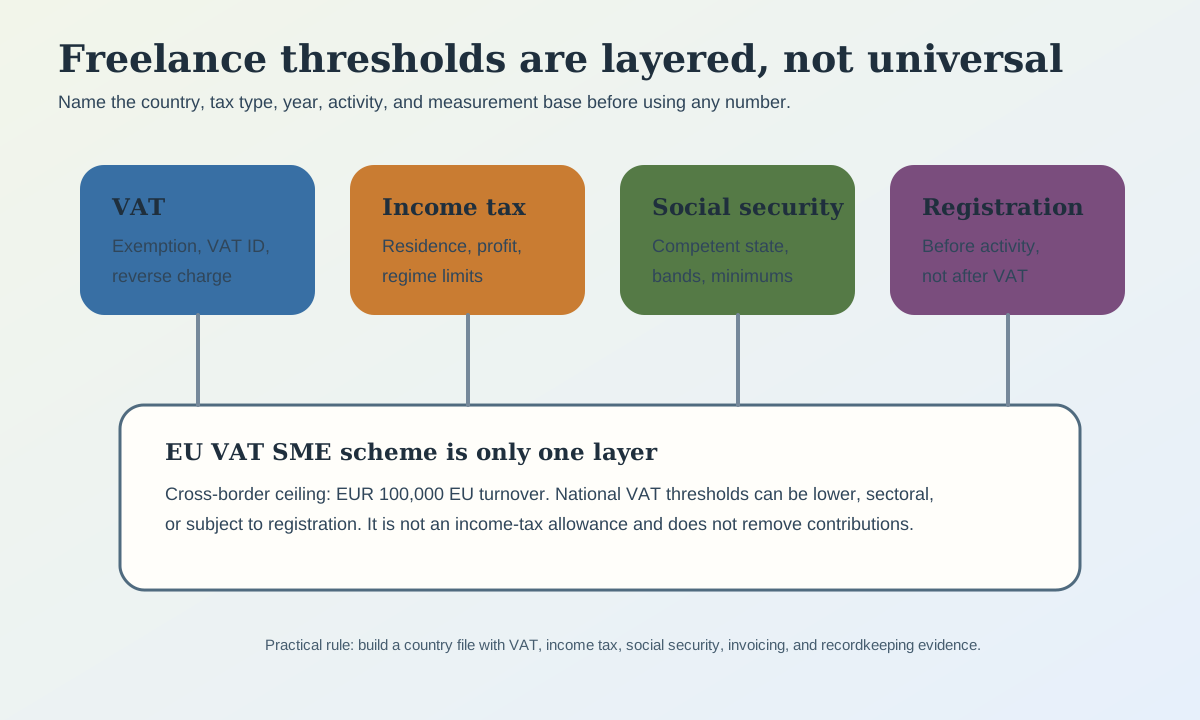
This article treats Freelance Tax Thresholds In Europe: VAT, Income Tax, And Social Contributions as a decision file rather than a generic overview. It explains checking tax position, payroll evidence, social-security exposure, net pay, and cross-border filing questions across Europe, then shows how to separate residence, treaty, payroll, contribution, withholding, and filing questions before signing or moving money. The later sections connect define the country before the threshold, vat thresholds are not income-tax thresholds, and the eu vat sme scheme so the next step is easier to judge. Read it before submitting forms, moving money, choosing a provider, or assuming that a rule from another country applies.
The safest answer is that Europe has no universal freelance tax threshold. The European Union coordinates parts of VAT and social-security coordination, but income tax, business registration, invoicing, and many social-contribution mechanics remain national. Even VAT thresholds differ by country, sector, and activity type.
Sources were checked on May 14, 2026. This guide is educational information, not tax, legal, accounting, immigration, or social-security advice.
Short Answer
A freelancer in Europe should track at least four separate threshold types.
| Threshold type | What it usually controls | Common mistake |
|---|---|---|
| VAT threshold | Whether you charge VAT, use a small-business exemption, or file VAT returns | Treating no VAT as no tax |
| Income-tax threshold | Personal allowance, simplified regime, bracket, filing duty, or advance payments | Confusing turnover with taxable profit |
| Social-contribution basis | Health, pension, disability, unemployment, or self-employed contributions | Ignoring contributions when comparing countries |
| Registration trigger | When to register as self-employed, taxable person, or business operator | Waiting until revenue exceeds a VAT threshold |
A freelancer can be below a VAT exemption threshold and still owe income tax and social contributions. A "no VAT" invoice is not a "no tax" invoice.
Define The Country Before The Threshold
"Europe" is not a tax jurisdiction. Before using any number, identify the legal system and measurement base.
| Question | Why it matters |
|---|---|
| Where are you tax resident? | Tax residence often controls worldwide income reporting |
| Where do you physically perform the work? | Source taxation and social security can follow the work location |
| Where is the client located? | VAT place-of-supply and reverse-charge rules may change |
| What is your legal form? | Sole trader, micro-entrepreneur, company owner, and platform worker can differ |
| What is your activity type? | Services, trade, accommodation, liberal professions, digital services, and mixed activities can use different thresholds |
Your Europe explains that EU countries define tax residence nationally and that spending time in another country can change the tax analysis. See Your Europe: income taxes abroad.
VAT Thresholds Are Not Income-Tax Thresholds
VAT is a tax on supplies of goods and services. Income tax is usually charged on taxable income or profit. Social contributions fund social-insurance systems and may be calculated on turnover, profit, contribution bases, professional categories, or income bands.
| VAT result | What it does not mean |
|---|---|
| You do not charge VAT under a small-business rule | It does not make the income tax-free |
| Your B2B client accounts for VAT under reverse charge | It does not remove bookkeeping or reporting |
| Your supply is VAT-exempt | It may restrict input VAT recovery and still require records |
| You are under a domestic threshold | It may not solve cross-border VAT |
If an article says "freelancers under EUR X pay no tax," treat it as incomplete unless it names the country, tax type, year, activity, and official source.
The EU VAT SME Scheme
From January 1, 2025, the EU SME VAT scheme allows qualifying small enterprises to apply VAT exemption domestically and, in certain cases, cross-border. The European Commission explains that a small enterprise must have total annual EU turnover of no more than EUR 100,000 in the current and previous calendar year to access the cross-border SME scheme. It also states that the maximum national annual VAT exemption threshold that member states may set is EUR 85,000. See the European Commission's VAT rules for small enterprises and cross-border SME scheme guidance.
That EU rule does not create one tax-free allowance for freelancers. It creates a VAT framework.
| EU VAT SME concept | Practical meaning |
|---|---|
| EUR 100,000 EU turnover ceiling | Cross-border VAT SME eligibility screen, not an income-tax allowance |
| National threshold up to EUR 85,000 | Each country may set its own threshold or sector thresholds |
| Optional scheme | A business may need to apply or notify |
| No input VAT deduction | Exempt small businesses generally lose deduction rights on related costs |
| EU-established businesses | Non-EU small enterprises cannot apply the SME scheme |
| Quarterly reporting | Cross-border users may file simplified reports instead of full local returns |
Income Tax: Residence, Profit, And Regime
Freelance income tax usually depends on tax residence, source of income, business form, and taxable profit. A country may tax you because you live there, because you work there, because the business is established there, or because a treaty allocates taxing rights.
The term "income-tax threshold" can mean several different things.
| Label | Meaning |
|---|---|
| Personal allowance | Income level before income tax starts |
| Filing threshold | Level at which a tax return must be filed |
| Simplified-regime limit | Turnover ceiling for a micro or small-business regime |
| Higher-rate bracket | Point where a higher marginal rate begins |
| Advance-payment trigger | Point where estimated tax payments become due |
| Expense limitation | Rule limiting deductions or requiring simplified expense percentages |
These are not interchangeable. A turnover limit for a simplified regime is not the same as an income-tax-free allowance.
Social Contributions: The Overlooked Threshold
Social contributions can exceed income tax for some freelancers. EU social-security coordination does not replace national systems with one European system. The European Commission states that, as a basic rule, a person is subject to the legislation of the country where they actually work as an employed or self-employed person. For multi-country work, special rules apply. See the European Commission's page on which social-security rules apply.
For freelancers, ask:
| Social-security question | Why it matters |
|---|---|
| Which country is competent? | You usually cannot choose freely |
| Are you self-employed under national social-security law? | Tax and social-security classification may differ |
| Is there a minimum contribution? | Low profit may still create payments |
| Are contributions based on turnover or net income? | The same revenue can create different bills |
| Is an A1 certificate needed? | Cross-border temporary work may require proof of applicable legislation |
| Does a professional fund apply? | Some professions have separate pension or insurance bodies |
Country Examples
These examples show why threshold copying is unsafe. They are not a ranking and not a filing position.
Germany
Germany's small-business VAT rule is the Kleinunternehmerregelung. Section 19 of the German VAT Act states that supplies by a domestic small entrepreneur are VAT-exempt if total turnover did not exceed EUR 25,000 in the previous calendar year and does not exceed EUR 100,000 in the current calendar year. See German VAT Act, Section 19.
That is a VAT rule. It does not remove income-tax registration, annual income-tax filing, health-insurance obligations, trade-tax analysis for commercial activities, or social-security issues. Some German self-employed people can be subject to statutory pension insurance depending on activity type, client structure, or professional category; the German pension insurance authority publishes official information for self-employed persons.
France
France is a strong example of separate VAT, micro-tax, and social-contribution thresholds. For 2026, Service Public Entreprendre states that the VAT exemption thresholds remain EUR 37,500 for services and EUR 85,000 for trade, restaurant, and accommodation activities outside furnished rentals, with increased thresholds of EUR 41,250 and EUR 93,500 before loss during the year. See Service Public Entreprendre: micro-entrepreneur taxation.
For the micro-entreprise regime, Service Public Entreprendre states that the 2026, 2027, and 2028 turnover ceilings are EUR 203,100 for sales and accommodation activities and EUR 83,600 for services and liberal professions. See Service Public Entreprendre: new micro-entreprise thresholds.
Social contributions are another layer. Service Public Entreprendre explains that micro-entrepreneur social contributions use a simplified calculation and payment system. See Service Public Entreprendre: micro-entrepreneur social contributions.
Spain
Spain is a warning against copying a small-business VAT threshold from another country. The Spanish Tax Agency states that the census registration declaration, Modelo 036, must be filed before the start of activities or operations. See Agencia Tributaria on when to file the census registration declaration.
That means a Spanish autonomo analysis usually starts with registration, VAT position, income-tax payments, and social-security registration, not with a generic EU freelancer threshold. Spanish self-employed social contributions use net-income-band mechanics, and the relevant tables and bases should be checked directly with Seguridad Social for the year in question.
Netherlands
The Netherlands has the small-business VAT exemption called kleineondernemersregeling, or KOR. The Dutch Tax Administration states that a business established in the Netherlands can participate if annual turnover is no more than EUR 20,000, and that the maximum applies to both the registration year and the previous calendar year. See Belastingdienst on KOR participation conditions and the general KOR overview.
Business.gov.nl explains that nearly all freelancers and self-employed professionals in the Netherlands deal with VAT and income tax, and that the Tax Administration decides whether someone is an entrepreneur for VAT and income-tax purposes. See Business.gov.nl: VAT and income tax for self-employed professionals.
Practical Threshold Map
Build a country file like this:
| Workstream | Record this evidence |
|---|---|
| VAT | Domestic threshold, cross-border SME eligibility, VAT ID, reverse-charge rules, invoice wording, return frequency |
| Income tax | Tax residence, source income, legal form, taxable base, deductible expenses, simplified regime, advance payments |
| Social security | Competent country, registration body, contribution base, minimums, A1 certificate if relevant |
| Business registration | Registration deadline, professional licensing, chamber or statistical registration |
| Invoicing | Required invoice language, VAT wording, sequential numbering, e-invoicing rules |
| Recordkeeping | Retention period, bank records, platform reports, client contracts, expense proof |
Scenario Tests
| Scenario | Threshold risk | Control |
|---|---|---|
| Local B2C service freelancer | Domestic VAT exemption and income-tax registration may diverge | Check tax office and social-security registration before invoicing |
| EU B2B consultant | Reverse charge may apply, but reporting remains | Confirm VAT ID, invoice wording, and recapitulative statements |
| Digital services to consumers | EU cross-border rules may override simple domestic assumptions | Check OSS, place-of-supply, and EUR 10,000 B2C threshold rules |
| Freelancer moving midyear | Tax residence and social-security competence may split | Keep workday, residence, client, and travel evidence |
| Platform income | Platforms may report under DAC7-style rules | Reconcile platform statements with tax return records |
Common Mistakes
| Mistake | Better approach |
|---|---|
| Treating a VAT threshold as an income-tax exemption | Separate VAT, income tax, and contributions |
| Using "Europe" when the rule is national | Name the country, year, activity, and source |
| Ignoring social-security contributions | Model tax and contributions together |
| Assuming foreign clients mean no local tax | Check residence, source, VAT place of supply, and treaties |
| Registering only after the first tax bill | Check registration duties before activity starts |
| Confusing turnover and profit | Track gross receipts, deductible expenses, and taxable base separately |
| Missing prorating rules | Check first-year or partial-year thresholds |
| Treating a freelance visa as tax advice | Immigration permission and tax residence are separate |
FAQ
Is there one freelance tax threshold in Europe?
No. VAT has EU-level coordination, but national thresholds still apply. Income tax and social contributions are country-specific.
Is the EU EUR 100,000 SME threshold a tax-free allowance?
No. It is a VAT cross-border SME scheme ceiling. It does not make income tax-free and does not remove social-security obligations.
If I do not charge VAT, do I still pay income tax?
Usually yes, if you have taxable freelance income or profit. No VAT may mean a small-business exemption, reverse charge, exempt supply, or another VAT rule.
Which countries have freelancer VAT thresholds?
Germany, France, and the Netherlands have clear small-business VAT exemption frameworks. Spain should not be treated as if it has the same kind of general freelancer VAT threshold; registration and activity analysis come first.
Do low-profit freelancers pay social contributions?
They can. Some countries use minimums, bands, turnover, or deemed bases. Always check the social-security authority, not only the tax authority.
Source Risks And Factual Uncertainty
EU VAT SME rules are current from the Commission's 2025 scheme materials, but national implementation and national thresholds can change. France changed or clarified several 2026 micro-entreprise and VAT points, so French figures should be rechecked before filing. Spain-specific contribution amounts are not restated here because current official-year tables should be verified directly before publication. This article focuses on EU examples; non-EU European countries such as the United Kingdom, Switzerland, and Norway require separate treatment.
Official References
- European Commission: VAT rules for small enterprises
- European Commission: Cross-border SME scheme
- European Commission: Which social-security rules apply?
- Your Europe: Income taxes abroad
- Germany: VAT Act Section 19
- France: Micro-entrepreneur taxation and VAT
- France: 2026 micro-entreprise thresholds
- France: Micro-entrepreneur social contributions
- Spain: Modelo 036 registration timing
- Netherlands: KOR conditions
- Netherlands: VAT and income tax for self-employed professionals
Related Reading
- Business Registration For Foreigners In Europe
- Freelance Visa Application Europe
- Can I Work Remotely In Europe
Threshold mapping workflow
A freelancer should build a threshold map before issuing invoices, not after crossing a limit. Start with the country of tax residence, then list every country where work is physically performed, where clients are located, where consumers are located, where digital services are consumed, and where the business is registered. A domestic threshold only answers one part of that map. It does not automatically cover foreign clients, platform sales, social-security competence, or local business-registration duties.
The second step is to separate turnover, profit, taxable income, and contribution base. VAT thresholds usually look at turnover or supplies. Income tax may look at profit after deductions, deemed profit, simplified bands, or total income. Social contributions may use profit, turnover, minimum contributions, fixed categories, or estimated bases. A freelancer who says "I am below the threshold" should be able to say which threshold, which year, which country, and which tax type.
The third step is to classify supplies. Local consumer services, professional B2B consulting, digital products, platform income, teaching, creative work, regulated professional services, and cross-border ecommerce can sit under different VAT and registration rules. If a freelancer sells to businesses in other EU countries, reverse-charge logic may apply, but reporting and invoice wording still matter. If the freelancer sells digital services to consumers, OSS and place-of-supply rules may become more important than the domestic small-business threshold.
The fourth step is to add a monitoring calendar. Record cumulative turnover by month, turnover by country, B2B versus B2C split, VAT-exempt supplies, reverse-charge supplies, platform-reported income, expenses, profit, and contribution estimates. Thresholds are easiest to manage before they are breached. Once breached, the freelancer may need registration, changed invoice wording, VAT collection, amended pricing, and customer communication.
For freelancers who are also moving countries, the threshold map should be paired with the remote-work tax analysis in remote work Europe tax. Residence, physical work location, social security, and VAT place of supply may point to different authorities.
Pricing impact of crossing a threshold
Crossing a VAT threshold is not only a filing issue. It can change pricing power. A freelancer selling to VAT-registered business clients may be able to add VAT with limited commercial friction because the client may recover input VAT. A freelancer selling to consumers, small exempt businesses, charities, or foreign clients who cannot recover VAT may need to absorb part of the cost or raise prices. Threshold planning should therefore be part of pricing, not just bookkeeping.
Income-tax and social-contribution thresholds can also create cash-flow shocks. A freelancer may owe advance payments, minimum contributions, or delayed assessments after the first profitable year. Low first-year payments can create false confidence if the authority later calculates contributions on higher income. A safe model reserves tax and contributions from each payment, even when the exact assessment will arrive later.
Freelancers should avoid pricing long contracts on the assumption that they will remain below a threshold. If a twelve-month contract, marketplace growth, or new retainer is likely to push turnover above the limit, the contract should say whether prices are VAT-exclusive, VAT-inclusive, or adjustable if registration becomes mandatory.
Evidence for low-threshold or no-VAT positions
If a freelancer relies on a small-business exemption, reverse charge, exempt supply, or no-registration position, the evidence file should show why. Keep invoices, client VAT numbers, VIES checks where relevant, customer location evidence, contracts, platform statements, bank receipts, expense records, and a running turnover calculation. If the freelancer applies a special regime, keep the registration confirmation or authority guidance that supports it.
Invoice wording is part of the evidence. A domestic VAT exemption, reverse charge, intra-EU B2B supply, export, exempt service, or platform-mediated transaction may require different wording. Incorrect invoice wording can create disputes even when the underlying tax position is defensible. The invoicing template should be checked whenever the client type or country changes.
For platform income, reconcile platform statements with bank deposits and invoices. Platforms may report gross sales, fees, refunds, taxes collected, or net payouts in different ways. Tax returns usually need a coherent explanation of gross receipts and deductions. A freelancer who reports only net bank deposits may understate turnover thresholds.
Social-security threshold traps
Social contributions can be more important than income tax for low-margin freelancers. Some countries require registration before activity begins, even if income is low. Some apply minimum contributions. Some allow reduced start-up contributions but later recalculate based on actual income. Some treat mixed employment and freelance income differently. A VAT threshold does not answer any of these questions.
Cross-border freelancers should also identify the competent social-security country. EU coordination rules generally try to avoid double contribution, but the result depends on residence, substantial activity, employment status, and where work is performed. If the freelancer lives in one country, works in several, and serves clients across borders, the social-security file should be built alongside the tax file.
The practical control is to budget contributions separately from tax. A freelancer should not spend all "tax reserve" on income tax and then discover that social contributions are due on top. A simple reserve model can use separate buckets for VAT collected, income tax, social contributions, and professional expenses.
Annual review checklist
At year end, compare invoiced turnover, collected cash, platform income, bank deposits, VAT reports, income-tax returns, and social-security declarations. Differences should be explainable. If turnover is near a threshold, preserve the calculation and the rule version used for the year. If the freelancer changed countries, preserve the move date, residence evidence, and allocation method.
The next year's threshold planning should start before January invoices are issued. Update the country rules, expected clients, pricing, VAT status, contribution estimates, and registration deadlines. Thresholds can change, and a freelancer's own facts can change faster than the law.
Client-mix controls
Freelancers should review thresholds whenever the client mix changes. Moving from local consumers to EU business clients can change VAT treatment, invoice wording, and reporting even if turnover is unchanged. Moving from one large domestic client to many small foreign consumers can create new place-of-supply questions. Moving from direct contracts to marketplace or platform sales can change what the platform reports, what the freelancer invoices, and which party collects VAT.
The safest monthly report separates revenue into domestic B2C, domestic B2B, EU B2B, EU B2C, non-EU clients, platform sales, exempt supplies, and reverse-charge supplies. This is more useful than a single income number because each category can have different VAT, evidence, and reporting consequences. If the freelancer uses accounting software, the categories should be built into the chart of accounts before transactions accumulate.
Retainers also need special attention. A freelancer with predictable monthly retainers can forecast threshold crossings early. A freelancer with irregular project payments may cross a threshold suddenly after a large invoice. In both cases, the contract should clarify whether fees are VAT-exclusive, whether taxes can be added if registration becomes required, and whether foreign withholding tax or client tax forms are expected.
When to get country-specific advice
Country-specific advice is worth getting before the freelancer signs a large contract, moves residence, hires subcontractors, sells to consumers in multiple countries, registers for VAT, exits a small-business regime, or receives platform income reported by a third party. These events change the facts that thresholds depend on. Advice is also useful when the freelancer has mixed employment and freelance income, because social-security and tax calculations may not follow the same base.
The adviser brief should include projected turnover, client countries, client type, work location, residence status, existing registrations, invoice samples, platform statements, expenses, and expected move dates. A precise brief produces a threshold answer; a vague question about "freelance tax in Europe" usually produces an unusable generality.
Conclusion
Freelance tax thresholds in Europe only make sense after you name the country, tax type, year, activity, and measurement base. VAT thresholds, income-tax regimes, social-contribution rules, and registration duties answer different questions. A compliant freelancer does not ask "What is the European threshold?" but "Where am I resident, where do I work, what am I supplying, and which national authorities control VAT, income tax, and social security?"