Last updated
Spain Freelance Visa Requirements: Cuenta Propia, Digital Nomad, RETA and Tax Proof
Spain freelance route-selection workflow
For new arrivals, expats, remote workers, and cross-border households, the hard part of Spain Freelance Visa Requirements: Cuenta Propia, Digital Nomad, RETA and Tax Proof is knowing which fact changes the answer. It explains checking tax position, payroll evidence, social-security exposure, net pay, and cross-border filing questions in Spain, then shows how to separate residence, treaty, payroll, contribution, withholding, and filing questions before signing or moving money. The later sections connect spain freelance route-selection workflow, executive answer, and step 1: separate immigration, tax, and social security so the next step is easier to judge. Read it before submitting forms, moving money, choosing a provider, or assuming that a rule from another country applies.
| Decision point | Cuenta propia file | Digital nomad file |
|---|---|---|
| Client location | Spanish activity, local clients, business plan, and viability evidence. | Foreign employer or clients, remote-work proof, and Spanish-client limits. |
| Income proof | Business plan, contracts, savings, pricing, and projected local revenue. | Salary or client contracts, SMI percentage, pay history, and continuity. |
| Social security | RETA planning, registration sequence, and contribution budget. | Coverage certificate, bilateral or employer arrangement, and Spanish registration if needed. |
| Tax setup | Modelo 036/037, invoices, VAT/IRPF planning, and accountant workflow. | Tax-residence analysis, payroll or self-employed setup, and renewal evidence. |
Direct answer
If you plan to run a real self-employed business in Spain, start with the cuenta propia route. If you will work remotely from Spain for foreign companies or clients under the international telework framework, start by testing the digital nomad route instead. Spain does not have one universal freelance visa, and choosing the wrong route early creates avoidable problems later with immigration, tax registration, and social security.
The answer changes when your clients are in Spain, your activity needs Spanish premises or licenses, your work is not mainly remote and technology-enabled, or your social-security position cannot be supported under the teleworker route. A digital nomad authorization is not a general substitute for a Spanish local freelance business setup.
Next step: map where the work will be performed, where the clients are, and whether the business will operate inside Spain, then verify that fact pattern against the official route before collecting documents.
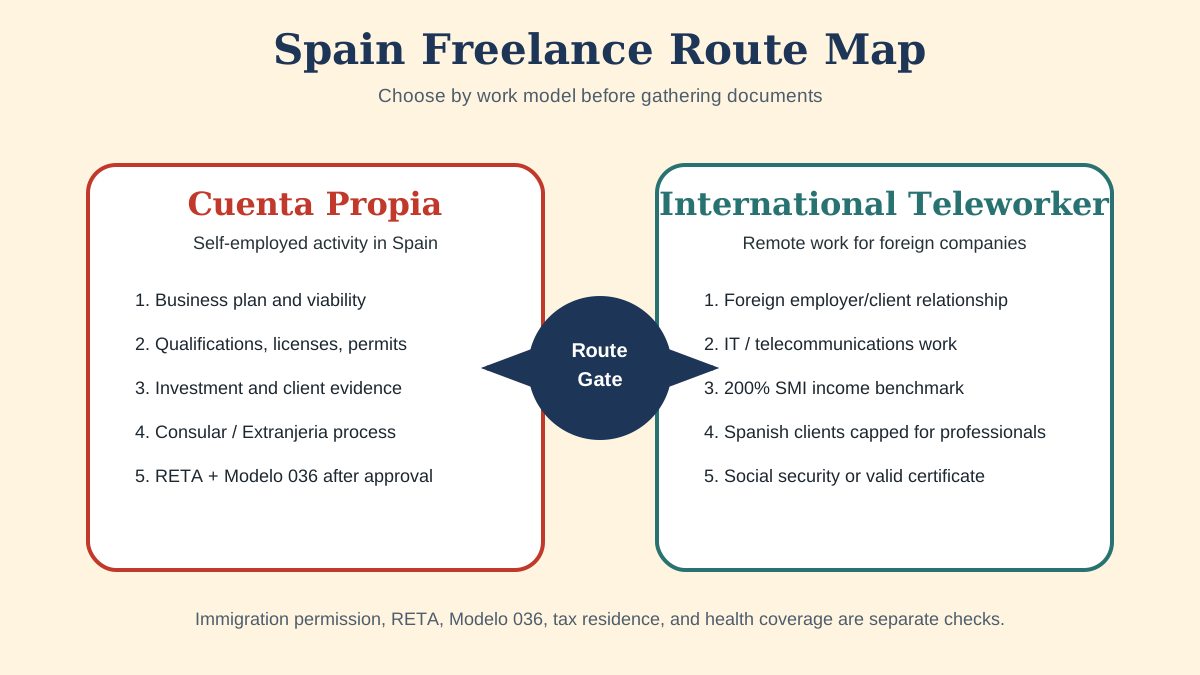
Spain freelance visa research usually mixes two different routes: the traditional self-employed work route, known as residencia temporal y trabajo por cuenta propia, and the international telework route, often called the digital nomad visa. They are different legal paths with different evidence, authorities, income logic, tax consequences, and social-security steps.
The safest way to choose is to map the work model first. If the business activity will operate in Spain, serve local clients, need Spanish premises, licenses, or professional registration, analyze the cuenta propia route. If the work is remote and technology-based for companies outside Spain, analyze the international teleworker route. A freelancer can sometimes fit the teleworker route, but only if the professional relationship and client-location limits satisfy the official rules.
Source check date: May 14, 2026. This article is general information, not legal, tax, immigration, accounting, or social-security advice. Verify current instructions with the Spanish consulate, Extranjeria, UGE-CE, Seguridad Social, Agencia Tributaria, or a qualified adviser before filing.
Executive Answer
Spain has no single universal "freelance visa." Most non-EU freelancers compare these two routes:
| Route | Best fit | Main authority path | Core evidence |
|---|---|---|---|
Self-employed work authorization, cuenta propia |
You will carry out a self-employed economic activity in Spain | Consular/immigration process for initial residence and self-employed work authorization | Business plan, qualifications, licenses, investment, viability, criminal record, visa file |
| International teleworker, digital nomad | You work remotely from Spain for companies outside Spain using IT/telecommunications | Consular visa or UGE-CE residence authorization when legally in Spain | Remote work proof, foreign-company/client relationship, qualifications or experience, income, social security or health coverage |
The routes are not interchangeable. A digital nomad authorization is not a general permission to run a local Spanish freelance business. A cuenta propia authorization is not merely a savings-based residence visa.
Step 1: Separate Immigration, Tax, And Social Security
Many applicants treat "autonomo," "freelance visa," "digital nomad visa," and "tax registration" as if they were one step. They are separate.
| Layer | Question | Institution |
|---|---|---|
| Immigration | May you reside and work under this route? | Consulate, Extranjeria, UGE-CE |
| Social security | Must you register with Spanish social security or import coverage under an agreement? | Seguridad Social, UGE-CE where relevant |
| Tax census | Must you register before business or professional activity starts? | Agencia Tributaria |
| Tax residence and filings | Where and how is income taxed? | Agencia Tributaria, tax adviser, treaty analysis |
| Professional regulation | Can you legally carry out the activity? | Sector regulator, professional body, municipality |
Approval of one layer does not automatically complete the others.
Step 2: The Self-Employed Work Route (Cuenta Propia)
Spain's consular guidance describes the self-employed work visa as the route for a foreign national who wants to carry out a lucrative activity on their own account in Spain. See Spanish consular guidance: self-employed work visa.
This route usually fits:
| Applicant type | Why it may fit |
|---|---|
| Consultant serving Spanish and foreign clients from Spain | Work is self-employed activity carried out from Spain |
| Therapist, designer, trainer, tradesperson, creative, shop owner | Local market, licenses, premises, and Spanish registration may be central |
| Regulated professional | Route can incorporate qualification and authorization evidence |
| Founder operating as self-employed rather than through a company | Business plan and investment evidence become central |
It usually does not fit a person who only wants to live in Spain while remotely serving one foreign employer or foreign client through technology systems. That profile belongs in the teleworker analysis.
Core Cuenta Propia Requirements
The official consular information is the control document. It requires the applicant to satisfy the legal requirements for the planned activity, prepare proof of qualification or experience where applicable, show sufficient investment or means, and pay the relevant fees. See Spanish consular guidance: cuenta propia visa.
Plan for this evidence set:
| Requirement | Practical evidence |
|---|---|
| Identity | Valid passport and complete copies |
| Application | EX-07 or route-specific form, fee forms, proof of consular jurisdiction |
| Criminal record | Certificates from relevant countries, legalized/apostilled and translated where required |
| Business plan | Activity description, market, pricing, revenue, costs, investment, clients, jobs, licenses |
| Qualification | Degree, professional registration, experience, portfolio, certifications |
| Legal operation | Licenses, municipal permissions, regulated-profession approvals |
| Funding | Bank statements, investment evidence, loan or financing evidence, client contracts |
| Health and visa stage documents | Medical certificate and visa documents required by the consulate |
Consular pages add local appointment, copies, fee, translation, and jurisdiction rules. For example, Spanish consulates publish self-employed work visa checklists that describe the route and visa-stage documents. See Spanish Consulate in Chicago: Self-employed work visa.
Business Plan Quality
The cuenta propia file is a business-case file. A weak plan often fails because it does not prove that the activity can legally and economically operate in Spain.
| Business-plan section | Minimum reviewer question |
|---|---|
| Activity | What exactly will you sell or provide? |
| Market | Who are the clients and where are they located? |
| Pricing | How does pricing create sustainable income after taxes and contributions? |
| Investment | What equipment, premises, software, insurance, licenses, and working capital are needed? |
| Qualification | Why are you legally and practically qualified? |
| Legal requirements | Which licenses, notices, registrations, or professional approvals apply? |
| Evidence | Are there contracts, letters of intent, invoices, prior accounts, or portfolio proof? |
| Risk | What happens if revenue is lower, a client cancels, or approval is delayed? |
Do not present only savings. The official test is not merely whether you can support yourself for a few months; it is whether the planned economic activity is credible, lawful, funded, and viable.
Step 3: The International Teleworker/Digital Nomad Route
The Spanish PRIE portal describes the international teleworker route for non-EU foreigners who move to Spain to work remotely for companies located outside Spain using exclusively computer, telematic, and telecommunications systems. See PRIE: Teletrabajadores de caracter internacional.
Official Spanish guidance for international teleworkers is especially important for freelancers because it separates remote work for foreign clients from activity connected to Spain. Review the live route before relying on a client-mix assumption. See PRIE: international teleworkers.
This creates a hard distinction:
| Issue | Cuenta propia | International teleworker |
|---|---|---|
| Work location | Self-employed activity in Spain | Remote work from Spain |
| Client/company location | Spanish and foreign clients possible if authorized | Mainly foreign companies/clients; Spanish professional work capped for self-employed professionals |
| Technology requirement | Not the defining feature | Work must be through IT/telecommunications systems |
| Business plan | Central | Less central than foreign work relationship and remote-work evidence |
| Local market activity | Can be part of route | Limited and carefully controlled |
2026 Income Reference: SMI And The 200% Rule
Official international-teleworker guidance should be checked for the current income and family-resource requirements before filing. See PRIE: international teleworker requirements.
For 2026, Royal Decree 126/2026 sets the Spanish minimum interprofessional salary at EUR 1,221 per month and EUR 17,094 per year from January 1, 2026. See BOE: Real Decreto 126/2026.
Therefore, a 200% monthly SMI benchmark equals:
| Calculation | Amount |
|---|---|
| 2026 monthly SMI | EUR 1,221 |
| 200% of 2026 monthly SMI | EUR 2,442 |
| 2026 annual SMI | EUR 17,094 |
| 200% of 2026 annual SMI | EUR 34,188 |
Do not treat these calculations as a universal visa guarantee. Consulates and UGE-CE may require specific evidence, translations, family additions, and route-specific documents. Always use the authority handling the case.
Social Security And RETA
Immigration approval does not eliminate Spanish social-security analysis. Seguridad Social states that self-employed workers are directly responsible for requesting registration, deregistration, and data changes in the Special Regime for Self-Employed Workers, RETA. The registration request must be made before the activity starts, up to 60 calendar days before. See Seguridad Social: RETA registration, deregistration, and data changes.
For cuenta propia, the consular route connects authorization to later affiliation, registration, contribution, and foreign identity card timing. Review the live procedure before planning start dates. See Spanish consular guidance: self-employed work visa.
For digital nomads, Spanish social-security treatment must be checked against the teleworker route, any applicable international agreement, and whether Spanish registration is required. See PRIE: international teleworkers.
Tax Registration And Modelo 036
Tax registration is separate from the visa. Agencia Tributaria states that the census registration declaration for entrepreneurs, professionals, and withholding agents must be submitted before starting the relevant activities or operations or before the obligation to withhold or pay on account arises. See Agencia Tributaria: When to file the census declaration.
Agencia Tributaria's 2026 Modelo 036 page also states that Order HAC/1526/2024 removed Modelo 037 from February 3, 2025, with the simplification now offered through Modelo 036. See Agencia Tributaria: Modelo 036 declaration.
Freelancers should determine:
| Tax question | Why it matters |
|---|---|
| Must Modelo 036 be filed before activity starts? | Late registration can create compliance problems |
| Are services subject to IVA, exemption, reverse charge, or intra-EU reporting? | Client location and service type change treatment |
| Are quarterly IRPF payments required? | Cash-flow planning |
| Are withholdings required on invoices to Spanish clients? | Affects net receipts |
| Does Spanish tax residence arise? | Time in Spain and center of economic interests matter |
| Are foreign clients or platforms reporting income elsewhere? | Reconciliation and treaty issues |
Do not assume that foreign clients make Spanish tax irrelevant. If the work is performed from Spain and residence or permanent establishment facts develop, the tax analysis can change.
Health Coverage And Medical Evidence
Health evidence depends on route and stage.
| Route | Common issue |
|---|---|
| Cuenta propia visa | Consular files usually include a medical certificate and route-specific visa documents; after approval, Spanish social-security registration may become part of the setup |
| International teleworker | UGE-CE requires public coverage through social security or equivalent private sickness insurance where valid; travel insurance and reimbursement-only policies are not treated as valid substitutes in the UGE guidance |
Teleworker applicants should verify the current health-coverage rule before filing, including whether public coverage or private insurance is required for the specific route. See PRIE: international teleworkers.
Buy insurance only after checking the exact checklist for the consulate or UGE-CE route. The wrong policy can be expensive and unusable.
Filing Path And Timing
The cuenta propia process generally starts from the Spanish consular office corresponding to the applicant's residence abroad, so timing should be checked against the relevant consulate before committing to start dates. See Spanish consular guidance: self-employed work visa.
For the international teleworker route, the applicant may use a consular visa path or, if legally in Spain, a residence authorization route through the competent large-companies unit. Confirm the current UGE-CE filing channel and required electronic certificate or representative setup before planning travel.
Document Checklist
Use this checklist as a planning tool, not a substitute for the official list:
| Document group | Cuenta propia | International teleworker |
|---|---|---|
| Identity | Passport, photos, jurisdiction proof | Passport, photos, legal stay if applying in Spain |
| Criminal record | Usually required at visa stage | Usually required depending on route and residence history |
| Medical certificate | Common consular requirement | Check consular/UGE route |
| Work evidence | Business plan, licenses, qualifications, investment | Foreign contract/client relationship, remote-work authorization, technology-based work |
| Income | Viability and funding | SMI-based resource evidence |
| Social security | RETA setup after authorization where applicable | Spanish registration or accepted foreign certificate |
| Tax | Modelo 036 and tax setup before activity | Tax-residence and registration analysis if professional activity from Spain |
| Family | Civil-status documents, dependency evidence | Family additions to income and documents |
| Translations/legalization | Apostille/legalization and sworn translations where required | Same |
Route Selection Matrix
| Fact pattern | More likely route to analyze first | Reason |
|---|---|---|
| Graphic designer moving to Spain with mostly US clients and no Spanish market plan | International teleworker | Remote professional activity for foreign clients |
| Yoga instructor opening classes in Valencia | Cuenta propia | Local self-employed activity |
| Software contractor with one UK client and laptop-only work | International teleworker | Technology-based remote work |
| Architect serving Spanish property clients | Cuenta propia plus regulated-profession review | Local regulated/professional activity |
| Consultant with 80% US clients and 20% Spanish professional work | International teleworker may be possible | UGE-CE 20% professional Spanish-client cap must be respected |
| Freelancer wanting to sell products from Spanish premises | Cuenta propia | Local business operation |
Common Mistakes
- Calling the digital nomad route a general freelance visa.
- Ignoring the 20% limit for Spanish professional activity under the teleworker route.
- Treating SMI income proof as the cuenta propia requirement.
- Submitting a business plan with no licenses, budget, contracts, or qualification evidence.
- Forgetting RETA and Modelo 036 after immigration approval.
- Buying travel insurance for a route that requires stronger health coverage.
- Using an old SMI figure after the 2026 Royal Decree.
- Assuming a consulate checklist from one country controls another consular district.
- Starting activity before registration and social-security timing are resolved.
- Forgetting Spanish tax residence and treaty analysis.
FAQ
Is there a freelance visa for Spain?
People use that phrase for more than one route. The official self-employed route is the temporary residence and self-employed work authorization, cuenta propia. The digital nomad route is for international telework and has different rules.
Is autonomo the same as a visa?
No. Autonomo usually refers to self-employed tax and social-security status. A non-EU national may need immigration authorization before lawful self-employed activity, then must handle tax and social-security registration.
Can digital nomads work for Spanish clients?
Employees under the route work only for companies outside Spain. Professional teleworkers may have Spanish-company activity only if it does not exceed 20% of total professional activity and the foreign professional relationship remains in place, according to UGE-CE guidance.
What is the 2026 income benchmark for Spain's digital nomad route?
UGE-CE refers to 200% of the SMI for the main applicant. The 2026 SMI is EUR 1,221 per month, so 200% is EUR 2,442 per month before family additions and documentary checks.
Does cuenta propia have one fixed income threshold?
Official guidance focuses on the legality, qualification, investment, viability, and expected impact of the activity rather than one universal public income number. The business plan and evidence quality matter.
Do freelancers need Modelo 036?
Agencia Tributaria states that the census declaration must be filed before starting relevant business or professional activities, operations, or withholding obligations. Since February 3, 2025, the previous Modelo 037 simplification is handled through Modelo 036.
Do freelancers need RETA?
In many self-employed cases, yes. Seguridad Social states that self-employed workers are responsible for requesting RETA registration before activity starts, up to 60 calendar days before. Digital nomad cases require separate analysis of Spanish registration or accepted foreign social-security certificates.
Route planning before applying
Spain's freelance and remote-work routes should be planned from the work model, not from the label the applicant prefers. Start with where the applicant will physically live, where services will be performed, where clients are located, whether Spanish clients are expected, whether the work is technology-enabled, whether the activity is regulated, and whether the applicant will trade as an individual, company owner, or employee of a foreign entity.
The cuenta propia route is built around self-employed activity in Spain. It normally requires a credible business plan, activity legality, professional qualifications where needed, investment or resources, and evidence that the business can operate. A generic "online freelancer" plan is weak if it does not show clients, pricing, licenses, costs, tax setup, and social-security path.
The international teleworker route is different. It is designed for remote work for foreign companies or clients, with specific limits and evidence. It should not be used as a general local freelance permit. If the applicant expects Spanish clients, local premises, in-person services, or a Spanish market strategy, the 20% professional-activity cap and route conditions must be checked carefully.
Business-plan evidence for cuenta propia
A strong cuenta propia file should show what the applicant will sell, who will buy it, why the applicant is qualified, where the work will happen, what permits are needed, how much the setup costs, how income will be generated, and how the applicant will support themselves. The business plan should include realistic revenue, expenses, tax, RETA, insurance, rent or workspace, equipment, marketing, and contingency reserves.
Letters of intent, draft contracts, portfolio evidence, professional licenses, qualification recognition, market research, lease or coworking options, supplier quotes, and financing proof make the plan more credible. If the activity is regulated, the file should show that the applicant has checked the relevant professional body or authority before applying.
The plan should not overpromise. A small freelance service business can be viable, but the numbers must be coherent. If projected revenue is high, explain client pipeline and capacity. If revenue is modest, show how living costs, tax, social security, and insurance will be covered.
Digital nomad and teleworker evidence
For the international teleworker route, the evidence should show a real foreign professional relationship and remote-work suitability. This may include foreign employment contract, freelance contracts, client letters, corporate registration of the foreign company, proof of continued activity, remote-work authorization, professional credentials, income evidence, and proof that work can be done through telecommunication systems.
Applicants should keep a client and income matrix. List each client or employer, country, contract type, start date, expected revenue, payment currency, and whether the work is Spanish-source or foreign-source for route purposes. If Spanish clients exist, calculate the percentage carefully and preserve evidence. Do not rely on rough estimates when the route has a cap.
If applying from Spain while legally present, check timing. The applicant should know when current lawful stay expires, whether electronic filing requires a certificate or representative, and whether travel during processing creates risk. If applying through a consulate, use the consulate's current checklist and jurisdiction rules.
Tax, RETA, and social-security sequencing
Immigration approval is not the end of setup. The worker may need Modelo 036, tax census registration, RETA registration, health coverage decisions, invoice templates, VAT treatment, and bookkeeping before starting activity. The timing can differ depending on the route and whether Spanish or foreign social-security coverage is accepted.
For cuenta propia, RETA and tax registration are usually central after authorization and before activity starts. For teleworkers, social-security treatment can depend on whether the applicant is employee or self-employed, whether a foreign certificate is accepted, and whether Spanish registration is required. Keep certificates and authority decisions in the file.
Spanish tax residence should be reviewed separately. A visa or residence authorization does not by itself decide tax residence, but living and working from Spain can create Spanish tax obligations. For broader tax context, compare remote work Europe tax and income tax for non-residents in Spain.
Family members and renewal planning
Family applications need their own evidence: relationship documents, dependency evidence where required, translated and legalized civil records, health insurance, and additional income. Do not assume the main applicant's income proof automatically satisfies family requirements without checking the current formula and checklist.
Renewal planning should begin during the first months in Spain. Keep invoices, contracts, bank statements, tax filings, social-security records, insurance, address registration, and evidence that the work still matches the approved route. A visa obtained with one activity but renewed after a different activity can create questions.
If the applicant changes from remote work to local clients, from freelance to employment, from one client to many, or from foreign clients to Spanish clients, review status before the change. The route must continue to match the facts.
Refusal and correction strategy
If the application is refused or delayed, classify the issue: incomplete documents, income evidence, insurance, criminal record, medical certificate, route mismatch, activity viability, regulated profession, translation/legalization, or jurisdiction. A corrected file should answer the actual weakness rather than resubmitting the same package.
Keep all notices and deadlines. Immigration decisions can have appeal or correction windows. If the refusal concerns route mismatch, consider whether the other route is more coherent instead of forcing the original path.
Case patterns and route risks
A designer with only foreign clients and no Spanish market activity may look like a teleworker file, but the contract evidence must show real foreign professional relationships and remote-service delivery. A local yoga instructor, therapist, tradesperson, photographer, shop operator, or food seller is more likely to need cuenta propia analysis because the activity is local and may involve premises, licenses, clients in Spain, or regulated services.
A consultant with mixed clients needs careful percentage control. If the teleworker route is used and Spanish professional activity is permitted only within a cap, the applicant should maintain invoices and client records that prove the split. The cap should be monitored monthly, not guessed at renewal time. If Spanish work grows, the immigration route may need redesign.
A founder who owns a foreign company but works from Spain should separate shareholder income, salary, director fees, freelance contracts, and company management. The immigration route, tax residence, social security, and permanent-establishment risk can all differ. A digital nomad authorization is not a company-tax ruling.
Consular filing controls
Consular filings vary by district. The applicant should use the checklist for the consulate with jurisdiction over their legal residence, not a random checklist found online. Confirm appointment rules, payment method, document age limits, apostille or legalization, sworn translation, medical-certificate wording, criminal-record scope, passport validity, and whether originals plus copies are required.
Document timing matters. Criminal records, medical certificates, bank statements, insurance certificates, and civil-status records can expire. Do not obtain them too early unless the consulate accepts the timing. Keep a checklist with issue date, expiry or age limit, translation status, apostille status, and whether the document is for the immigration authorization stage or visa stage.
If a favorable cuenta propia authorization is issued, the visa application deadline should be tracked immediately. Missing the visa window can waste months of preparation. After entry into Spain, the applicant should track TIE, registration, tax, and social-security steps.
Spanish-client monitoring for teleworkers
Professional teleworkers should maintain a client ledger showing foreign-client revenue, Spanish-client revenue, contract country, invoice date, work performed, and percentage of total professional activity. If Spanish-client work approaches the cap, stop accepting Spanish work until advice confirms the position.
The ledger should distinguish Spanish clients from work physically performed in Spain for foreign clients. A foreign client can still create Spanish tax facts because the worker is in Spain, while the route's client-location rules answer a different immigration question. Do not merge immigration percentage control with tax residence analysis.
Tax and accounting setup after arrival
After arrival, set up Spanish bookkeeping before issuing invoices. Decide invoice numbering, VAT treatment, withholding if relevant, Modelo 036 data, expense categories, bank account, social-security reserve, and quarterly calendar. Keep copies of filings and payment receipts because they may support renewals.
If the applicant remains linked to a foreign tax system, coordinate calendars. U.S. persons, UK residents leaving midyear, EU cross-border workers, and people with foreign companies may have dual filings or reporting duties. Spain's visa route does not remove foreign tax obligations.
Renewal evidence file
Renewal is easier when evidence is collected continuously. Keep monthly bank statements, invoices, contracts, client communications, tax filings, RETA or social-security evidence, insurance renewals, lease, empadronamiento if relevant, and travel records. If income fluctuates, keep explanations and pipeline evidence.
The renewal file should show that the applicant complied with the route originally granted. For cuenta propia, show real self-employed activity. For telework, show foreign professional relationship, remote-work continuity, income, and compliance with Spanish-client limits.
Minimum route memo
Before filing, prepare a one-page route memo naming the route, client geography, expected Spanish activity, income proof, insurance basis, social-security position, tax setup, and renewal evidence. If the memo cannot explain why the chosen route fits the facts, the application is not ready.
Official Sources
- Spanish consular guidance: self-employed work visa
- Spanish Consulate in Chicago: Self-employed work visa
- PRIE: International teleworkers
- PRIE: international teleworkers
- BOE: current official text relevant to 2026 immigration rules
- BOE: Royal Decree 126/2026 setting the 2026 SMI
- Seguridad Social: RETA registration and data changes
- Seguridad Social: Self-employed contribution bases
- Agencia Tributaria: When to file the census declaration
- Agencia Tributaria: Modelo 036 declaration