Last updated
Freelance Visa Application Europe: How To Compare Self-Employed Residence Routes
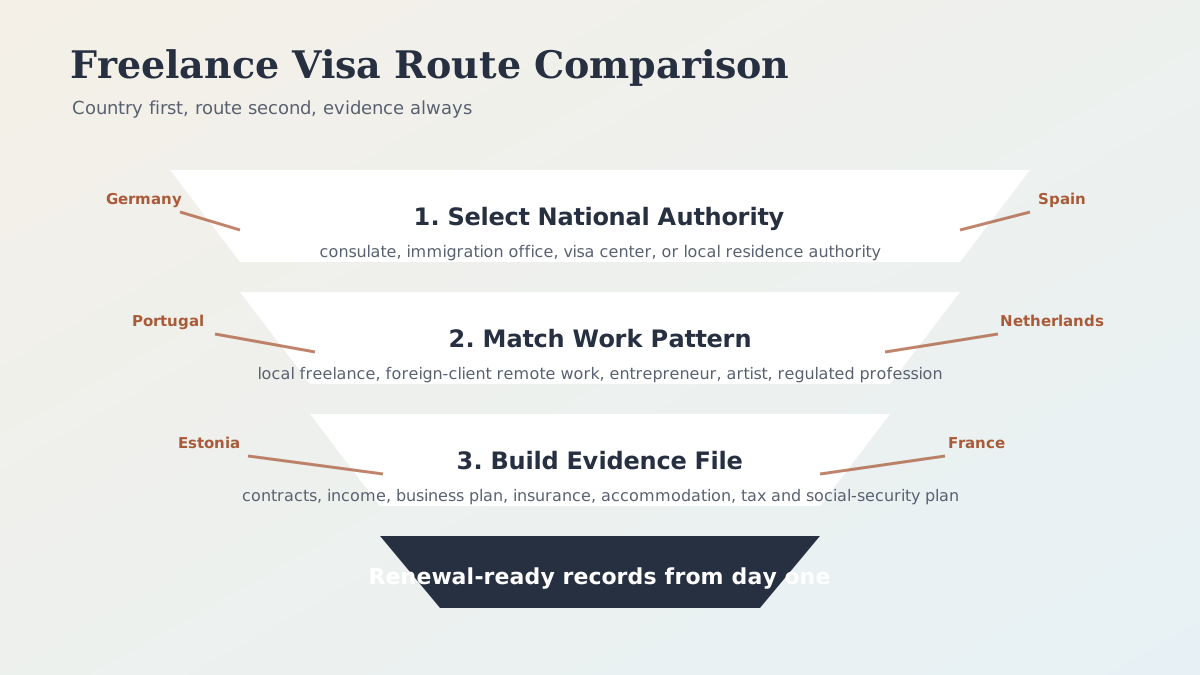
Use Freelance Visa Application Europe: How To Compare Self-Employed Residence Routes to understand the moving parts before you pay, apply, sign, book, or rely on a third-party summary. It explains checking tax position, payroll evidence, social-security exposure, net pay, and cross-border filing questions across Europe, then shows how to separate residence, treaty, payroll, contribution, withholding, and filing questions before signing or moving money. The later sections connect quick answer, first principle: europe is not the visa authority, and eu citizens and non-eu citizens are in different systems so the next step is easier to judge. Read it before submitting forms, moving money, choosing a provider, or assuming that a rule from another country applies.
This means a "freelance visa Europe" search can mislead applicants. Germany, Spain, Portugal, France, Estonia, the Netherlands, Czechia, and other countries use different legal categories, income tests, client rules, business-plan expectations, health-insurance standards, tax-registration processes, renewal evidence, and permanent-residence timelines.
Source check date: May 18, 2026. This guide is educational information, not legal, tax, immigration, accounting, or insurance advice.
Quick Answer
To apply for a freelance visa in Europe, choose the target country first, then identify whether the correct route is a self-employed permit, liberal-profession permit, entrepreneur permit, digital nomad visa, remote-worker permit, or local business route. Prepare proof of legal entry or consular eligibility, passport, business plan, client contracts or letters of intent, financing evidence, health insurance, accommodation, professional permits, tax registration plan, and renewal evidence.
The European Union states that non-EU nationals should apply for a visa or residence permit directly through the authorities of the EU country where they plan to move. There is no EU institution that issues visas or residence permits for individual countries. See European Union: Immigration to the EU.
First Principle: Europe Is Not The Visa Authority
A freelancer must compare countries, not continents.
| Question | Why it matters |
|---|---|
| Which country will issue the residence permit? | That country controls eligibility and filing |
| Will you serve local clients, foreign clients, or both? | Some routes distinguish local self-employment from remote foreign-client work |
| Are you a freelancer, sole trader, company founder, or remote employee? | Different routes apply |
| Is your profession regulated? | You may need professional permission before residence approval |
| Can you prove sustainable income? | Renewal usually depends on real income, not only plans |
| Can you obtain compliant health insurance? | Almost every route requires it |
| Will you become tax resident? | Residence and tax outcomes are related but not identical |
If the country is not chosen, the application cannot be built correctly.
EU Citizens And Non-EU Citizens Are In Different Systems
EU citizens generally do not need a work permit to work as self-employed people in another EU country. Your Europe states that EU citizens have the right to live in any EU country where they work as an employee, self-employed person, or posted worker. See Your Europe: Workers' residence rights.
Non-EU citizens need a national residence basis unless they already have a status that permits the activity.
| Applicant type | Main rule |
|---|---|
| EU citizen moving within the EU | Usually no work permit, but registration and tax/social-security duties may apply |
| Non-EU citizen outside Europe | Usually applies through the competent consulate or visa center |
| Non-EU citizen already legally resident in target country | May apply locally if national law allows status change |
| Non-EU citizen resident in another EU country | That permit usually does not automatically allow freelance work in a second EU country |
| EU long-term resident in one country | May have mobility rights, but still needs host-country procedures |
A residence card from one European country is not a general freelance license for all of Europe.
Main Route Types
| Route type | Best fit | Typical evidence |
|---|---|---|
| Freelance or liberal-profession permit | Independent professionals, artists, teachers, consultants | Portfolio, qualifications, clients, income forecast |
| Self-employed or entrepreneur permit | Business founders and sole traders | Business plan, financing, market need, registrations |
| Digital nomad or remote-work visa | Foreign-client remote work | Foreign contracts, income threshold, health insurance |
| Artist visa or cultural route | Artists, performers, writers, cultural workers | Portfolio, engagements, cultural impact |
| Startup route | Scalable business founders | Innovation review, incubator support, financing |
| Professional-card route | Regulated independent work | Professional authorization, chamber membership |
| Student-to-freelance change | Graduates starting independent activity | Degree link, business plan, lawful status |
Do not file under the route with the lowest advertised income threshold if your work pattern does not match it.
Core Application File
Most European freelance routes require a version of this evidence file.
| Evidence category | Documents to prepare |
|---|---|
| Identity | Passport, photos, prior visas, residence cards |
| Legal residence or consular jurisdiction | Proof you can file from the chosen location |
| Business concept | Business plan, service description, market analysis |
| Client evidence | Signed contracts, letters of intent, project pipeline |
| Income and financing | Bank statements, savings, grants, forecast, fee agreements |
| Qualifications | Degrees, certificates, licenses, portfolio |
| Professional permission | Chamber registration, professional license, regulated-sector approval |
| Health insurance | Statutory, private, travel-to-residence bridge, or route-specific proof |
| Accommodation | Lease, registration, host declaration, hotel bridge where accepted |
| Tax plan | Tax number, VAT registration, self-employed registration |
| Social security | Country-specific contribution plan or registration |
| Criminal and medical checks | Required in several consular routes |
| Translations and legalization | Sworn translations, apostilles, legalized documents |
The strongest applications connect all documents into one coherent story: what you do, who pays you, why the country should permit it, how you will support yourself, and how you will comply after arrival.
Germany Example: Freelance And Self-Employment Routes
Germany distinguishes self-employment and freelance work. BAMF explains that self-employment can be permitted if financing is ensured and the enterprise is expected to have a positive impact on the regional economy. It also states that liberal-profession freelancers may obtain a residence permit under less strict conditions, and examples include doctors, interpreters, artists, writers, and architects. See BAMF: Self-employment and freelancing.
Make it in Germany explains that applicants outside Germany generally apply for a visa for self-employed occupation at the competent German mission, while applicants already in Germany with a suitable residence basis may apply at the foreigners authority if they have planned the business and prepared a written business plan. See Make it in Germany: Do I need a visa?.
Germany file highlights:
| Topic | Practical evidence |
|---|---|
| Route | Section 21 Residence Act self-employment or freelance activity |
| Business viability | Business plan, forecast, clients, financing |
| Freelancer proof | Liberal-profession classification, qualifications, portfolio |
| Health insurance | German statutory or comparable private insurance |
| Older applicants | Pension provision may be required if over 45 |
| Renewal | Actual income, tax registration, bank statements, ongoing work |
Spain Example: Self-Employed Work Visa
Spain's self-employed work visa is a structured route for people who want to carry out self-employed activity in Spain. Spanish consular guidance explains that obtaining a self-employed work visa may require an initial residence and self-employed work permit, and that the procedure can involve forms EX-07, 790 code 052, and 790 code 062. See Spanish Consulate: Self-employed work visa.
Typical Spain file issues:
| Topic | Practical evidence |
|---|---|
| Initial authorization | EX-07 residence and self-employed work permit file |
| Activity permission | Licenses and permits required for the business or professional activity |
| Professional qualifications | Evidence needed for regulated activities |
| Financial plan | Investment, income, business viability, bank statements |
| Criminal record | Consular-stage requirement for adult applicants |
| Medical certificate | Often required at visa stage |
| Social security | Registration after arrival and before starting activity where required |
Spain also has international teleworker and digital-nomad routes for certain remote work patterns. Do not confuse those with the ordinary self-employed local activity route.
Portugal Example: Independent Professional Or Entrepreneur Residence Visa
Portugal's official government service page states that foreign citizens who are not nationals of EU, EEA, or Swiss states and who intend to exercise independent professional activity or invest in Portugal may apply for the relevant residence visa. The listed documents include passport, photos, travel insurance, criminal-record checks, accommodation proof, subsistence means, and, for independent professional activity, a service contract or proposal and, where applicable, a competent-entity declaration for regulated professions. See Portugal gov.pt: Residence visa for independent professional activity or entrepreneurs.
Portugal file highlights:
| Topic | Practical evidence |
|---|---|
| Route | Independent professional activity or entrepreneur route |
| Filing | Portuguese consular post or competent mission |
| Work proof | Service contract or proposal for liberal-profession activity |
| Regulated profession | Declaration from competent authority where required |
| Accommodation | Proof of lodging conditions |
| Subsistence | Financial means evidence |
| Insurance | Valid travel insurance for medical and repatriation costs |
Freelance Visa Versus Digital Nomad Visa
These are not always the same route.
| Feature | Freelance or self-employed permit | Digital nomad or remote-work permit |
|---|---|---|
| Main work location | Often local activity in host country | Remote work for foreign clients or employers |
| Client location | Local, foreign, or mixed depending on law | Often mostly or entirely foreign |
| Evidence | Business plan, clients, licenses, viability | Remote contract, income threshold, foreign-client proof |
| Tax result | Often host-country self-employment registration | Often still host-country tax-residence analysis |
| Local clients | May be allowed | May be restricted or capped |
| Renewal | Business success and compliance | Ongoing remote income and residence compliance |
A remote worker serving one foreign employer may not be a freelancer under local labor law. Misclassifying employment as contracting can create immigration, tax, and social-security problems.
Country Shortlist By Work Pattern
The most useful comparison starts with the work pattern, not the applicant's favorite city. A freelance writer with U.S. clients, a designer selling to German startups, and a consultant with mixed clients should not optimize for the same route.
| Work pattern | Countries to examine first | Why these routes may fit | Main caution |
|---|---|---|---|
| Foreign-client remote freelancer | Spain, Portugal, Croatia, Estonia | These routes are designed around remote or foreign-client activity | Local-client limits, income thresholds, and social-security proof |
| Local-market professional | Germany, France, Portugal, Spain, Czechia | These systems contain self-employed, liberal-profession, or business routes | Viability, local registrations, and renewal evidence are heavier |
| Artist, writer, performer, cultural worker | Germany, France, Netherlands where relevant | Some countries have practical experience with cultural or liberal professions | Portfolio quality and income evidence still matter |
| Treaty-eligible U.S. or Japanese entrepreneur | Netherlands | Treaty rules may be more favorable than the standard Dutch self-employed route | Eligibility is narrow and still requires a real business |
| Founder planning to hire or raise capital | Netherlands, France, Portugal, Germany, Spain | Entrepreneur or startup routes can fit better than solo freelancing | Innovation, financing, and local economic interest are scrutinized |
| One-client contractor | Employment, employer-of-record, or remote-work route analysis | A one-client freelancer can look like an employee | False self-employment risk can affect immigration, tax, and labor law |
Use this table as a shortlist, not as an approval prediction. The same country can be easy for one profile and difficult for another. Spain can be strong for a foreign-client consultant with organized contracts, but less suitable for someone who wants mostly Spanish clients. Germany can work well for a designer with local demand and credible income, but poorly for an applicant who has no client evidence. Portugal may be attractive as a residence base, but the file still needs orderly documents, insurance, tax planning, and realistic administrative timing.
Evidence Quality: What Officers Can Actually Verify
Many weak applications fail because the documents look impressive but do not prove the legal test. A long business plan is less persuasive than a short plan supported by signed contracts, invoices, bank inflows, professional qualifications, and a coherent registration plan.
| Evidence type | Strong version | Weak version |
|---|---|---|
| Contract | Signed, dated, identifies parties, services, duration, compensation, and remote or local work context | Template agreement with no signatures or vague scope |
| Client letter | Names the service, expected volume, commercial need, and contact person | Generic recommendation that does not create future work evidence |
| Bank statement | Shows income consistent with invoices and tax records | Large unexplained transfer with no business connection |
| Business plan | Links target market, pricing, acquisition channel, operating costs, and compliance steps | Inspirational pitch without numbers or route-specific relevance |
| Portfolio | Demonstrates work that matches the proposed activity | Beautiful but unrelated work samples |
| Insurance certificate | States coverage period, territory, cancellation terms, and residence suitability | Travel policy screenshot with unclear residence acceptance |
| Tax plan | Explains likely registration, VAT position, invoicing, and social security | "I will pay taxes if required" |
The file should be easy to audit. A reviewer should be able to connect passport identity, residence route, work activity, client evidence, income, insurance, housing, and tax plan without guessing. When the story depends on undocumented assumptions, the risk rises.
Business Plan That Fits A Residence File
A freelance visa business plan is not a venture-capital pitch. It should show that the applicant can lawfully live, work, pay costs, comply with local rules, and generate enough income to renew. Keep the plan concrete and testable.
| Business-plan part | What to include | What to avoid |
|---|---|---|
| Activity description | Specific services, deliverables, client types, and work location | Broad labels such as "consulting" without scope |
| Market rationale | Why clients in the target market or foreign market will buy the service | Generic claims that Europe has demand for everything |
| Client pipeline | Signed clients, letters of intent, proposals, recurring revenue, platforms used | Unnamed leads or speculative future networking |
| Pricing | Day rate, project rate, monthly retainer, expected volume, currency assumptions | Revenue projections with no pricing basis |
| Costs | Rent, insurance, tax, professional tools, accountant, translations, travel | Treating gross revenue as disposable income |
| Compliance | Tax registration, VAT, social security, licensing, data protection if relevant | Saying compliance will be handled later |
| Renewal plan | Documents the first year will produce for renewal | Assuming first approval automatically leads to continuation |
For early-stage freelancers, the plan should be conservative. Authorities may be more comfortable with a modest but documented income story than an ambitious forecast with no proof. If the applicant is moving from employment into freelancing, explain the transition: existing portfolio, first clients, savings runway, and why the proposed work is economically plausible.
Health Insurance Is Not A Minor Detail
Health insurance can decide whether a residence permit is issued or renewed.
Check:
| Insurance question | Why it matters |
|---|---|
| Is travel insurance enough for the visa stage only? | Residence permits often require local compliant cover |
| Is private insurance comparable to statutory cover? | Some authorities reject limited policies |
| Does the policy cover pre-existing conditions? | May be reviewed in residence contexts |
| Is long-term care insurance required? | Germany and other countries may connect health and care systems |
| Is family coverage included? | Dependents usually need proof |
| Can the insurer issue the required certificate? | Authorities may require specific wording |
For Germany, Berlin's official freelance residence-permit page states that applicants must have health insurance in Germany, either statutory or comparable private health insurance, and that foreign health insurance is not sufficient. See Berlin: Residence permit for freelance employment.
Tax Registration And Social Security
A visa lets you live and work under immigration law. It does not replace tax registration, VAT analysis, invoicing rules, or social-security obligations.
| Compliance area | Questions to answer |
|---|---|
| Tax residence | Will you become resident under national law or treaty rules? |
| Tax registration | When must you register with the tax office? |
| VAT | Are you exempt, reverse-charged, or required to charge VAT? |
| Invoicing | What language, numbering, and VAT wording are required? |
| Social security | Which country is competent and when must you register? |
| Accounting | Do you need bookkeeping, advance payments, or annual accounts? |
The European Commission explains that, under EU social-security coordination, the basic rule is that a person is subject to the legislation of the country where they actually work, with special rules for multi-country work. See European Commission: Which social-security rules apply?.
The First Ninety Days After Approval
Approval is not the end of the project. The first ninety days after arrival often determine whether renewal will be easy or chaotic.
| Timeframe | Task | Renewal value |
|---|---|---|
| Week 1 | Complete address registration if required | Creates the local residence record needed for banking, tax, and health systems |
| Week 1-2 | Confirm residence-card or permit appointment requirements | Prevents lawful-stay gaps and missed deadlines |
| Week 2 | Open or activate the operating bank account | Separates business income from personal travel spending |
| Week 2-4 | Register with tax or business authorities where required | Creates the official activity footprint |
| Month 1 | Issue invoices under the correct name, address, and tax wording | Makes later income proof coherent |
| Month 1-2 | Confirm health-insurance continuation | Avoids a coverage gap between visa entry and local residence |
| Month 2 | Organize bookkeeping, receipts, and deductible expenses | Supports tax filings and renewal explanations |
| Month 3 | Review client mix against visa conditions | Detects route drift before renewal |
This is where many applicants lose discipline. They treat the permit as permission to improvise, then discover at renewal that the documents do not match the original route. A freelancer approved for foreign-client remote work should be careful before taking local clients. A person approved for local self-employment should document real local activity. A regulated professional should not start work that requires separate authorization before that authorization exists.
Internal Linking And Next-Step Research Map
Freelance visa planning touches banking, insurance, housing, and tax. Readers usually need a sequence, not a single article.
| Next question | Why it matters |
|---|---|
| Which European freelance visa is easiest for my profile? | Helps compare route fit before choosing a country |
| What health insurance is acceptable after moving? | Insurance can block visa issuance, residence-card pickup, or renewal |
| How do I open a bank account as a non-resident or new arrival? | Banking affects income proof, rent, tax, and card access |
| How does double taxation work after moving to Germany or another EU country? | Freelancers often cross tax-residence thresholds quickly |
| What documents do landlords require? | Housing proof can be part of immigration and local registration |
The right editorial path is to move from immigration eligibility to evidence assembly, then to banking, insurance, housing, tax, and renewal. That mirrors the actual customer journey and reduces the chance that a reader wins approval but fails operational setup.
When To Get Professional Help
Some applicants can prepare a straightforward file with official checklists and careful document handling. Others should seek qualified immigration, tax, accounting, or insurance support before filing.
| Situation | Why professional help is sensible |
|---|---|
| Regulated profession | A residence permit may not be enough to practice lawfully |
| One-client contractor | Employment, tax, and social-security classification risk can be material |
| Family relocation | Dependants, school, housing, and insurance can change the route analysis |
| Prior refusal or overstay | Past immigration history can affect admissibility and credibility |
| Complex tax residence | Cross-border clients, companies, and social-security coverage need coordinated advice |
| High-value business setup | Company formation, VAT, payroll, and permanent-establishment issues can outweigh visa paperwork |
The practical rule is simple: use official pages for baseline requirements, but do not rely on a generic checklist when the facts are unusual. A short pre-filing review can be cheaper than a refusal, a missed renewal, or a tax structure that contradicts the immigration story.
Application Workflow
| Step | Action | Evidence output |
|---|---|---|
| 1 | Choose the country | Route shortlist and authority page |
| 2 | Identify the legal category | Freelance, self-employed, remote-worker, artist, startup, or professional route |
| 3 | Confirm filing location | Consulate, visa center, immigration office, or local authority |
| 4 | Check client mix | Local-client, foreign-client, or mixed-activity analysis |
| 5 | Build evidence file | Business plan, contracts, insurance, funds, accommodation |
| 6 | File through official channel | Receipt, payment proof, case number |
| 7 | Complete arrival steps | Address registration, residence card, tax, social security |
| 8 | Track renewal evidence | Invoices, bank statements, tax filings, health cover |
Do not submit a generic "Europe freelancer" file. Submit the evidence file the specific authority expects.
Pre-Filing Risk Audit
Before booking an appointment or paying for translations, run a pre-filing audit. The goal is to discover route mismatch before the file becomes expensive.
| Audit question | Why it matters | Corrective action |
|---|---|---|
| Are my clients inside or outside the target country? | Digital nomad, self-employment, and local-market routes often treat client geography differently | Reclassify the route before filing if local clients are material |
| Can I prove income without relying on projections only? | Authorities and consulates usually trust bank statements, tax records, invoices, and signed contracts more than optimistic forecasts | Add contracts, statements of work, payment history, and conservative revenue assumptions |
| Does my insurance match residence approval, not just travel entry? | Travel medical cover may be insufficient for residence-card issuance or renewal | Ask the insurer for written confirmation of territorial scope, duration, cancellation rules, and statutory compatibility |
| Will my profession require permission? | Regulated work can fail even if the business plan looks viable | Check chamber, licensing, recognition, and title-use rules before the immigration filing |
| Can my bank account, invoices, and tax registration tell the same story? | Renewal officers look for consistency between the permit basis and actual activity | Use one operating narrative across contracts, invoices, tax registrations, and residence documents |
This audit is especially important for consultants, developers, designers, coaches, health professionals, financial advisers, and education providers because their work can move across borders digitally while the law still asks national questions.
Renewal Evidence
Many applicants focus on approval and forget renewal. Renewal usually depends on actual compliance.
| Renewal evidence | Why it matters |
|---|---|
| Invoices issued | Shows real activity |
| Paid client contracts | Shows commercial viability |
| Bank statements | Shows income flow |
| Tax registration | Shows legal compliance |
| Tax returns or assessments | Shows declared income |
| Health insurance proof | Shows ongoing coverage |
| Accommodation registration | Shows lawful residence |
| Social-security payments | Shows contribution compliance |
| Professional permits | Shows continued authorization |
| Updated business plan | Explains growth or pivots |
A weak first-year paper trail can create renewal risk even if the original visa was approved.
Common Mistakes
| Mistake | Better approach |
|---|---|
| Searching for "Europe freelance visa" without choosing a country | Start with the national route |
| Confusing digital nomad and self-employed permits | Match the legal route to client reality |
| Assuming foreign-client income avoids tax | Analyze tax residence and social security |
| Using travel insurance for residence renewal | Obtain locally acceptable coverage |
| Filing without client evidence | Provide contracts, letters, and revenue forecast |
| Ignoring regulated professions | Confirm licenses before filing |
| Treating a consular checklist as universal | Use the checklist for your consular jurisdiction |
| Waiting until renewal to organize accounts | Track invoices, tax, and bank records from day one |
| Assuming one EU residence permit permits freelance work everywhere | Check the host country's rules |
| Misclassifying employment as freelancing | Review labor-law and tax risk |
Decision Table: Which Route Fits?
| Your situation | Likely route to examine | Main risk |
|---|---|---|
| Designer with local German clients | German freelance residence permit | Client and income proof |
| Consultant serving foreign clients from Spain | Spain digital nomad or self-employed route depending facts | Wrong route selection |
| Developer with one foreign employer | Remote-worker route or employment route | False self-employment |
| Artist moving to Berlin | Freelance artist route | Portfolio, income, insurance |
| Founder opening local company | Entrepreneur or self-employed route | Financing and economic interest |
| Regulated medical professional | Professional route plus license | Recognition and practice permit |
FAQ
Is there a European freelance visa?
No. There are national freelance, self-employed, entrepreneur, artist, digital nomad, and remote-worker routes. The EU does not issue one freelance visa for all member states.
Can I freelance in any EU country once I have a residence permit?
Usually no. A residence permit is issued by one country and normally authorizes residence and work only under that country's rules. Mobility to another country requires separate analysis.
Do I need clients before applying?
Often yes, or at least credible letters of intent, contracts, business-plan evidence, and financing. Some routes are more business-plan based, while others require existing income.
Is health insurance required?
Yes in practical terms for most routes. The acceptable type differs by country and stage. Travel insurance may be enough for a visa stage in some routes but not for residence renewal.
Will I become tax resident?
Possibly. Immigration residence, tax residence, VAT registration, and social security are related but separate. Ask a qualified adviser before moving if you will serve clients across borders.
Can I apply while already in Europe?
Sometimes, but it depends on nationality, current visa or residence title, and national law. A Schengen tourist stay often does not authorize local filing or freelance work.
Source Risks And Factual Uncertainty
Freelance and digital nomad routes change frequently. Income thresholds, consular checklists, online portals, health-insurance wording, tax registration procedures, and renewal standards vary by country and sometimes by consulate. This guide provides a framework and official examples, not a universal checklist.
Official And Primary Sources
- European Union: Immigration to the EU
- Your Europe: Workers' residence rights
- BAMF: Self-employment and freelancing
- Make it in Germany: Visa for self-employment
- Berlin: Residence permit for freelance employment
- Spain: Self-employed work visa
- Portugal: Residence visa for independent professional activity or entrepreneurs
- European Commission: Social-security coordination
Related Reading
- Freelance visa requirements Spain
- Freelance visa requirements Berlin
- Freelance tax thresholds in Europe