Last updated
Freelance Business Permit Requirements in Europe
The practical question behind Freelance Business Permit Requirements in Europe is which facts, documents, costs, and deadlines change the next step. It explains checking tax position, payroll evidence, social-security exposure, net pay, and cross-border filing questions across Europe, then shows how to separate residence, treaty, payroll, contribution, withholding, and filing questions before signing or moving money. The later sections connect research map, why europe does not have one freelance permit, and the five-layer compliance model so the next step is easier to judge. Read it before submitting forms, moving money, choosing a provider, or assuming that a rule from another country applies.
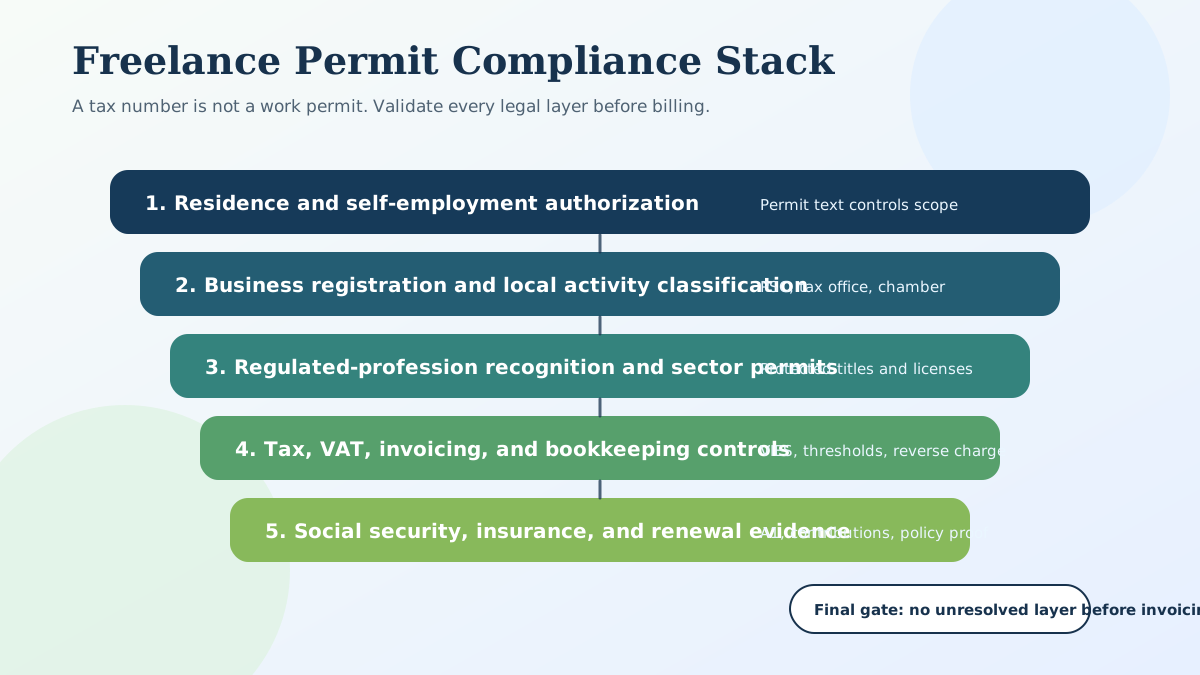
The practical mistake is to treat one approval as if it validates the entire stack. A tax number is not a work permit. A residence permit is not always permission to freelance. A VAT number does not prove professional licensing. A client contract does not decide which country's social security rules apply.
This article is general information for planning. It is not legal, immigration, tax, accounting, social security, or professional-license advice.
Direct answer
If you want to freelance in Europe, assume you may need several separate permissions before issuing invoices: the right to stay, the right to do self-employed work, any business or tax registration, and extra approval if the profession is regulated. There is no single EU freelance permit.
The answer changes with nationality, residence status, the country where you will live and work, whether the profession is regulated, and whether the activity is temporary, local, or cross-border. A tax number or VAT number does not by itself prove you are allowed to freelance.
Next step: identify the residence country and the exact activity first, then check the immigration authority, the national Point of Single Contact, and the tax and social-security sequence for that activity before signing clients or issuing invoices.
A freelancer in Europe may need one or more of the following approvals or registrations before issuing invoices.
| Requirement | When it matters | Typical proof | Source to check |
|---|---|---|---|
| Residence authorization | Non-EU nationals, long stays, or permit-limited status | Visa, residence permit, permit decision letter | National immigration authority |
| Self-employment work authorization | If the activity is independent rather than employed | Permit text allowing freelance or self-employed work | Immigration authority or consulate |
| Business or activity registration | When local law requires registration before trading | Trade register, tax census, chamber, municipality, or PSC filing | National Point of Single Contact |
| Professional authorization | If the profession or title is regulated | Recognition decision, chamber registration, professional license | Regulated-professions authority |
| Tax and VAT registration | When local tax law or EU VAT rules require registration | Tax number, VAT number, VIES validation, invoice setup | National tax authority |
| Social security enrollment | When work creates contribution liability | Social security registration, A1 certificate where applicable | Competent social security institution |
| Mandatory insurance | Where immigration, profession, contract, or local law requires it | Professional liability, health cover, sector insurance | Regulator, insurer, immigration authority |
Primary official references include the EU guidance on business registration, permits, and licenses, the European Commission page on Points of Single Contact, the EU page on regulated professions, the Commission's VAT identification number guidance, and EU social security coordination rules.
Research Map
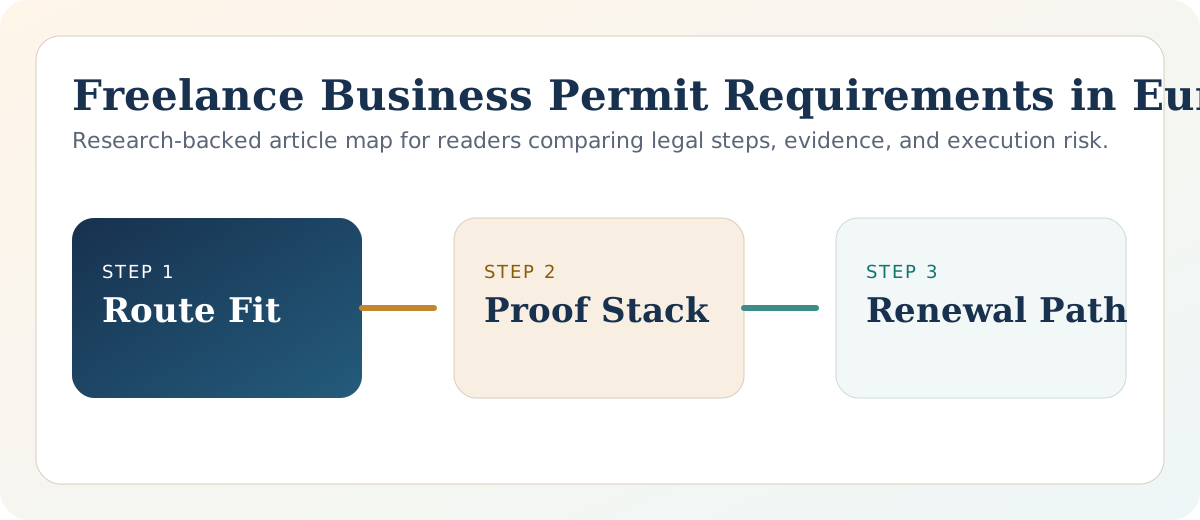
The map above is useful because freelance authorization in Europe is rarely linear. The sequence changes depending on citizenship, country of residence, profession, client location, and whether the activity is temporary, continuous, regulated, or multi-state.
Why Europe Does Not Have One Freelance Permit
The EU single market creates free-movement and services rules, but each country still controls immigration categories for third-country nationals, business-registration procedures, tax administration, social-security collection, and many professional licenses.
For EU citizens, the starting point is normally free movement, but that does not remove residence registration, tax, VAT, social security, or regulated-profession duties. For non-EU citizens, the starting point is the visa or residence permit. A permit that allows employment may not allow self-employment. A permit that allows a specific freelance activity may not allow a different business line.
The Five-Layer Compliance Model
| Layer | Core question | Authority type | Typical failure |
|---|---|---|---|
| Immigration | Can this person reside and perform independent work? | Consulate, immigration office, residence authority | The person has residence permission but not self-employment permission |
| Business registration | Must the activity be declared before trading or invoicing? | Business registry, municipality, tax office, chamber | The freelancer starts invoicing before local registration |
| Professional licensing | Is the title or activity regulated? | Professional body, ministry, chamber, recognition authority | The freelancer markets a protected title without recognition |
| Tax and VAT | Where is the activity taxable, and does VAT registration apply? | National tax authority | Wrong invoice treatment, late VAT registration, missing reverse-charge logic |
| Social security | Which country's system applies to the self-employed activity? | Social security institution | Retroactive contributions or invalid coverage |
Immigration First: Residence Permission Is Not Business Permission
For non-EU nationals, the decisive document is the visa or residence permit. Some permits allow employment only. Some allow self-employment only after additional approval. Some allow one business plan, one occupation, or one professional category.
Germany is a useful example. BAMF states that third-country nationals may immigrate for self-employment or freelancing, but the requirements differ by activity. For self-employment, authorities review financing, regional economic effect, business sustainability, experience, capital investment, and contribution to innovation or employment. For freelance liberal professions, a license may be required for certain activities. See BAMF's self-employment and freelancing overview and Make it in Germany's self-employment visa guide.
Immigration Evidence Checklist
| Evidence | Why it matters |
|---|---|
| Passport and entry history | Establishes identity, nationality, entry basis, and deadlines |
| Residence permit card or approval letter | Shows legal category, duration, and conditions |
| Permit conditions and annexes | Controls whether self-employment is allowed |
| Business plan or activity description | Helps classify the activity and verify permit fit |
| Client contracts or letters of intent | Shows commercial reality, but can also expose premature-work risk |
| Proof of funds or financing | Often required for self-employment routes |
| Professional license evidence | Required where the activity is regulated |
| Health insurance or social coverage | Often required for residence and renewal |
Business Registration: Use the National Point of Single Contact
The European Commission describes Points of Single Contact as e-government portals that allow service providers to obtain information and complete administrative procedures online. PSCs can cover licenses, notifications, permits, professional-qualification recognition, labor and social laws, costs, and time frames.
Use the PSC as a map, not as the only authority. A freelancer may still need separate contact with a tax office, municipality, chamber, professional regulator, health insurer, or social security institution.
Registration Decision Table
| Activity pattern | Likely registration need | Practical note |
|---|---|---|
| Local freelance services to local clients | High | Register before issuing invoices if national law requires it |
| Remote services from one EU country to clients abroad | High | Residence, tax residency, VAT, and social security still attach to where work is performed |
| Temporary services in another EU country | Medium to high | Check temporary-service declarations and regulated-profession rules |
| Digital nomad activity | High | A visa label does not automatically solve tax, VAT, or social security |
| Regulated professional service | Very high | Qualification recognition may be required before marketing or contracting |
| Platform work or creator monetization | Medium to high | Small invoices can still be economic activity for tax/VAT purposes |
Regulated Professions: The Hidden Permit Layer
A profession is regulated if access, scope of practice, or title is controlled by law. The EU warns that regulated professions differ across countries, so a profession that is not regulated in one country may be regulated in another.
Examples that require additional checks include:
| Sector | Possible additional requirement | Risk if ignored |
|---|---|---|
| Medicine, dentistry, nursing, pharmacy | Professional license and qualification recognition | Illegal practice and patient-safety exposure |
| Architecture and engineering | Chamber membership or professional authorization | Unenforceable engagement, professional complaint |
| Law and tax advice | Bar, chamber, or protected-scope rules | Unauthorized practice and client-harm risk |
| Real estate brokerage | Country-specific license or authorization | Administrative penalties and contract delays |
| Security, transport, childcare, food, construction | Sector permits, safety certifications, municipal approvals | Work stoppage or insurance exclusion |
| Financial, insurance, or investment advice | Licensing and conduct-of-business rules | Regulatory enforcement and client-compensation risk |
Use the EU regulated professions guide and the Commission's regulated professions database before accepting clients.
Tax and VAT: Registration Is Activity-Specific
VAT rules are not immigration rules. The European Commission explains that a VAT identification number identifies a taxable person or legal entity registered for VAT, helps identify customer tax status and place of taxation, and appears on invoices where required. The Commission also warns that only tax administrations issue VAT numbers.
A freelancer may need VAT registration when they:
| VAT trigger | Example | Control |
|---|---|---|
| Supply taxable goods or services | Consulting, software, design, training, or local services | Confirm national registration threshold and invoice format |
| Receive services under reverse-charge rules | Buying B2B services from abroad | Check whether domestic reporting is required |
| Supply cross-border B2B services | Work for EU business customers | Validate customer VAT numbers through VIES |
| Sell digital or consumer services across borders | Online courses, downloads, subscriptions | Review OSS or local registration rules |
| Exceed local thresholds | Rapid revenue growth | Monitor monthly turnover, not only annual accounts |
The official VIES tool is available at VIES VAT number validation.
Social Security: One Country's Rules Usually Apply
EU coordination rules state that a person moving within the EU, Iceland, Liechtenstein, Norway, or Switzerland is subject to the legislation of only one country at a time. As a basic rule, self-employed people are covered by the country where they actually work. Multi-country activity has special tests, including whether a substantial part of the activity is performed in the country of residence.
This matters because a freelancer can be tax-resident in one place, invoice clients elsewhere, and still owe social contributions in the country where work is performed or where the applicable-legislation test points.
Social Security Risk Table
| Scenario | Main risk | Control |
|---|---|---|
| Freelancer lives in France and works for German clients | Confusing client location with social security location | Confirm rules based on where work is actually performed |
| Consultant splits work across two countries | Wrong competent state | Ask the social security institution about multi-state activity |
| Self-employed person temporarily works abroad | Missing A1 or posting documentation | Confirm whether self-posting rules apply |
| Freelancer adds employment in another country | Employed activity may control applicable legislation | Reassess before signing the employment contract |
| Remote worker becomes tax resident elsewhere | Social security, tax, and immigration clocks diverge | Rebuild the status map before the move |
Country Snapshots
These examples show how different the freelance-permit stack can be. They are not substitutes for country-specific advice.
| Country | Main freelance entry point | Official reference |
|---|---|---|
| Germany | Residence permit for self-employment or freelance liberal profession, plus tax and registration steps | BAMF self-employment and freelancing |
| Spain | Tax census registration and social security registration for self-employed activity, subject to immigration status | Agencia Tributaria Model 036 and Spanish Social Security self-employed information |
| Portugal | Residence route for independent professional activity plus professional-order proof where applicable | AIMA independent professional residence process |
| France | Residence and activity setup depend on status and business form | Service-Public business and foreign-founder information |
| Netherlands | Local registration, tax/VAT, and professional rules depend on activity | Business.gov.nl starting a business |
Evidence File for a Serious Freelance Application
Build one evidence file before the first invoice. It should answer three questions: who are you, what exactly will you do, and why are you allowed to do it in that country?
| Evidence group | Documents |
|---|---|
| Identity and residence | Passport, visa, residence card, permit decision, address registration |
| Work authorization | Permit text, self-employment approval, immigration correspondence |
| Activity classification | Service description, industry code, NACE or local activity classification |
| Business registration | PSC filing, local register extract, tax census filing, chamber proof |
| Professional authorization | Degree, recognition decision, license, professional-body confirmation |
| Tax and VAT | Tax number, VAT number, VIES checks, invoice template, accounting setup |
| Social security | Enrollment confirmation, contribution basis, A1 if applicable |
| Commercial proof | Client contracts, letters of intent, portfolio, rate sheet, terms of service |
| Insurance | Professional liability, health insurance, sector-mandated coverage |
Operational Risk Matrix
| Risk | Why it happens | Likely consequence | Prevention |
|---|---|---|---|
| Invoicing before work authorization | Client pressure or misunderstanding permit scope | Immigration breach or renewal risk | Confirm permit text before paid work |
| Wrong activity registration | Broad labels such as "consulting" hide regulated work | Reclassification, fines, or license issue | Match actual work to official classification |
| Regulated title misuse | Freelancer translates title loosely into English | Professional-body complaint or contract risk | Use only authorized titles in the host country |
| VAT under-registration | Cross-border B2B work grows quickly | Back VAT, penalties, invoice corrections | Monitor thresholds and reverse-charge rules |
| Social security mismatch | Work is performed in a different state than expected | Back contributions and coverage gaps | Ask the competent institution early |
| Immigration renewal denial | Business exists on paper but lacks viable activity | Permit not extended | Keep revenue, tax, and client evidence organized |
Practical Launch Sequence
- Read the visa or residence permit text and identify whether independent work is allowed.
- Define the activity in precise operational language, not marketing language.
- Check whether the profession is regulated in the country where the work is performed.
- Use the national Point of Single Contact or official business portal to map registration steps.
- Register with tax authorities before issuing invoices if required.
- Determine whether a VAT number is required before the first cross-border invoice.
- Confirm social security coverage and contribution obligations.
- Create compliant invoices, contracts, privacy notices, and bookkeeping workflows.
- Store all approvals and filings in a renewal-ready evidence folder.
- Reassess status after any change in country, clients, activity, revenue, or permit category.
FAQ
Do EU citizens need a freelance permit in another EU country?
Usually they do not need a work permit in the same way non-EU nationals do, but they may still need residence registration, business registration, tax/VAT setup, social security enrollment, and regulated-profession recognition.
Can a non-EU national freelance on a student, employee, or family permit?
Only if the permit or immigration authority allows it. Some permits restrict self-employment or require separate approval. The permit text controls the answer.
Is a VAT number the same as permission to freelance?
No. A VAT number is a tax identifier. It does not prove immigration permission, professional authorization, or business-license compliance.
Can a freelancer invoice clients in another EU country without registering there?
Sometimes, but not always. The answer depends on where the work is performed, the customer type, VAT rules, permanent-establishment risk, professional licensing, and the duration or regularity of activity in the other country.
What is the safest first step?
Confirm the right to perform self-employed work in the country of residence before registering, advertising, or invoicing.
Permit route decision model
Freelance business permission in Europe starts with the person's legal status. EU citizens usually rely on free movement but still need residence registration, tax registration, social security, and regulated-profession compliance. Non-EU nationals must identify whether the residence permit allows self-employment, employment only, study with limited work, family work rights, digital nomad activity, entrepreneur activity, or no economic activity.
The second layer is activity. "Freelance" is too broad for permit analysis. A software consultant, architect, therapist, taxi driver, language teacher, financial adviser, food seller, photographer, and construction contractor can face different licensing and professional rules. The application should describe the real service, not a vague commercial label.
The third layer is location. A freelancer may live in one country, serve clients in another, and physically perform work in several. Immigration permission normally concerns the country where the person is physically present and working. Tax, VAT, and professional licensing may look at client country, work country, residence country, and registration country separately.
Non-EU freelancer evidence pack
Non-EU applicants should build a renewal-ready file from the beginning. Include passport, residence permit, permit conditions, business plan, client contracts or letters of intent, proof of qualifications, professional license if needed, insurance, expected income, bank statements, tax registration, VAT status, social-security registration, invoices, and proof that work matches the authorized activity.
Renewal authorities may ask whether the business is real, viable, and compliant. A permit obtained with a business plan but followed by no invoices, no tax filings, no insurance, or work outside the approved scope can create renewal risk. The freelancer should save evidence continuously rather than trying to reconstruct the business at renewal time.
If the freelancer changes activity, adds local clients, moves home country, forms a company, or becomes economically dependent on one client, the permit position should be reviewed. Some permits are tied to activity, income level, business viability, or foreign-source income.
Regulated profession and title controls
Regulated professions require careful title and scope review. A person qualified abroad may not be allowed to use the same professional title or provide the same services in the host country without recognition, registration, supervision, or local exams. Translated titles can mislead clients and regulators. Use only titles the host country permits.
Even unregulated consulting can touch regulated areas. Business advice may become tax advice, legal advice, investment advice, insurance intermediation, immigration advice, medical advice, or engineering certification depending on the work performed. Contracts and websites should describe services accurately and avoid regulated promises unless authorization exists.
Keep evidence of professional-body replies, qualification recognition, license numbers, continuing-education requirements, and insurance. If no license is required, keep the authority or database result that supports that conclusion.
VAT, invoicing, and business registration alignment
A freelancer should not treat a business permit as a tax setup. After immigration and professional permission, the freelancer still needs the correct tax registration, VAT decision, invoice template, bookkeeping, and social-security registration. A VAT number does not prove the right to work, and a residence permit does not prove VAT compliance.
Invoices should match the registered identity, address, tax number, VAT treatment, client details, service description, date, amount, and payment account. If the freelancer changes country or legal form, update templates before issuing new invoices. Incorrect invoices can create client disputes, VAT errors, and renewal evidence problems.
For EU B2B clients, validate VAT numbers where reverse charge is used. For consumer clients, check whether local consumer-law, digital-service, or distance-selling rules apply. For platform income, reconcile platform statements with invoices and bank deposits.
Social-security and health-insurance planning
Freelance permits and social security interact because authorities often expect the freelancer to show coverage and contribution compliance. Some countries require self-employed social-security registration before or soon after activity begins. Others assess contributions based on income estimates and later reconcile. Health-insurance coverage may be tied to contribution status.
Cross-border freelancers should identify the competent country. If work is performed in several states, or if the person combines employment and freelancing, EU coordination rules or bilateral agreements may matter. Keep certificates and institutional decisions in the permit file because they can support renewals and avoid duplicate contributions.
Client dependency and employment-status risk
A freelancer who works almost entirely for one client, follows fixed hours, uses client tools, reports to a manager, cannot subcontract, and bears little commercial risk may be treated as an employee in substance. This can affect taxes, labor law, social security, and immigration. Some freelance or self-employment routes expect independent business activity; disguised employment can undermine the permit.
Contracts should show independence where it is real: scope, deliverables, fees, substitution rights if applicable, non-exclusivity, business equipment, professional insurance, and responsibility for taxes. The actual work must match the contract.
Country-by-country implementation file
Because freelance permission remains country-specific, build an implementation file for the host country. It should list the immigration route, business registration portal, tax office, VAT authority, social-security institution, professional chamber, insurance requirement, local municipality, and renewal authority. For each authority, record the required documents, deadline, filing method, fee, and evidence produced.
This file prevents a common mistake: completing the easiest registration and assuming the stack is finished. A freelancer may receive a tax number but still lack residence permission, social-security enrollment, or professional authorization. Another may have immigration permission but no right invoice setup. The file should show every layer as complete or not required.
Update the file after every relocation, new activity, or client-country change. Freelance status in one country does not automatically transfer to another. Even within the EU, tax, social security, and professional rules can require new filings.
Business viability for permit renewals
Many freelance or self-employment residence routes require the business to remain viable. Renewal evidence may include invoices, contracts, tax filings, bank statements, profit, insurance, social contributions, and proof that the activity matches the approved plan. A freelancer should save renewal evidence monthly, not search for it near expiry.
Viability is not only revenue. Authorities may look at whether income supports the applicant, whether tax and contributions are paid, whether clients are real, whether the activity is lawful, and whether the applicant still meets insurance or accommodation requirements. If the business pivots, document why the new activity remains within the permit scope.
If income is seasonal or project-based, keep contracts, pipeline evidence, deposits, and explanations. A low-income quarter may be defensible if the annual business remains viable and documented.
Working across borders
A freelancer authorized in one country should not assume they can perform work physically in another country without review. Short business trips, client visits, remote work, recurring workdays, and local service delivery can have different immigration, tax, VAT, and social-security implications. A client in another country is not the same as work performed in that country.
If the freelancer travels regularly, keep a workday ledger by country. Include client served, service performed, location, invoice period, and travel evidence. This supports tax residence, source income, social security, and potential local registration analysis.
For remote and cross-border work, compare can I work remotely in Europe, income tax rules for freelancers in Europe, and freelance tax thresholds in Europe.
Home-based and online freelance work
Online work is still work performed somewhere. A designer, developer, consultant, coach, or writer working from a European apartment may need self-employment permission, tax registration, social contributions, and home-use approval even if all clients are abroad. Foreign-source clients do not make the activity invisible.
Home-based freelancers should confirm whether the address can be used for business, whether clients may visit, whether stock or equipment is allowed, and whether insurance covers the activity. If the business grows, a registered office, coworking space, or commercial premises may be safer.
Client due diligence and contract terms
Clients may ask freelancers for proof of registration, VAT number, insurance, right to work, and tax residence. A prepared freelancer can respond quickly with a limited evidence pack. Do not send full passports, residence permits, or tax records unnecessarily; provide only what is needed and redact sensitive details where appropriate.
Contracts should state scope, deliverables, independent status, payment terms, tax treatment, VAT, confidentiality, data handling, liability, governing law, and termination. If the client requires local licensing or insurance, confirm before work starts.
Stop-work triggers
Stop or pause freelance activity if the permit expires, renewal rights are unclear, the activity changes materially, a regulated profession issue appears, social-security status is unresolved, VAT registration becomes overdue, or the freelancer moves to another country. Continuing to invoice during an unresolved legal gap can damage immigration renewals and tax compliance.
The safer approach is to pause, document the issue, obtain authority or adviser confirmation, and restart with a corrected file.
Primary References
- Your Europe: registration, permits, and licenses
- European Commission: Points of Single Contact
- Your Europe: regulated professions
- European Commission: VAT identification numbers
- European Commission: social security coordination
- BAMF: self-employment and freelancing
Final Checklist
- Confirm residence status and self-employment authorization.
- Identify the country where the work is actually performed.
- Check the national business registration path through official portals.
- Screen the activity against regulated-profession rules.
- Register for tax and VAT where required.
- Confirm invoice wording, VAT treatment, and recordkeeping.
- Establish the correct social security system and contribution path.
- Obtain professional insurance where required by law, contract, or sector.
- Keep evidence for renewals, audits, and client due diligence.
- Recheck the full compliance stack after relocation, revenue growth, or scope change.
A freelancer is ready to operate only when immigration, business registration, professional authorization, tax/VAT, social security, and insurance are aligned.