Last updated
Income Tax for Non-Residents in Spain: Complete 2026 Guide
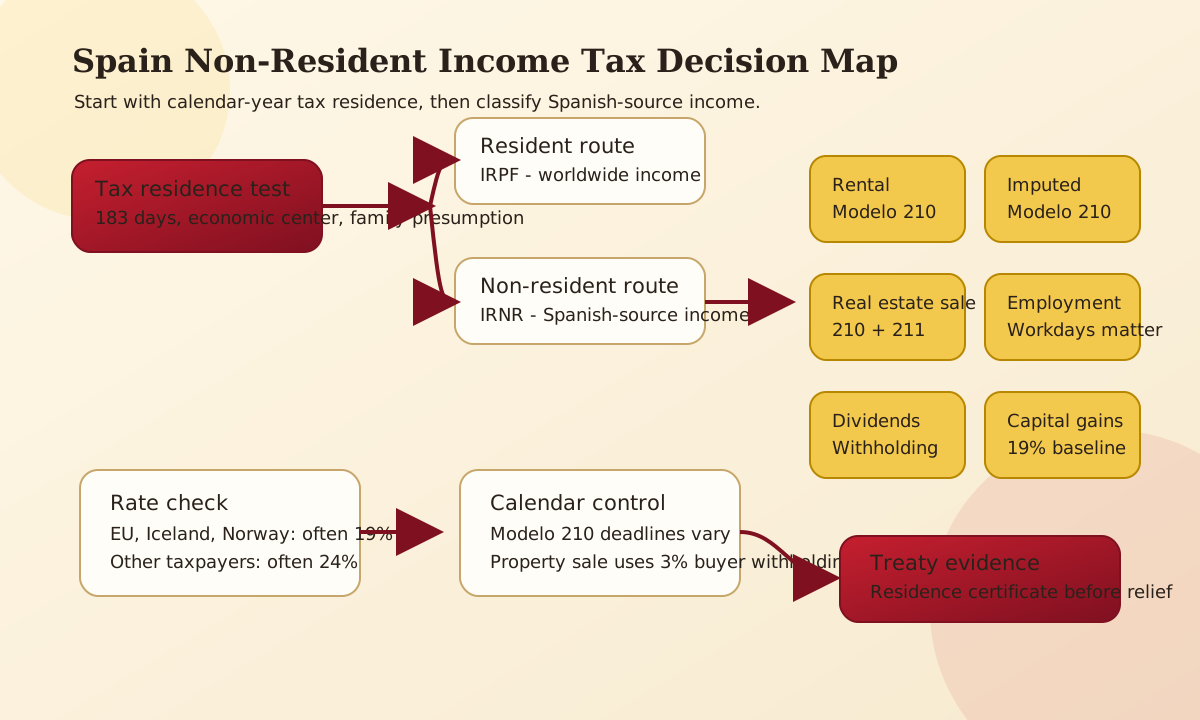
Quick Answer
Income Tax for Non-Residents in Spain: Complete 2026 Guide helps expats separate account access, product choice, tax reporting, and evidence before investing. It explains opening or using broker accounts, comparing bank interest and ETFs, tracking capital gains, and preserving tax-reporting evidence, then shows how to separate tax residence, account eligibility, product risk, reporting records, withholding, and platform evidence before investing. The later sections connect quick answer, irnr vs irpf: the first decision, and tax residence is not the same as immigration residence so the next step is easier to judge. Read it before opening an account or placing trades so eligibility, tax records, product risk, and reporting duties are understood.
The practical question is not "Do I have a Spanish NIE?" or "Do I have a residence card?" The controlling question is whether Spain treats you as tax resident for the calendar year and, if not, which Spanish-source income you received.
Source-check date: May 14, 2026. This guide uses Agencia Tributaria, Ministry of Finance, EU, and other primary sources where possible. It is general information, not tax advice.
IRNR vs IRPF: the first decision
Spain separates the tax position of individuals into resident and non-resident categories. The difference is foundational.
| Question | Non-resident route | Resident route |
|---|---|---|
| Main tax | IRNR, Non-Resident Income Tax | IRPF, Personal Income Tax |
| Scope | Spanish-source income and certain Spanish assets | Worldwide income, subject to treaty relief |
| Common form | Modelo 210 for many non-resident income items without a permanent establishment | Modelo 100 for annual resident income tax |
| Typical rate logic | Flat statutory rates by income type and residence country | Progressive national and regional scales |
| Foreign assets reporting | Usually outside the resident Form 720 framework | May apply if thresholds and conditions are met |
| Treaty role | Can reduce or eliminate Spanish tax on some income | Can resolve double residence and foreign tax credits |
Agencia Tributaria states that tax residence for individuals is assessed by complete calendar years. Its tax-residence guidance includes the familiar more than 183 days in Spain during the calendar year test, but also looks at the main center or base of economic activities and family presumptions. See Agencia Tributaria's tax-residence guidance: Tax resident in Spain.
Tax residence is not the same as immigration residence
A person can hold Spanish immigration permission and still need a tax-residence analysis. Conversely, someone physically present in Spain without a long-term residence card may still create Spanish tax issues if income is earned in Spain.
Key distinctions:
| Status | What it proves | What it does not prove |
|---|---|---|
| NIE | Spanish identification number for dealings with authorities | Tax residence |
| TIE or residence card | Immigration permission | Final tax treatment |
| Empadronamiento | Municipal registration | Final tax residence |
| Tax residence certificate from another country | Evidence for treaty or non-residence claims | Automatic exemption from all Spanish tax |
| Spanish tax-residence certificate | Evidence Spain views you as tax resident | Immigration permission |
Agencia Tributaria notes that non-residence can be evidenced with a tax-residence certificate issued by another state's tax authorities, generally valid for one year: Acreditación de la no residencia.
What income is taxed under IRNR?
IRNR applies to Spanish-source income received by non-residents. The rules are different depending on whether the non-resident has a permanent establishment in Spain. This guide focuses mainly on individuals and entities without a permanent establishment, because that is the route most non-resident property owners, investors, and short-stay earners encounter.
| Income type | Common Spanish tax route | Practical note |
|---|---|---|
| Spanish rental income | Modelo 210 | Taxable even if the owner lives abroad |
| Imputed income from Spanish property not rented | Modelo 210 | Usually annual filing for non-resident owners |
| Sale of Spanish real estate | Modelo 210 plus buyer Modelo 211 withholding | Buyer generally withholds 3% of the price |
| Spanish employment income | IRNR withholding and/or reporting depending on facts | Work physically performed in Spain requires fact-specific analysis |
| Dividends from Spanish companies | Withholding, possible treaty relief | Domestic rate may be reduced by treaty |
| Interest from Spanish sources | Withholding/exemption analysis | Treaty and domestic exemptions matter |
| Capital gains on Spanish assets | Modelo 210 or withholding mechanism | Real estate has special withholding mechanics |
| Business activity in Spain | Could trigger permanent establishment or local registration | Do not treat this as simple Modelo 210 without review |
Agencia Tributaria's IRNR area for income without a permanent establishment is here: Non-Residents' Income Tax: income obtained without a permanent establishment.
IRNR rates: EU/EEA distinctions matter
For non-residents without a permanent establishment, the general IRNR rate depends partly on residence country.
| Income category | EU, Iceland, Norway | Liechtenstein | Other taxpayers | Notes |
|---|---|---|---|---|
| General income | 19% | 19% since July 11, 2021 | 24% | Confirm current AEAT table before filing |
| Dividends and equity income | 19% | 19% | 19% | Treaty may reduce |
| Interest and other capital income | 19% | 19% | 19% | Treaty or domestic exemptions may apply |
| Most capital gains on asset transfers | 19% | 19% | 19% | Includes many sale gains |
| Seasonal worker income under specific fixed-term rules | 2% | 2% | 2% | Narrow category |
| Pensions | Scale | Scale | Scale | Not a flat general rate |
Agencia Tributaria publishes the current rate table here: Tax rates for income tax for non-residents without a permanent establishment.
Rental income from Spanish property
Rental income from Spanish real estate is one of the most common IRNR cases. Spain generally has taxing rights over income from real estate located in Spain, even when the owner is tax resident elsewhere.
| Rental question | Practical answer |
|---|---|
| Which form is commonly used? | Modelo 210 |
| Can income be grouped? | In some cases yes, if the income type, taxpayer, rate, property, and period rules are met |
| Are expenses deductible? | EU, Iceland, and Norway residents may deduct qualifying directly related expenses under AEAT guidance; other taxpayers should verify current law and any litigation-driven changes before assuming deductions |
| Is short-term tourist rental different? | It may trigger additional regional licensing, VAT, platform, or economic-activity questions |
| Is property management enough to create a business? | It depends on facts; recurring operations and local resources need review |
Agencia Tributaria's real-estate rental IRNR guidance states that income from Spanish real estate may be taxed in Spain and identifies the 19%/24% distinction for residents in the EU, Iceland, and Norway versus other taxpayers: Non-resident Income Tax for rental property.
Imputed income for non-rented Spanish property
Non-resident owners often miss this point: Spanish property can create a filing obligation even when it is not rented. Spain may impute income to certain urban properties and other qualifying real estate not used for economic activity.
| Property situation | Likely income-tax issue |
|---|---|
| Non-resident owns a Spanish holiday home and does not rent it | Imputed real-estate income under Modelo 210 |
| Property rented for part of the year and vacant part of the year | Rental income for rented days plus possible imputed income for available days |
| Main home of a Spanish tax resident | Resident IRPF rules, not the same non-resident analysis |
| Land under construction or unusable buildings | Special rules; check whether imputation applies |
Agencia Tributaria explains the imputation conditions here: To which properties is real estate income imputed?. It also explains calculation concepts here: Calculation of imputed income.
Employment income for non-residents
Employment income can be deceptively difficult. The source of salary is not determined only by where the employer is incorporated or where the bank account is located. Physical workdays, payroll withholding, treaty rules, and whether the employer has a Spanish presence can all matter.
| Scenario | Risk level | Why |
|---|---|---|
| Non-resident works outside Spain for a non-Spanish employer | Low Spanish income-tax risk | No Spanish-source workdays in ordinary cases |
| Non-resident works in Spain for a Spanish employer | High | Spanish payroll and IRNR/IRPF classification must align |
| Non-resident works temporarily in Spain for a foreign employer | Medium to high | Treaty employment article, days, recharge, and employer presence matter |
| Director fees from a Spanish company | High | Often separately addressed in treaties |
| Remote work from Spain while claiming non-residence | High | Physical presence and source rules need careful documentation |
If you are close to 183 days, have family in Spain, or perform work physically in Spain, do not treat yourself as a simple non-resident property filer without advice.
Capital gains and Spanish real estate sales
When a non-resident sells Spanish real estate, the buyer generally must withhold 3% of the agreed consideration and pay it to Agencia Tributaria using Modelo 211. The seller then uses Modelo 210 to declare the gain or loss and credit the withholding.
| Step | Responsible party | Form | Timing concept |
|---|---|---|---|
| Sale closes | Buyer and seller | Notarial deed and sale documents | Completion date drives tax deadlines |
| 3% withholding paid | Buyer | Modelo 211 | Buyer pays withholding as payment on account |
| Gain or loss declared | Seller | Modelo 210 | Generally within three months after the one-month period following the sale date |
| Refund claim if withholding exceeds tax | Seller | Modelo 210 | Requires evidence of cost basis, sale price, expenses, and withholding |
Agencia Tributaria explains the buyer withholding here: Retention of the purchaser of a building. Modelo 211 instructions are here: Form 211 instructions.
A property sale may also trigger local municipal tax on urban land value increases, commonly called plusvalía municipal, which is separate from IRNR.
Modelo forms non-residents should recognize
| Form | Purpose | Who uses it |
|---|---|---|
| Modelo 210 | Main self-assessment for many IRNR items without a permanent establishment | Non-resident taxpayers |
| Modelo 211 | 3% withholding on acquisition of Spanish real estate from a non-resident seller | Buyer/acquirer |
| Modelo 213 | Special tax on real estate owned by non-resident entities | Certain non-resident entities |
| Modelo 216 | Withholding/payment on account for certain non-resident income | Withholding agents |
| Modelo 296 | Annual summary for certain non-resident withholding | Withholding agents |
| Modelo 100 | Resident personal income tax | Spanish tax residents |
| Modelo 030 | Census data for individuals | Individuals updating tax data |
| Modelo 036/037 | Business census declarations | Businesses and professionals |
Agencia Tributaria's Form 210 page is here: Form 210 IRNR.
Filing deadlines: build a calendar, not a memory system
Modelo 210 deadlines depend on the type of income.
| Income type | Deadline logic |
|---|---|
| Real-estate sale gains | Within three months after the one-month period from the transfer date |
| Imputed income from real estate | Calendar year following the accrual date, which is usually December 31 |
| Positive returns from other income | Generally first 20 calendar days of April, July, October, or January for the previous quarter, unless a special rule applies |
| Rental income grouping | Check whether quarterly or annual grouping applies under current AEAT instructions |
Agencia Tributaria's official Form 210 instructions describe the filing periods here: Form 210 instructions. Its model-and-deadline page is here: Model and deadline for declaration.
Treaty relief and double taxation
Spain has a wide treaty network. A treaty can reduce Spanish withholding on dividends, interest, royalties, employment income, director fees, pensions, or business profits. But treaty relief is not automatic in practice. You normally need to prove tax residence in the treaty country, apply the correct treaty article, and maintain evidence.
| Treaty issue | Practical control |
|---|---|
| Dual residence | Apply domestic law first, then treaty tie-breakers |
| Spanish real estate income | Treaties commonly allow Spain to tax real estate located in Spain |
| Employment income | Days, employer, recharge, and permanent establishment tests matter |
| Dividends and interest | Treaty may reduce withholding; refund may require certificate |
| Capital gains | Real-estate-rich company rules may matter |
| Evidence | Keep foreign tax-residence certificate, income statements, withholding certificates, and filings |
Spain's Ministry of Finance publishes double-taxation agreements here: Convenios de doble imposición. Spain's public administration also summarizes treaty relief principles here: Double taxation agreements.
Practical non-resident tax checklist
Before filing, assemble:
| Evidence | Why it matters |
|---|---|
| Passport and travel calendar | Supports day-count analysis |
| Foreign tax-residence certificate | Supports non-residence and treaty claims |
| NIE/NIF | Required for Spanish tax interaction |
| Property deed and cadastral reference | Needed for property filings |
| Rental statements and platform reports | Supports income calculation |
| Expense invoices | Needed where deductions are permitted |
| Mortgage interest and insurance records | Potential rental expense support for eligible taxpayers |
| Sale deed and purchase deed | Needed for capital gains |
| Modelo 211 copy | Credits 3% withholding on property sale |
| Spanish withholding certificates | Avoids double reporting or missed credits |
| Treaty analysis memo | Documents why a reduced rate or exemption was claimed |
Common mistakes
| Mistake | Consequence |
|---|---|
| Assuming a NIE makes you tax resident | Wrong tax form and classification risk |
| Assuming a residence card proves IRPF status | Immigration and tax are separate |
| Ignoring imputed income on a non-rented property | Late Modelo 210 exposure |
| Using gross rental numbers without checking deduction eligibility | Overpayment or underpayment risk |
| Missing the 3% property-sale withholding mechanics | Refund delays or tax mismatch |
| Claiming treaty relief without a residence certificate | Denial or audit risk |
| Crossing 183 days without updating the analysis | Wrong tax regime for the whole calendar year |
| Treating remote work from Spain as foreign by default | Spanish-source and residence risk |
Non-resident classification workflow
Start with the calendar year. Spain's residence analysis is annual, so a person can be non-resident for one year and resident the next, or become resident after a move that changes the center of life. The day count matters, but so do family ties, economic interests, habitual presence, and treaty tie-breakers. A NIE, visa, property purchase, or bank account does not by itself decide tax residence.
The second step is to identify Spanish-source income. Common categories include rent from Spanish property, imputed income from a property available for personal use, gains from Spanish real estate, employment performed in Spain, director fees from Spanish companies, dividends, interest, royalties, pensions, and business income connected to Spanish activity. Each category may have a different form, rate, deduction rule, or withholding mechanism.
The third step is to check whether the taxpayer is resident in another EU or EEA country. Deduction rules and rates can differ from non-EU treatment, especially for rental income. The evidence should include a foreign tax-residence certificate and proof of expenses where deductions are claimed. Do not apply EU/EEA deduction treatment without evidence of residence status.
Spanish property owners
Non-resident owners often have a filing duty even when the property is not rented. Imputed real-estate income can apply to a property available for personal use. If the property is rented, rental income may require Modelo 210 filings, expense analysis, and platform-report reconciliation. If the property is sold, the buyer's 3 percent withholding and the seller's capital-gains filing must be coordinated.
Owners should keep the purchase deed, sale deed, cadastral reference, IBI receipts, community fees, insurance, mortgage interest, repair invoices, agency fees, rental contracts, tourist-license documents if relevant, platform statements, and bank receipts. The tax file should separate personal-use periods from rental periods. A mixed-use property is harder to file accurately than a fully rented property.
Short-term rentals add extra risk. Tourist licensing, platform reporting, VAT or local taxes, regional rules, and expense allocation may differ from ordinary long-term rental. Non-resident owners should not assume that a platform's tax summary is enough for Spanish filing.
Workers, directors, and frequent visitors
Non-residents who physically work in Spain need a separate review. Employment income can be Spanish-source when work is performed in Spain, even if the employer is foreign. Remote workers who spend long periods in Spain can also become Spanish tax residents or create employer payroll issues. A tourist or digital nomad narrative does not replace tax analysis. For remote-work context, use remote work Europe tax.
Directors and board members should classify fees carefully. Director remuneration from a Spanish company can have different withholding and treaty treatment from ordinary employment income. Executives who manage foreign companies from Spain should also consider whether their presence affects corporate tax or permanent-establishment risk.
Frequent visitors should keep travel evidence. Passport stamps, boarding passes, accommodation records, work calendars, and family-location evidence may be needed if residence is questioned. The file should be built during the year, not after AEAT asks for proof.
Filing calendar controls
Create a Spanish tax calendar by income type. List property imputed income, rental income, sale gains, withholding certificates, treaty-residence certificates, and foreign filing deadlines. Modelo 210 deadlines are not identical for every income category. If a withholding agent files Modelo 216 or annual summaries, reconcile those figures with the taxpayer's own records.
A practical control is to close the file quarterly. Download rental statements, platform data, bank receipts, expense invoices, and withholding certificates while they are still accessible. At year end, confirm whether the taxpayer remained non-resident and whether any move, family change, work pattern, or property-use change affects the filing route.
Treaty and certificate workflow
Treaty relief starts with proof of residence outside Spain. A taxpayer claiming reduced withholding, exemption, or non-resident treatment should obtain a certificate of tax residence from the other country for the relevant year. The certificate should match the taxpayer, year, and treaty country. If the certificate arrives late, keep evidence of the request and update the file when it is issued.
The treaty article should be matched to the income type. Rental income from Spanish real estate, employment income, director fees, pensions, dividends, interest, royalties, and business profits can follow different articles. A single "double taxation treaty applies" statement is not enough. The file should state the article, the Spanish domestic rule, the treaty outcome, and whether Spain still has taxing rights.
If Spanish tax is withheld above the treaty rate, a refund route may be available, but the taxpayer needs withholding certificates, payment evidence, residence proof, and correct forms. Refund timing can be slow, so cash-flow planning matters.
Deduction and expense controls
Non-resident expense deductions are not universal. EU and EEA residents may have broader deduction possibilities for certain income, while non-EU residents may be taxed more often on gross income. The taxpayer should not deduct property expenses simply because a Spanish resident could. The deduction position should be tied to residence status, income type, and the official instructions for the year.
For rental property, keep invoices in the taxpayer's name, proof of payment, allocation between rental and personal-use periods, mortgage interest statements, insurance, repairs, community fees, agency fees, utilities, and local taxes. Capital improvements should be separated from repairs. If the property is rented only part of the year, expenses may need apportionment.
For property sales, keep acquisition costs, improvement costs, taxes, notary fees, agent fees, and the buyer's withholding evidence. The 3 percent withholding does not necessarily equal the final tax. The seller may owe more or request a refund depending on the gain calculation.
Remote workers and digital nomads
Non-resident treatment can change quickly for people who spend time working from Spain. A remote worker may become Spanish tax resident under domestic rules, or may remain non-resident but have Spanish-source employment income for workdays in Spain. The answer depends on days, family location, economic interests, employer, payroll, and treaty position.
Digital nomad or residence permission should not be treated as a tax ruling. A visa can authorize residence or remote work while the tax result is determined separately. Workers should keep travel calendars, workday calendars, employer letters, payroll records, and residence evidence. If the person expects to stay close to or above 183 days, get advice before the year closes.
Employers should also review payroll and social-security exposure when an employee works from Spain. A worker's personal Modelo 210 question may be only one part of the employer's compliance problem.
Modelo 210 operating file
For recurring filings, build a Modelo 210 file by income type. For each filing period, record income, deductions if allowed, rate, withholding, form submission, payment proof, and supporting documents. Use consistent labels for property, tenant, period, and income category. This makes future filings faster and reduces errors when several quarters or properties are involved.
If the taxpayer owns multiple Spanish properties, keep separate calculations for each property. Imputed income, rental periods, cadastral values, and expenses can differ. Combining properties in a spreadsheet without property-level evidence can create filing mistakes.
After filing, save the submission receipt and payment confirmation. If a representative files, the taxpayer should still keep copies. Non-residents often discover years later that they need prior filings for property sales, mortgages, residency applications, or tax authority questions.
Representative and payment controls
Non-residents should decide who is responsible for filings before deadlines arrive. A Spanish tax representative, accountant, property manager, or lawyer may help, but the taxpayer should still keep filing receipts, payment confirmations, and source documents. Delegating the filing does not remove the taxpayer's obligation to prove the position later.
Payment method also matters. Keep bank proof showing the exact tax paid, date, model, period, and taxpayer identity. If a refund is expected, keep the Spanish bank or international payment details current so administrative delays do not become lost refunds.
Bottom line
For non-residents, Spanish income tax is manageable only if the analysis starts in the right order:
- Confirm tax residence for the calendar year.
- Identify Spanish-source income.
- Separate IRNR from IRPF.
- Apply the correct rate and EU/EEA distinction.
- Use the correct Modelo form and deadline.
- Preserve treaty evidence before claiming relief.
- Re-check the position whenever workdays, family location, property use, or residence status changes.
For most non-resident owners and investors, Modelo 210 is the central filing tool. For workers, directors, entrepreneurs, and frequent visitors, the answer can change quickly and should be reviewed before income is earned, not after the filing deadline.