Last updated
Digital Nomad Visa Requirements in Europe: Eligibility, Evidence, and Tax Risk
Direct answer
This article treats Digital Nomad Visa Requirements in Europe: Eligibility, Evidence, and Tax Risk as a decision file rather than a generic overview. It explains checking tax position, payroll evidence, social-security exposure, net pay, and cross-border filing questions across Europe, then shows how to separate residence, treaty, payroll, contribution, withholding, and filing questions before signing or moving money. The later sections connect legal context: what these visas actually regulate, official sources used for current verification, and comparative eligibility matrix so the next step is easier to judge. Read it before submitting forms, moving money, choosing a provider, or assuming that a rule from another country applies.
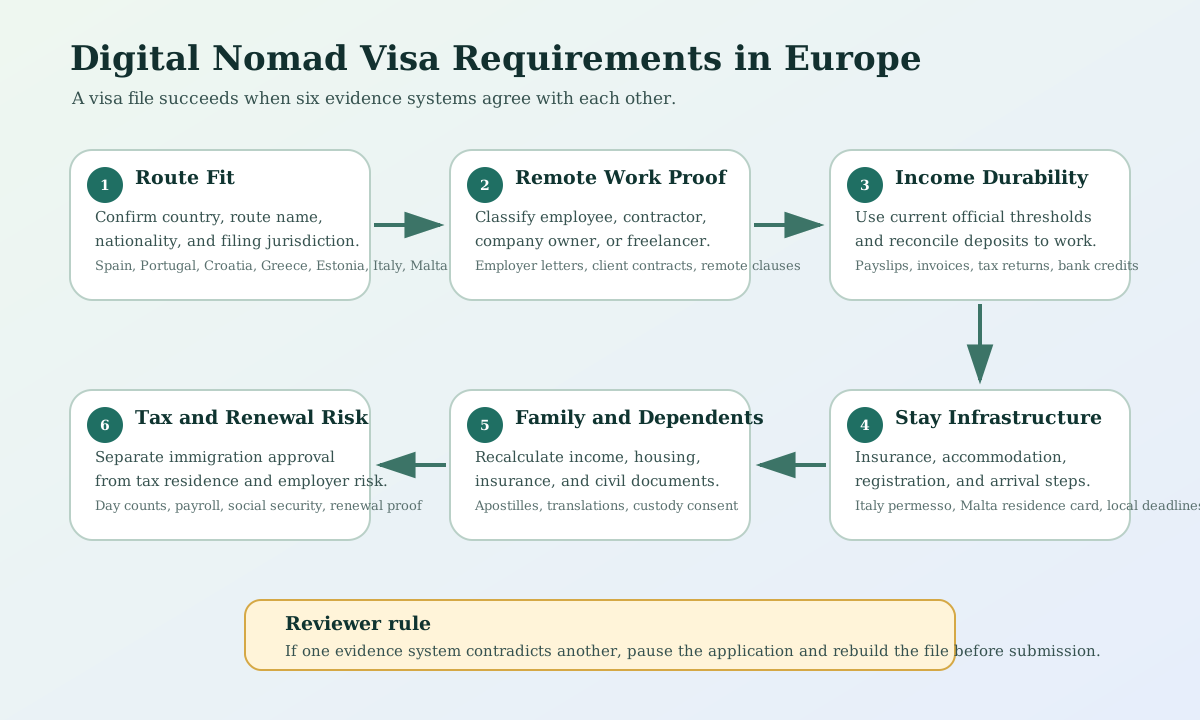
Europe does not have a single digital nomad visa. It has national immigration routes that use similar vocabulary but different legal tests. A remote worker who qualifies in Croatia may fail in Italy because Italy focuses on highly specialized work. A freelancer who fits Malta's model may not fit Spain if too much revenue is connected to local Spanish clients. A family that satisfies an income threshold in one country may need a different filing sequence, accommodation file, or dependent proof in another.
The core rule is simple: a digital nomad visa is not a lifestyle permit. It is a documented residence route for people who can prove remote work, foreign-source activity, financial capacity, admissibility, insurance, and a credible stay plan. The stronger applications read less like a travel story and more like an audit file.
This guide reviews major European routes and gives a practical framework for applicants, mobility teams, and advisers. It is not legal or tax advice. Requirements change by consulate, country of residence, nationality, family composition, and filing date; verify the authority page before applying.
Decision matrix
Use this matrix before choosing a country or paying for translations, leases, or adviser work. The right route is the one your evidence can prove under the current official checklist, not the one with the most appealing label.
| Decision point | Low-risk answer | Evidence to collect | Escalate before filing if |
|---|---|---|---|
| Work model | Your employment, freelance, or company role is explicitly covered by the country's remote-work route. | Employment contract, employer letter, client contracts, company registration, invoices, and remote-work authorization. | The route excludes your work type, local clients are involved, or the employer will not confirm remote work abroad. |
| Income durability | Income is recurring, traceable, above the published threshold, and consistent across contracts, bank statements, payslips, invoices, and tax records. | Bank statements, payslips, invoices, tax returns, client contracts, salary letter, and dependent-income calculations. | Income is seasonal, paid through platforms without clear payer identity, recently changed, or barely above threshold. |
| Health insurance | The policy names every applicant, covers the host country and required period, and matches the official wording closely enough for the authority. | Policy certificate, full terms, proof of payment, coverage territory, start and end dates, exclusions, and claim instructions. | The policy is travel-only, excludes residence-like stays, omits family members, or cannot explain hospital and emergency coverage. |
| Tax and social security | You can explain where tax residence, payroll, social security, and employer obligations are expected to sit during the stay. | Work-location plan, employer payroll note, A1 or social-security correspondence where relevant, tax adviser note, and residence timeline. | You will stay near or beyond tax-residence thresholds, manage contracts locally, use local clients, or keep foreign payroll without review. |
| Family application | Every dependant has relationship proof, funds, insurance, accommodation, and consent documents that meet the route's rules. | Marriage or birth certificates, apostilles or legalisation, translations, custody or consent documents, family insurance schedule, and income uplift calculation. | Custody is complex, names differ, documents are old, or the route treats dependants differently at visa and residence stages. |
| Filing channel | You know whether to file at a consulate, in-country authority, online portal, or residence office, and the evidence matches that channel. | Official checklist, appointment record, fee receipt, lawful-residence proof in filing country, translations, and submission copy. | Consular and in-country checklists conflict, appointment timing is tight, or you will enter before approval. |
Legal Context: What These Visas Actually Regulate
Digital nomad routes sit at the intersection of immigration, tax, labor, and social-security law. The immigration approval usually answers one question: may the applicant reside in the host country while performing remote work under the defined route? It does not automatically answer whether the applicant becomes tax resident, whether an employer creates permanent-establishment risk, whether social-security coverage changes, or whether local client work is allowed.
Most European digital nomad routes use five controls:
| Control | What authorities test | Why it matters |
|---|---|---|
| Remote-work status | Employment, freelance, company ownership, or client contracts | Determines whether the route covers the applicant's actual work model |
| Foreign-source activity | Employer, clients, or business counterparties outside the host country | Prevents the route from becoming an ordinary local labor-market permit |
| Income durability | Recurring salary, invoices, bank statements, tax returns, or contracts | Shows the applicant can support the stay without local employment |
| Admissibility | Criminal-record checks, Schengen history, lawful residence in filing jurisdiction | Controls public-order and procedural eligibility |
| Stay infrastructure | Health insurance, accommodation, family documents, local registration | Converts visa approval into a lawful residence file |
The most reliable applications separate these controls. Do not rely on a high bank balance to compensate for a weak work contract, and do not rely on a strong employment contract to compensate for missing health insurance or family documents.
Official Sources Used for Current Verification
The principal official or primary references for this article include Spain's consular telework guidance, Croatia's Ministry of Interior digital-nomad route, Portugal's AIMA residence authorization page for remote professional activity, Greece's Ministry of Foreign Affairs page, Estonia's official work-in-Estonia digital-nomad portal and D-visa processing resources, Italy's consular digital nomad/remote worker checklist, Malta's Residency Malta Nomad Residence Permit materials, and EU tax-residence guidance.
Key source links:
Spain Ministry of Foreign Affairs telework visa guidance Spain 2026 minimum-wage decree reference Croatia Ministry of Interior temporary stay of digital nomads Portugal AIMA remote professional activity residence authorization Greece Ministry of Foreign Affairs digital nomad visa page Work in Estonia digital nomad visa portal Italy Embassy digital nomad and remote worker visa checklist Residency Malta Nomad Residence Permit FAQ Your Europe cross-border taxation overview
Comparative Eligibility Matrix
The following table is designed as a filing-risk map, not as a substitute for official checklists.
| Country | Route character | Income proof logic | Work-source rule | Family and duration notes |
|---|---|---|---|---|
| Spain | Telework visa for remote work or professional activity using telecommunications | Amount varies with Spain's annual SMI and family composition; consulates may publish detailed formulas | Work is for companies outside Spain; limited Spain-linked work may be possible only within route limits | Family members can be included if relationship and income evidence satisfy consular rules |
| Portugal | Residence pathway for remote professional activity performed for entities outside Portugal | Consular and AIMA practice generally focuses on stable remote income and proof over a recent period | Remote activity must be performed for outside Portugal | Residence-stage and visa-stage evidence should be consistent |
| Croatia | Temporary stay of digital nomads | Croatia publishes an income benchmark and supporting evidence options through the Ministry of Interior | The applicant works remotely for a foreign employer or own foreign-registered company, not a Croatian employer | Close family members may join after the principal route is granted under family rules |
| Greece | Digital nomad national-visa pathway | Published guidance has historically used a monthly income baseline with dependent adjustments | Applicant must work remotely for employers or clients outside Greece | Residence permit extension and family treatment require local verification |
| Estonia | Digital nomad visa processed through C-visa or D-visa architecture | Evidence focuses on remote work and sufficient recent income; consular processors may publish checklists | Employer, company, or clients are outside Estonia | Useful for temporary stays; local residence and tax consequences need separate review |
| Italy | Digital nomad/remote worker visa for highly specialized workers | Italian consular materials require qualifying professional status, income proof, insurance, lodging, and experience | Distinguishes self-employed digital nomads from employee remote workers; passive income is not enough | National visa holders must apply for a permesso di soggiorno after arrival |
| Malta | Nomad Residence Permit | Residency Malta materials set a gross yearly income threshold and require proof over a minimum period | Third-country nationals work for foreign employers, foreign companies, or foreign clients; Malta-based services are excluded | Initial permit is one year and may be renewable if conditions remain satisfied |
Evidence Architecture: The Application as an Audit File
Applicants often ask which document matters most. The better question is whether the file tells one coherent story across identity, work, money, insurance, housing, and family status. Authorities do not evaluate documents in isolation; they evaluate whether the documents agree with each other.
Build the file in five folders.
| Folder | Documents | Reviewer question |
|---|---|---|
| Identity and jurisdiction | Passport, residence permit in filing country, proof of address, photos, application forms | Can this office legally accept the application and identify the applicant? |
| Work authorization logic | Employment contract, employer letter, client contracts, company documents, remote-work permission | Is the work genuinely remote and within the route category? |
| Income and funds | Payslips, invoices, tax returns, bank statements, accountant letters | Is income recurring, traceable, and sufficient for the applicant and dependents? |
| Stay infrastructure | Insurance, accommodation, local registration plan, travel history | Can the applicant lawfully and practically reside during the permit period? |
| Family and civil status | Marriage certificate, birth certificates, custody consent, dependency proof, translations | Are dependents eligible and correctly sequenced? |
Income Proof: Recurring Capacity Beats Snapshot Wealth
Digital nomad permits usually reward recurring, documented income. A large bank balance may help, but it rarely replaces the need to prove ongoing work. The strongest income files include contract terms, bank credits, tax declarations, and a short reconciliation table showing that deposits match the claimed income source.
Use this income model:
| Evidence type | Strong version | Weak version |
|---|---|---|
| Employment salary | Contract, employer remote-work letter, recent payslips, matching bank credits | Contract only, with no deposits or employer confirmation |
| Freelance income | Client contracts, invoices, bank receipts, tax return or accountant statement | Unpaid proposals or screenshots from platforms |
| Company-owner income | Incorporation documents, ownership proof, management role, distributions or salary | Company registration with no personal income evidence |
| Savings buffer | Six to twelve months of statements showing source and stability | One unexplained closing balance |
If the route uses a wage-indexed or annually updated income formula, calculate the threshold using the official source in force on the appointment date. Spain is a good example: its telework visa materials tie the required amount to Spain's SMI, which changes by year. Do not reuse a prior year's blog number.
Country-Specific Review Notes
Spain
Spain's telework visa is one of the most structured routes. The application should prove remote work performed through computer, telematic, or telecommunication systems for non-Spanish companies. Consular materials state that the minimum monthly amount varies each year because it is calculated by reference to Spain's SMI. For 2026, use the current SMI source and the consulate's dependent formula before filing.
Risk point: applicants sometimes assume any online job qualifies. The key evidence is not merely "I work on a laptop"; it is that the legal employer/client structure, work method, and income source match the Spanish route.
Portugal
Portugal's remote-work route is administered through visa and residence stages. The application should demonstrate remote professional activity outside Portugal, sufficient means, accommodation, insurance where required, and clean admissibility. The common error is mixing a passive-income D7 narrative with a remote-work D8 narrative without explaining the legal basis.
Risk point: Portuguese processing has changed institutionally in recent years, so use the current consular checklist and AIMA residence-stage page rather than a cached relocation guide.
Croatia
Croatia's Ministry of Interior route focuses on temporary stay for digital nomads and makes clear that close family members may join through family-reunification logic. Croatia also emphasizes timing, renewal behavior, and evidence that the applicant is not using the route for local employment.
Risk point: the principal applicant and family members are not necessarily processed symmetrically. The family file should be prepared as its own legal package, not as an informal appendix.
Greece
Greece's Ministry of Foreign Affairs directs applicants to the dedicated remote-work information channel. The core practical test is whether the applicant is a non-EU professional who can work remotely from Greece without entering the Greek labor market. Income and dependent adjustments should be checked on the current route materials.
Risk point: remote work from Greece can still affect tax residence, employer payroll exposure, and social-security planning even if immigration status is approved.
Estonia
Estonia was an early mover in named digital nomad visa policy and still uses the visa architecture to test temporary remote work. Applicants should focus on work-source evidence, recent income, and the correct C-visa or D-visa route for intended stay length.
Risk point: Estonia's e-residency, company formation, and digital nomad visa are separate concepts. An e-resident company does not by itself solve residence, visa, or tax-residence issues.
Italy
Italy's route is narrower than many applicants expect. The 2026 consular checklist for Washington describes the visa as available to non-EU applicants who will work remotely in Italy and who satisfy highly specialized worker requirements. It distinguishes digital nomads from employee remote workers, requires prior experience, documented lodging, insurance, income from the work to be performed, and a post-arrival residence-permit step.
Risk point: Italy is not a generic "remote worker with savings" permit. Passive income is not enough, and professional qualification evidence may need apostille, legalization, translation, or recognition.
Malta
Malta's Nomad Residence Permit is a residence permit rather than a Schengen visa label. Residency Malta materials require third-country nationality, remote work through telecommunications, qualifying foreign work categories, income evidence, accommodation, health insurance, and background screening. Malta's official FAQ states that applicants submitting from April 1, 2024 onward must meet a EUR 42,000 gross yearly income threshold, with older renewal conditions preserved for prior applicants.
Risk point: providing services to Malta-based companies or individuals is expressly incompatible with the route.
Tax Residence and Employer Risk
Immigration approval does not freeze tax residence. Many European tax systems consider physical presence, home availability, center of vital interests, habitual abode, or domestic statutory day counts. A person can hold a digital nomad permit and still become tax resident in the host country. A person can also trigger employer risks if the work performed from the host country creates payroll, corporate tax, labor-law, or social-security obligations.
Use a separate tax memo before applying:
| Tax question | Why it cannot be ignored |
|---|---|
| Will I exceed a domestic physical-presence test? | Visa duration and tax-year counting are not necessarily aligned |
| Where is my employer located and registered? | Employer payroll and corporate obligations may arise |
| Where are clients located? | Local-client income may violate route terms or change tax treatment |
| Where is social security due? | EU coordination, bilateral agreements, and private insurance are different systems |
| What happens after renewal? | Multi-year stays are more likely to create durable tax residence |
Family Applications: Do Not Treat Dependents as Attachments
Family eligibility is often where otherwise strong applications slow down. A family file needs civil-status proof, custody documents, apostilles or legalizations, translations, income recalculation, accommodation adequacy, insurance coverage for each person, and sequence planning. Some routes allow simultaneous filing; others require the principal permit first or local sponsorship after arrival.
Use a dependent-risk checklist:
| Family issue | Control |
|---|---|
| Spouse or partner evidence | Verify whether marriage, registered partnership, or durable partnership is recognized |
| Minor children | Include birth certificates and custody or travel consent where one parent is absent |
| Adult dependents | Do not assume eligibility; check route-specific dependency rules |
| Income threshold | Recalculate after every dependent, not after approval |
| Accommodation | Match lease size, duration, and address to family composition |
Advanced Decision Flow
- Choose a target country and identify the exact legal route name.
- Confirm nationality eligibility and filing jurisdiction.
- Classify work model: employee, contractor, company owner, freelancer, or mixed.
- Test foreign-source work rules and local-client restrictions.
- Calculate income threshold using official materials current on the appointment date.
- Build the evidence folders before booking a high-stakes appointment.
- Run tax-residence, employer-risk, and social-security analysis separately.
- Recalculate for spouse, children, or other dependents.
- Prepare a post-arrival compliance calendar for registration, residence card, renewals, taxes, and insurance.
FAQ
Is a digital nomad visa the same as a work permit?
No. It is usually a residence route allowing remote work under defined conditions. It normally does not create an unrestricted right to work for local employers or serve local clients.
Can I apply if my employer is in the United States?
Often yes, if the country route allows foreign employers and the employer provides the required remote-work evidence. The employer should also review payroll, corporate tax, data-security, and social-security implications.
Are income thresholds gross or net?
It depends on the route and the authority's wording. Some use gross income, some use monthly means, some use wage-indexed formulas, and some consulates interpret documentation differently. Use the official checklist for the consulate handling the application.
Does the visa make me tax resident?
Not automatically. Tax residence is a separate analysis. However, a long stay under a digital nomad route can make tax residence more likely, especially where day-count or center-of-interest rules apply.
Can I bring my family?
Usually only if the route permits it and the evidence package supports each dependent. Family applications often require additional income, accommodation, civil-status, and insurance documentation.
Final Application Checklist
- Verify the route name, authority, and filing jurisdiction on the day the application package is finalized.
- Save PDFs or screenshots of the official checklist and date-stamp them.
- Build an income reconciliation that ties contracts, invoices or payslips, and bank credits together.
- Obtain employer or client letters that explicitly authorize remote work from the target country.
- Confirm local-client restrictions before signing any host-country contract.
- Prepare insurance and accommodation evidence for the full required period.
- Recalculate family thresholds and collect apostilled or legalized civil-status documents.
- Complete a separate tax and social-security review before relocating.
- Keep a renewal dossier from day one, including travel days, residence evidence, and income continuity.
Post-Approval Compliance Calendar
Approval is not the end of a digital nomad file. Many routes require post-arrival registration, residence-card pickup, address reporting, insurance continuity, tax filings, and renewal evidence.
| Timing | Control |
|---|---|
| Arrival week | Confirm local address, insurance, and registration obligations |
| First month | Complete residence-card or local registration step if required |
| First quarter | Track days in country and work performed locally |
| Mid-year | Recheck tax-residence and social-security position |
| Before renewal | Update income, insurance, accommodation, travel, and family documents |
| Before departure | Check deregistration, tax, lease, and insurance closure |
Keep the renewal file from day one. It should include contracts, invoices, payslips, bank credits, travel days, accommodation, insurance, tax correspondence, and proof that work remained foreign-source where the route requires it.
Employer Approval Letter
Remote employees should not rely on informal Slack messages or verbal approval. A strong employer letter should state:
- employee name and role;
- employer legal name and country;
- permission to work remotely from the target country;
- expected dates;
- confirmation that work is performed for the foreign employer;
- salary or remuneration evidence if required;
- whether local clients are excluded;
- HR contact for verification.
The employer should separately review payroll, corporate tax, labor law, data protection, and social-security exposure. Immigration approval does not automatically protect the employer.
Local Client Restriction Control
Several digital nomad routes restrict work for local clients or local employers. Before signing any new contract in the host country, check whether it violates the permit terms.
| Work type | Risk |
|---|---|
| Local employment | Often incompatible with remote-work permit |
| Local freelance client | May breach foreign-source income condition |
| Local company directorship | Can create tax, corporate, or permit issues |
| Selling services to local residents | May be treated differently from foreign remote work |
| Platform work performed locally | Needs route-specific review |
If the income source changes, do not wait until renewal. Ask an immigration or tax adviser whether the permit remains valid.
Rejection and Correction File
If refused or delayed, classify the issue.
| Issue | Correction |
|---|---|
| Income not proven | Reconcile contract, invoices, bank credits, and tax records |
| Employer letter weak | Request route-specific remote-work authorization |
| Insurance rejected | Obtain certificate matching official wording |
| Accommodation inadequate | Provide lease, booking, or host declaration accepted by authority |
| Family documents incomplete | Add apostille, legalization, translation, or custody proof |
| Tax risk unclear | Add adviser memo or clarify residence plan |
Keep refusal letters, submission receipts, and corrected documents. A second filing should solve the stated problem, not just add more pages.
Next steps
- Pick one target country and download the current official checklist for your filing channel.
- Build a route-fit note covering work model, foreign-source income, income level, insurance, accommodation, family members, tax residence, and social-security position.
- Prepare evidence in the order the authority will test it, then reconcile names, dates, employer details, and addresses across every document.
- Ask an immigration, tax, payroll, or social-security professional to review the file if the stay is long, family members are included, local clients exist, or the employer has no local compliance plan.
- Before filing, keep a copy of the submitted package, fee receipt, appointment confirmation, and the official page version used for the application.
References
Spain Ministry of Foreign Affairs: Telework visa Spain BOE: 2026 minimum wage decree Croatia Ministry of Interior: Temporary stay of digital nomads Portugal AIMA: Remote professional activity residence authorization Greece Ministry of Foreign Affairs: Digital Nomad Visa Work in Estonia: Digital Nomad Visa Embassy of Italy: Digital Nomad / Remote Worker visa checklist Residency Malta: Nomad Residence Permit FAQ Your Europe: Cross-border taxation
Official source and decision check
Use this section as the practical checkpoint for Digital Nomad Visa Requirements in Europe: Eligibility, Evidence, and Tax Risk. The reader decision is whether the available evidence is strong enough to act now, or whether the file should first be confirmed with the competent authority. Rules can change by country, status and date, so treat this guide as orientation for the file and recheck the current rule before relying on an appointment, payment, journey or application deadline.
For expats, foreigners, students, workers, founders, families and other mobile readers, record the reader category, country, residence status and deadline before comparing the official source with the article checklist.
Official sources to verify first
- Your Europe citizen rights portal
- European Commission social security coordination
- EUR-Lex EU law access
- EURES mobility and work portal
- European Commission information portal
| Decision point | What to check | Reader action |
|---|---|---|
| Administrative decision | Confirm that the case is really about administrative decision, not a different category that follows another rule. | Write down the country, authority, dates, status and document number before asking for a decision. |
| File for competent authority | Keep the identity, residence and document evidence in one dated file, with originals, translations where required and proof of submission. | Save receipts, emails, appointment confirmations, payment records and authority replies in the same order as the checklist. |
| Digital Nomad Visa Requirements in Europe: Eligibility, Evidence, and Tax Risk fallback | If the answer is refused, delayed or unclear, identify the competent authority, review window, complaint route or regulated provider escalation path. | Ask for the reason in writing and compare it with the official source before paying again, travelling, closing an account or resubmitting. |
| When the answer is unclear | What to do next |
|---|---|
| The authority, bank, insurer, employer or provider gives a verbal answer only. | Ask for the answer in writing, save the name of the office or provider, and compare it with the official source before changing travel, payroll, residence or payment plans. |
| The file depends on a deadline, appointment, payment, address or status change. | Keep the dated receipt, note the next deadline, and avoid closing the old route until the replacement document, account, policy or registration is confirmed. |
Related guides to cross-check
- First month in Europe checklist
- Living in one European country and working in another
- EU remote working guide
- Cross-border worker benefits in the EU
- Private health insurance documents in Europe
For legal, tax, medical, immigration or financial consequences, confirm the position with the competent authority or a qualified adviser. This page is designed to organize the decision, source checks and next steps; it is not a substitute for case-specific professional advice.