Last updated
Cross-Border Worker Benefits in the EU: Social Security, U1/U2, Family and Pension
Benefits coordination map
Cross-border worker benefits become confusing when healthcare, unemployment, family benefits, and pension records point to different countries or different documents. This guide helps you identify the competent state first, then match that conclusion to the evidence authorities usually expect, including core records such as A1, S1, U1, and U2. If you are trying to understand where you are insured, which country handles which benefit, or what to keep on file before moving or teleworking, the rest of the article turns that into a workable checklist.
| Benefit layer | Evidence to keep | Reader risk controlled |
|---|---|---|
| Applicable legislation | Employer location, residence country, work pattern, telework percentage, A1 where relevant, and contribution record. | Two systems treat the worker differently or neither accepts responsibility quickly. |
| Unemployment and family benefits | U1/U2 records where relevant, employment end dates, household composition, child residence, and previous benefit decisions. | A life event triggers a delay because the worker cannot prove prior insurance or family status. |
| Healthcare and pension continuity | S1/EHIC/private cover, national insurance numbers, payslips, annual pension statements, and correction requests. | Medical access or pension history becomes fragmented after several years of cross-border work. |
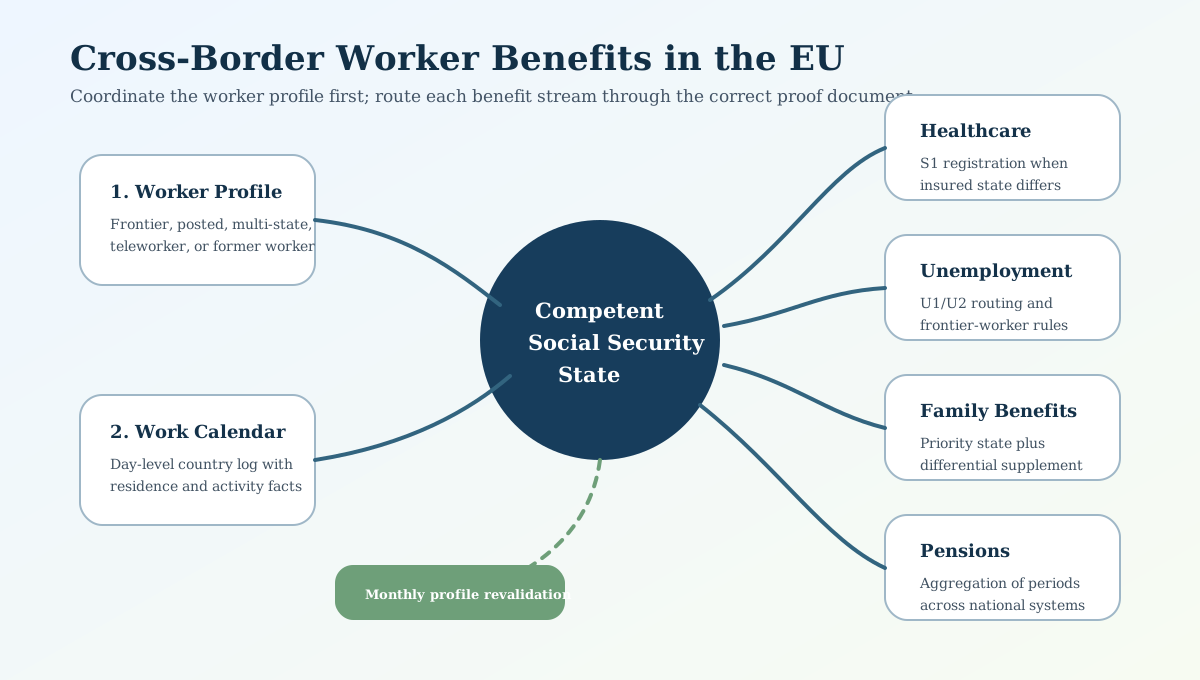
Cross-border worker benefits in the EU are governed by coordination, not by one unified European welfare system. That distinction is operationally important. The EU does not replace national social security systems with a single benefits code; it decides which national system is competent, protects equal treatment, prevents lost contribution periods, and allows certain benefits to travel with the worker.
The practical question is never simply "Where does the worker live?" It is: where is the work actually performed, which state is competent for social security, what benefit is being claimed, and which proof document connects the person to the correct institution?
This guide is written for cross-border workers, frontier workers, HR teams, payroll teams, immigration advisers, and finance teams that need a decision-ready framework before a claim is filed. It is general information, not legal, tax, payroll, immigration, or social security advice.
Executive Summary
The strongest cross-border benefits file starts with the competent state. Once that state is identified, the worker can route healthcare, unemployment, family benefits, and pension evidence through the correct institutions. If the competent-state analysis is wrong, later forms may only accelerate a wrong claim.
| Decision point | Correct operating rule | Practical consequence |
|---|---|---|
| One country or multiple countries? | EU rules generally assign one applicable social security legislation at a time. | Payroll and contribution records should not drift across states without a legal basis. |
| Frontier worker or ordinary mobile worker? | A frontier worker works in one covered state and returns to the residence state daily or at least weekly. | Special healthcare and unemployment rules can override assumptions based only on contribution location. |
| Posted or multi-state worker? | Posted workers and habitual multi-state workers follow different tests. | A1 evidence must match the actual legal category. |
| Telework below or above 25%? | Cross-border telework can change social security allocation, with a framework agreement available for some 25%-49% cases. | Remote-work calendars are benefit evidence, not HR trivia. |
| Which benefit stream? | Healthcare, unemployment, family benefits, and pensions do not use identical routing logic. | Build separate evidence packs under one master worker file. |
Primary official references include Regulation (EC) No 883/2004, Regulation (EC) No 987/2009, the European Commission page on EU social security coordination, and the Commission guide to which social security rules apply.
Primary Legal Architecture
EU coordination law is designed to protect workers who move across borders without forcing Member States into a single welfare model. Its practical outputs are fourfold:
| Principle | What it means in practice | Compliance consequence |
|---|---|---|
| Single applicable legislation | A person is normally covered by one country's social security legislation at a time. | Payroll and benefit claims must align to one competent system unless an exception applies. |
| Equal treatment | A covered person must generally be treated like nationals of the competent state. | Nationality should not be used to deny covered benefits within the coordination framework. |
| Aggregation | Prior insurance, employment, or residence periods in other covered countries may count when a benefit requires qualifying periods. | Missing historical records can delay or reduce claims. |
| Exportability | Certain cash benefits may remain payable even when the person lives in another covered country. | Residence abroad does not automatically end every entitlement. |
The system applies across EU Member States and, through separate coordination arrangements, also covers Iceland, Liechtenstein, Norway, and Switzerland in many mobility cases. The United Kingdom requires a separate review because post-Brexit protection depends on whether the person is covered by the Withdrawal Agreement or by the EU-UK Trade and Cooperation Agreement protocol.
The First Decision: Worker Profile
Before analyzing any benefit, classify the worker. The same person can move between categories over time, so the classification must be date-specific.
| Worker profile | Typical fact pattern | First legal question |
|---|---|---|
| Frontier worker | Lives in one country and works in another, usually returning home daily or weekly. | Does residence state or work state handle the specific benefit? |
| Posted worker | Sent temporarily by an employer to another Member State. | Is the posting temporary, documented, and covered by an A1 certificate? |
| Multi-state worker | Habitually works in two or more covered countries. | Is a substantial part of activity performed in the state of residence? |
| Cross-border teleworker | Works partly from home in one state and partly for an employer in another. | Does the normal Article 13 rule apply, or is an Article 16 telework framework agreement available? |
| Former cross-border worker | Has stopped working and needs unemployment or pension coordination. | Which institution must process the claim and aggregate prior periods? |
The European Commission states that a person moving within the EU, Iceland, Liechtenstein, Norway, or Switzerland is subject to the legislation of only one country, and that the basic rule is coverage by the country where the person actually works. It also states that, for multi-state work, at least 25% of activity in the residence state can trigger residence-state legislation in many employee cases. See which rules apply to you.
Competent State Rules
The default rule is that social security follows the place where work is actually performed. Regulation 883/2004 then creates exceptions and special rules for posting, multi-state work, civil servants, mixed employed/self-employed activity, and special agreements.
For multi-state employees, Article 13 of Regulation 883/2004 is central. If a person normally works in two or more Member States, the legislation of the residence state can apply when the person performs a substantial part of activity there. If not, the employer's registered office or place of business can become decisive.
For cross-border telework, a multilateral framework agreement has been available since July 1, 2023 for participating states. EURES explains that the framework can apply where both the employer-seat state and residence state are signatories, the employee divides work between remote and on-site work, and telework in the residence state is between 25% and 49% of working time. The framework does not apply to self-employed persons, and 50% or more telework usually requires residence-state notification and a separate Article 16 exemption request if employer-state coverage is sought. See EURES on cross-border telework and social security.
Key Documents: A1, S1, U1, and U2
The forms are not paperwork decoration. They are legal-routing instruments.
| Document | Used for | Practical function | Common mistake |
|---|---|---|---|
| A1 | Applicable social security legislation | Shows which country's social security system covers the worker. | Treating it as tax clearance. |
| S1 | Healthcare access when insured in one country and living in another | Allows registration for healthcare in the residence country while insured elsewhere. | Using EHIC instead of registering residence-based rights. |
| U1 | Previous periods of insurance or employment for unemployment purposes | Helps a claim country count qualifying periods from another state. | Requesting it only after a claim stalls. |
| U2 | Exporting unemployment benefits while looking for work in another country | Allows benefit export for a limited period when conditions are met. | Leaving the paying country before obtaining authorization. |
Official form guidance is available from Your Europe: social security forms.
Healthcare for Cross-Border Workers
Healthcare is often the first benefit problem because residence, employment, and insurance can be split across borders. A worker may be insured in the work state while needing healthcare access in the residence state. In those cases, the S1 pathway is often the key.
Use this sequence:
- Determine the competent social security state.
- Confirm whether the worker lives in a different state.
- Request the required certificate from the competent institution.
- Register the certificate with the residence-state health institution.
- Keep dependents, address changes, and insurance status synchronized.
The European Health Insurance Card is useful for necessary care during temporary stays, but it is not a substitute for correctly registering residence-based healthcare rights when the person lives abroad. See Your Europe: health insurance cover abroad.
Healthcare Routing Table
| Worker situation | Likely tool | Risk control |
|---|---|---|
| Lives in Belgium, works in Luxembourg, returns weekly | S1 may be needed for residence-state access while insured through work state. | Register the S1 before relying on routine local care. |
| Posted from France to Germany for a temporary assignment | A1 plus temporary-stay healthcare documents. | Confirm posting validity and assignment duration. |
| Remote worker living in Spain, employed in Netherlands, 40% home telework | A1 or Article 16 decision may be needed under framework rules. | Verify signatory states and employer/employee consent. |
| Worker moves residence but keeps old work pattern | Competent-state reassessment before benefit claim. | Do not carry forward old healthcare assumptions after relocation. |
Unemployment Benefits
Unemployment is one of the most misunderstood areas. The place where contributions were paid does not necessarily decide where the claim is filed.
General rule: if you become unemployed, you usually claim in the country where you last worked. Frontier workers are different. The European Commission FAQ states that if a frontier worker becomes unemployed, they should register with employment services and claim unemployment benefits in the country of residence. It also explains that a U1 document can help institutions take into account employment or insurance periods completed in another country. See European Commission unemployment FAQ.
Unemployment Decision Table
| Situation | Claim country | Evidence priority |
|---|---|---|
| Worker lived and worked in the same country | Last work country | Employment termination, payroll, insurance periods |
| Frontier worker becomes fully unemployed | Residence country | U1 form, proof of residence, work-state employment history |
| Non-frontier worker returns home less than weekly while employed abroad | May have options between last work state and residence state depending on facts | Residence pattern, employment records, U1 |
| Former worker moves abroad to seek work | Benefit-paying country may allow export with U2 | U2 authorization, registration with employment service abroad |
Exported unemployment benefits are generally limited in time. The Commission FAQ states that export can be available for three months and may be extended by the competent institution to a maximum of six months, subject to conditions and timely registration in the job-search state.
Family Benefits
Family benefits are coordinated through priority rules. The worker should not receive the same full family benefit twice for the same family situation, but a second country may owe a differential supplement if its benefit is higher.
Official guidance is available from the European Commission on family benefits under EU coordination.
Priority Logic
| Family situation | Likely priority rule |
|---|---|
| Whole family lives where the worker is insured | Insurance state usually pays. |
| Parents work in different countries and children live in one of them | The children's residence state often has priority if one parent works there. |
| One right is based on employment and another on residence | Employment-based entitlement usually has priority. |
| Two countries owe benefits | Primary state pays first; secondary state may pay a supplement. |
The risk is rarely the benefit application itself. The risk is stale family evidence: custody changes, address changes, a spouse's new job, a child's move, or a change in the state of insurance.
Pensions
Pension coordination is built for fragmented careers. If a person worked in several EU/EEA/Swiss systems, each country checks its own pension rules while taking relevant periods in other countries into account where aggregation is required.
Official guidance is available from Your Europe: state pensions abroad.
| Pension issue | What to do |
|---|---|
| Multiple career countries | Collect insurance statements from each country early. |
| Different retirement ages | Do not assume all pension portions start at the same age. |
| Short periods under one year | Ask whether special aggregation rules prevent the period from being lost. |
| Claim filing | Usually apply in the country of residence or last work country; that institution coordinates with others. |
| Timing | Start at least six months before retirement because multi-country claims can take time. |
Evidence Matrix
| Benefit stream | Core evidence | Common failure |
|---|---|---|
| Applicable legislation | A1, work-location calendar, contracts, employer registered office | Treating intent as proof instead of actual work pattern |
| Healthcare | S1, residence proof, dependent records, insurance confirmation | EHIC used where S1 registration is required |
| Unemployment | U1, termination documents, wage records, residence evidence | Claim filed in the wrong state |
| Family benefits | Household register, children's residence, parents' employment records | Duplicate claims without priority analysis |
| Pension | Insurance statements, dates of work, contribution records | Missing short-period country records |
| Telework | Day-level work log, employer approval, A1 or Article 16 decision | Crossing thresholds without reclassification |
Operational Workflow
- Build a country-by-country work calendar.
- Classify the worker profile for the exact period.
- Determine the competent social security legislation.
- Request or verify the A1 decision where applicable.
- Route each benefit separately: healthcare, unemployment, family benefits, pension.
- Match each benefit to the required document set.
- Reconcile payroll contributions to the competent state.
- Archive authority correspondence and renewal dates.
- Reassess after every material change in residence, telework, employer, or family status.
Risk Register
| Risk | Why it happens | Likely consequence | Control |
|---|---|---|---|
| Wrong competent state | Residence, payroll, and work location are confused | Back contributions, denied benefits, correction claims | Legal determination before payroll start |
| Frontier unemployment filed in work state | Worker assumes prior contribution country controls | Delay or rejection | Residence-state filing analysis and U1 request |
| S1 never registered | Worker relies on EHIC or private card | Healthcare access gap | Register S1 with residence institution |
| Telework ratio drifts | Remote days grow after approval | Competent-state change | Monthly country work log |
| Family benefit double claim | Both parents file without priority analysis | Recovery or offset | Household and employment matrix |
| Pension periods missing | Old short employment periods not documented | Lower or delayed pension award | Annual insurance statement archive |
FAQ
Do cross-border workers pay social security in the country where they live?
not necessarily. The competent state depends on the applicable EU coordination rule. Residence matters, especially for frontier workers and multi-state workers, but actual work location and employer structure can be decisive.
Is a frontier worker Usually covered by the work country?
No. For active social security coverage, the work country is often central. For full unemployment after job loss, frontier workers generally claim in the residence country.
Does an A1 certificate cover tax?
No. A1 concerns applicable social security legislation. Income tax, payroll withholding, corporate tax presence, and employment law must be analyzed separately.
Can family benefits be paid by two countries?
You should not receive duplicate full benefits for the same entitlement. Priority rules decide the primary payer, and a secondary country may owe a differential supplement.
What is the biggest practical risk?
Profile drift. A worker begins as a simple frontier worker, then teleworks more, changes residence, adds a second employer, or has a family-status change. The file must be reclassified when facts change.
Benefit-by-benefit operating model
Cross-border worker benefits should be managed as separate benefit streams. Healthcare, unemployment, sickness, maternity or paternity, family benefits, pensions, disability, and workplace accident coverage can follow different procedures even when the competent social-security state is the same. A worker should not assume that one certificate solves every benefit.
The operating file should start with applicable legislation: which country is competent for social security for the period. Then create subfiles for healthcare access, family benefits, unemployment, pension periods, and any special benefits. Each subfile should show the institution, form, deadline, evidence, and renewal trigger.
This structure matters because cross-border workers often discover gaps only during a life event: illness, job loss, childbirth, retirement, or family move. At that point, missing forms can delay benefits. A proactive file reduces dependency on emergency bureaucracy.
Healthcare access file
Healthcare coordination should be documented before care is needed. The worker should know whether they use an S1, EHIC, national health card, private insurance, or residence-country registration. Dependants may have different steps from the worker. If the worker changes competent state, healthcare registration may need to change too.
Keep copies of S1 forms, registration confirmations, insurer correspondence, dependent records, and local health cards. If private insurance is used during a transition, record whether it is temporary, supplementary, or required by residence status. EHIC should not be treated as a substitute for ordinary residence healthcare.
Unemployment and job-change planning
Unemployment benefits are one of the most confusing areas for frontier workers. A fully unemployed frontier worker may need to claim in the residence country even though contributions were paid in the work country. A partially unemployed worker may have a different route. The worker should request U1 or equivalent contribution evidence quickly after job loss.
Before changing jobs, verify whether the new work pattern changes the competent state. A move from full on-site work to hybrid work, a second employer, self-employment on the side, or a new residence country can change social-security coordination. Payroll should not assume the old A1 or competent-state decision remains valid.
Family benefits and household changes
Family benefits depend on household facts. Marriage, separation, custody, children moving country, a spouse starting or stopping work, or a parent changing residence can change priority rules. Families should update evidence quickly rather than waiting for annual review.
Keep children's residence proof, school enrollment, custody documents, parents' employment records, benefit decisions, and correspondence from both countries. If two countries are involved, document which one is primary and whether the other pays a differential supplement. Duplicate claims without priority analysis can create recovery demands.
Pension record maintenance
Workers with multi-country careers should request insurance statements periodically. Do not wait until retirement. Old employer records, contribution periods, short jobs, and country moves become harder to prove decades later. Store statements by country and year.
Different pension portions may start at different ages and under different rules. A worker should plan retirement timing by country, not assume one European retirement date. If the worker has non-EU periods, bilateral agreements or national rules may also matter.
Employer controls
Employers should maintain a benefits coordination checklist for cross-border workers. It should record residence country, work country, telework percentage, A1 status, healthcare form, payroll contribution country, family-benefit flags, and review date. HR policies should require employees to report residence, family, and telework changes.
Benefit coordination is not only an employee issue. Wrong contributions can create employer arrears, employee benefit gaps, and correction claims. Employers should reconcile payroll contributions with the competent-state decision and renew certificates before expiry.
Telework and hybrid-work controls
Hybrid work is the main modern stress test for cross-border benefits. A worker who once commuted daily may begin working from home two or three days per week, changing the percentage of work performed in the residence country. That can affect applicable legislation, A1 certificates, healthcare routing, family-benefit priority, and employer contributions.
Employers should track telework by country monthly. The record should distinguish home-office days, work-country office days, business travel, training, leave, and sick days. If the employee approaches a threshold or the agreed pattern changes, payroll and HR should review the competent-state decision before the change becomes routine.
Employees should keep their own records too. If a benefit claim is disputed, an employee's calendar, employer approvals, payslips, and travel records can help prove the actual work pattern.
Posted worker versus frontier worker
Posted workers and frontier workers follow different logic. A posted worker is temporarily sent by an employer to another country and may remain covered by the sending state's system if conditions are met. A frontier worker normally lives in one country and works in another on a regular basis. A remote worker may live and work in the same country for an employer elsewhere.
The wrong label leads to the wrong documents. A posted worker may need posting paperwork and an A1 based on temporary assignment. A frontier worker may need residence-country healthcare registration, unemployment planning, and family-benefit priority analysis. A multi-state worker may need a separate applicable-legislation decision.
Before filing any form, write the worker profile for the exact period. If the profile changes, update the file.
Claims workflow after a life event
Benefit files should be ready before a life event, but many claims start after illness, childbirth, job loss, family move, or retirement. The first step is to identify the competent institution for that benefit. The second step is to collect the specific form or evidence: S1 for healthcare access, U1 for unemployment history, U2 for export of unemployment benefits, A1 for applicable legislation, pension insurance statements for retirement, and family records for child benefits.
The worker should ask authorities for written decisions where possible. Phone guidance is helpful, but written decisions and forms are stronger if another country disagrees. Keep translations when required.
Payroll and contribution corrections
If contributions were paid to the wrong country, correction can be slow. Employers may need to adjust payroll, request refunds, pay arrears, amend declarations, and coordinate employee records. Employees may face temporary benefit uncertainty while institutions reconcile coverage.
The best control is early determination. If the worker pattern is unclear, ask the competent institution before payroll runs for months. If a correction is needed, preserve the authority decision and payment records so benefit rights are not lost.
Family scenarios
Family benefits become complex when parents work in different countries, children live in a third country, custody is shared, or one parent stops working. The priority state can change. A parent starting part-time work, moving residence, or becoming unemployed should trigger a family-benefit review.
Keep one family matrix with parent residence, parent employment, child residence, school, custody, benefits claimed, and decisions received. Update it after any family-status change. This prevents duplicate claims and missed supplements.
Retirement preparation for mobile workers
Mobile workers should start pension record cleanup years before retirement. Request contribution statements from every country where work occurred, including short periods. Check names, dates, employer numbers, and contribution periods. Correct errors while records and employers still exist.
At retirement, the residence-country or last-work-country institution may coordinate claims, but the worker still needs to know which countries are involved. Different countries can have different pension ages, early-retirement rules, and survivor-benefit rules. Planning should include tax and healthcare effects after retirement.
Annual benefits audit
Once a year, the worker and employer should audit the benefits file. Confirm residence country, work country, telework percentage, employer, second jobs, self-employment, family status, children's residence, healthcare registration, A1 validity, S1 registration, family-benefit decisions, and pension records. Any mismatch should be corrected before a claim arises.
The audit should produce a dated summary. It does not need to be long, but it should state which country is competent, which documents prove it, and which renewals are pending. This is especially useful for workers whose facts look simple until a benefit claim, job loss, or retirement application exposes missing evidence.
Practical stop triggers
Reopen the benefits analysis before facts drift. Stop and review when telework increases, the worker changes residence, a spouse starts work, a child moves country, a second employer is added, self-employment begins, or an A1 expires. These changes can alter competent state, healthcare registration, family-benefit priority, and unemployment route.
The rule is simple: benefits coordination follows real life, not last year's payroll setup. Update the file before an authority, hospital, insurer, pension body, or unemployment office forces the correction later, when benefits may already be delayed, reduced, suspended, disputed, or wrongly denied for months.
Final Checklist
- Confirm the worker profile before filing any benefit claim.
- Determine the competent social security state.
- Verify A1, S1, U1, or U2 requirements before relying on them.
- Keep a day-level work-location calendar.
- Separate healthcare, unemployment, family, and pension evidence.
- Reconcile payroll contributions to the applicable legislation.
- Update family and residence evidence immediately after changes.
- Begin multi-country pension preparation at least six months before retirement.
- Treat telework thresholds as compliance triggers, not HR preferences.
The defensible file is the one that can show, by date, where the person lived, where the person worked, which institution was competent, and which document supported each benefit route.
Official source and decision check
Use this section as the practical checkpoint for Cross-Border Worker Benefits in the EU: Social Security, Unemployment, Family Benefits, and Pension Coordination. The reader decision is whether the available evidence is strong enough to act now, or whether the file should first be confirmed with the competent authority. Rules can change by country, status and date, so treat this guide as orientation for the file and recheck the current rule before relying on a payroll, workday, social-security certificate, tax-residence or cross-border employment deadline.
For expats, foreigners, students, workers, founders, families and other mobile readers, record the reader category, country, residence status and deadline before comparing the official source with the article checklist.
Official sources to verify first
- Your Europe work in another EU country
- European Commission social security coordination
- EURES mobility and work portal
- Your Europe taxes abroad
- EUR-Lex EU law access
| Decision point | What to check | Reader action |
|---|---|---|
| Administrative decision | Confirm that the case is really about administrative decision, not a different category that follows another rule. | Write down the country, authority, dates, status and document number before asking for a decision. |
| File for competent authority | Keep the identity, residence and document evidence in one dated file, with originals, translations where required and proof of submission. | Save receipts, emails, appointment confirmations, payment records and authority replies in the same order as the checklist. |
| Cross-Border Worker Benefits in the EU: Social Security, Unemployment, Family Benefits, and Pension Coordination fallback | If the answer is refused, delayed or unclear, identify the competent authority, review window, complaint route or regulated provider escalation path. | Ask for the reason in writing and compare it with the official source before paying again, travelling, closing an account or resubmitting. |
| When the answer is unclear | What to do next |
|---|---|
| The authority, bank, insurer, employer or provider gives a verbal answer only. | Ask for the answer in writing, save the name of the office or provider, and compare it with the official source before changing travel, payroll, residence or payment plans. |
| The file depends on a deadline, appointment, payment, address or status change. | Keep the dated receipt, note the next deadline, and avoid closing the old route until the replacement document, account, policy or registration is confirmed. |
Related guides to cross-check
- First month in Europe checklist
- Living in one European country and working in another
- EU remote working guide
- Private health insurance documents in Europe
- Health insurance for expats in Germany
For legal, tax, medical, immigration or financial consequences, confirm the position with the competent authority or a qualified adviser. This page is designed to organize the decision, source checks and next steps; it is not a substitute for case-specific professional advice.