Last updated
Business Registration Requirements in Europe: Practical Guide
Business Registration Requirements in Europe: Practical Guide helps compliance teams, directors, risk owners, and advisers translate a Luxembourg supervisory topic into owners, evidence, and escalation points. It explains understanding the Luxembourg regulatory obligation, supervisory evidence, internal ownership, and escalation points in Business Registration Requirements in Europe: Practical Guide, then shows how to map the controlling rule, prepare board or compliance evidence, and know when a CSSF-facing specialist should review the file. The later sections connect executive summary, search intent answer, and methodology and scope so the next step is easier to judge. Read it before assigning owners or responding to a supervisory request, so the evidence file matches the regulatory question.
This guide treats business registration as a compliance architecture. It is written for founders, operators, finance teams, and advisers who need a defensible route to trade in the EU and closely connected European markets. It uses official EU and national sources wherever possible and is current for planning use as of May 14, 2026.
Executive Summary
The safest rule is: register where the business has a legally defensible operating connection, not where incorporation appears cheapest or fastest.
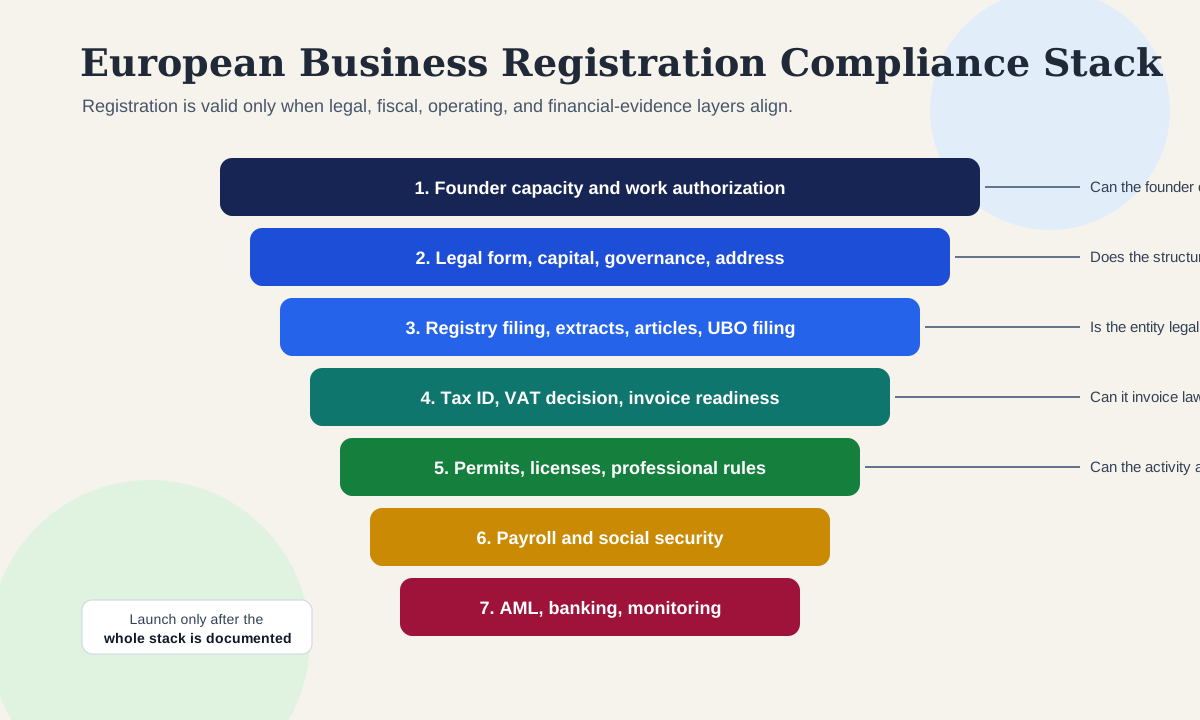
European business registration normally requires six linked decisions.
| Decision | What it controls | Why it matters |
|---|---|---|
| Founder capacity | Whether a person may establish, own, manage, or work | Ownership and day-to-day work authorization are separate questions |
| Legal form | Liability, capital, governance, reporting, and tax treatment | Similar commercial activities use different legal forms by country |
| Registry filing | Legal creation or recognition of the entity or activity | Filing errors can block tax, banking, payroll, and licensing |
| Tax and VAT registration | Invoicing, reporting, place of taxation, and cross-border supplies | VAT may be required before meaningful revenue exists |
| Licensing and professional clearance | Permission to operate in regulated fields | Formation alone rarely authorizes regulated services |
| AML and banking readiness | Ability to receive funds and process payments | Beneficial ownership and source-of-funds evidence are operational gates |
EU-level rules support establishment and digitalization, but national law controls most filing mechanics. Your Europe states that EU citizens may set up businesses in EU countries and Iceland, Norway, or Liechtenstein, while requirements vary by country Your Europe: starting a business.
Search Intent Answer
If you are searching for "business registration requirements in Europe," the practical answer is:
| Step | Action | Failure if skipped |
|---|---|---|
| 1 | Choose the country based on real activity, management location, customers, staff, and tax exposure | Shell structure with weak substance |
| 2 | Select the legal form under national rules | Liability, capital, governance, and investor conflicts |
| 3 | File through the relevant national register or Point of Single Contact | No legal operating identity |
| 4 | Obtain tax identifiers and VAT registration where required | Invalid invoices, penalties, or customer rejection |
| 5 | Confirm permits, licenses, and professional qualifications | Illegal trading despite incorporation |
| 6 | Prepare UBO, source-of-funds, and identity evidence | Bank onboarding failure |
| 7 | Maintain a compliance calendar after launch | Missed filings, renewals, payroll, and tax deadlines |
Methodology and Scope
This article uses a source hierarchy. Official EU institutions, national portals, regulators, and primary legal texts are weighted above commercial incorporation providers. Private provider pages can be useful for procedure examples, but they are not authority for legal eligibility, VAT obligations, or banking acceptance.
| Source type | Use in this guide | Reliability note |
|---|---|---|
| EU official portals | Establishment rights, VAT, payment, AML, company-law framework | Good baseline, but national execution remains decisive |
| National government portals | Filing, tax, permit, and formalities details | Must be checked per country and legal form |
| Primary legal texts | Treaty, directive, and regulation references | Strong authority, but may require local transposition |
| Bank or provider materials | Practical onboarding evidence | Useful operationally, not a legal substitute |
EU Baseline: Establishment Rights, National Execution
For EU citizens and EU-based businesses, the starting point is the right to establish and manage a business in another EU country under the same conditions as nationals, subject to national rules. Your Europe summarizes this for business setup and for registration, permits, and licenses Your Europe: registration, permits and licences.
The treaty foundation is the freedom of establishment, including TFEU Article 49 and TFEU Article 54. These provisions matter because they limit discriminatory barriers against eligible EU actors. They do not remove national requirements for registry filings, notaries, tax numbers, VAT, social security, sector permits, or professional qualifications.
The EU also encourages quicker formation. Your Europe lists targets such as setup in no more than three working days, cost below EUR 100, completion through a single administrative body, and online registration formalities. These are policy targets, not a guarantee for every country, legal form, founder profile, or regulated sector.
Digital Company Law and Business Registers
EU company law increasingly supports digital formation and cross-border data exchange. The European Commission explains that EU company law covers formation, capital, disclosure requirements, and operations, and that Directive (EU) 2025/25 entered into force on January 30, 2025 to expand and upgrade the use of digital tools and processes in company law European Commission: company law and corporate governance.
The Business Registers Interconnection System, or BRIS, connects EU and EEA business registers for company searches and cross-border register communication European Commission: BRIS dashboard. The European e-Justice portal also provides access to EU business-register search European e-Justice: business registers search.
A BRIS-searchable record is useful evidence. It does not replace national registry extracts, tax certificates, VAT registration, beneficial ownership filings, or sector permits.
Core Registration Requirements
1. Founder and Manager Eligibility
The first requirement is legal capacity to establish, own, manage, and work. These are separate legal questions.
| Founder status | Registration issue | Evidence to prepare |
|---|---|---|
| EU/EEA/Swiss citizen | Broad establishment rights, subject to national formalities | ID, address proof, filing forms, professional qualification evidence |
| Existing EU company | Subsidiary or branch formation | Parent extract, board authorization, representation authority, UBO chart |
| Non-EU individual | Ownership may be possible, but residence or management may need immigration clearance | Passport, visa or residence permit, self-employment authorization, local address evidence |
| Non-EU company | Branch, subsidiary, or tax presence depends on national rules | Legalized extracts, translations, representative authority, tax and UBO documentation |
Do not assume that share ownership creates permission to work. A foreign founder may own a company while still needing a residence permit, founder visa, self-employment authorization, or work authorization to manage it locally.
2. Legal Form Selection
Legal forms vary by country. The same business may be registered as a sole trader activity, limited liability company, partnership, branch, representative office, association, cooperative, or regulated entity.
| Decision factor | Practical question |
|---|---|
| Liability | Is the founder personally liable, or is liability limited by capital and corporate form? |
| Capital | Is minimum capital required, and must it be deposited before filing? |
| Governance | Who may sign contracts, appoint directors, approve accounts, and bind the company? |
| Taxation | Is profit taxed at company level, personal level, or both? |
| Reporting | Are annual accounts, audits, public filings, or e-invoicing rules required? |
| Investment readiness | Can the form handle equity, options, convertibles, debt, and group ownership? |
3. Name, Address, and Activity Classification
Most countries require a business name, registered office or address, declared activity, founder details, and authorized representatives. Some require notarial execution, sworn translations, capital-bank certificates, criminal-record declarations, or professional-license evidence.
The address requirement is not cosmetic. It may determine tax office assignment, court jurisdiction, social-security processing, licensing authority, and bank risk review. A mailbox address can be valid in some cases, but it does not create economic substance by itself.
4. Registry Filing and Formation Evidence
Typical filing outputs include:
| Output | Function |
|---|---|
| Registration certificate or extract | Proves the business is recorded |
| Company number | Used on contracts, invoices, tax filings, and bank applications |
| Articles or statutes | Define purpose, governance, capital, and shareholder rights |
| Manager or director appointment | Proves who can bind the business |
| Beneficial ownership filing | Identifies natural persons who ultimately own or control the business |
| Publication notice | Required in some countries to make formation public |
France illustrates the national-portal model. Its official formalities portal explains that economic activity declarations are filed online through the single window, and that a foreign company extending activity into France can receive a SIREN for activity in France France formalities portal: business types and France formalities portal: business identity.
5. Tax and VAT Registration
Tax registration is required once activity triggers national tax obligations. VAT needs particular care because the EU framework is harmonized, but obligations are applied through national tax administrations.
The European Commission explains that a VAT identification number identifies a taxable person or non-taxable legal entity registered for VAT, helps determine tax status and place of taxation, and is issued by national tax administrations. It also states that businesses supplying goods or services in several EU countries may have to obtain VAT numbers in each of those countries European Commission: VAT identification numbers.
| VAT question | Why it matters |
|---|---|
| Are you making taxable supplies? | Determines whether VAT registration is needed |
| Are you acquiring goods intra-EU? | May trigger acquisition reporting or VAT registration |
| Are you receiving or supplying reverse-charge services? | A VAT number may be required even before local consumer revenue |
| Are you selling cross-border to consumers? | OSS or IOSS may be relevant |
| Are you invoicing B2B EU customers? | VIES validation and invoice wording can affect customer acceptance |
6. Permits, Licenses, and Professional Rules
Company formation does not authorize all activity. Your Europe and the European Commission identify Points of Single Contact as portals that help service providers find and complete administrative procedures online European Commission: Points of Single Contact.
| Sector | Common extra checks |
|---|---|
| Financial services | Banking, payments, lending, insurance, investment, crypto-assets |
| Health and wellness | Medical licensing, pharmacy, devices, therapeutic claims |
| Food and hospitality | Hygiene, premises, alcohol, safety inspections |
| Construction and real estate | Building permits, brokerage rules, professional qualifications |
| Transport and logistics | Operator licenses, vehicle rules, customs, warehousing |
| Education and childcare | Accreditation, safeguarding, premises and staff checks |
| Employment agencies | Labor-market and agency licensing rules |
7. Payroll, Social Security, and Employment Registration
If the business hires staff, employs founders, posts workers, or has remote employees in more than one country, payroll and social-security registration must be reviewed before work begins. Your Europe highlights employment-contract and working-condition obligations for employers Your Europe: employment contracts.
| Worker scenario | Registration implication |
|---|---|
| Local employee | Employer registration, payroll withholding, social-security contributions |
| Founder working for own company | Immigration, payroll, and social-security classification |
| Contractor in another country | Misclassification, permanent establishment, VAT, and withholding review |
| Posted worker | A1 certificate or local registration analysis |
| Remote employee | Labor law, payroll, social security, and permanent establishment review |
8. AML, Beneficial Ownership, and Bank Readiness
Banks and many professional service providers must perform customer due diligence. A legally registered company can still fail onboarding if beneficial ownership, source of funds, activity, address, or control evidence is weak.
The Commission's AML/CFT materials explain that the EU framework strengthens beneficial ownership registers, verification, and access for competent authorities and obliged entities, while broader public access changed after the Court of Justice judgment of November 2022 European Commission: AML/CFT and European Commission: AML/CFT questions and answers.
Evidence Checklist Before Filing
| Evidence | Minimum quality standard |
|---|---|
| Founder ID | Current passport or national ID, same spelling across documents |
| Residence and work evidence | Visa, residence card, EU registration certificate, or legal memo for manager role |
| Registered address | Lease, domiciliation contract, office agreement, or authorization |
| Legal-form memo | Written rationale for liability, capital, governance, and tax fit |
| Activity description | Plain-English activity plus national activity-code mapping |
| Articles or statutes | Signed and compliant with national form requirements |
| Capital evidence | Bank certificate or founder declaration if required |
| Manager authority | Appointment resolution and signature authority |
| UBO chart | Natural-person ownership and control chain, dated and signed |
| Source of funds | Founder contribution trail, loan agreement, investment documents, or bank statements |
| Tax memo | Corporate tax, VAT, withholding, and payroll starting position |
| Permit memo | Regulated-activity and professional-qualification review |
| Translation and legalization | Apostille, certified translation, or notarization where required |
Sequencing Model
| Stage | Gate | Do not proceed if |
|---|---|---|
| Planning | Founder and activity legality confirmed | Immigration, sector, or tax assumptions are unresolved |
| Structure | Legal form selected | Liability, capital, governance, and investor needs are unclear |
| Filing | Registry package complete | Names, addresses, signatures, or translations are inconsistent |
| Fiscal setup | Tax and VAT status confirmed | First invoice would be issued without correct VAT treatment |
| Activation | Bank and payment account ready | UBO, funding, or activity evidence is incomplete |
| Operation | Payroll, permits, and compliance calendar active | Employees, regulated services, or renewals are unmanaged |
Where Should You Register?
Score each candidate country on five dimensions.
| Criterion | Weight | Questions |
|---|---|---|
| Real activity and management | 30% | Where are decisions made, contracts negotiated, services delivered, and staff located? |
| Customer and revenue geography | 20% | Where are customers, VAT obligations, consumer rules, and disputes likely to arise? |
| Founder status | 15% | Can the founder live, work, manage, and sign locally? |
| Sector regulation | 15% | Which regulator or professional body controls the activity? |
| Banking and operations | 20% | Can the entity open accounts, receive payments, hire, and document substance? |
Recommended rule: if the low-cost jurisdiction is not also plausible under activity, management, tax, and banking evidence, treat it as a high-risk choice.
Common Failure Patterns
| Failure | Why it happens | Control |
|---|---|---|
| Registering before immigration review | Founder separates ownership from work authorization too late | Confirm manager and self-employment rights first |
| Using a remote company without substance | Fee optimization overrides real management location | Keep a management-location memo and activity evidence |
| Filing activity too broadly or narrowly | Activity codes are chosen casually | Match codes to contracts, invoices, permits, and VAT |
| Ignoring VAT until revenue | Founder treats VAT as post-launch accounting | Confirm VAT status before first invoice |
| Missing sector permits | Formation is mistaken for operating authorization | Make licensing a launch gate |
| Failing bank due diligence | UBO and source-of-funds evidence are thin | Prepare a bank-grade onboarding file before filing |
| Inconsistent records | Different addresses, names, or directors across systems | Use one canonical data sheet |
FAQ
Is there one Europe-wide business registration?
No. EU law supports establishment, disclosure, digitalization, and register interconnection, but ordinary businesses register under national law. Some EU legal forms exist for specific uses, but most startups and small companies use national forms.
Can I register a business online in Europe?
Often yes, but not for every form, country, founder, or sector. EU digital-company-law reforms support online formation and filings, but national identity, notarial, translation, and licensing rules still matter.
Does registration mean I can legally trade?
not necessarily. You may still need VAT registration, sector permits, professional authorization, social-security registration, environmental permits, or immigration permission.
Do I need a VAT number immediately?
It depends on the activity, country, turnover, and cross-border transactions. VAT registration can be required for taxable supplies, intra-EU acquisitions, reverse-charge services, or multi-country activity.
Can a non-EU person own a European company?
Often yes, subject to sanctions, investment-screening, sector, and national rules. Ownership does not automatically give the right to live in Europe, manage locally, or work for the company.
What is the difference between a branch and a subsidiary?
A branch is usually an extension of a foreign company. A subsidiary is a separate local legal entity owned by the parent. Branches can be faster but may expose the parent more directly and require parent-company evidence.
Are beneficial ownership filings public?
Access varies. EU rules require beneficial ownership information, but broad public access changed after the Court of Justice judgment in 2022. Competent authorities and obliged entities retain access; broader access depends on national implementation and legitimate-interest rules.
Source Risks and Review Notes
National procedures change frequently, especially filing portals, fees, VAT thresholds, UBO access, e-invoicing, immigration categories, and bank onboarding policies. This guide is a European framework, not legal, tax, immigration, or financial advice. For regulated sectors, country-specific counsel should validate the route before trading.
Sources
- Your Europe: starting a business
- Your Europe: registration, permits and licences
- European Commission: Points of Single Contact
- European Commission: company law and corporate governance
- European Commission: Business Registers Interconnection System dashboard
- European e-Justice: business registers search
- European Commission: VAT identification numbers
- European Commission: AML/CFT
- European Commission: AML/CFT questions and answers
- France formalities portal: business types
- France formalities portal: business identity
Official source and decision check
Use this section as the practical checkpoint for Business Registration Requirements in Europe: Practical Guide. The reader decision is whether the available evidence is strong enough to act now, or whether the file should first be confirmed with the business register, tax authority or company-law source. Rules can change by country, status and date, so treat this guide as orientation for the file and recheck the current rule before relying on a company-registration filing, tax setup, business-bank onboarding or founder evidence deadline.
For expats, foreigners, students, workers, founders, families and other mobile readers, record the reader category, country, residence status and deadline before comparing the official source with the article checklist.
Official sources to verify first
- Your Europe starting a business
- Your Europe company registration
- European Commission single market and industry
- European e-Justice business registers
- EUR-Lex EU law access
| Decision point | What to check | Reader action |
|---|---|---|
| Business-registration route and company evidence | Confirm that the case is really about business-registration route and company evidence, not a different category that follows another rule. | Write down the country, authority, dates, status and document number before asking for a decision. |
| File for business register, tax authority or company-law source | Keep the legal form, owner identity, tax and address evidence in one dated file, with originals, translations where required and proof of submission. | Save receipts, emails, appointment confirmations, payment records and authority replies in the same order as the checklist. |
| Business Registration Requirements in Europe: Practical Guide fallback | If the answer is refused, delayed or unclear, identify the competent authority, review window, complaint route or regulated provider escalation path. | Ask for the reason in writing and compare it with the official source before paying again, travelling, closing an account or resubmitting. |
| When the answer is unclear | What to do next |
|---|---|
| The authority, bank, insurer, employer or provider gives a verbal answer only. | Ask for the answer in writing, save the name of the office or provider, and compare it with the official source before changing travel, payroll, residence or payment plans. |
| The file depends on a deadline, appointment, payment, address or status change. | Keep the dated receipt, note the next deadline, and avoid closing the old route until the replacement document, account, policy or registration is confirmed. |
Related guides to cross-check
- First month in Europe checklist
- Living in one European country and working in another
- EU remote working guide
- Cross-border worker benefits in the EU
- Private health insurance documents in Europe
For legal, tax, medical, immigration or financial consequences, confirm the position with the competent authority or a qualified adviser. This page is designed to organize the decision, source checks and next steps; it is not a substitute for case-specific professional advice.