Last updated
How To Apply For A Business Bank Account In Luxembourg
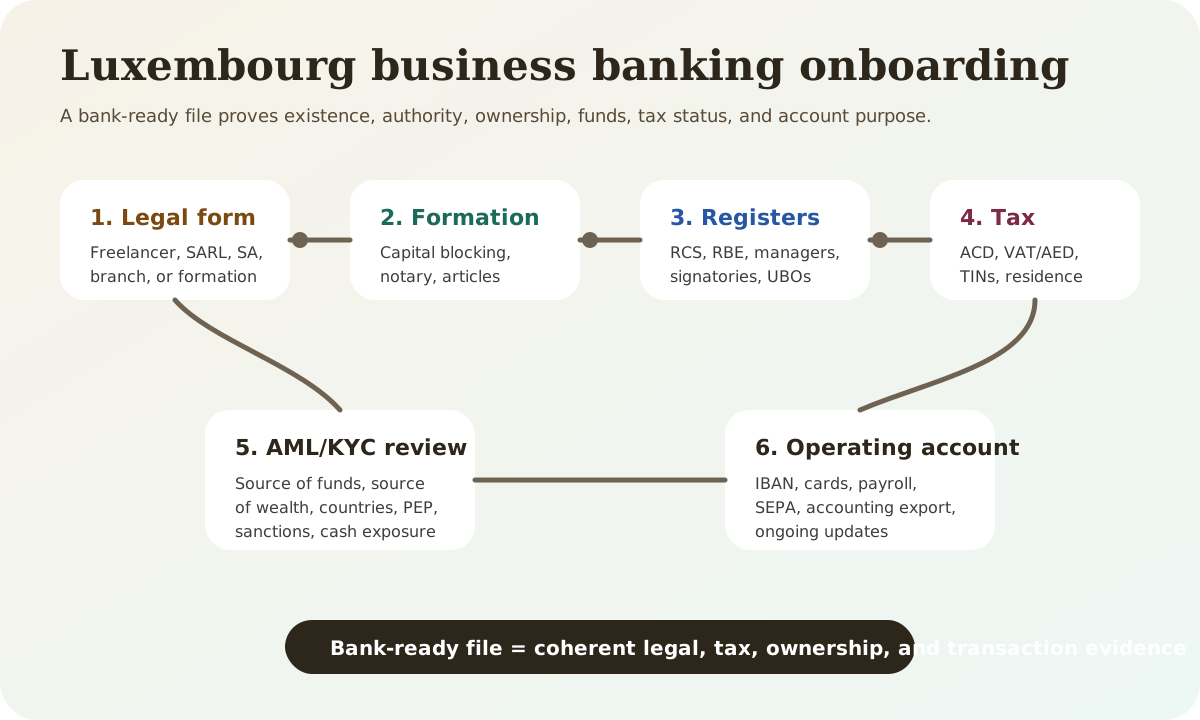
For new arrivals, expats, remote workers, and cross-border households, the hard part of How To Apply For A Business Bank Account In Luxembourg is knowing which fact changes the answer. It explains opening or using accounts, identity numbers, KYC evidence, cards, credit history, and payment access in Luxembourg, then shows how to prepare identity, address, tax, income, source-of-funds, and card or credit evidence before an application is refused. The later sections connect quick answer, company, freelancer or formation account, and step-by-step application sequence so the next step is easier to judge. Read it before submitting forms, moving money, choosing a provider, or assuming that a rule from another country applies.
This guide is general information, not legal, tax, financial, immigration, or banking advice. Luxembourg banks, payment institutions, and e-money institutions apply their own onboarding policies within the regulatory framework. A complete file can still be refused if the provider does not support the legal form, country exposure, activity, ownership structure, or risk profile.
The safest way to apply is to separate three questions:
- Legal form: are you a self-employed person, sole trader, partnership, capital company, branch, or existing company?
- Administrative status: do you have the relevant RCS, RBE, VAT, ACD, business permit, notary, or formation evidence?
- Compliance file: can you explain identity, authority, beneficial ownership, source of funds, expected transactions, tax residence, and cross-border links?
Quick Answer
To apply for a business bank account in Luxembourg, prepare the documents that prove the business exists, the applicant is allowed to act for it, and the ownership and tax profile are clear.
For a Luxembourg company, that usually means articles of association, RCS evidence, RBE beneficial-owner information, directors or managers, signatories, business activity, tax details, source of funds, and expected account use. The Guichet.lu RCS guidance explains that all newly incorporated Luxembourg companies must register with the Trade and Companies Register, and that the RCS contains published information used to identify traders and companies.
For a company still being incorporated, the first banking step may be a blocked capital account. Guichet.lu's share-capital procedure says a person creating a capital company must deposit the required minimum share capital into an account in the company's name before signing the articles of association, and that the funds remain blocked until the company is formed. Guichet.lu also notes that the account can be with a bank established in Luxembourg or abroad, although a Luxembourg bank may simplify the procedure.
For a self-employed person or freelancer operating in their own name, Guichet.lu notes on the same share-capital page that the capital-blocking obligation does not apply and that an individual entrepreneur can use a personal account for business financial transactions. That does not make mixed personal and professional banking a good operational choice. A dedicated account is usually cleaner for invoices, VAT, tax, accounting, client payments, and proof of business income.
Company, Freelancer Or Formation Account
The bank account route depends on the legal form. Do not start by comparing cards or monthly fees. Start by matching the application to the business status.
| Applicant type | Main account issue | Typical evidence to prepare |
|---|---|---|
| Self-employed person or freelancer | Prove identity, activity, tax status, business permit where applicable, and expected income | ID, address, activity description, business permit if required, ACD or tax correspondence, VAT registration if applicable, invoices or contracts |
| Sole trader operating under own name | Separate business activity from private spending and support accounting | ID, business permit if applicable, tax and VAT information, business address, expected transactions |
| Company in formation | Deposit and block share capital if the legal form requires it | Draft articles, IDs of representatives and agents, registered-office address, business permit if available, source of capital |
| Existing Luxembourg company | Prove legal existence, authority, UBOs, tax profile, and account purpose | RCS extract, articles, RBE filing evidence or UBO register evidence, manager/director details, signatory powers, tax/VAT information, financial records if requested |
| Foreign-owned Luxembourg company | Explain the full ownership chain to natural persons | Luxembourg company documents plus foreign register extracts, parent-company documents, ownership chart, translations or certifications if requested |
| Branch or cross-border structure | Show why a Luxembourg account is needed and who controls the Luxembourg operation | Branch or company registration evidence, foreign company documents, authorised representative, tax and activity explanation |
The account should be opened in the name that matches invoices, contracts, tax registration, and accounting records. If the company name, registered office, manager, shareholder list, and account application do not match, onboarding can pause even when the business is legitimate.
Step-By-Step Application Sequence
- Choose the legal form and formation route. The bank cannot assess the file correctly if the applicant is still deciding between self-employment, SARL, SA, partnership, branch, or another structure.
- Check whether the activity needs a business permit. Guichet.lu's business-permit page says, apart from some exceptions, regular economic activity is subject to a prior business permit, including commercial activity, craft activity, and certain liberal professions.
- Prepare formation or registration documents. For a capital company in formation, prepare draft articles and representative IDs. For an existing company, prepare RCS evidence and final articles.
- Document beneficial ownership. Entities registered with the RCS generally have to file beneficial-owner details with the RBE. Guichet.lu's RBE guidance says the filing or update must be submitted within one month of the event or circumstances triggering it.
- Prepare the tax file. Guichet.lu's income-tax registration page says a business is registered with the Luxembourg Inland Revenue, the ACD, when it starts activity. VAT registration is handled separately with the AED, as explained on Guichet.lu's VAT registration page.
- Build the AML/KYC explanation. The CSSF AML/CFT page says supervised financial-sector professionals must comply with customer due diligence, internal management, and cooperation obligations.
- Apply only to providers that support your profile. Confirm whether they onboard companies in formation, non-resident directors, foreign shareholders, branches, cash-heavy activities, regulated activities, or your specific legal form.
- Respond consistently to follow-up questions. Keep answers aligned across the notary file, RCS, RBE, tax documents, ownership chart, business plan, and bank forms.
Capital Deposit For A Company In Formation
For a Luxembourg capital company, the business bank account may begin as a blocked share-capital account. This is not the same as a fully operating account.
According to Guichet.lu's blocking-share-capital procedure, the future entrepreneur first draws up draft articles of association. To open the account, Guichet lists the draft articles and copies of identity documents for the company's representatives and any agents. The bank may also request the registered-office address, postal address, legal address of representatives and agents, and business permit where applicable. The official procedure allows the account to be opened with a bank established in Luxembourg or abroad, but says using a Luxembourg bank is recommended to simplify the process.
The same official guidance explains the sequence:
- the bank opens an account for the company being formed;
- the share capital is deposited;
- the bank issues a blocking certificate for the notary;
- the notary completes the formation;
- the entrepreneur gives the bank the release certificate, final articles, any missing supporting documents, and beneficial-owner information;
- the bank releases the funds for the company after formation.
Do not assume the capital deposit completes onboarding. The bank may still need final incorporation documents, RCS details, UBO/RBE information, signatory records, tax information, and activity explanations before allowing normal account use.
Documents For Existing Luxembourg Companies
An existing company should prepare a file that proves legal existence, authority, control, tax status, and account purpose.
Common documents include:
- RCS extract or current registration evidence;
- articles of association and any amendments;
- RBE filing evidence, RBE extract where available, or internal beneficial-owner evidence;
- list of shareholders or partners and an ownership chart;
- IDs and addresses of managers, directors, signatories, and beneficial owners;
- powers of attorney or board/shareholder resolutions where needed;
- business permit or professional authorisation if the activity requires one;
- ACD correspondence, tax identification details, and VAT number if registered;
- financial statements, management accounts, bank statements, contracts, invoices, or business plan if requested;
- source-of-funds and source-of-wealth explanation for capital, shareholder loans, investment, or major incoming transfers;
- expected account activity, including countries, counterparties, transaction volumes, currencies, cash exposure, and payment methods.
The official RCS guidance matters because banks use register evidence to confirm the company, its articles, and published information. The official RBE guidance matters because the bank must identify natural-person beneficial owners, not only nominee companies or intermediate holding entities. Depending on current access rules and the provider's own channels, the applicant may be asked for filing confirmations, ownership charts, supporting documents, or an RBE extract rather than being able to rely on public lookup alone.
Documents For Freelancers And Self-Employed Applicants
A freelancer or self-employed person normally has a lighter legal file than a company, but the bank still has to understand the activity and tax profile.
Prepare:
- passport or national identity card;
- proof of residential address if requested;
- business address or place of activity;
- description of services or trade;
- business permit if the activity requires one;
- professional licence, chamber registration, or regulated-profession evidence where relevant;
- ACD tax registration correspondence or tax number when available;
- VAT registration evidence if the activity is VAT-registered;
- contracts, client emails, invoices, website, portfolio, or business plan if the provider asks for activity proof;
- expected turnover, payment sources, countries, currencies, and client types;
- source-of-funds evidence for initial deposits if the provider asks.
The business-permit question is important. Guichet.lu states that the business permit is granted if legal requirements are met, including professional integrity, required qualifications where applicable, establishment in Luxembourg, effective and permanent management, and compliance with tax and business obligations. It also notes that non-EU nationals who wish to set up in Luxembourg as self-employed persons submit the business-permit application together with their authorisation-to-stay application.
For taxes, separate ACD and VAT concepts. Guichet.lu's income-tax registration page concerns registration with the ACD for income-tax obligations. Guichet.lu's VAT registration page concerns registration with the Registration Duties, Estates and VAT Authority, the AED, and says the VAT initial declaration asks for a bank or postal checking account number with IBAN and BIC at a Luxembourg or foreign bank.
RCS, RBE, ACD And VAT: What The Bank Is Checking
Banks do not ask for register and tax evidence as a formality. These documents help them check that the business story is coherent.
RCS: The Trade and Companies Register identifies traders and companies whose information must be disclosed and published. Guichet.lu says all newly incorporated Luxembourg companies must register with the RCS and file their articles in full or in extract form depending on the legal form.
RBE and UBOs: The Register of Beneficial Owners records natural persons who ultimately own or control the entity. Guichet.lu says all business entities registered with the RCS must file beneficial-owner details with the RBE, while sole traders are not bound by that RBE registration requirement. For account opening, treat the RBE as a filing and verification requirement, not as a substitute for your own ownership chart and supporting documents; the LBR separately publishes a procedure for professional access to RBE consultation.
ACD: The Luxembourg Inland Revenue handles direct tax registration. Guichet.lu says, in general, every economic entity that may have income must register with the ACD and become subject to income tax.
VAT and AED: VAT registration is handled by the AED, not the ACD. Guichet.lu explains that a taxable person registers for VAT by filing an initial declaration with the AED.
For the bank, mismatches are the problem. A company that says it is active but has no coherent RCS, RBE, tax, permit, or activity explanation may face delays. A freelancer who cannot explain whether they are self-employed, salaried, trading, VAT-registered, or operating through a company may also face delays.
AML, KYC And CSSF Supervision
Luxembourg banking onboarding is shaped by AML and KYC obligations. A bank is not only confirming a passport. It is assessing the customer relationship.
The CSSF AML/CFT page states that AML/CFT supervision is organised on a risk-based approach and that financial-sector professionals must comply with customer due diligence obligations. The CSSF also explains in its press release on suspicious assets that financial institutions must check the identity of the client or beneficial owner before entering into a business relationship or executing transactions, and must examine transactions throughout the relationship, especially regarding the origin of funds.
In practical terms, expect questions about:
- legal customer name and legal form;
- applicant identity and authority to act;
- directors, managers, representatives, and authorised signatories;
- beneficial owners and ownership percentages;
- source of share capital, savings, loans, investor funds, or initial deposits;
- source of wealth for founders or shareholders in higher-risk cases;
- expected countries of incoming and outgoing payments;
- cash handling, high-value goods, crypto exposure, marketplaces, payment processors, or regulated sectors;
- tax residence and tax identification numbers;
- sanctions, politically exposed persons, and high-risk jurisdictions;
- purpose of the Luxembourg account if directors, owners, or operations are outside Luxembourg.
KYC can continue after opening. If the business changes shareholders, directors, address, activity, transaction pattern, or countries of operation, the provider may ask for updated documents.
Cross-Border Founders And Foreign Ownership
Luxembourg is a cross-border business hub, so foreign founders are common. They should still expect more documentation than a simple local file.
A cross-border founder may need to prepare:
- passport or national ID and proof of address for each relevant person;
- residence permit or immigration evidence where required for the founder's status;
- foreign tax identification numbers and tax-residence self-certifications;
- foreign company register extracts for corporate shareholders;
- constitutional documents for parent companies;
- ownership chart that ends with natural-person beneficial owners;
- certified copies, apostilles, legalisations, or sworn translations if the provider requests them;
- explanation of why a Luxembourg entity and Luxembourg account are needed;
- source-of-funds evidence for foreign capital contributions;
- expected countries of clients, suppliers, payroll, tax payments, and transfers.
The key is transparency. A foreign shareholder is not automatically a problem. An unexplained chain of entities, inconsistent addresses, missing UBO information, unclear source of funds, or a business model with no Luxembourg connection can become a problem.
If the applicant is a non-EU national setting up as self-employed, the business-permit and immigration sequence matters. Guichet.lu's business-permit guidance says non-EU nationals who want to set up in Luxembourg as self-employed persons submit the business permit application together with the application for authorisation to stay as a self-employed person.
How To Compare Providers Without Turning The File Into A Sales Pitch
After the documents are ready, compare providers on fit. Avoid choosing only by a headline monthly fee.
Check whether the provider supports:
- your legal form and formation stage;
- blocked share-capital accounts, if needed;
- non-resident founders, directors, or beneficial owners;
- foreign corporate shareholders;
- Luxembourg and foreign IBAN needs;
- SEPA direct debits, supplier transfers, payroll, cards, accounting exports, and multi-user access;
- cash deposits, if your activity needs them;
- payment processor, marketplace, or card-acquiring integrations;
- English, French, German, or Luxembourgish support;
- the expected transaction countries and currencies;
- regulated or higher-risk sectors, if relevant.
Also check the regulatory status behind the brand. A business account may be offered by a credit institution, payment institution, e-money institution, or another supervised professional. The CSSF provides a supervised entities search that can help verify Luxembourg-supervised professionals.
Evidence Matrix For A Bank-Ready File
The strongest applications read like a controlled dossier rather than a stack of unrelated documents. Build the file so that every bank reviewer can trace the same four facts: the customer exists, the applicant has authority, the natural-person owners are known, and the money movement is plausible.
| Evidence layer | Primary question | Typical documents | Common failure mode | Quality-control test |
|---|---|---|---|---|
| Legal existence | Does the business exist or is it validly in formation? | Draft or final articles, RCS evidence, notary documents, registration receipts | The company name, address, or legal form differs between documents | One name, one address, one legal form across the full file |
| Authority | Who can act for the business? | Manager appointment, board decision, power of attorney, signatory list, ID documents | A shareholder applies but has no written signing authority | Every signer is linked to a legal power source |
| Beneficial ownership | Which natural persons ultimately own or control the entity? | RBE filing, ownership chart, shareholder register, parent-company extracts | Ownership chart stops at a foreign company or nominee | The chart ends with identified natural persons |
| Source of funds | Where did the initial capital or deposit come from? | Bank statements, sale agreement, loan agreement, dividend record, savings history | "Founder funds" is stated without documentary proof | Each major inflow has an origin document |
| Account purpose | Why is a Luxembourg account needed and how will it be used? | Business plan, contracts, invoices, client list, country-flow estimate | No Luxembourg nexus or unexplained high-risk counterparties | Expected flows match the activity, tax file, and contracts |
| Tax profile | Which tax and VAT identifiers apply now or will apply soon? | ACD correspondence, VAT registration, foreign tax self-certifications | ACD, AED, and foreign tax details are mixed together | Direct tax, VAT, and CRS/FATCA answers are separated |
For a foreign-owned Luxembourg company, prepare a one-page ownership chart before the bank asks for it. Include percentage ownership, voting control, country of incorporation for legal persons, register numbers where available, and the final natural-person beneficial owners.
Reviewer Method: How To Reduce Rejection Risk
This is the practical due-diligence sequence that converts a promising application into a bankable one.
| Stage | Reviewer action | Why it matters | Output |
|---|---|---|---|
| Pre-screen | Confirm the provider supports the legal form, formation stage, countries, and sector | Avoids applications that fail because of business policy rather than documents | Provider-fit shortlist |
| Coherence check | Compare articles, RCS, RBE, tax, permit, and bank form fields | Banks pause when the same business is described differently | Inconsistency log |
| AML narrative | Explain source of funds, expected activity, counterparties, and countries | KYC is risk-based and needs a plausible business story | Two-page account-purpose memo |
| Remediation | Fill missing permits, translations, UBO proof, and tax evidence | Follow-up requests are easier when anticipated | Final document index |
| Post-opening control | Calendar RBE, director, address, tax, and activity updates | KYC continues after onboarding | Annual banking compliance file |
Do not oversell the company to the bank. A precise low-volume account with clear clients, clear ownership, and clear funds is stronger than a vague growth story with unexplained jurisdictions or projected volumes that do not match contracts.
What Usually Delays Or Blocks An Application
- The legal form is not final, or the applicant uses the wrong application flow.
- The RCS extract, articles, shareholder list, and account application do not match.
- The RBE filing is missing, outdated, or does not match the ownership chart.
- The ownership chart stops at a foreign company instead of identifying natural-person UBOs.
- A business permit or professional authorisation is needed but not provided.
- The applicant cannot explain source of funds or expected account activity.
- Cross-border directors or shareholders submit foreign documents without translation, certification, or register evidence when requested.
- Tax information is incomplete, especially tax residence, ACD status, VAT status, or foreign TINs.
- The business model involves high-risk countries, cash, crypto, high-value goods, or regulated services without a clear compliance explanation.
- The applicant gives inconsistent answers across bank forms, notary documents, RCS/RBE records, and tax documents.
If The Bank Refuses Or Does Not Respond
For an ordinary business account, a provider may decline the relationship for commercial, operational, or risk reasons. Ask for the reason in writing, but do not assume every refusal is unlawful.
If the issue becomes a formal complaint against a Luxembourg-supervised professional, the CSSF customer complaints page explains that the CSSF can receive complaints from customers of professionals subject to its supervision and act as an intermediary for an amicable settlement. The CSSF also says the complaint must first be submitted in writing to the professional's complaint-handling manager, and that the CSSF route is subject to cumulative conditions, including that the complaint must not concern the professional's business policy.
Keep the complaint factual:
- identify the provider and account type;
- state the business legal form and registration status;
- list documents submitted;
- attach the refusal or correspondence;
- ask whether the issue is missing documentation, unsupported profile, AML/KYC, business policy, or another reason;
- avoid speculative accusations or incomplete screenshots.
FAQ
Do I need a Luxembourg business bank account to start a company?
If you are forming a Luxembourg capital company, a capital deposit account is usually part of the formation workflow because the required minimum share capital must be deposited before the articles are signed. Guichet.lu explains that the bank issues a blocking certificate and releases the funds after formation when the required documents are provided.
Can a freelancer use a personal bank account in Luxembourg?
Guichet.lu says the capital-blocking obligation does not apply to entrepreneurs operating in their own name and that an individual entrepreneur can use a personal account for business financial transactions. In practice, a dedicated account is usually cleaner for accounting, VAT, client payments, tax evidence, and provider terms.
What is the difference between RCS and RBE?
The RCS is the Trade and Companies Register, which identifies traders and companies and contains published company information. The RBE is the Register of Beneficial Owners, which records the natural persons who ultimately own or control entities registered with the RCS.
Are sole traders listed in the RBE?
Guichet.lu's RBE page states that sole traders are not bound by the RBE registration requirement. Companies and other entities registered with the RCS generally must file beneficial-owner details.
Is VAT registration handled by the ACD?
No. Direct tax registration is with the ACD, the Luxembourg Inland Revenue. VAT registration is with the AED, the Registration Duties, Estates and VAT Authority. A bank may ask about both because the account file needs a coherent tax profile.
Can I open the account before the VAT number exists?
Sometimes a provider may start onboarding before all tax numbers are issued, especially for a new business. That does not remove tax obligations. Keep ACD and AED correspondence and update the bank when the final numbers are available.
Can foreign founders open a Luxembourg business account?
Often yes, but they should expect more KYC. A bank may request foreign register extracts, parent-company documents, certified copies, translations, tax-residence details, and an ownership chart showing the natural-person beneficial owners.
Does a bank have to accept my business?
Not necessarily. A provider can apply customer-acceptance and risk policies, and AML/KYC checks can lead to delay or refusal. For disputes with Luxembourg-supervised professionals, the CSSF complaint procedure may be relevant, but the CSSF notes that its out-of-court complaint route does not cover complaints about a professional's business policy.
What documents prove source of funds?
Depending on the case, source-of-funds evidence can include shareholder bank statements, salary or savings history, loan agreements, investment documents, sale agreements, audited accounts, dividend records, inheritance documents, or contracts. The exact request depends on the provider and risk review.
What is the biggest mistake in a Luxembourg business bank application?
The biggest mistake is inconsistency. The company name, legal form, registered office, articles, RCS data, RBE filing, tax status, business permit, ownership chart, and bank application should tell the same story.
Official Sources
- Guichet.lu: Blocking the share capital
- Guichet.lu: Business registration and filings with the RCS
- Guichet.lu: Filing of beneficial ownership details with the Register of Beneficial Owners
- Guichet.lu: Application for, or modification of, a business permit
- Guichet.lu: Registration for income tax
- Guichet.lu: Registration for VAT
- Guichet.lu: General principles of company taxation
- Luxembourg Business Registers: Request for professional access to the consultation of the Beneficial Owners Register
- CSSF: Anti-Money Laundering and Countering the Financing of Terrorism
- CSSF: Prevention, detection and treatment of possible suspicious assets held with financial institutions
- CSSF: Customer complaints
- CSSF: Supervised entities search
Related Reading
- Bank Account In Luxembourg For Non-Residents: Complete Guide
- Business Registration For Foreigners In Europe
- Cross Border Workers Luxembourg Tax: Complete Guide
Conclusion
The practical way to apply for a business bank account in Luxembourg is to prepare the legal, tax, ownership, and compliance file before comparing providers. A freelancer needs clean identity, activity, permit, tax, VAT, and transaction evidence. A company needs RCS, articles, managers, signatories, UBO/RBE information, tax status, source of funds, and a coherent business explanation. A company in formation may first need a blocked capital account before normal operations begin.
For cross-border founders, the standard is not secrecy or speed. It is traceability. Show who owns the business, who can act for it, why Luxembourg is the right jurisdiction for the account, where the funds come from, and how money will move after opening.