Last updated
Cheapest Country To Live In Europe: Evidence-Based 2026 Guide
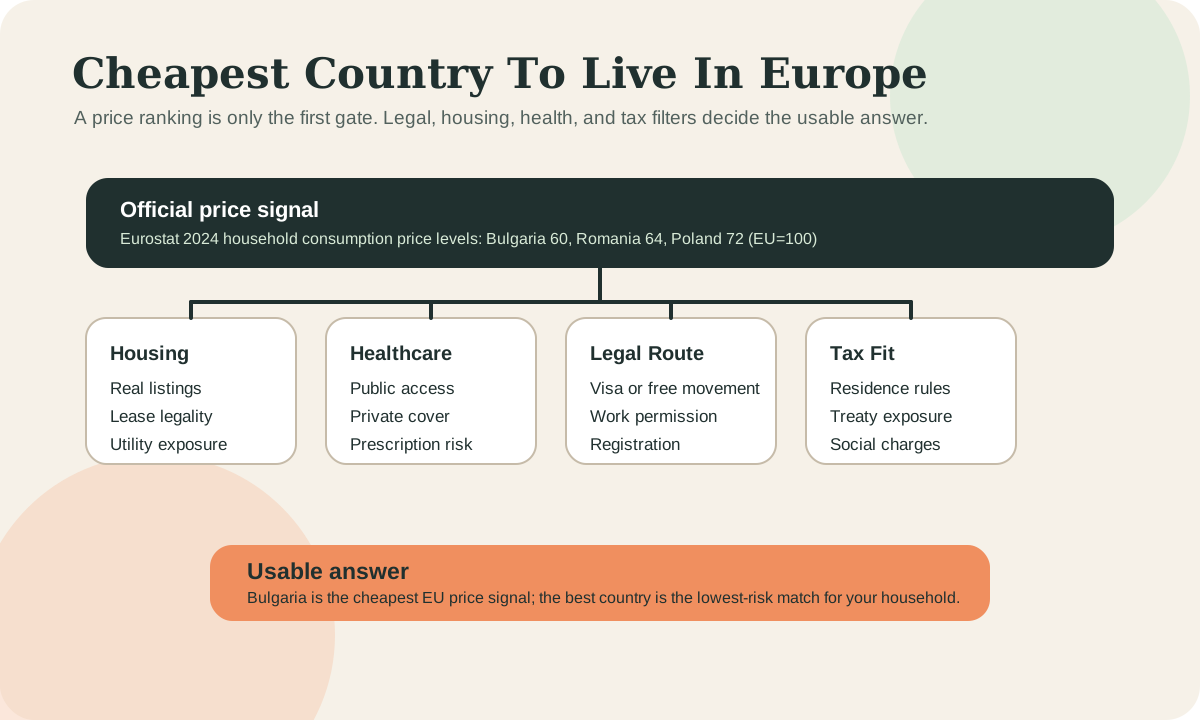
Cheapest Country To Live In Europe: Evidence-Based 2026 Guide helps compare places by the practical constraints that matter after arrival, not by lifestyle slogans alone. It explains comparing places by jobs, rent, schools, healthcare, transport, language access, visa or tax pressure, and day-to-day fit, then shows how to compare locations by the constraints that matter after arrival: documents, work, housing, schools, healthcare, tax, transport, and language access. The later sections connect quick answer, why there is no single cheapest number, and the official eu cost signal so the next step is easier to judge. Read it before choosing a city or country so the trade-offs are tied to documents, budgets, schools, healthcare, work, and daily services.
That does not automatically make Bulgaria the best place for every expat, retiree, student, family, freelancer, or remote worker. A low national price level can be offset by weak rental availability in your target city, private health insurance needs, car dependence, tax residence consequences, language friction, currency exposure, or a visa route that does not fit your activity.
Source check date: May 14, 2026. This guide is educational, not legal, tax, immigration, medical, investment, or relocation advice.
Quick Answer
For an evidence-based EU answer, Bulgaria is the cheapest country to live in Europe by Eurostat household consumption price levels. Romania is the next-lowest EU country, followed by Poland.
For a practical expat answer, the shortlist is broader:
| Profile | Strong low-cost candidates | Why |
|---|---|---|
| Lowest EU consumer prices | Bulgaria, Romania, Poland | Lowest EU household consumption price levels in Eurostat 2024 data |
| Low-cost EU with stronger city infrastructure | Poland, Romania, Hungary, Bulgaria | Better tradeoff between prices, rentals, transport, and services |
| Low-cost retirement base | Bulgaria, inland Portugal, inland Spain, parts of Greece | Depends heavily on healthcare, visa, and housing |
| Non-EU budget seeker | Albania, Serbia, Bosnia and Herzegovina, North Macedonia | Often cheaper, but residence, healthcare, banking, and data comparability require separate checks |
The disciplined conclusion is: Bulgaria is the cheapest EU country by official consumer price levels, but Romania or Poland may be more practical for many expats who need larger labor markets, transport links, and deeper service infrastructure.
Why There Is No Single Cheapest Number
A country can be cheap for restaurants but expensive for capital-city rent. Another can have low rent but high heating costs, car costs, private-school costs, or tax exposure on foreign income.
Use this evidence hierarchy:
| Evidence layer | What it tells you | Main limitation |
|---|---|---|
| Eurostat price level indices | Relative consumer prices by country | National average, not city-specific budget |
| Eurostat housing indicators | Housing pressure, tenure patterns, affordability stress | Does not equal available rent for newcomers |
| HICP inflation | Current price momentum | Inflation is price change, not absolute price level |
| National residence and visa rules | Whether you can live and work there legally | Highly personal and nationality-specific |
| Healthcare entitlement rules | Whether public access, private cover, or contribution is needed | Depends on residence status and registration |
| Local rental searches | Actual housing cost | Volatile and neighborhood-specific |
Eurostat's HICP framework is useful because it measures inflation comparably across countries. See Eurostat: Harmonised Indices of Consumer Prices. But inflation data cannot tell you whether the apartment you need is available, legal, registered, and suitable.
The Official EU Cost Signal
Eurostat's 2024 consumer price level data gives the cleanest official comparison for EU countries.
| EU country signal | 2024 price level for household consumption | Interpretation |
|---|---|---|
| Bulgaria | 60 percent of EU average | Lowest EU consumer price level |
| Romania | 64 percent of EU average | Second-lowest EU consumer price level |
| Poland | 72 percent of EU average | Third-lowest EU consumer price level |
| Denmark | 143 percent of EU average | Highest EU consumer price level |
| Ireland | 138 percent of EU average | Very high consumer price level |
| Luxembourg | 133 percent of EU average | Very high consumer price level |
Eurostat also reported that restaurants and hotels were lowest in Bulgaria, Romania, and Hungary, while food and non-alcoholic beverages were lowest in Romania. See Eurostat: Household consumption price levels in 2024.
This supports a narrow answer: if you need one EU country name from official consumer price evidence, Bulgaria is the cheapest.
Housing Can Change The Answer
Housing is the largest variable for many expats. Eurostat's Housing in Europe publication defines housing cost overburden as the share of people living in households where housing costs exceed 40 percent of disposable income. Its 2024 edition is useful for understanding housing stress, tenure patterns, overcrowding, and affordability. See Eurostat: Housing in Europe 2024.
That creates an important warning: a country can rank low on consumer prices while still being difficult for a newcomer who needs a legal lease, family-size housing, public transport, and a landlord willing to accept foreign documents.
| Housing question | Why national rankings mislead |
|---|---|
| Is rent cheap? | Capital, coastal, university, and tourist markets diverge sharply |
| Is housing available? | Low rent is irrelevant if long-term rentals are scarce |
| Can I register there? | Some residence, tax, school, or utility processes need a valid address |
| Can I heat and cool the home affordably? | Energy efficiency and building condition change real cost |
| Can I avoid a car? | Cheap outskirts can become expensive if car ownership is required |
Practical Cost Model
Use this monthly budget model before selecting a country.
| Budget line | Low-cost-country risk | How to verify |
|---|---|---|
| Rent or mortgage | Good listings may be scarce in preferred cities | Check at least 20 current listings |
| Utilities | Old buildings can erase rent savings | Ask for winter and summer bills |
| Groceries | Imported brands can be expensive | Price a local basket, not home-country brands |
| Health insurance | Public access may depend on residence status | Check national health fund and visa rules |
| Transport | Cheap rent outside the center may require a car | Compare transit pass, fuel, parking, and insurance |
| Tax | Foreign pension, salary, dividends, or business income may be taxable | Read treaty and national tax rules |
| Banking | Nonresident onboarding can be slower | Confirm account and card access |
| Language and administration | Translation, legal help, and bureaucracy have costs | Budget for setup support |
| Flights home | Cheap daily life can be offset by expensive travel | Price off-season and peak flights |
For many people, the cheapest country is not the country with the lowest price index. It is the country where the total system works: lawful residence, a realistic lease, banking access, healthcare continuity, and a tax position that does not destroy the apparent savings.
Country Assessment
Bulgaria
Bulgaria is the strongest answer for the cheapest EU country by official consumer price levels. It is especially relevant for people with foreign income, pension income, or remote income who are not dependent on local wages.
| Strength | Caution |
|---|---|
| Lowest EU household consumption price level in Eurostat 2024 data | Local salaries and purchasing power are lower |
| Low restaurant and service prices relative to most EU countries | Healthcare and language planning matter |
| EU member state | Not every newcomer has an automatic right to work or stay long term |
| Sofia, Plovdiv, Varna, and Burgas offer different lifestyles | Capital and coastal markets can be pricier than national averages |
Best fit: budget-focused EU residents, compliant remote workers, and retirees who can solve healthcare and language needs.
Romania
Romania is second-lowest in Eurostat's EU household consumption price-level comparison. Bucharest and Cluj-Napoca are not as cheap as the national signal suggests, but the country remains one of the strongest EU value options.
| Strength | Caution |
|---|---|
| Very low consumer price level by EU standards | Major cities have rising housing pressure |
| Large cities with tech, universities, and transport | Quality varies by neighborhood and service |
| EU member state | Residence and work details still depend on nationality and status |
| Stronger urban labor market than some lower-cost peers | Local wages may not match Western expectations |
Best fit: expats who want low costs but need larger cities, professional services, and more urban infrastructure.
Poland
Poland is not the cheapest EU country, but it is often one of the best value countries because it combines relatively low prices with large labor markets, strong cities, and broad services.
| Strength | Caution |
|---|---|
| Third-lowest EU household consumption price level in Eurostat 2024 data | Warsaw, Krakow, Wroclaw, and Gdansk can be materially pricier |
| Strong transport and service depth in major cities | Cold-weather utility costs matter |
| Deep rental and job markets | Immigration and tax rules vary by status |
| Good option for younger professionals and families | Not always the cheapest for retirees seeking mild weather |
Best fit: working expats, students, remote workers with legal status, and families needing infrastructure.
Hungary
Hungary often appears in low-cost discussions because restaurants and hotels were among the lower-priced EU categories in Eurostat's 2024 data. Budapest offers a major-city lifestyle at below Western European prices, but inflation, currency movements, housing demand, and policy risk can change the picture.
| Strength | Caution |
|---|---|
| Budapest has strong cultural and transport infrastructure | Capital-city rents can be competitive |
| Lower service cost than much of Western Europe | Currency risk if income is not in forint |
| Central European location | Healthcare and residence planning matter |
Best fit: city-focused expats who want culture and transport at lower cost than Western capitals.
EU Versus Non-EU Europe
Non-EU countries in the Balkans and Eastern Europe can be cheaper than EU countries in day-to-day spending. However, comparisons become harder because EU datasets and rights do not always apply.
Use purchasing power parity concepts for broad comparisons, but do not treat them as a rent quote. The World Bank explains that PPP conversion factors compare purchasing power across economies and that private consumption PPPs relate to household final consumption expenditure. See World Bank: Why PPP series are used.
| Non-EU issue | Why it matters |
|---|---|
| Residence permits | You may not have EU free-movement rights |
| Healthcare | Public access and private insurance rules differ |
| Banking | International transfers and card costs can matter |
| Currency | Exchange-rate swings affect foreign-income budgets |
| Legal certainty | Property, tax, and business rules require local advice |
| Data comparability | EU indicators may not cover all relevant countries |
Cheapest Does Not Mean Best
A country is only cheap if it fits your income source and legal status.
| Person | Cheapest useful answer |
|---|---|
| EU citizen with remote job | Bulgaria or Romania may be lowest-cost; Poland may be more practical |
| U.S. retiree | Visa, tax, and healthcare may make Portugal, Spain, France, or Italy more relevant despite higher prices |
| Family with children | Schooling and healthcare can outweigh rent |
| Freelancer | Social contributions and VAT rules can outweigh consumer prices |
| Digital nomad | Visa conditions and permanent-establishment risk matter |
| Pensioner with medical needs | Healthcare access can matter more than grocery prices |
Your Europe explains EU residence rights and the difference between short stays, longer residence, work, study, and economic inactivity. See Your Europe: Residence rights when living abroad in the EU. Non-EU citizens need national route analysis, not a generic "Europe" answer.
Decision Checklist
Before choosing the cheapest country, answer these questions:
| Question | Green signal | Red flag |
|---|---|---|
| Can I legally stay more than 90 days? | Clear residence route | Tourist-stay plan only |
| Is my income taxable there? | Treaty and local rules understood | Assuming foreign income is invisible |
| Can I access healthcare? | Public or private cover confirmed | Relying on travel insurance long term |
| Can I rent legally? | Lease supports residence registration | Informal cash rental |
| Are prices low in my target city? | Real listings and local basket checked | National averages only |
| Can I live without a car? | Transit and walkability work | Cheap rent but car dependency |
| Is inflation manageable? | Budget includes buffer | Fixed income with no margin |
| Can I handle language and administration? | Translation and setup budget included | Expecting everything in English |
FAQ
What is the cheapest country to live in Europe?
Using official EU consumer price data, Bulgaria is the cheapest EU country. Eurostat reported Bulgaria at 60 percent of the EU average for household consumption price levels in 2024.
Is Romania cheaper than Bulgaria?
By Eurostat's 2024 household consumption price level index, Bulgaria was cheaper overall than Romania. Romania was second-lowest among EU countries.
Is Poland cheap to live in?
Poland is not the absolute cheapest EU country, but it offers strong value because prices remain below the EU average while major cities provide stronger infrastructure than many lower-cost destinations.
Are non-EU Balkan countries cheaper?
Often yes, but the decision is more complex. Residence rights, healthcare access, currency risk, banking, and official data comparability must be checked separately.
Should I use crowdsourced cost rankings?
Crowdsourced city data can be useful for rough checks, but it should not replace official indicators, real rental searches, visa rules, healthcare rules, or tax analysis.
Source Risks And Factual Uncertainty
Eurostat price-level data is national and retrospective. It does not show the exact cost of a newcomer's apartment, medical insurance, school, imported groceries, tax position, or legal route. Housing markets change quickly, especially in capitals and tourist regions. Non-EU European countries may be cheaper but require separate legal and healthcare review.
Official And Primary Sources
- Eurostat: Household consumption price levels in 2024
- Eurostat: Housing in Europe 2024
- Eurostat: Harmonised Indices of Consumer Prices
- Eurostat: Actual individual consumption per capita in 2024
- Your Europe: Residence rights in the EU
- World Bank: Why PPP series are used
Build a real relocation budget
The cheapest country on a price index is not always the cheapest country for a newcomer. A relocation budget should separate setup costs, recurring costs, legal costs, and risk buffers. Setup costs include deposits, agency fees, temporary accommodation, moving, translations, document legalization, residence applications, insurance, furniture, utilities, and local SIM or internet setup. These costs can erase several months of savings from cheaper groceries.
Recurring costs should be modeled by city and household type, not only by country. Rent, utilities, heating, childcare, school meals, transport, insurance, medication, coworking, language classes, and flights home can vary sharply between capitals, secondary cities, tourist regions, and rural areas. A person who needs international schools, private healthcare, imported food, or frequent flights may not experience the national average.
Legal costs belong in the budget. Non-EU citizens may need visa fees, immigration lawyers, proof-of-means deposits, private insurance, translations, apostilles, and renewals. Freelancers may need accountants, VAT registration, social-contribution planning, and business registration. Remote employees may need employer approval or payroll changes. A cheap rent country can become expensive if the legal route is weak.
Risk buffers matter because many expats earn in one currency and spend in another. Exchange rates, inflation, rent increases, healthcare surprises, and tax bills can change affordability. A conservative plan keeps emergency savings in accessible accounts and avoids choosing a country where the budget only works under perfect assumptions.
Cost by life stage
A single remote worker can prioritize rent, coworking, internet, transport, tax, and social life. Bulgaria, Romania, Poland, and some Balkan countries may look attractive if the person has stable foreign income and a valid residence route. The key risks are visa limits, tax residence, employer approval, and healthcare coverage.
A family should weight housing, schools, healthcare, childcare, safety, commute, and language support more heavily than restaurant prices. A lower-cost country can be a poor choice if the family needs private international schooling or frequent travel to access healthcare. Families should compare school calendars, enrollment rules, pediatric care, and local registration before choosing based on rent.
A retiree should model healthcare, long-term residence, taxation of pensions, inheritance planning, accessibility, climate, and proximity to support networks. The cheapest grocery basket is less important than reliable care, manageable bureaucracy, and stable residence status. Portugal, Spain, France, Italy, Greece, and parts of Central Europe may be more expensive than Bulgaria or Romania but more practical for some retirees.
A freelancer should model social contributions, VAT, income tax, business registration, accounting, and client location. A country with low consumer prices may not be cheapest once mandatory contributions and business administration are included. For freelancers, the affordability question should be paired with freelance tax thresholds in Europe and remote work Europe tax.
City selection inside cheap countries
National rankings hide city-level tradeoffs. Sofia, Bucharest, Warsaw, Krakow, Porto, Valencia, Athens, Thessaloniki, Budapest, Prague, and Tallinn can have very different rent, wage, transport, healthcare, and English-service markets from smaller cities in the same country. The cheapest towns may require a car, limited rental stock, fewer international services, and more language dependence.
Use a two-stage filter. First, choose countries where residence, tax, healthcare, and income source are viable. Second, compare cities using real apartment listings, transport maps, hospital access, grocery baskets, school availability, coworking options, airport access, and local bureaucracy. A city that is 15 percent more expensive but removes the need for a car can be cheaper in practice.
Housing deserves special caution. Eurostat housing data is useful for context, but newcomers often rent in a narrower market than locals. Short-term rentals, furnished apartments, deposits, agency fees, guarantor requirements, and foreigner documentation can raise actual costs. Before moving, check whether a lease supports residence registration, because an informal rental can create legal problems even if it is cheap.
Tax and healthcare can change the ranking
A country with low prices can become expensive if the tax result is unfavorable. Remote workers may become local tax residents, freelancers may owe contributions, retirees may face pension taxation, and investors may have reporting duties. Double-taxation treaties can help, but they do not eliminate filing, documentation, or cash-flow planning. Do not compare countries on rent while ignoring tax.
Healthcare can also change the ranking. Public healthcare access may depend on employment, social-security contributions, residence status, or registration. Private insurance may be required for visas or used during waiting periods. People with chronic conditions should compare medication availability, specialist access, language support, and private-care prices before moving.
The practical answer is that "cheapest" means lowest sustainable cost after legal stay, tax, healthcare, housing, and lifestyle constraints are included. A country that is cheapest for an EU citizen remote worker may not be cheapest for a US retiree, non-EU freelancer, family with children, or person needing specialist care.
Scoring model for choosing a cheap country
A practical scoring model should weight affordability, legal stay, tax, healthcare, housing, transport, income fit, language, and resilience. Give each category a score from 1 to 5, then reject any country with a fatal score in legal stay, healthcare, or income fit. A very cheap country is not viable if the person cannot stay legally, cannot access medical care, or cannot earn or receive income there.
Affordability should include rent, utilities, food, transport, insurance, taxes, and setup costs. Legal stay should include visa route, renewal path, family rights, work permission, and registration. Tax should include residence, foreign income, pension, freelance, capital gains, and treaty treatment. Healthcare should include public access, private insurance, medication, specialists, and language support.
Resilience is the category many movers ignore. It measures whether the plan survives a rent increase, illness, job loss, exchange-rate move, delayed visa renewal, or tax bill. If the budget has no margin, the country is not truly cheap; it is fragile.
Income-source matching
The cheapest country depends heavily on how the person earns money. A remote employee needs employer approval, tax and payroll review, social-security analysis, and a secure work setup. A freelancer needs business registration, VAT and income-tax planning, contribution modeling, and client-payment reliability. A retiree needs pension taxation, healthcare access, residence renewal, and estate-planning review. A student needs tuition, housing, health insurance, and work-hour limits.
Foreign-currency income can make low-cost countries attractive, but it also creates exchange-rate risk. A person paid in dollars, pounds, francs, or another non-euro currency should model a weaker currency scenario. A five to ten percent exchange-rate move can wipe out much of the apparent price advantage.
Local-income earners should compare wages, not only prices. A country can be cheap because local salaries are low. If the mover must find local work, the affordability calculation should use realistic local net income after tax and contributions, not foreign-income assumptions.
Trial stay before relocation
Before committing, run a trial stay if legally possible. Spend several weeks in the target city during an ordinary season, not only during a holiday. Test grocery costs, transit, internet, healthcare access, coworking, bureaucracy, language barriers, housing searches, and neighborhood safety. Track actual spending daily.
The trial should also test administration. Can you obtain a tax number, open a bank account, register an address, find a doctor, sign a lease, and communicate with authorities? A country that looks cheap online can become expensive if every administrative step requires paid help or repeated travel.
After the trial, update the budget with real numbers and decide whether the savings justify the legal and lifestyle tradeoffs. The best cheap country is the one that remains workable after real housing, tax, healthcare, and bureaucracy are included.
Decision rule
Choose the country that is cheapest after constraints, not cheapest before constraints. If two countries have similar budgets, prefer the one with clearer residence rights, stronger healthcare access, easier banking, better transport, and lower tax uncertainty. The cheapest spreadsheet option is not the cheapest lived option if it creates repeated legal, medical, or administrative failures.