Last updated
Best Places In Europe For Expats To Retire: Evidence-Based 2026 Guide
Direct answer
Use Best Places In Europe For Expats To Retire: Evidence-Based 2026 Guide when a retirement shortlist needs practical constraints, not just climate or lifestyle claims. It explains comparing retirement locations by residence rights, healthcare, pensions, tax, housing, daily services, language access, and long-term fit, then shows how to compare healthcare access, pension handling, housing costs, tax exposure, residence stability, transport, and community fit. The later sections connect executive shortlist, retirement selection framework, and cost evidence so the next step is easier to judge. Read it before choosing a retirement base so healthcare, pensions, tax, housing, residence rights, and daily support are checked together.
The answer changes when your nationality, pension source, health needs, and tax profile change. EU citizens usually have an easier residence path than non-EU retirees, and a country that works for a healthy couple on private income may be a poor fit for someone who needs predictable specialist care, English-language administration, or a formal passive-income residence route.
Next step: score your top three countries on five points before comparing cities: legal residence, healthcare access, housing stability, tax treatment of your pension and investments, and climate fit for year-round living.
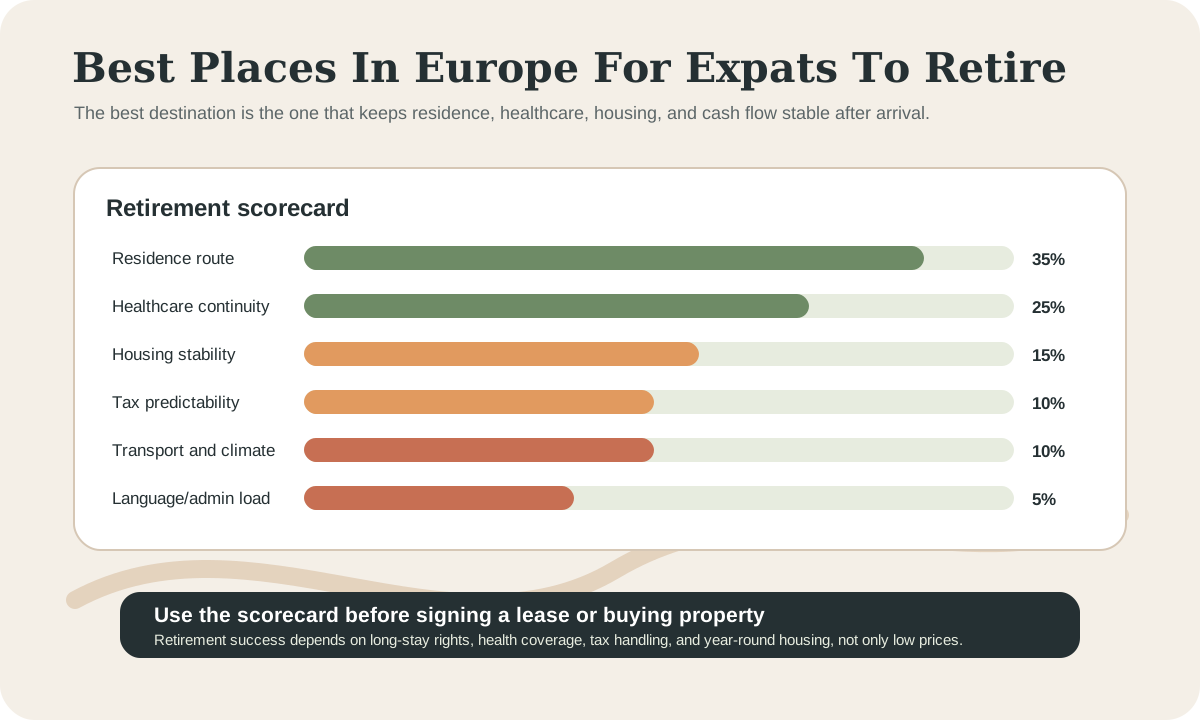
The best places in Europe for expats to retire are not necessarily the cheapest places. A good retirement destination must pass five tests: legal residence, healthcare access, stable housing, tax predictability, and day-to-day livability.
For many retirees, the strongest European shortlist includes Portugal, Spain, France, Italy, Greece, Malta, Bulgaria, Croatia, and Slovenia. The best choice depends on income type, nationality, health needs, language tolerance, climate preference, tax residence, and whether the retiree needs a formal passive-income or visitor residence route.
Source check date: May 14, 2026. This guide is educational and is not legal, tax, immigration, pension, medical, or financial advice.
Executive Shortlist
| Retiree profile | Best places to research first | Why |
|---|---|---|
| Wants established retirement route | Portugal, Spain, France, Italy | Well-known long-stay, visitor, passive-income, or elective-residence pathways |
| Wants lower EU costs | Bulgaria, Romania, inland Portugal, inland Spain | Lower cost potential than Western and Northern Europe |
| Wants healthcare and infrastructure | France, Spain, Portugal, Slovenia | Strong public systems and practical services, subject to eligibility |
| Wants Mediterranean lifestyle | Spain, Portugal, Italy, Greece, Malta, Croatia | Climate, coast, culture, and travel access |
| Wants English-language convenience | Malta, parts of Portugal and Spain | Easier transition, but often higher cost in expat-heavy areas |
| Wants low-cost EU base | Bulgaria, Romania, Poland | Cost strength, but retirement lifestyle fit varies |
There is no universal best. The right answer is the lowest-risk match between your residence rights, pension income, health needs, housing budget, tax profile, and tolerance for administration.
Retirement Selection Framework
Score every destination on these dimensions:
| Factor | Why it matters |
|---|---|
| Residence route | Tourist status is not retirement residence |
| Healthcare | Medical access matters more with age |
| Housing | Stable long-term rental or ownership is critical |
| Tax | Pension, Social Security, dividends, gains, and estate rules can differ |
| Cost level | Must be sustainable under inflation |
| Climate | Heat, humidity, winter, and air quality affect health |
| Language | Administrative independence matters |
| Transport | Car-free living may become important |
| Community | Isolation risk is real |
| Estate planning | Inheritance, wills, and property rules differ |
EU citizens and their family members have EU free-movement rules, but retirees still need to satisfy residence conditions and national registration rules. Your Europe explains residence rights for pensioners and economically inactive people. See Your Europe: Pensioners abroad in the EU.
Cost Evidence
Eurostat's 2024 price-level data is useful for cost context. Bulgaria, Romania, and Poland had the lowest EU household consumption price levels, while Denmark, Ireland, and Luxembourg were highest. See Eurostat: Household consumption price levels in 2024.
Retirees should not chase the lowest price level alone. Healthcare, housing quality, summer heat, winter damp, prescription availability, walkability, and proximity to hospitals can matter more than restaurant prices.
| Cost signal | Retirement interpretation |
|---|---|
| Low national consumer prices | Good first screen, but not enough |
| Lower rent outside capitals | Useful only if healthcare and transport work |
| Cheap restaurants | Less important than pharmacy and clinical access |
| Lower utilities | Depends on dwelling quality and heating/cooling needs |
| Lower labor costs | Helpful for household help, but formal care standards must be checked |
Housing Evidence
Eurostat's Housing in Europe publication shows why retirees should not rely on national stereotypes. Housing cost overburden, overcrowding, tenure, and household conditions vary sharply by country and city. See Eurostat: Housing in Europe 2024.
| Retirement housing question | Why it matters |
|---|---|
| Can I get a legal long-term lease? | Needed for residence and stability |
| Is the home accessible? | Stairs, elevators, bathrooms, and hospitals matter |
| Can I afford heating and cooling? | Old buildings can create large bills |
| Is the area active year-round? | Tourist areas may lose services off-season |
| Can I live car-free? | Driving may not be permanent |
| Is healthcare nearby? | Specialist access matters |
| Is there damp, mold, noise, or heat risk? | Comfort and health can deteriorate quickly |
Portugal
Portugal remains one of Europe's most researched retirement destinations because it combines climate, safety, Atlantic lifestyle, and a residence route for retirees and people living from their own income.
The Portuguese government describes a residence visa route for foreign citizens who want to reside in Portugal as retired people or people living from their own income. See Portugal government: residence visa for retirees and people living from own income.
| Strength | Caution |
|---|---|
| Established retirement and passive-income pathway | Consular requirements and appointments vary |
| Strong expat infrastructure | Lisbon, Porto, and Algarve can be expensive |
| Mild climate in many regions | Summer heat and housing insulation matter |
| Public healthcare access may be possible after residence | Private insurance may be needed initially |
| Good travel links | Popular areas can be crowded and costly |
Best-fit retiree: someone who values lifestyle, ocean access, relative administrative familiarity, and a recognized long-stay route more than the absolute lowest cost.
Spain
Spain is a strong retirement candidate for healthcare, climate, transport, and regional choice. It is not the cheapest country in Europe, but inland and secondary cities can offer strong value.
Spain's non-lucrative residence visa is designed for residence without work. The Spanish consular page states that the visa does not constitute a work permit and does not allow gainful work, including remote online work; it also describes the financial-means requirement based on IPREM. See Embassy of Spain: Non-working residence visa.
| Strength | Caution |
|---|---|
| Excellent regional diversity | Tourist and major-city markets are expensive |
| Strong healthcare reputation | Access depends on status, registration, and insurance route |
| Good rail and urban transport | A car may still be needed in rural areas |
| Large expat communities | Expat-heavy coasts can be overpriced |
| Non-lucrative route for non-working residents | Remote work is not allowed under that visa |
Best-fit retiree: someone with stable pension or investment income who wants Mediterranean lifestyle, infrastructure, and strong healthcare planning.
France
France is one of the strongest retirement options for retirees who prioritize healthcare, food, transport, and quality of life over the lowest monthly budget.
France-Visas states that a person staying more than three months for tourism or private stay must apply for a long-stay visitor visa and prove socioeconomic situation, resources, accommodation, and medical cover. See France-Visas: Tourist stay of more than three months.
| Strength | Caution |
|---|---|
| Strong healthcare system | Administrative language burden can be high |
| Many affordable towns outside Paris and the Riviera | Taxes and social charges require advice |
| Excellent food, transport, and cultural access | Rural areas may require French fluency |
| Visitor route may suit non-working retirees | Work is not the purpose of visitor status |
Best-fit retiree: someone who wants deep infrastructure, healthcare, culture, and regional variety, and is willing to handle French administration.
Italy
Italy is attractive for retirees who want culture, food, climate variety, and smaller-town living. It is not a simple budget choice, and the immigration route requires careful documentation.
Italian consular guidance on elective residence visas states that the route is for people who can support themselves and that income from subordinate work or self-employment cannot be considered. See Italian consular checklist: elective residence visa.
| Strength | Caution |
|---|---|
| Strong lifestyle and regional variety | Elective residence visa is document-heavy |
| Many towns cheaper than major tourist cities | Healthcare and residence steps require planning |
| Rich culture and food | Bureaucracy and language can be challenging |
| Good fit for pension or passive-income retirees | Remote work is not the elective-residence model |
Best-fit retiree: someone with stable non-work income who wants Italy specifically and can handle administrative complexity.
Greece
Greece can be attractive for retirees seeking climate, islands, culture, and potentially lower costs than Western Europe. It requires careful housing and healthcare planning.
Housing cost burden is a major caution. Eurostat's housing indicators show that national and city-level affordability pressure can diverge sharply across Europe. See Eurostat: Housing in Europe 2024.
| Strength | Caution |
|---|---|
| Mediterranean lifestyle | Housing burden and local income pressure can be high |
| Many lower-cost areas outside prime islands | Island healthcare and winter services vary |
| Attractive climate | Summer heat can be severe |
| Possible residence routes for financially independent persons | Income thresholds and rules must be checked with Greek authorities |
Best-fit retiree: someone who wants Greece's lifestyle and has enough budget buffer for housing, private healthcare, and seasonal logistics.
Malta
Malta is one of the easiest cultural transitions for English-speaking retirees, but it is not a low-cost default.
The Malta Tax and Customs Administration describes the Malta Retirement Programme as designed for nationals of the EU, non-EU countries, the EEA, and Switzerland who are not in employment and receive a pension as their regular source of income. See Malta Tax and Customs Administration: Malta Retirement Programme.
| Strength | Caution |
|---|---|
| English is widely used | Housing can be expensive |
| Formal retirement programme | Programme conditions must be followed |
| Island lifestyle and mild winters | Small size, density, traffic, and summer heat |
| Good air links | Limited countryside and high demand areas |
Best-fit retiree: someone who values English-language convenience and a formal programme more than low rent.
Bulgaria
Bulgaria is one of the strongest low-cost EU retirement options by price data. Eurostat reported Bulgaria as the lowest EU country for household consumption price levels in 2024. See Eurostat: Household consumption price levels in 2024.
| Strength | Caution |
|---|---|
| Lowest EU consumer price level | Healthcare route and language planning are essential |
| Sofia, Plovdiv, Varna, and Burgas offer different lifestyles | Smaller expat infrastructure than Portugal or Spain |
| EU member state | Local services vary by region |
| Lower housing costs in many areas | Quality and accessibility differ widely |
Best-fit retiree: budget-sensitive retiree with private health planning and comfort outside mainstream expat destinations.
Croatia And Slovenia
Croatia and Slovenia are best treated as lifestyle-value options rather than cheapest-retirement picks.
| Country | Strength | Caution |
|---|---|---|
| Croatia | Coast, islands, EU membership, lifestyle | Seasonal rents, tourist pricing, healthcare access by region |
| Slovenia | Safety, nature, infrastructure, proximity to Italy, Austria, and Croatia | Smaller market and not a low-cost country compared with Bulgaria or Romania |
Best-fit retiree: someone who values quality of life, nature, and EU location more than the lowest possible monthly budget.
Retirement Decision Matrix
| Destination | Cost level | Healthcare potential | Visa or residence clarity | Best for |
|---|---|---|---|---|
| Portugal | Medium | Good with correct status | Strong retiree/passive-income route | Lifestyle retirees |
| Spain | Medium | Strong with correct status | Non-lucrative route | Healthcare and climate |
| France | Medium-high | Strong | Visitor route | Infrastructure and culture |
| Italy | Variable | Strong but administrative | Elective residence | Italy-focused retirees |
| Greece | Variable | Location-dependent | Financial independence route to verify | Mediterranean lifestyle |
| Malta | Medium-high | Good but small-system limits | Retirement programme | English-speaking retirees |
| Bulgaria | Low | Requires planning | EU residence context plus national rules | Budget-first retirees |
| Croatia | Medium | Region-dependent | National residence rules | Coastal lifestyle |
| Slovenia | Medium | Strong | National residence rules | Safety and nature |
Tax And Pension Planning
Retirees must model tax before moving.
| Income source | Planning issue |
|---|---|
| Public pension | Treaty rules and source-country rules may differ |
| Private pension | Residence-country taxation may apply |
| U.S. Social Security | U.S. citizens have continuing U.S. filing obligations |
| Dividends and interest | Withholding tax and residence tax interact |
| Rental income | Source country and residence country may both matter |
| Capital gains | Timing of sale before or after moving can change tax |
| Retirement accounts | Distribution treatment can be treaty-specific |
U.S. retirees should start with IRS guidance for U.S. citizens abroad. See IRS: U.S. citizens and resident aliens abroad.
Healthcare Checklist
| Question | Why it matters |
|---|---|
| Can I join the public system? | Determines long-term affordability |
| Is private insurance required for the visa? | Often required at entry stage |
| Are pre-existing conditions covered? | Critical for retirees |
| Where is the nearest hospital? | Rural charm can create medical risk |
| Are specialists available locally? | Important for chronic conditions |
| Can I manage prescriptions? | Drug names, availability, and reimbursement differ |
| Is long-term care available? | Retirement planning must include later-life needs |
Your Europe provides guidance on state pensions abroad and healthcare when living in another EU country. See Your Europe: State pensions abroad and Your Europe: Health insurance cover.
Housing Checklist
| Question | Why it matters |
|---|---|
| Is the lease long-term and registered? | Residence and stability |
| Is the home accessible? | Stairs and bathrooms matter with age |
| Is heating and cooling efficient? | Utility risk |
| Is the area active year-round? | Services may close in seasonal areas |
| Is public transport usable? | Driving may not be permanent |
| Can guests or caregivers stay? | Family and care planning |
| Is there noise, heat, damp, or mold? | Health and comfort |
Common Mistakes
| Mistake | Better approach |
|---|---|
| Choosing by best-retirement-country rankings | Build a personal scorecard |
| Ignoring tax until after moving | Model tax before residence begins |
| Assuming healthcare is automatic | Confirm status-specific access |
| Renting in a tourist market | Test year-round availability |
| Moving on tourist status | Secure a legal long-stay route |
| Underestimating language | Budget for translation and admin support |
| Ignoring heat | Check summer temperatures and air conditioning |
| Buying property too early | Rent first and test the region |
FAQ
What is the best place in Europe for American retirees?
There is no single best place. Portugal, Spain, France, and Italy are common starting points because they have recognizable long-stay routes and strong lifestyle appeal. U.S. tax and healthcare planning should be done before choosing.
What is the cheapest place in Europe to retire?
Inside the EU, Bulgaria is the strongest low-cost candidate by Eurostat consumer price-level data. But the cheapest place is not always the safest retirement choice if healthcare, language, or housing quality are weak fits.
Is Portugal still good for retirees?
Yes, but it should not be treated as automatically cheap. It remains strong for lifestyle and residence-route familiarity, while Lisbon, Porto, and parts of the Algarve require higher budgets.
Is Spain better than Portugal for retirement?
Spain may be stronger for some retirees because of healthcare infrastructure, regional variety, and transport. Portugal may be simpler for others because of its established passive-income retirement pathway and expat ecosystem. Tax and visa fit decide the answer.
Can retirees work remotely on retirement visas?
Often no. Spain's non-lucrative visa states that it does not allow work or professional activity, including online remote work. Italy's elective residence route is also not designed for work income. Retirees who plan to work need a different route.
Retirement location scorecard
Retirees should use a scorecard rather than a ranking. Score each candidate country and city for legal residence, healthcare access, tax fit, housing, climate, transport, language, community, safety, cost, estate planning, and care options. A country with excellent lifestyle but weak healthcare access for the retiree's status should not rank highly. A cheap country with poor specialist access may be a poor retirement choice.
Legal residence is the first gate. A retiree needs a route that permits long-term stay, renewals, dependants if relevant, and the intended lifestyle. Some routes prohibit work. Others require passive income, private insurance, accommodation, clean criminal records, or consular filing. Retirees who plan consulting, board work, online business, or rental management should not use a route that forbids professional activity.
Healthcare is the second gate. Confirm whether public healthcare is available, when access starts, whether private insurance is required, whether pre-existing conditions are covered, and where specialist care is located. The best climate or lowest rent does not compensate for unmanageable medical access.
Country archetypes for retirement
Portugal often suits retirees who value mild climate, Atlantic lifestyle, English-speaking services in some areas, and a familiar residence pathway. The tradeoffs are rising housing costs in popular areas, changing tax rules, and pressure in expat-heavy markets. Inland regions can be better value than Lisbon, Porto, or premium coastal zones.
Spain can suit retirees who want healthcare infrastructure, regional variety, transport, and established international communities. The non-lucrative route is useful for passive-income retirees but not designed for work. Housing, heat, and regional tax differences should be reviewed carefully.
France can suit retirees who value healthcare, food culture, transport, and rural or small-city living, but administrative language and tax complexity can be more demanding. Italy can be attractive for lifestyle and regional variety, but bureaucracy, healthcare access by region, and housing condition require due diligence. Malta can suit English-speaking retirees but requires careful tax and healthcare review.
Lower-cost EU countries such as Bulgaria, Romania, Hungary, Poland, and parts of Croatia can reduce monthly expenses, but retirees should test language, healthcare, winter conditions, transport, and long-term care before moving. A place that is excellent for a remote worker may be less suitable for an older retiree with medical needs.
Tax and estate planning
Retirement tax planning should include pensions, Social Security, annuities, investment income, capital gains, rental income, wealth or solidarity taxes where relevant, inheritance tax, and treaty relief. U.S. citizens have a separate U.S. filing overlay. UK pensioners, Canadian retirees, and other non-EU retirees may also have treaty-specific pension questions.
Tax residence can change unintentionally through days, home, family, and center-of-life facts. A retiree who buys property, moves spouse, registers healthcare, and spends most of the year in a country may become tax resident even if income is paid from abroad. The tax model should be built before the first full year of residence.
Estate planning should be reviewed before buying property. Forced-heirship rules, wills, matrimonial property, beneficiary designations, and cross-border probate can affect family outcomes. Local property ownership can create local inheritance procedures even if the retiree remains connected to another country.
Housing and trial-stay strategy
Rent before buying where possible. A trial rental reveals noise, heating, cooling, stairs, healthcare access, bureaucracy, shops, transport, internet, seasonal crowds, and winter reality. Tourist impressions are unreliable for retirement planning. A beach town in May may feel very different in August or January.
Accessibility should be assessed early. Stairs, elevators, bathroom layout, distance to shops, hill gradients, parking, public transport, and emergency services matter more with age. A charming property can become unsuitable after mobility changes.
Buying should wait until legal residence, tax, healthcare, and local fit are tested. If buying early is necessary, use local legal support and avoid assuming that property ownership creates residence rights.
Later-life and contingency planning
Retirement planning should include later-life scenarios: illness, widowhood, loss of driving ability, need for home care, need to return home, currency decline, pension changes, or family emergency. The best retirement location is the one that remains workable when health and finances are less perfect.
Keep a cross-border emergency file with residence documents, healthcare cards, insurance, medication list, doctors, bank contacts, powers of attorney, wills, tax advisers, and family contacts. Share access instructions with trusted people.
Budget model for retirement countries
A retirement budget should be built in layers. The first layer is fixed monthly income: pensions, Social Security, annuities, investment withdrawals, rental income, and other recurring sources. The second layer is fixed costs: rent or mortgage, utilities, healthcare, insurance, taxes, transport, communications, and food. The third layer is variable lifestyle: travel, restaurants, hobbies, family visits, and household help. The fourth layer is late-life reserve.
Use local net numbers. A pension quoted gross in one country may be taxed differently in another. Exchange-rate swings can reduce effective income. Healthcare premiums can rise with age. Rent can increase or a landlord may not renew. A budget that works only with today's exchange rate and best-case rent is not retirement-ready.
Keep a separate relocation budget. Visa fees, translations, apostilles, legal advice, deposits, furniture, moving costs, temporary accommodation, private health insurance, and tax advice can be significant. The first year is usually more expensive than a normal year.
Healthcare due diligence by city
National healthcare reputation is not enough. Retirees should check the target city or region: nearest hospital, emergency services, specialists, English-speaking or multilingual doctors, prescription availability, private clinics, dental care, rehabilitation, home care, and transport to appointments. Rural beauty can become a problem if specialist care is two hours away.
Pre-existing conditions require written insurance clarity. A policy that satisfies a visa may not cover ongoing care the way the retiree expects. Ask about waiting periods, exclusions, renewal rights, age limits, reimbursement procedures, and whether treatment abroad is covered.
Medication should be checked before moving. Brand names, formulations, controlled-substance rules, reimbursement, and prescription renewal processes differ. Bring medical records and establish a local doctor before supplies run low.
Social and administrative fit
Retirement quality depends on daily administration. Can the retiree communicate with doctors, banks, landlords, tax offices, insurers, and local authorities? Is translation affordable? Are appointments online, in person, or paper-based? Is local transport manageable without driving? Can the retiree build community outside tourist season?
Isolation is a real risk. A place with good weather and low rent may still be a poor fit if language barriers, seasonal closures, or limited community make daily life difficult. Retirees should test ordinary routines: shopping, pharmacy, doctor visit, bank appointment, bus route, and local social activities.
Couple and widowhood planning
Couples should model both-person and one-person scenarios. What happens if one spouse dies, loses capacity, or returns home for care? Does the survivor keep residence rights, healthcare access, housing affordability, pension income, and local support? Are wills, powers of attorney, and beneficiary designations valid across borders?
Widowhood can change tax brackets, pension income, housing needs, and family support. A retirement destination should remain viable for the surviving spouse. If it does not, the plan needs an exit strategy.
Property purchase caution
Buying property can be sensible, but retirees should usually rent first. Renting tests climate, bureaucracy, healthcare, neighbors, noise, transport, and seasonal reality. Buying too early can trap capital in a region that does not fit.
If buying, consider accessibility, resale liquidity, inheritance law, renovation standards, energy efficiency, stairs, damp, heating, cooling, and distance to care. A low purchase price can hide high renovation or maintenance costs.
Review cadence after relocation
Retirees should review the plan annually. Confirm residence renewal, healthcare access, insurance, tax filings, pension payments, exchange rates, housing, estate documents, and emergency contacts. Update the plan after health changes, family changes, tax changes, or currency shocks.
Minimum decision memo
Before choosing a retirement destination, write a one-page decision memo. It should name the exact city or region, residence route, healthcare route, tax treatment, monthly budget, housing plan, language plan, transport plan, and exit plan. If any line is based on assumption rather than evidence, delay the final move.
The memo should compare at least two alternatives. A retiree may discover that the second-choice country is slightly more expensive but far stronger on healthcare, administration, family access, or tax certainty. Retirement planning should optimize durability, not only lifestyle appeal.
Family access and return plan
Retirees should also test access to family and the ability to return if circumstances change. Count flight frequency, airport distance, travel insurance, pet travel, storage, property exit costs, and whether family can visit easily. A destination that is affordable but hard to leave can become risky after illness or bereavement.
The return plan should identify where the retiree would live, how healthcare would restart, how pensions and tax would change, and how property or leases would be handled. This is not pessimism; it is basic resilience planning for later life abroad.
Source Risks And Factual Uncertainty
Visa rules, income thresholds, health-insurance requirements, tax rules, and consular practices change. Cost data is national and may not reflect expat-heavy neighborhoods. Healthcare access depends on residence status, registration, insurance, and local implementation. Retirees should verify rules with official authorities and qualified advisers before applying or relocating.
Official And Primary Sources
- Eurostat: Household consumption price levels in 2024
- Eurostat: Housing in Europe 2024
- Eurostat: Harmonised Indices of Consumer Prices
- Your Europe: Pensioners abroad in the EU
- Portugal government: residence visa for retirees and people living from own income
- Embassy of Spain: Non-working residence visa
- France-Visas: Long-stay visitor visa
- Italian consular checklist: elective residence visa
- Malta Tax and Customs Administration: Malta Retirement Programme
- IRS: U.S. citizens and resident aliens abroad