Last updated
Best Cities in Europe for American Expats: Deep Research Shortlist for 2026
Direct answer
Best Cities in Europe for American Expats: Deep Research Shortlist for 2026 helps compare places by the practical constraints that matter after arrival, not by lifestyle slogans alone. It explains comparing places by jobs, rent, schools, healthcare, transport, language access, visa or tax pressure, and day-to-day fit, then shows how to compare locations by the constraints that matter after arrival: documents, work, housing, schools, healthcare, tax, transport, and language access. The later sections connect best cities for american expats in 2026: quick picks, how this ranking was built, and the american-specific baseline so the next step is easier to judge. Read it before choosing a city or country so the trade-offs are tied to documents, budgets, schools, healthcare, work, and daily services.
The best city in Europe for an American expat is not the city with the most cafes, coworking spaces, or Instagram posts. It is the city where your legal route, income model, housing budget, healthcare plan, tax obligations, family needs, and exit options all work at the same time.
For U.S. citizens, the first relocation mistake is treating Europe as one system. The second is treating city choice as a lifestyle decision before proving the legal route. The United States continues to tax U.S. citizens and resident aliens on worldwide income, even while they live abroad. See IRS: foreign earned income exclusion and IRS Publication 54.
This shortlist is therefore built as a relocation-risk framework, not a tourism ranking.
Last source check: May 14, 2026.
Decision matrix
| Reader situation | Best first shortlist | What must be proven before choosing |
|---|---|---|
| Remote worker or independent professional | Lisbon, Porto, Valencia, Berlin | Valid residence route, employer or client permission, healthcare coverage, and U.S. plus local tax filing plan. |
| Entrepreneur or solo founder | Amsterdam, Berlin, Lisbon, Madrid | Company structure, treaty or visa eligibility, capital runway, accounting support, and local registration burden. |
| Family relocation | Vienna, Lyon, Valencia, Munich | School access, housing size, healthcare continuity, language support, and spouse or partner work rights. |
| Cost-sensitive first year | Porto, Valencia, Prague, Lyon | Realistic rent, deposit cash, income stability, public transport access, and fallback city if housing search fails. |
Best cities for American expats in 2026: quick picks
| Best for | City | Why it works |
|---|---|---|
| Best overall first move | Lisbon | Strong expat infrastructure, visa familiarity, English access, and large service ecosystem |
| Best Portugal alternative | Porto | Lower pressure than Lisbon, strong quality of life, good for slower onboarding |
| Best Mediterranean balance | Valencia | Strong healthcare access, livability, climate, and lower intensity than Madrid or Barcelona |
| Best career-density city in Spain | Madrid | Transport, services, schools, jobs, and consular/legal support depth |
| Best treaty-based entrepreneur route | Amsterdam | Dutch-American Friendship Treaty relevance and strong English operating environment |
| Best startup/freelance ecosystem | Berlin | Deep labor market and founder culture, but high administrative friction |
| Best high-income professional city | Munich | Strong salaries and infrastructure, but high housing and cost barriers |
| Best culture/career city in France | Paris | High opportunity density, but expensive and administratively demanding |
| Best family-oriented France alternative | Lyon | Strong public services, food/culture, transport, and lower pressure than Paris |
| Best stability-first city | Vienna | Strong infrastructure, public services, safety, and family fit |
| Best value-central Europe option | Prague | Lower cost profile and central location, with language and bureaucracy tradeoffs |
| Best high-reliability Nordic option | Copenhagen | Strong systems and quality of life, but very high cost and harder immigration fit |
How this ranking was built
The ranking uses seven decision criteria weighted for an American relocating for more than six months.
| Criterion | Weight | Why it matters |
|---|---|---|
| Legal-route fit | 30% | Without a valid residence/work basis, the city is not viable |
| Housing feasibility | 20% | Rent, deposits, and supply determine first-year survival |
| Healthcare continuity | 15% | Chronic care, prescriptions, dependents, and registration timing matter |
| Tax and reporting complexity | 10% | Americans carry U.S. filing, FBAR/FATCA, and host-country obligations |
| Language/admin friction | 10% | Bureaucracy is easier when the city has English-capable service depth |
| Family readiness | 10% | Schools, pediatrics, safety, transit, and neighborhood stability matter |
| Exit and backup options | 5% | A resilient move needs fallback cities, routes, and return logistics |
This is not a claim that one city is universally "best." It is a tool for matching city to profile.
The American-specific baseline
Before choosing a city, every U.S. citizen should model these obligations:
| U.S. issue | Why it matters abroad | Primary source |
|---|---|---|
| Worldwide income taxation | Moving abroad does not end U.S. tax filing duties | IRS Publication 54 |
| Foreign earned income exclusion | May reduce U.S. taxable income if tests are met | IRS FEIE guidance |
| Foreign tax credit | Often central when host-country tax is higher | IRS international tax FAQ |
| FBAR | Foreign accounts can trigger reporting | IRS FBAR guidance |
| STEP registration | Helps receive U.S. embassy and consulate updates | U.S. State Department STEP |
For 2026, the IRS lists the maximum foreign earned income exclusion as $132,900 per qualifying person. See IRS: figuring the foreign earned income exclusion.
Comparative city matrix
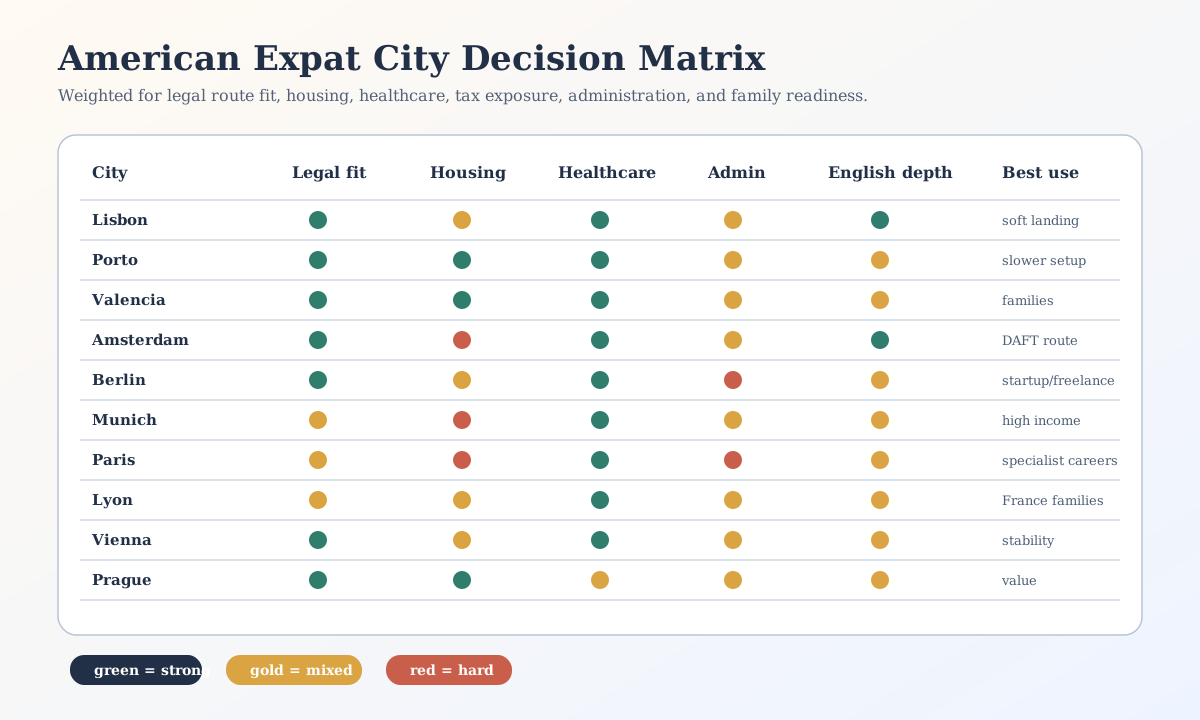
| City | Legal-route fit | Housing pressure | Healthcare continuity | Admin friction | English-service depth | Best profile |
|---|---|---|---|---|---|---|
| Lisbon | 5 | 3 | 4 | 3 | 5 | First-cycle remote worker or retiree |
| Porto | 4 | 4 | 4 | 3 | 4 | Portugal-focused family or budget-conscious remote worker |
| Valencia | 4 | 4 | 5 | 3 | 4 | Mediterranean family, retiree, or remote worker |
| Madrid | 4 | 3 | 5 | 3 | 4 | Career-oriented Spain move |
| Amsterdam | 4 | 1 | 4 | 3 | 5 | U.S. entrepreneur or high-income professional |
| Berlin | 4 | 2 | 5 | 4 | 4 | Startup, freelance, creative, or tech profile |
| Munich | 3 | 1 | 5 | 3 | 3 | High-income employee |
| Paris | 3 | 2 | 5 | 5 | 4 | Specialist career or culture-driven relocation |
| Lyon | 3 | 3 | 5 | 4 | 3 | France-focused family or retiree |
| Vienna | 4 | 3 | 5 | 3 | 4 | Stability-first household |
| Prague | 4 | 5 | 4 | 3 | 3 | Value-focused central Europe move |
| Copenhagen | 3 | 1 | 5 | 4 | 5 | Sponsored high-skill employee or high-budget family |
Scores are qualitative decision aids, not guarantees. Local housing markets move quickly, and immigration routes depend on facts.
1. Lisbon, Portugal
Lisbon is the strongest first-cycle city for many American expats because it combines international services, immigration familiarity, coworking infrastructure, English-speaking professional support, and a large foreign-resident ecosystem.
| Profile | Fit |
|---|---|
| Remote worker | Strong |
| Founder | Moderate to strong |
| Retiree | Strong |
| Family | Moderate to strong |
| Local-job seeker | Moderate |
| Low-budget mover | Weakening |
Main strengths:
- Large American and international network.
- High availability of English-speaking lawyers, accountants, doctors, and relocation support.
- Strong air connections to the United States and Europe.
- Familiarity with D7, D8, and residence-permit workflows.
- Good private healthcare availability.
Main risks:
- Housing pressure is the largest practical risk.
- Immigration appointment timing can create uncertainty.
- Some newcomers underestimate Portuguese tax and social-security classification.
- Lisbon can become expensive faster than expected if temporary housing extends.
Official sources to validate:
- AIMA: remote professional activity residence authorization
- gov.pt: healthcare in Portugal for migrants
Verdict: best for Americans who want a soft landing and can absorb housing volatility.
2. Porto, Portugal
Porto is the better Portugal choice for Americans who want Portugal's legal and lifestyle advantages but prefer a slower, less saturated environment than Lisbon.
| Profile | Fit |
|---|---|
| Remote worker | Strong |
| Retiree | Strong |
| Family | Strong |
| Founder | Moderate |
| Local-job seeker | Moderate to weak |
| Low-budget mover | Better than Lisbon, but not cheap |
Main strengths:
- Lower intensity than Lisbon.
- Strong neighborhood identity and walkability.
- Good fit for retirees, writers, consultants, and remote professionals.
- Stronger cost control than Lisbon in many cases.
Main risks:
- Smaller professional market.
- Fewer specialized English-speaking providers than Lisbon.
- Rainier climate and less global-city infrastructure.
- High-quality rentals can still be competitive.
Verdict: best for Americans who want Portugal but do not need Lisbon's full global-city density.
3. Valencia, Spain
Valencia is one of the best lifestyle-to-risk tradeoffs in Europe. It has beach access, urban services, strong healthcare, a major airport, universities, family appeal, and lower intensity than Madrid or Barcelona.
| Profile | Fit |
|---|---|
| Retiree | Strong |
| Family | Strong |
| Remote worker | Strong if visa route fits |
| Spanish learner | Strong |
| Local-job seeker | Moderate |
| Founder | Moderate |
Main strengths:
- Strong public and private healthcare environment.
- Excellent climate and outdoor life.
- More manageable than Barcelona or Madrid for many families.
- Good urban scale: large enough for services, small enough for daily livability.
Main risks:
- Spanish immigration and tax planning must be done carefully.
- Private insurance requirements for some visas can be strict.
- Salaries can be lower than in northern Europe.
- Summer demand and neighborhood selection matter.
Official sources to validate:
Verdict: best Mediterranean city for Americans who want daily livability without maximum-city friction.
4. Madrid, Spain
Madrid is the stronger Spain choice when professional density, transport, schools, legal services, and national connectivity matter more than beach lifestyle.
| Profile | Fit |
|---|---|
| Career-oriented expat | Strong |
| Family | Strong |
| Remote worker | Strong if route fits |
| Spanish learner | Strong |
| Retiree | Moderate |
| Low-budget mover | Weak to moderate |
Main strengths:
- Spain's administrative, transport, and business center.
- Strong legal/accounting ecosystem for foreigners.
- Deep private healthcare and education options.
- Better domestic and international mobility than most Spanish cities.
Main risks:
- Cost and housing pressure are significant.
- Summer heat can affect quality of life.
- Bureaucratic steps still require careful Spanish-language execution.
- Digital nomad and employment classifications require evidence quality.
Verdict: best for Americans who want Spain with maximum institutional depth.
5. Amsterdam, Netherlands
Amsterdam is expensive, but it has one major American-specific advantage: the Dutch-American Friendship Treaty can make the Netherlands unusually relevant for U.S. entrepreneurs and self-employed applicants.
| Profile | Fit |
|---|---|
| U.S. entrepreneur | Strong |
| Consultant or freelancer | Strong if DAFT-aligned |
| High-income employee | Strong |
| Family | Strong but expensive |
| Low-budget mover | Weak |
| Retiree | Weak to moderate |
Main strengths:
- English is widely usable in professional and daily contexts.
- Strong business infrastructure.
- Excellent transport and international connectivity.
- The IND provides explicit self-employed guidance, including DAFT-related requirements.
Main risks:
- Housing is the main blocker.
- Dutch basic health insurance obligations are strict.
- The cost floor is high.
- Employee work authorization differs from self-employed authorization.
Official sources to validate:
Verdict: best for Americans with a real self-employed or entrepreneurial structure and enough capital for Dutch housing.
6. Berlin, Germany
Berlin is still one of Europe's strongest cities for startup, creative, technical, and freelance ecosystems. It is not the easiest city administratively, but it offers unusually deep opportunity for people who can tolerate bureaucracy.
| Profile | Fit |
|---|---|
| Founder | Strong |
| Freelancer | Strong if visa profile fits |
| Tech worker | Strong |
| Artist or creative | Strong |
| Family | Moderate to strong |
| Low-bureaucracy seeker | Weak |
Main strengths:
- Deep startup and creative labor markets.
- Large international community.
- More affordable than Munich, though no longer cheap.
- Strong public transport.
Main risks:
- Housing search can be difficult.
- Administrative appointments and paperwork can be frustrating.
- German health-insurance classification requires care.
- Freelancers need a credible client and income structure.
Official sources to validate:
Verdict: best for Americans who prioritize opportunity and ecosystem over administrative ease.
7. Munich, Germany
Munich is Germany's premium professional city: high salaries, strong employers, strong infrastructure, and very high living costs.
| Profile | Fit |
|---|---|
| High-income employee | Strong |
| Engineer or technical professional | Strong |
| Family with high budget | Strong |
| Founder | Moderate |
| Freelancer | Moderate |
| Budget mover | Weak |
Main strengths:
- Strong labor market.
- Excellent infrastructure and safety.
- High-quality healthcare and schools.
- Proximity to the Alps and strong regional economy.
Main risks:
- Housing cost and availability are severe constraints.
- Less forgiving for uncertain income.
- More conservative and less flexible than Berlin for some newcomers.
- Local integration often requires more German.
Verdict: best only when income and housing are validated before arrival.
8. Paris, France
Paris is not the easiest expat city, but it remains one of Europe's strongest centers for culture, policy, luxury, education, technology, media, and international organizations.
| Profile | Fit |
|---|---|
| Specialist professional | Strong |
| Culture, media, or fashion | Strong |
| Student or researcher | Strong |
| Founder with France strategy | Moderate to strong |
| Family | Moderate |
| Low-stress mover | Weak |
Main strengths:
- Deep career and cultural ecosystem.
- Excellent transport.
- Strong healthcare once the system is activated.
- Large international community.
Main risks:
- Housing is difficult.
- Administration can be slow and document-heavy.
- French language matters more than in Amsterdam or Lisbon.
- Cost-to-space ratio can be poor.
Official sources to validate:
- France-Visas official portal
- Service-Public: entrepreneur/profession libérale residence card
- Ameli: PUMa health coverage
Verdict: best for Americans with a specific Paris reason, not for people seeking the easiest relocation.
9. Lyon, France
Lyon is a high-quality France alternative with strong food culture, family livability, healthcare, transport, and access to the Alps and southern France.
| Profile | Fit |
|---|---|
| Family | Strong |
| France-focused professional | Moderate to strong |
| Retiree | Strong |
| Remote worker | Moderate |
| Student | Strong |
| English-only mover | Moderate to weak |
Main strengths:
- Lower pressure than Paris.
- Strong medical and university environment.
- Excellent domestic transport links.
- More manageable neighborhoods for families.
Main risks:
- French-language administration matters.
- Fewer global-company options than Paris.
- Housing can still be competitive.
- Visa route must be validated nationally, not locally.
Verdict: best France option for Americans who want French infrastructure without Paris-level friction.
10. Vienna, Austria
Vienna ranks highly for stability, public services, transit, safety, and family life. It is less obvious for remote workers because Austria's immigration pathways are generally more structured around employment, qualifications, or business contribution.
| Profile | Fit |
|---|---|
| Family | Strong |
| High-stability seeker | Strong |
| Researcher or student | Strong |
| Skilled worker | Moderate to strong |
| Founder | Moderate if high-value case |
| Digital nomad | Weak to moderate |
Main strengths:
- Strong public infrastructure.
- High quality of life.
- Excellent transit and cultural life.
- Good family fit.
Main risks:
- Immigration route can be less flexible than Portugal or Spain.
- German-language administration matters.
- Startup or self-employed routes require more than a casual freelance plan.
Official source to validate:
Verdict: best for stability-first households with a clear Austrian legal route.
11. Prague, Czechia
Prague offers strong value, central Europe access, good public transport, and a large international community. It is a strong choice for Americans who want affordability and European urban life, but it requires more tolerance for language and administrative complexity.
| Profile | Fit |
|---|---|
| Budget-conscious remote worker | Moderate to strong |
| Freelancer or business applicant | Moderate |
| Student | Strong |
| Young professional | Moderate |
| Family | Moderate |
| English-only retiree | Moderate to weak |
Main strengths:
- Better cost profile than western European capitals.
- Beautiful, walkable urban environment.
- Central location.
- Established international community.
Main risks:
- Czech-language bureaucracy can be difficult.
- Salaries are lower than in Germany, Netherlands, or Denmark.
- Visa processing and documentation must be handled carefully.
- Healthcare access is good, but navigation can be harder for English-only residents.
Official source to validate:
Verdict: best value-central Europe option for Americans who can manage language and paperwork risk.
12. Copenhagen, Denmark
Copenhagen is one of Europe's most functional cities, but it is not an easy default choice for Americans. Costs are high, immigration routes are structured, and local labor-market fit matters.
| Profile | Fit |
|---|---|
| Sponsored high-skill employee | Strong |
| Family with high budget | Strong |
| Researcher or student | Strong |
| Founder with approved concept | Moderate |
| Remote worker without Danish route | Weak |
| Budget mover | Weak |
Main strengths:
- Excellent infrastructure and safety.
- Strong cycling, transit, and public services.
- High English proficiency.
- Strong design, life sciences, sustainability, and tech sectors.
Main risks:
- Very high cost floor.
- Immigration route must be concrete.
- Housing can be difficult.
- Social integration can take time.
Official sources to validate:
Verdict: best for Americans with a sponsored job, approved startup route, or high-budget family plan.
Scenario-based recommendations
| If you are... | Start with these cities | Avoid until proven |
|---|---|---|
| Remote worker seeking easiest soft landing | Lisbon, Porto, Valencia | Copenhagen, Vienna, Munich |
| U.S. entrepreneur | Amsterdam, Berlin, Lisbon | Paris or Vienna without a strong business case |
| Retiree | Valencia, Porto, Lyon | Amsterdam or Copenhagen unless budget is high |
| Family with school-age children | Vienna, Valencia, Lyon, Madrid | Berlin without housing solved |
| High-income employee | Munich, Amsterdam, Copenhagen, Madrid | Prague if salary is tied to local market |
| Budget-conscious but serious | Porto, Prague, Valencia | Amsterdam, Munich, Copenhagen, Paris |
| France-focused | Lyon first, Paris only if needed | Any France move without language/admin support |
| Spain-focused | Valencia for lifestyle, Madrid for infrastructure | Barcelona if housing stress is unacceptable |
12-month relocation checklist
Before signing a lease or shipping belongings, document:
| Category | Evidence |
|---|---|
| Visa/residence route | Official rule, checklist, application window, renewal path |
| Work legality | Whether remote, self-employed, local employment, or passive income is allowed |
| Tax model | U.S. filing, host tax residency, foreign tax credit/FEIE position |
| Banking | FBAR threshold awareness and account-opening documents |
| Healthcare | Entry insurance, public/statutory path, private top-up decision |
| Housing | Temporary housing reserve, lease rules, deposit, guarantor requirements |
| Family | School deadlines, pediatric care, spouse work rights |
| Language | Admin interpreter, translated documents, local-language plan |
| Exit plan | Backup city, return timeline, emergency fund |
| Document control | Apostilles, background checks, birth/marriage certificates, PDFs |
FAQ
What is the best city in Europe for American expats overall?
Lisbon is the best overall soft-landing city for many Americans, but Amsterdam may be better for U.S. entrepreneurs, Valencia for lifestyle and healthcare, Munich for high-income employees, and Vienna for stability-focused families.
What is the easiest European country for Americans to move to?
"Easy" depends on profile. Portugal and Spain are often easier for retirees and remote-income applicants. The Netherlands can be unusually practical for American entrepreneurs because of DAFT-related self-employment options. Germany may be better for skilled workers and freelancers with strong documentation.
Which European city is best for American retirees?
Valencia, Porto, Lyon, and Vienna are strong candidates. The deciding factors are healthcare access, language tolerance, housing budget, and whether the residence route allows non-working status.
Which European city is best for American digital nomads?
Lisbon, Porto, Valencia, and Madrid are strong starting points because Portugal and Spain have official pathways relevant to remote work. The exact route must be verified through official consular or immigration sources.
Which city is best if I only speak English?
Amsterdam is the strongest English-first option, followed by Copenhagen and Lisbon. But English comfort does not remove immigration, tax, healthcare, or local-registration requirements.
Should Americans avoid high-tax countries?
Not automatically. A high-tax country with strong healthcare, schools, transit, and safety can be better than a low-tax move with poor compliance fit. Americans should model U.S. and host-country tax together.
Is Europe cheaper than the United States?
Sometimes, but not automatically. Healthcare and transit may be less expensive, but housing, taxes, energy, and salaries vary sharply. Amsterdam, Munich, Paris, and Copenhagen can be expensive by U.S. standards.
Factual uncertainty and source risks
| Risk | Why it matters |
|---|---|
| Housing markets change faster than official immigration rules | Verify rents close to move date |
| Consular practice can vary by U.S. jurisdiction | Use the official checklist for the consulate handling the file |
| Private blogs often simplify digital-nomad rules | Official consular wording should control |
| U.S. tax outcomes are individual | Model FEIE, foreign tax credit, FBAR, and state-tax exposure with a qualified adviser |
| Local healthcare access depends on registration timing | Legal entitlement does not necessarily mean immediate operational access |
Sources
- IRS Publication 54: Tax Guide for U.S. Citizens and Resident Aliens Abroad
- IRS: foreign earned income exclusion
- IRS: figuring the foreign earned income exclusion
- IRS: FBAR guidance
- U.S. State Department: Smart Traveler Enrollment Program
- AIMA: Portugal remote professional activity residence authorization
- Spain MFA: telework visa
- Netherlands IND: residence permit self-employed person
- Make it in Germany: self-employment
- France-Visas official portal
- Austria migration portal: self-employed key workers
- Czech Ministry of Foreign Affairs: entrepreneurship long-stay visa
- New to Denmark: Start-up Denmark
- Work in Denmark: residence and work rules
Official source and decision check
Use this section as the practical checkpoint for Best Cities in Europe for American Expats: Deep Research Shortlist for 2026. The reader decision is whether the available evidence is strong enough to act now, or whether the file should first be confirmed with the competent authority. Rules can change by country, status and date, so treat this guide as orientation for the file and recheck the current rule before relying on an appointment, payment, journey or application deadline.
For expats, foreigners, students, workers, founders, families and other mobile readers, record the reader category, country, residence status and deadline before comparing the official source with the article checklist.
Official sources to verify first
- Your Europe citizen rights portal
- European Commission social security coordination
- EUR-Lex EU law access
- EURES mobility and work portal
- European Commission information portal
| Decision point | What to check | Reader action |
|---|---|---|
| Administrative decision | Confirm that the case is really about administrative decision, not a different category that follows another rule. | Write down the country, authority, dates, status and document number before asking for a decision. |
| File for competent authority | Keep the identity, residence and document evidence in one dated file, with originals, translations where required and proof of submission. | Save receipts, emails, appointment confirmations, payment records and authority replies in the same order as the checklist. |
| Best Cities in Europe for American Expats: Deep Research Shortlist for 2026 fallback | If the answer is refused, delayed or unclear, identify the competent authority, review window, complaint route or regulated provider escalation path. | Ask for the reason in writing and compare it with the official source before paying again, travelling, closing an account or resubmitting. |
| When the answer is unclear | What to do next |
|---|---|
| The authority, bank, insurer, employer or provider gives a verbal answer only. | Ask for the answer in writing, save the name of the office or provider, and compare it with the official source before changing travel, payroll, residence or payment plans. |
| The file depends on a deadline, appointment, payment, address or status change. | Keep the dated receipt, note the next deadline, and avoid closing the old route until the replacement document, account, policy or registration is confirmed. |
Related guides to cross-check
- First month in Europe checklist
- Living in one European country and working in another
- EU remote working guide
- Cross-border worker benefits in the EU
- Private health insurance documents in Europe
For legal, tax, medical, immigration or financial consequences, confirm the position with the competent authority or a qualified adviser. This page is designed to organize the decision, source checks and next steps; it is not a substitute for case-specific professional advice.