Last updated
Best Place in Europe for Remote Work: Practical Deep-Research Guide
Direct answer
Best Place in Europe for Remote Work: Practical Deep-Research Guide helps compare places by the practical constraints that matter after arrival, not by lifestyle slogans alone. It explains comparing places by jobs, rent, schools, healthcare, transport, language access, visa or tax pressure, and day-to-day fit, then shows how to compare locations by the constraints that matter after arrival: documents, work, housing, schools, healthcare, tax, transport, and language access. The later sections connect fast ranking by use case, the decision rule, and core legal context so the next step is easier to judge. Read it before choosing a city or country so the trade-offs are tied to documents, budgets, schools, healthcare, work, and daily services.
The answer changes when you are an EU citizen, when your employer will not support cross-border payroll or compliance, when budget is the main constraint, or when climate, language, and housing pressure matter more than visa design. The best city for a single remote worker is often not the best fit for a family, a freelancer with local clients, or someone trying to minimize tax and social-security complexity.
Next step: shortlist three country-city combinations and test each one for work authorization, tax and social-security fit, housing budget, and healthcare before comparing lifestyle photos or coworking lists.
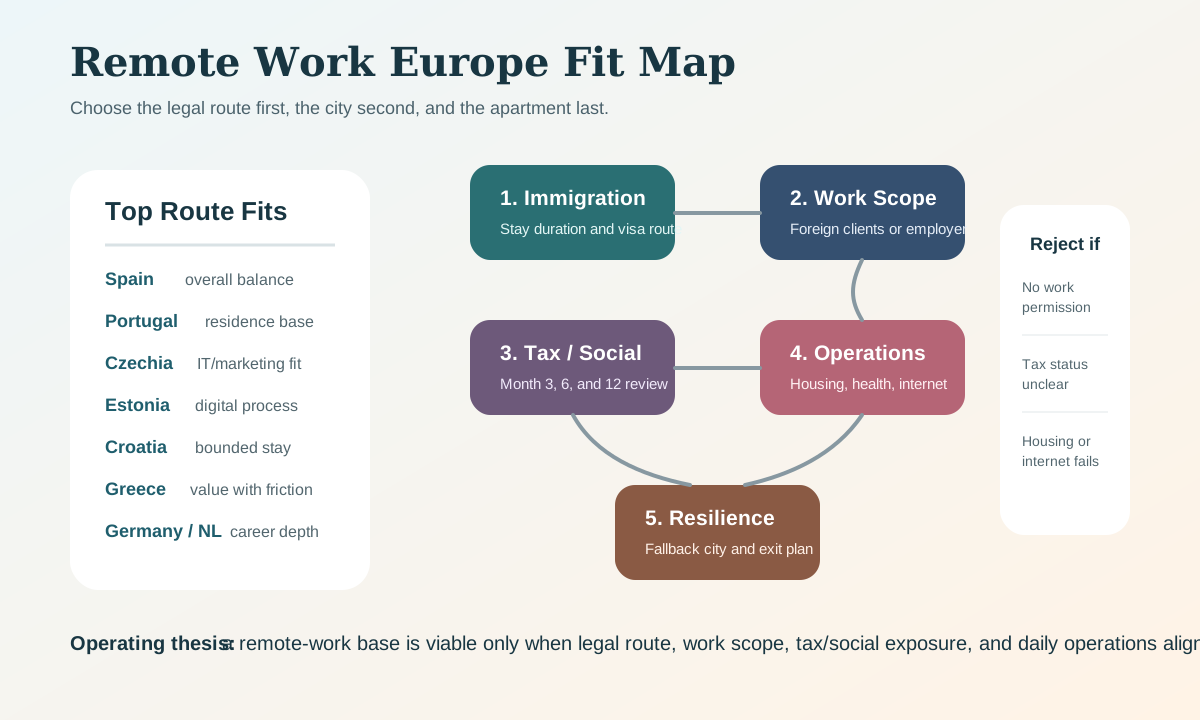
The best place in Europe for remote work is not the city with the prettiest laptop photo. It is the place where your right to stay, right to work remotely, tax position, social-security exposure, housing budget, health coverage, internet redundancy, and daily life all hold together after the first month.
For many non-EU remote workers, Spain is the strongest all-around first choice in 2026 because it combines a mature telework route, large city options, infrastructure depth, and practical lifestyle variety. Portugal remains a top alternative for remote workers who meet its income and residence requirements. Croatia is compelling for a bounded stay. Estonia is best for process-driven operators. Czechia is underrated for eligible IT and marketing specialists. Greece is attractive but requires careful housing, tax, healthcare, and heat-season planning.
For EU citizens, the analysis changes: free movement makes legal entry easier, but tax residence, social security, employer compliance, registration, and housing constraints still matter.
This guide is general information, not immigration, tax, employment, social-security, or legal advice. Verify requirements with official authorities and qualified advisers before moving.
Fast Ranking by Use Case
| Rank | Best fit | Best for | Main caution |
|---|---|---|---|
| 1 | Spain | Best overall balance for many non-EU remote workers | Consulate-specific document expectations and tax review |
| 2 | Portugal | Remote workers seeking residence continuity and Atlantic lifestyle | Housing pressure in Lisbon/Porto and processing friction |
| 3 | Czechia | Eligible IT and marketing specialists who want Central Europe value | Program eligibility is narrower than generic "digital nomad" marketing suggests |
| 4 | Estonia | Digital operators who value administrative clarity | Climate, smaller market, and income threshold |
| 5 | Croatia | Bounded coastal or city stay | Seasonal housing and limited long-term continuity |
| 6 | Greece | Mediterranean life and strong-income remote workers | Bureaucratic variation, housing quality, and summer heat |
| 7 | Germany | Career ecosystem, stability, family infrastructure | Cost, bureaucracy, and no simple generic digital nomad visa |
| 8 | Netherlands | English-friendly business ecosystem | Housing scarcity and high cost |
The Decision Rule
A place is viable only when five layers are green.
| Layer | Question |
|---|---|
| Immigration | Can you legally stay for the intended duration? |
| Work authorization | Does the route permit your actual remote-work model? |
| Tax and social security | What happens at month 3, month 6, and month 12? |
| Operations | Can you secure housing, healthcare, banking, school access, and internet? |
| Resilience | What is the fallback if the permit, lease, employer, or client situation changes? |
A sunny city with a weak legal route is not a remote-work base. It is a vacation with compliance risk.
Core Legal Context
EU citizens have broad rights to move and reside in other EU countries, but stays longer than three months may require residence registration and evidence of work, self-employment, sufficient resources, or health insurance. See Your Europe: residence rights.
For non-EU citizens, short Schengen stays are generally limited to 90 days in any 180-day period unless a national visa or residence permit applies. The EU's Entry/Exit System FAQ states that EES changes nothing about the short-stay rule and that the 90/180-day limit continues to apply. See EU Entry/Exit System FAQ and the Commission's short-stay calculator.
Tax residence must be analyzed separately. Your Europe explains that tax obligations abroad depend on national rules and personal/economic ties; treaty concepts are useful but not automatic safe harbors. See Your Europe: income taxes abroad. Social security is also separate from immigration. EU coordination depends on where and how work is performed. See European Commission: which social security rules apply.
Infrastructure and Housing Evidence
Remote work lives or dies at the neighborhood level, but official EU data gives useful macro signals.
The European Commission's 2025 broadband coverage study covers 31 countries and examines technologies including FTTP, 5G, VDSL2, DOCSIS, and satellite, with national and rural data. See Digital Decade 2025: broadband coverage in Europe 2024.
Eurostat's 2025 housing publication reports that, on average in 2024, EU households spent 19% of disposable income on housing and that the housing-cost overburden rate measures households spending more than 40% of disposable income on housing. See Eurostat: Housing in Europe 2025 edition.
The conclusion is practical: do not choose by national averages alone. Choose by exact address, lease quality, internet installation, mobile backup, healthcare access, workspace cooling/heating, registration possibility, and tax status.
Country Comparison Table
| Country | Remote-work route clarity | Infrastructure | Housing pressure | Family readiness | Best city pattern | Overall fit |
|---|---|---|---|---|---|---|
| Spain | 5 | 5 | 3 | 5 | Valencia, Madrid, Barcelona, Malaga, Bilbao | 4.6 |
| Portugal | 5 | 4 | 3 | 4 | Porto, Braga, Lisbon outskirts, Madeira, Coimbra | 4.3 |
| Czechia | 4 | 4 | 4 | 4 | Prague, Brno | 4.1 |
| Estonia | 5 | 4 | 3 | 3 | Tallinn, Tartu | 3.9 |
| Croatia | 4 | 3 | 4 | 3 | Zagreb, Split off-season, Rijeka, Zadar | 3.8 |
| Greece | 4 | 3 | 3 | 3 | Athens, Thessaloniki, Chania, Heraklion | 3.7 |
| Germany | 3 | 5 | 2 | 5 | Berlin, Hamburg, Munich, Leipzig | 3.6 |
| Netherlands | 3 | 5 | 1 | 4 | Amsterdam, Utrecht, Eindhoven, Rotterdam | 3.4 |
Scores reflect remote-work practicality, not tourism appeal.
1. Spain: Best Overall for Many Remote Workers
Spain is the strongest default recommendation for many non-EU remote workers because it offers a specific international telework route, strong urban infrastructure, excellent rail and air connectivity, and multiple city types.
Spanish official guidance describes the international telework route as covering foreigners who carry out remote work or professional activity for companies outside Spain through computer, telematics, and telecommunications systems. Official Spanish material also states that, for professional activity, work for Spanish companies is allowed only if it does not exceed 20% of total professional activity. See Spain PRIE: international teleworkers and Spain consular telework visa guidance.
| City | Best for | Watchpoint |
|---|---|---|
| Valencia | Best overall lifestyle/cost/infrastructure balance | Housing competition has risen |
| Madrid | Business access, flights, Spanish-language immersion | Heat, rent, and big-city pace |
| Barcelona | International community and creative industries | Housing cost and local regulation |
| Malaga | Climate, airport, tech momentum | Seasonal pressure |
| Bilbao | Quality of life and infrastructure | Wetter climate and smaller nomad scene |
Spain is best if you want a real base rather than a short experiment.
2. Portugal: Best Alternative for Residence-Oriented Remote Workers
Portugal remains one of Europe's leading remote-work destinations because of language accessibility, Atlantic lifestyle, safety, expat infrastructure, and residence pathways.
AIMA's remote-work residence page covers authorization for professional activity performed remotely outside Portugal and lists required documents such as a valid passport, valid remote-work residence visa, and declaration proving employment or service provision for an entity outside Portugal. See AIMA: remote professional activity residence authorization.
| City | Best for | Watchpoint |
|---|---|---|
| Porto | Balanced city life, culture, flights | Rising rents |
| Braga | Lower cost, quieter base | Smaller international network |
| Lisbon outskirts | Access to capital without central rent | Commute and lease quality |
| Madeira | Remote-work community and island life | Island logistics |
| Coimbra | Students, calmer pace, lower cost | Smaller job and startup ecosystem |
Portugal is strongest for workers who can document income cleanly and who do not need the lowest possible rent in Lisbon or Porto.
3. Czechia: Best Underrated Central Europe Base
Czechia is compelling for remote workers who want Central Europe, good transport, strong urban life, and a more grounded cost profile than Amsterdam, Munich, or Paris.
CzechInvest describes the Digital Nomad Program as covering highly skilled IT or marketing specialists from specified countries who work remotely either for a foreign employer, through their own company outside Czechia, or as self-employed persons. See CzechInvest: Digital Nomad Program.
| City | Best for | Watchpoint |
|---|---|---|
| Prague | International access, beauty, infrastructure | Central rent and tourism pressure |
| Brno | Tech, students, calmer cost profile | Smaller airport and international scene |
| Ostrava | Lower cost and space | Less obvious for first-time movers |
Czechia is best for people who match the route, not for anyone assuming "digital nomad visa" means broad eligibility.
4. Estonia: Best for Digitally Disciplined Operators
Estonia is excellent for remote workers who value administrative clarity, digital services, and a compact environment.
Estonia's e-Residency materials distinguish e-Residency from the Digital Nomad Visa. E-Residency does not grant immigration rights, while the Digital Nomad Visa is for remote workers who can work independently of location and meet a minimum threshold of EUR 4,500 net monthly income. See Estonia e-Residency vs. Digital Nomad Visa and Estonia e-Residency knowledge base.
| City | Best for | Watchpoint |
|---|---|---|
| Tallinn | Digital infrastructure, startup culture, airport | Winter and smaller market |
| Tartu | Academic and quieter lifestyle | Fewer international flights |
Estonia is not the cheapest or warmest answer. It is the clean-process answer.
5. Croatia: Best for a Bounded Coastal or City Stay
Croatia is attractive for remote workers who want a defined stay, coastal life, and a softer cost profile than Western European capitals.
Croatia's Ministry of the Interior states that digital nomad temporary stay is for third-country nationals who work through communication technology for a foreign company or their own company not registered in Croatia and do not provide services to employers in Croatia. It also states that subsistence means are tied to 2.5 average monthly net salaries paid for the previous year, according to official statistics. See Croatia Ministry of the Interior: temporary stay of digital nomads.
| City | Best for | Watchpoint |
|---|---|---|
| Zagreb | Year-round practicality | Less coastal romance |
| Split | Coastal life and community | Summer prices and tourist pressure |
| Rijeka | Port-city affordability | Smaller remote-work ecosystem |
| Zadar | Lifestyle and access | Seasonal housing |
Croatia is best when the stay is planned as a defined chapter, not when you need an obvious long-term residence ladder.
6. Greece: Best Mediterranean Value if You Can Manage Friction
Greece offers beauty, food, history, islands, and major lifestyle upside, but it requires more operational caution than glossy nomad lists admit.
Greek Ministry of Foreign Affairs material states that non-EU self-employed workers, freelancers, or employees based outside Greece may apply for a long-term national visa for remote work and references evidence of steady income. See Greek Ministry of Foreign Affairs: Digital Nomad Visa.
| City | Best for | Watchpoint |
|---|---|---|
| Athens | Culture, flights, services | Heat, traffic, uneven housing quality |
| Thessaloniki | Food, walkability, student energy | Smaller international flight network |
| Chania | Island lifestyle | Seasonal rents and logistics |
| Heraklion | Crete infrastructure | Summer pressure |
Greece rewards experienced remote workers who can tolerate bureaucracy and pre-check apartment cooling, internet, healthcare, and tax consequences.
7. Germany: Best for Career Infrastructure, Not Simple Nomad Entry
Germany is excellent for serious career building, family life, research, engineering, enterprise sales, and long-term stability. It is not the easiest generic digital-nomad choice.
Germany's self-employment route exists, but it is not a casual remote-worker visa. See Make it in Germany: visa for self-employment.
| City | Best for | Watchpoint |
|---|---|---|
| Berlin | Startups, international life | Housing and bureaucracy |
| Hamburg | Quality of life, media, trade | Cost |
| Munich | Enterprise, engineering, salaries | Very high rent |
| Leipzig | Lower cost, creative scene | Smaller international economy |
Germany is best when your work model benefits from the German market itself or from German institutional depth.
8. Netherlands: Best for English-Friendly Business, Weak for Housing
The Netherlands is one of Europe's easiest countries for English-language professional life, but housing pressure makes it hard to recommend as a default remote-work base.
The Dutch self-employed residence route is formal and points-based rather than a broad digital nomad visa. See Netherlands IND: residence permit for self-employed person.
| City | Best for | Watchpoint |
|---|---|---|
| Amsterdam | International business and culture | Severe housing pressure |
| Rotterdam | Modern city, port economy | Rising rent |
| Utrecht | Central, livable, educated | Scarce housing |
| Eindhoven | Tech and design | Smaller lifestyle scene |
Choose the Netherlands for strategic business reasons, not because it is easy.
The Best City Shortlist
| Profile | Best city | Why |
|---|---|---|
| Best all-around first base | Valencia | Infrastructure, livability, airport access, relative value |
| Best Atlantic alternative | Porto | Culture, flights, strong remote-worker fit |
| Best Central Europe value | Brno | Tech, lower pressure than Prague, strong quality of life |
| Best digital-administration fit | Tallinn | Estonia's digital ecosystem and compact operating environment |
| Best bounded coastal stay | Split off-season | Beautiful and workable outside peak summer |
| Best serious career ecosystem | Berlin | Network density and international culture |
| Best high-income business ecosystem | Amsterdam | English-friendly and commercially dense, if housing is solved |
| Best Mediterranean lower-friction city | Thessaloniki | Urban life without Athens scale |
Remote-Work Risk Matrix
| Risk | Where it appears | Control |
|---|---|---|
| Visa mismatch | Applying under the wrong route | Get written route confirmation before signing a lease |
| Employer compliance | Employees working abroad without payroll review | Ask employer for written remote-work authorization |
| Tax drift | Staying past month 6 without analysis | Run tax-residence review before arrival and at month 5 |
| Social-security error | EU cross-border or multi-country work | Confirm applicable system and certificates where needed |
| Housing shock | Lisbon, Amsterdam, Barcelona, Munich, Athens | Secure lease evidence before committing |
| Internet mismatch | Rural or island areas | Test fixed-line provider and mobile backup before move |
| Healthcare delay | Families and chronic conditions | Confirm insurance and registration process before arrival |
| Summer climate | Southern Europe | Verify air conditioning and workspace cooling |
| Winter climate | Baltics and Central Europe | Budget for heating, daylight, and coworking |
A Practical 90-Day Validation Plan
| Timing | Action |
|---|---|
| Day -60 | Confirm legal route, income proof, passport validity, health insurance, and criminal-record document needs |
| Day -45 | Build tax and social-security memo with a qualified adviser if staying beyond a short visit |
| Day -30 | Secure housing with written internet details, cancellation terms, and registration ability |
| Day -14 | Test banking, cards, VPN, employer device policy, and backup SIM |
| Day 1-7 | Confirm workspace, neighborhood noise, commute, grocery access, and mobile signal |
| Day 30 | Compare real monthly cost to forecast |
| Day 60 | Decide whether to extend, switch city, or exit |
| Day 75 | Start renewal or next-country paperwork if needed |
FAQ
What is the best place in Europe for remote work?
Spain is the best overall answer for many non-EU remote workers because it combines a specific telework route, strong infrastructure, multiple livable cities, and practical year-round depth. Portugal, Czechia, Estonia, Croatia, and Greece may be better depending on income, profession, family status, and desired stay length.
What is the best city in Europe for remote workers?
Valencia is one of the strongest all-around city choices because it offers urban life, beach access, infrastructure, airport connections, and a more manageable scale than Madrid or Barcelona. Porto, Brno, Tallinn, and Thessaloniki are strong profile-specific choices.
Can I work remotely in Europe on a tourist stay?
Do not assume that. Immigration, tax, employment, and social-security rules are separate. Short tourist stays do not automatically authorize every remote-work arrangement, especially if you stay long, serve local clients, or create employer compliance issues.
Is Portugal or Spain better for digital nomads?
Spain is stronger for many applicants who want a large-country base with multiple city options. Portugal is excellent for applicants who meet the remote-work residence requirements and prefer Portuguese lifestyle, Atlantic climate, and a smaller-country feel.
Is Europe cheap for remote work?
Not universally. Greece, Portugal, Croatia, and Czechia can be cost-effective outside the hottest neighborhoods, but housing pressure has changed the equation. Amsterdam, Munich, central Lisbon, Barcelona, and similar markets can erase salary advantages quickly.
What should U.S. remote workers check first?
Check employer permission, visa eligibility, tax residence, state tax exposure, health insurance, Social Security/totalization issues, data security policy, and whether your income documentation matches the visa route.
Source Stack
- Your Europe: residence rights
- EU Entry/Exit System FAQ
- European Commission: short-stay calculator
- Your Europe: income taxes abroad
- European Commission: social-security rules
- Digital Decade 2025 broadband coverage in Europe 2024
- Eurostat Housing in Europe 2025
- Spain PRIE: international teleworkers
- Portugal AIMA: remote professional activity
- CzechInvest Digital Nomad Program
- Estonia Digital Nomad Visa vs e-Residency
- Croatia temporary stay of digital nomads
- Greece Digital Nomad Visa
- Germany self-employment visa guidance
- Netherlands self-employed residence permit
Final Checklist
- Confirm whether you are analyzing as an EU citizen or non-EU citizen.
- Do not treat Schengen 90/180 travel permission as a remote-work residence plan.
- Choose the legal route before choosing the city.
- Run tax and social-security analysis before month 6.
- Secure housing that supports registration where required.
- Verify fixed internet and mobile backup at the exact address.
- Keep employer or client remote-work authorization in writing.
- Budget for deposits, translations, apostilles, insurance, coworking, and legal help.
- Maintain a fallback city and fallback country.
- Review the plan at day 30, day 60, and before any renewal deadline.
The best place in Europe for remote work is the place where the paperwork and the daily life agree. Choose the route first, the city second, and the apartment last.