Last updated
Health Insurance for Expats in France: PUMa, S1, Mutuelle and Documents
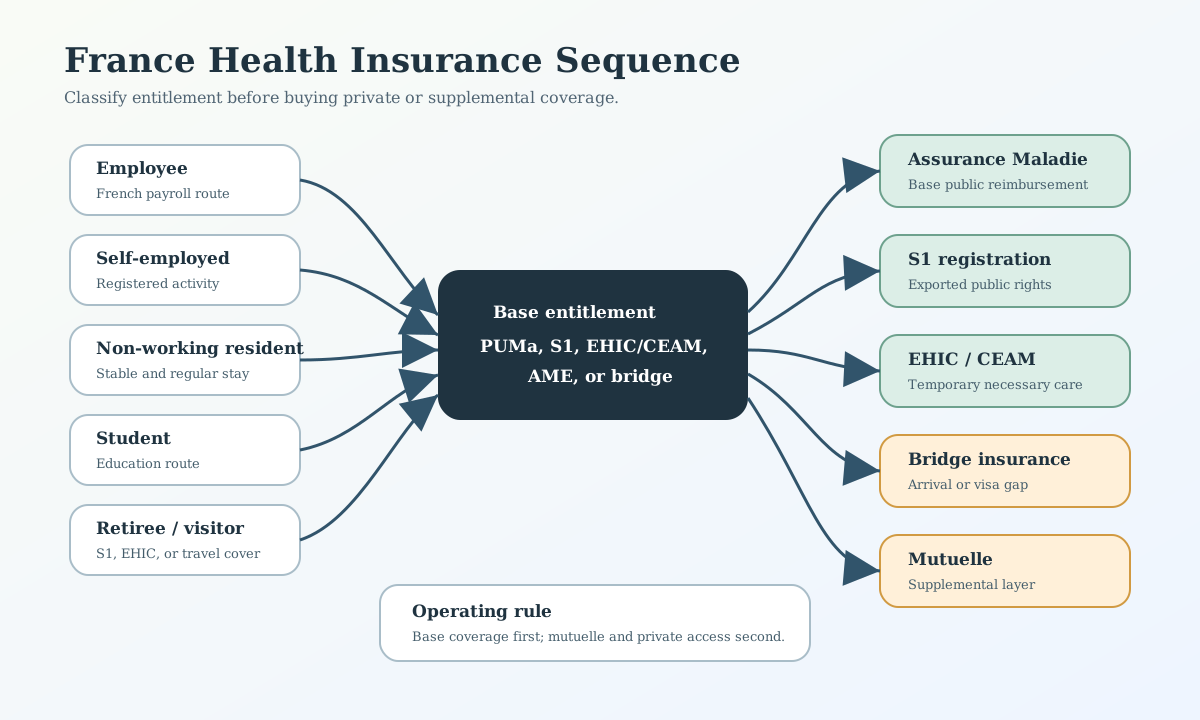
Health insurance in France for expats is easier to understand once you stop treating it as a simple price comparison. The real question is which route applies to your situation, such as work, self-employment, stable residence, student status, S1 portability, or interim private cover. This page helps readers map those routes, understand where mutuelle fits, and prepare the documents and timing issues that matter before registration, reimbursements, or a move. It is written for people trying to make an organized start rather than guess their way through the system.
The correct order is:
- Identify your legal basis for coverage.
- Prove your residence, work, student, retiree, or portability status.
- Register with the right French or cross-border institution.
- Use private insurance only where it has a defined role: visa evidence, bridge coverage, supplemental mutuelle, or private-care access.
France's core rule is PUMa, the protection universelle maladie. Ameli states that anyone who works or resides in France in a stable and regular manner has the right to coverage of health costs. See Ameli: protection universelle maladie.
Last source check: June 3, 2026.
Quick answer
Most expats in France need one of these coverage routes. Start by matching your status, then build the document file for that route before comparing private policies.
| Profile | Likely base route | Private insurance role |
|---|---|---|
| Employee in France | French Assurance Maladie through work | Supplemental mutuelle; possibly employer plan |
| Self-employed person in France | French Assurance Maladie through activity | Supplemental mutuelle |
| Non-working resident | PUMa after stable and regular residence conditions are met | Visa/bridge coverage, then mutuelle |
| Long-stay visitor | Private medical cover may be needed for visa and early stay | Bridge coverage until eligible route is clear |
| Student | French student social-security registration or EHIC/other route depending on status | Student mutuelle or top-up |
| EU/EEA/Swiss retiree with S1 | S1 registered in France | Mutuelle for residual costs |
| Short-stay visitor | EHIC/CEAM if eligible, or travel medical insurance | Travel insurance only |
| Person without regular residence | AME may apply if conditions are met | Emergency/private coverage may still matter |
Related planning guides: first month in Europe expat checklist, documents needed for private health insurance in Europe, can I buy health insurance privately in Europe, and cross-border worker health insurance.
The French system in plain English
France has a public health-insurance system, usually called Assurance Maladie. PUMa is the principle that lets people who work or reside in France stably and regularly have their health costs covered on a personal and continuous basis.
The system usually has three layers:
| Layer | French term | What it does |
|---|---|---|
| Base public coverage | Assurance Maladie / PUMa | Reimburses eligible medical costs under French rules |
| Supplemental coverage | Mutuelle / complementaire sante | Covers part or all of the remaining out-of-pocket amount |
| Private access layer | Private insurance or direct payment | May support private hospitals, international networks, or transition gaps |
A common expat mistake is buying the third layer before proving the first layer.
Legal context: who enters which route?
If you work in France
If you come to work in France as an expatriate worker, Ameli states that you are attached to French Assurance Maladie and no longer rely on your origin country's social protection, subject to family conditions and special cases. See Ameli: worker expatriated in France.
For employees, Ameli also states that employees are mandatorily attached to the general social-security regime and affiliated with the health-insurance fund for their place of residence. See Ameli: employee coverage.
Practical meaning: if you are employed in France, private insurance is usually not a replacement for French payroll or social-security affiliation.
If you are self-employed in France
PUMa covers workers, including self-employed people, from the start of professional activity according to Ameli's PUMa guidance. This can include artisans, merchants, liberal professionals, and micro-entrepreneurs if properly registered.
Practical meaning: your business registration, professional status, and social contributions matter more than a private policy.
If you are a non-working resident
Service-Public explains that without professional activity, once in France you generally wait three months before rights are opened, while some people are exempt from that waiting condition. See Service-Public: Universal Health Protection.
Practical meaning: non-working expats should expect a transition period and should not arrive without bridge coverage.
If you are a student
Ameli provides dedicated guidance for students and foreign students. Foreign students who register in French higher education may need to complete the French social-security registration process, while EU/EEA/Swiss students may have different options depending on EHIC/CEAM and employment status. See Ameli: student medical expenditure coverage and Ameli: foreign student in France.
Practical meaning: students should follow the student route, not a generic expat-insurance route.
If you are retired and have S1 rights
EU social-security coordination may allow retirees and some cross-border cases to register an S1 form in France. Your Europe explains that pensioners who do not receive a pension from the country where they live may need an S1 from the country paying the pension. See Your Europe: health insurance cover in host country.
CLEISS is the specialist French body for international social-security coordination. See CLEISS: S1 information.
Practical meaning: S1 is not private insurance. It is a public coordination document.
If you are a short-stay visitor
Short-stay visitors are not moving into the French resident system. Depending on nationality and status, they may rely on EHIC/CEAM, bilateral arrangements, or travel insurance. See Service-Public: health insurance for a foreigner on holiday or short stay in France.
Practical meaning: travel medical insurance is not a long-term resident healthcare plan.
Decision matrix
| Question | If yes | If no |
|---|---|---|
| Are you working in France? | Start with French social-security/Assurance Maladie affiliation | Test residence, student, S1, or private bridge route |
| Are you self-employed in France? | Register activity and health rights through French systems | Do not assume private insurance solves work status |
| Are you an EU/EEA/Swiss/UK-linked retiree with public pension rights? | Investigate S1 | Use PUMa/private/visa route depending on status |
| Are you a non-working long-stay resident? | Plan for PUMa timing and bridge insurance | Use visitor/student/worker logic instead |
| Are you only visiting temporarily? | Use EHIC/CEAM or travel insurance | Resident rules may apply |
| Do you already have Assurance Maladie rights? | Compare mutuelle options | Do not buy top-up before base status is clear |
| Do you have chronic prescriptions? | Build a continuity plan before arrival | Still identify emergency and primary-care route |
What private insurance can and cannot do in France
| Private insurance role | Useful? | Notes |
|---|---|---|
| Visa medical cover | Yes | France-Visas may require proof of medical cover for some long-stay visitor situations |
| Arrival bridge coverage | Yes | Useful before PUMa or S1 registration is active |
| Full substitute for French public coverage | Usually no | If you are required or entitled to French coverage, private insurance is usually supplemental |
| Mutuelle or top-up | Yes | Common after base rights are open |
| Private hospital or international network access | Yes | Useful for comfort, language, and speed |
| Payroll or social-security replacement | No | Private insurance does not cancel French employer or contribution duties |
| EHIC replacement | No | EHIC/CEAM is a public coordination tool for temporary stays |
France-Visas states that long-stay visitors must prove resources, accommodation, medical cover in France, and agree not to work. See France-Visas: tourist or private visit.
Registration workflow for expats
Step 1: classify your route
Choose one primary route:
| Route | Trigger |
|---|---|
| Employee | French employment contract or payroll |
| Self-employed | Registered French activity |
| Non-working resident | Stable and regular residence |
| Student | French higher-education enrollment |
| S1 holder | Public healthcare rights exported from another country |
| Short-stay visitor | Temporary stay only |
| AME | No regular residence but eligible under social-access rules |
Step 2: build your document file
Typical documents may include:
| Document | Why it matters |
|---|---|
| Passport or national ID | Identity |
| Visa or residence permit | Regularity of stay |
| Birth certificate | Social-security number verification |
| Proof of address in France | Residence |
| Employment contract or business registration | Activity route |
| School enrollment certificate | Student route |
| S1 form | Cross-border or retiree coordination |
| Bank details/RIB | Reimbursements |
| Prior health-coverage proof | Continuity and coordination |
| Marriage/birth documents for family | Dependent or family processing |
| Certified translations | French administration may require them |
Ameli explains the process for people born abroad requesting a French social-security number and refers to the S1106 opening-rights form and supporting documents. See Ameli: born abroad and requesting a social-security number.
Step 3: submit to the right health-insurance fund
Most people deal with CPAM, the local primary health-insurance fund. Some agricultural workers may use MSA. Special cases can involve Paris CPAM or other designated handling.
Step 4: use the temporary number carefully
People born abroad may first receive a temporary identification number before final registration. Do not treat the process as complete until rights, reimbursement, and account access are operational.
Step 5: create the operating layer
Once base rights are active:
- Create or access your Ameli account when eligible.
- Order or update your Carte Vitale.
- Choose a medecin traitant when appropriate.
- Test reimbursement with a routine consultation.
- Decide whether a mutuelle is needed.
- Store all submissions and decisions as PDFs.
Mutuelle: when supplemental insurance makes sense
French public insurance typically reimburses part of covered costs based on official rates. A mutuelle can cover some or all of the remaining amount depending on the contract.
A mutuelle is especially relevant for:
| Need | Why mutuelle matters |
|---|---|
| Dental care | Public reimbursement may leave meaningful out-of-pocket costs |
| Optical care | Glasses and lenses can create residual cost |
| Hospitalization | Private room and comfort charges may not be fully covered |
| Frequent specialist care | Copays and fee overruns can add up |
| Family coverage | Children and spouse costs can compound |
| Chronic-care management | Predictable recurring costs should be modeled |
Service-Public explains that complementary health insurance covers expenses remaining after health-insurance reimbursement, and that Complémentaire santé solidaire is available under residence and resource conditions. See Service-Public: complementary health and mutuelle.
Cost and risk model
Build a 12-month model with three categories:
| Category | Examples | Control |
|---|---|---|
| Mandatory or system cost | Social contributions, payroll-linked coverage, public insurance rules | Confirm with payroll/accountant |
| Residual medical cost | Copays, dental, optical, specialists, private rooms | Compare mutuelle options |
| Transition risk | Waiting period, delayed social-security number, prescription gaps | Buy bridge cover and carry records |
Risk scoring
Score each item from 0 to 2:
| Risk item | 0 | 1 | 2 |
|---|---|---|---|
| Legal route identified | No | Maybe | Yes |
| Residence/work evidence ready | No | Partial | Complete |
| Bridge insurance active | No | Partial | Yes |
| CPAM submission prepared | No | Partial | Complete |
| Chronic prescriptions translated | No | Partial | Complete |
| Family documents ready | No | Partial | Complete |
| Mutuelle need modeled | No | Partial | Complete |
| Doctor/pharmacy identified | No | Partial | Yes |
| Score | Meaning |
|---|---|
| 0-6 | High vulnerability |
| 7-11 | Manageable but incomplete |
| 12-16 | Operationally ready |
90-day implementation roadmap
| Timing | Task |
|---|---|
| Before arrival | Confirm visa/residence category, buy bridge coverage if needed, translate key medical records |
| Days 1-15 | Secure address proof, organize documents, confirm CPAM/MSA route |
| Days 16-30 | Submit opening-rights file or validate employer/student/S1 route |
| Days 31-45 | Establish doctor/pharmacy plan; refill prescriptions conservatively |
| Days 46-60 | Track temporary number, missing-document requests, and reimbursements |
| Days 61-75 | Compare mutuelle if base rights are active or near active |
| Days 76-90 | Test reimbursement workflow and close document gaps |
Special cases
Digital nomads and remote workers
France does not have the same digital-nomad positioning as Portugal or Spain. A remote worker's health-insurance outcome depends on the actual visa/residence category, whether they perform work in France, employer structure, social-security coordination, and tax residence.
Do not assume that foreign payroll plus private insurance is enough.
U.S. citizens
Americans must handle French healthcare separately from U.S. tax compliance. U.S. citizens living abroad generally remain subject to U.S. tax filing on worldwide income. See IRS Publication 54.
This matters because French residence, healthcare, and tax timelines can interact with U.S. foreign earned income exclusion, foreign tax credit, and bank-reporting decisions.
Families
Each family member needs status validation. A spouse's or child's coverage may not automatically follow the principal applicant in every case or at the same speed.
Build a family matrix:
| Person | Status | Base route | Documents missing | Bridge coverage | Mutuelle need |
|---|---|---|---|---|---|
| Applicant | |||||
| Spouse/partner | |||||
| Child 1 | |||||
| Child 2 |
Chronic conditions and medication
Before arrival:
- Bring medical summaries in English and, if possible, French.
- Carry generic medication names, not only U.S. brand names.
- Confirm whether medication is available in France.
- Plan refills for the transition period.
- Identify a local general practitioner and relevant specialist.
FAQ
Do expats get free healthcare in France?
Not exactly. France has public health coverage, but it is funded through taxes and social contributions, and reimbursements follow French rules. You may still pay upfront, owe copays, or need a mutuelle.
Can I use private health insurance instead of French social security?
Usually not if French law requires or entitles you to Assurance Maladie through work or residence. Private insurance is normally a bridge, visa tool, or supplemental layer.
How long does it take to get French health insurance?
It depends on your route, documents, and local processing. Workers may be attached through employment; non-working residents often need to satisfy residence conditions. Plan for a transition period rather than assuming immediate full operation.
What is PUMa?
PUMa is France's universal health protection principle. It gives people who work or reside in France stably and regularly a right to coverage of health costs on a personal and continuous basis.
What is a Carte Vitale?
The Carte Vitale is the French health-insurance card used to transmit information for reimbursements. It is not the legal basis of rights by itself; it is an operating tool after registration.
What is a mutuelle?
A mutuelle is supplemental health insurance that helps cover costs left after French public reimbursement. Many expats should consider one after base coverage is confirmed.
Do retirees need private insurance?
Retirees may need private insurance for a visa or transition period, but EU/EEA/Swiss/UK-linked retirees should check S1 rights if applicable. Other retirees should validate PUMa and long-stay visitor requirements.
Can students use French health insurance?
Many international students can register through the French student process, while EU/EEA/Swiss students may use EHIC/CEAM depending on status. Student employment can change the analysis.
Factual uncertainty and source risks
| Risk | Practical consequence |
|---|---|
| CPAM processing varies by department and case | Keep bridge coverage and document every submission |
| France-Visas requirements vary by visa category and consular jurisdiction | Use the exact checklist for your route |
| Automatically translated pages may simplify French legal wording | French-language official text should control if wording conflicts |
| S1 eligibility depends on the issuing country | Confirm with the pension or health authority before relying on it |
| Private insurer marketing is not legal entitlement proof | Treat insurer certificates as evidence only for the authority that accepts them |
| U.S. citizens have separate tax obligations | Health registration is not tax-residence advice |
First 90 Days After Arrival
The first 90 days in France should be managed as a transition file. Expats often arrive with private insurance, employer documents, a visa, a lease, and partial understanding of the French public system. The practical risk is assuming that one document solves every stage. It rarely does.
| Timing | Action | Evidence to keep |
|---|---|---|
| Arrival week | Confirm whether the current policy is bridge, visa, public, or supplemental cover | Certificate, policy schedule, visa checklist |
| First month | Identify the CPAM or student/employer route | Official instructions and submission receipt |
| First month | Collect identity, residence, employment, student, or family documents | Passport, permit, lease, contract, enrollment |
| Days 30 to 60 | Submit or follow up on French registration where applicable | Dated submission record |
| Days 60 to 90 | Compare mutuelle needs after base route is clearer | Reimbursement examples and quote documents |
| Before bridge expiry | Confirm replacement cover is active | Written public or private confirmation |
Do not cancel bridge or private cover just because a public-system application has been submitted. Wait until coverage is confirmed and you understand how care will be reimbursed.
Document Packet for France
Prepare a practical packet before applying or renewing.
| Document | Why it matters |
|---|---|
| Passport or national ID | Identity |
| Visa, residence permit, or application receipt | Legal status |
| Birth certificate if requested | French administration may request civil-status evidence |
| Lease or accommodation certificate | Residence and local CPAM context |
| Employment contract or payslips | Worker route |
| Student enrollment | Student route |
| S1, EHIC, or prior public cover evidence | EU coordination or temporary coverage context |
| Private insurance certificate | Visa, bridge, or supplemental proof |
| RIB or bank details | Reimbursement setup |
If a document is foreign-language, ask whether translation is required before submitting. Keep originals, translations, and submission receipts together.
Mutuelle Decision Framework
A mutuelle should be compared after the base route is understood. It is not a substitute for the public route when the public route applies.
| Need | Mutuelle question |
|---|---|
| Routine doctor visits | What copayments remain after public reimbursement? |
| Dental | Are crowns, orthodontics, and implants meaningfully covered? |
| Optical | What glasses and lens limits apply? |
| Hospital | Is private room coverage included? |
| Specialists | Are dépassements d'honoraires covered and at what level? |
| Family | Are children and spouse priced separately? |
| Chronic care | Does the plan help with recurring uncovered expenses? |
The cheapest mutuelle can be sufficient for a healthy single person with low expected use, but weak for families, dental work, specialists, or hospital comfort. Compare annual premium plus expected remaining charges.
When to Escalate
Escalate to an adviser, CPAM, employer, university, insurer, or official help channel if:
- the CPAM file is stuck without clear reason;
- private insurance is expiring before public registration is active;
- family members are not recognized;
- medication or chronic care must continue immediately;
- a foreign document is rejected;
- you are both working remotely and residing in France;
- the case involves S1, posted work, cross-border employment, or U.S. tax complications.
The goal is continuity. France has a strong health system, but administrative sequencing still matters.
Practical Review Before Cancelling Any Policy
Before cancelling travel, private, student, employer, or supplemental cover, run a final continuity review.
| Question | Why it matters |
|---|---|
| Do I have written confirmation that the replacement route is active? | A submitted application is not the same as active coverage. |
| Does the confirmation name every covered family member? | Dependants can be missed when only the main applicant is registered. |
| Is the start date before or equal to the old policy end date? | A one-day gap can matter during illness, hospitalization, or administration. |
| Do I know how reimbursement will work before receiving a final card? | Some systems use provisional numbers, paper claims, or later reimbursement. |
| Does the policy cover the care I expect to need in the next 90 days? | Dental, maternity, mental health, and chronic medication may require special review. |
| Have I stored the cancellation proof and replacement certificate? | Future offices may ask why there was no gap. |
The safest operational rule is to keep the old proof until the new proof is active in writing and the next reviewer has accepted it. This can feel redundant, but it prevents the most expensive failure: being technically insured somewhere while the doctor, university, employer, or residence office cannot verify the document they need.
Sources
- Ameli: protection universelle maladie
- Service-Public: Universal Health Protection
- Ameli: worker expatriated in France
- Ameli: employee coverage
- Ameli: born abroad and requesting a social-security number
- Ameli: student medical expenditure coverage
- Ameli: foreign student in France
- Service-Public: health insurance for a foreigner on holiday or short stay in France
- Service-Public: complementary health and mutuelle
- France-Visas: tourist or private visit
- Your Europe: health insurance cover in host country
- CLEISS: S1 information
- IRS Publication 54: Tax Guide for U.S. Citizens and Resident Aliens Abroad