Last updated
Cost of Expat Insurance in Europe: Public, Private, and Travel Cover
Direct answer
Cost of Expat Insurance in Europe: Public, Private, and Travel Cover is for readers who need to turn a broad search result into a concrete decision. It explains matching health-insurance eligibility, public or private cover, registration evidence, and renewal risk across Europe, then shows how to separate public eligibility, private cover, emergency access, contribution rules, and the evidence needed for residence or work. The later sections connect fast answer, the first rule: insurance follows status, and public health insurance: when it is cheap, when it is not so the next step is easier to judge. Read it before submitting forms, moving money, choosing a provider, or assuming that a rule from another country applies.
Start by identifying your legal status and the institution that will review your proof. Then compare annual cost, deductible, exclusions, waiting periods, certificate wording, cancellation terms, and the cost of the worst uncovered event, not just the monthly premium.
Source-check date: May 14, 2026.
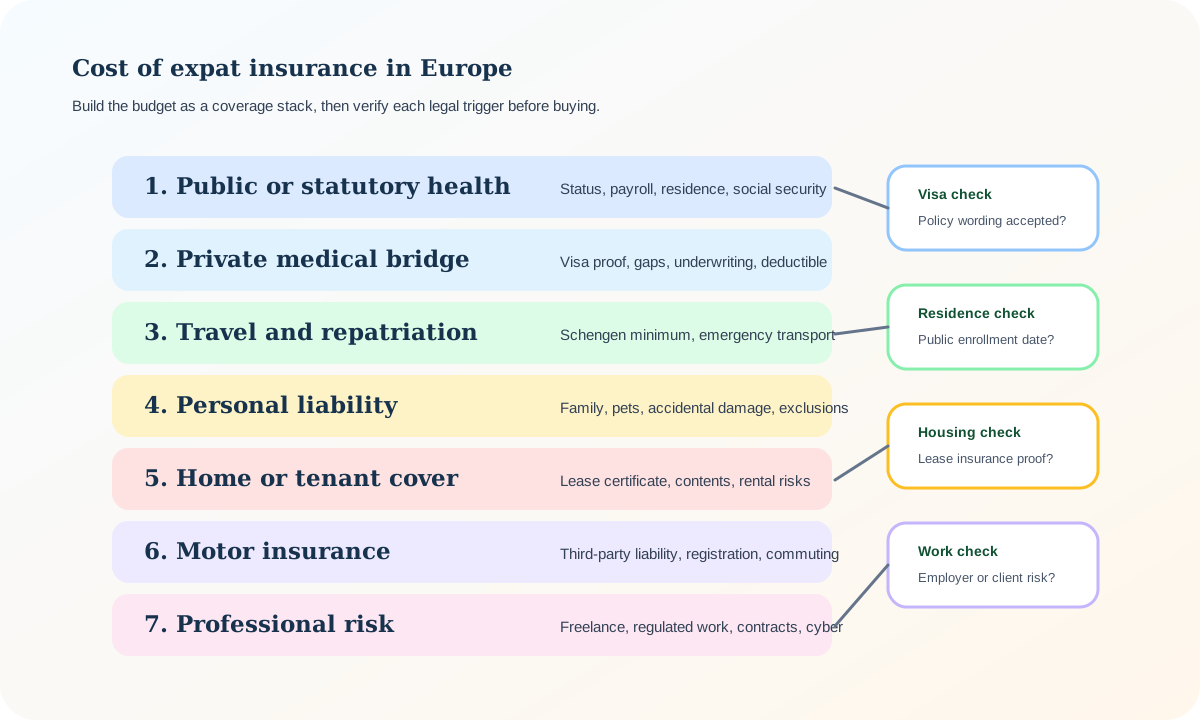
The cost of expat insurance in Europe is not one price. It is a stack of legal requirements, public entitlements, private contracts, deductibles, exclusions, and proof documents. A local employee in Germany, a retiree using an S1 form in Spain, a student in France, a digital nomad in Portugal, and a non-EU visa applicant entering the Schengen area may all need different coverage before they can live safely and legally in Europe.
The practical question is not "What is the cheapest expat insurance in Europe?" The better question is: which risks must be covered by law, which must be covered to satisfy a residence or visa process, and which remain private financial risks after public coverage starts?
This guide is educational information, not legal, tax, immigration, or insurance advice. Always confirm current rules with the competent public authority, insurer, visa office, employer, or qualified adviser before buying a policy.
Fast Answer
Most expats should budget for several insurance layers, not just one medical policy.
| Insurance layer | Why it matters | Cost driver | Verification point |
|---|---|---|---|
| Public or statutory health coverage | May be mandatory after residence, work, or enrollment | Income, payroll status, residence status, national premium rules | Confirm with the national health insurer or competent institution |
| Private medical insurance | May bridge gaps before public enrollment or satisfy visa/residence rules | Age, underwriting, country, deductible, benefits, network | Confirm that the policy is accepted for the visa or residence route |
| Travel medical insurance | Often required for short-stay visa entry and temporary travel | Trip length, age, coverage limit, exclusions | Confirm Schengen or national visa wording |
| Repatriation and evacuation cover | Not normally covered by EHIC | Destination, activity risk, medical transport limit | Confirm rescue, mountain, sea, and repatriation clauses |
| Personal liability | Protects against damage caused to others | Country, coverage limit, family members, pets | Check exclusions for work, vehicles, rentals, and children |
| Home or tenant insurance | Required or expected in many rentals | Property size, contents, building risk, liability | Check lease and local law |
| Motor insurance | Third-party liability is compulsory for registered vehicles | Vehicle, driver history, country, claims system | Confirm validity after moving or re-registering |
| Professional liability | Critical for freelancers, consultants, health, legal, tech, and regulated work | Profession, revenue, territory, contractual liability | Confirm client contract and local professional rules |
The First Rule: Insurance Follows Status
Europe has no single "expat insurance" system. Insurance obligations follow your legal and social-security position.
| Expat status | Likely baseline | Insurance mistake to avoid |
|---|---|---|
| Salaried local employee | Payroll-linked public or statutory system may apply | Buying travel insurance and assuming it replaces statutory coverage |
| Freelancer or self-employed person | Public enrollment, private coverage, or hybrid rules vary by country | Underestimating contributions, waiting periods, and proof requirements |
| Student | EHIC, student insurance, private policy, or national enrollment may apply | Using a policy that the university or residence office will not accept |
| Retiree | S1, public coverage, private top-up, or private bridge cover may apply | Assuming retirement income automatically creates local health access |
| Posted worker | Home-country social security may continue temporarily | Failing to obtain A1 or equivalent proof before the assignment |
| Cross-border commuter | Social security, health treatment, and unemployment may involve two countries | Confusing tax residence with social-security coverage |
| Digital nomad | Visa wording, tax, social security, and insurance may point in different directions | Buying a global travel policy that excludes residence, work, or long stays |
| Economically inactive resident | Comprehensive sickness insurance may be required before ordinary access | Moving first and discovering that private proof is needed for registration |
EU social-security coordination is the official starting point for people moving within the EU, EEA, and Switzerland. The European Commission explains that coordinated rules determine which country is responsible for social security when people move across borders: European Commission social security coordination.
Public Health Insurance: When It Is Cheap, When It Is Not
Public health coverage may look inexpensive compared with private international insurance, but it is not always flat-rate. It may be funded by payroll contributions, income-based contributions, residence-based premiums, taxation, co-payments, or a combination.
| Cost model | How it affects expats | Common planning issue |
|---|---|---|
| Payroll contribution | Employee and employer contributions are withheld through payroll | Easy for local employees, harder for cross-border or remote arrangements |
| Income-based self-employed contribution | Contributions depend on declared income or minimum bases | Low first-year income may not mean low contribution forever |
| Flat monthly public premium | Adult residents pay a standard or insurer-specific premium | Deductibles and co-payments still matter |
| Tax-funded access | Coverage may depend on lawful residence and local registration | Private bridge cover may be needed before eligibility is confirmed |
| Special agreement or voluntary access | Some countries offer paid public access for ineligible residents | Eligibility, waiting periods, and price bands must be checked locally |
The European Health Insurance Card is not a substitute for residence-compliant health insurance. Your Europe explains that the EHIC covers necessary public healthcare during temporary stays, but it does not cover private healthcare, planned treatment abroad, or rescue and repatriation: Your Europe health cover for temporary stays.
Private Medical Insurance Cost Categories
Private medical insurance prices vary too much for a reliable Europe-wide premium. The quote depends on age, medical history, underwriting, deductible, country of residence, hospital network, maternity cover, dental cover, outpatient coverage, cancer treatment rules, emergency evacuation, and whether the policy is local or international.
| Policy type | Best used for | Watch carefully |
|---|---|---|
| Visa-compliant private health policy | Residence applications, digital nomad visas, students, retirees, bridge periods | Must match the exact wording required by the consulate or residence office |
| Local private health insurance | Residents who opt into or are required to use private coverage | Renewal rules, age pricing, waiting periods, cancellation rights |
| International private medical insurance | Mobile families, executives, frequent movers, cross-border professionals | High premiums, exclusions, territorial limits, direct-billing availability |
| Travel medical insurance | Temporary visits and short-stay visa files | Usually not designed for ordinary residence or local primary care |
| Top-up or supplementary insurance | Dental, optical, private rooms, co-payments, faster access | Does not replace mandatory public coverage |
A good quote comparison should include the total annual cost, not just the monthly premium.
| Cost line | Why it matters |
|---|---|
| Premium | The headline monthly or annual cost |
| Deductible | Amount you pay before the insurer reimburses |
| Co-insurance | Percentage you continue paying after deductible |
| Co-payment | Fixed charge per visit, medicine, or service |
| Exclusions | Conditions or activities not covered |
| Waiting periods | Time before maternity, dental, psychiatric, or pre-existing-condition benefits apply |
| Annual limit | Maximum reimbursed per year |
| Lifetime limit | Maximum reimbursed over the policy life |
| Repatriation limit | Medical transport can be financially catastrophic without adequate cover |
| Direct billing | Determines whether you must pay first and claim later |
Schengen Visa Insurance Is a Minimum, Not a Life Plan
Short-stay Schengen visa applicants normally must show travel medical insurance that meets Schengen rules. Article 15 of the Visa Code requires adequate and valid travel medical insurance with minimum coverage of EUR 30,000 for emergency medical care, urgent hospital treatment, and repatriation: Regulation (EC) No 810/2009 Visa Code.
That minimum is not the same as a robust expat insurance plan. It may satisfy an entry file while leaving major gaps for ordinary residence, private care, chronic care, liability, work accidents, or long-term treatment.
| Feature | Schengen short-stay insurance | Residence-grade health planning |
|---|---|---|
| Main purpose | Visa entry and emergency travel risk | Living legally and accessing care over time |
| Typical duration | Trip-specific | Monthly, annual, or ongoing |
| Core risk | Emergency treatment and repatriation | Primary care, specialist care, hospital care, prescriptions, chronic care |
| Public-system integration | Usually limited | Must align with local enrollment rules |
| Long-term suitability | Weak | Must be tested by status, country, and visa route |
Home, Tenant, and Liability Insurance
Medical coverage receives most attention, but home and liability insurance can be equally practical. Some landlords require proof before handing over keys. In France, for example, official public-service guidance states that tenants under ordinary residential leases must take home insurance covering rental risks such as fire, water damage, and explosion: Service-Public.fr tenant home insurance obligation.
| Insurance | Typical expat trigger | What to verify |
|---|---|---|
| Tenant home insurance | Lease requires certificate before move-in | Rental risks, contents, civil liability, water damage |
| Personal liability | Damage to others, children, pets, accidental injury | Country coverage, family members, exclusions |
| Legal expenses | Housing disputes, employment disputes, consumer claims | Waiting periods, covered jurisdictions, lawyer choice |
| Contents insurance | Theft, fire, water damage, laptop, valuables | Proof of value, locks, security clauses, depreciation |
| Professional liability | Freelance, consulting, regulated professions | Contractual liability, negligence, cyber, territory |
Liability is often where cheap policies fail. A policy may exclude professional activities, motor vehicles, short-term rentals, certain sports, pets, or damage to property in your care.
Car Insurance and Cross-Border Use
If you register a car in an EU country, third-party liability insurance is compulsory. Your Europe explains that compulsory third-party motor insurance is valid in other EU countries, but optional cover can vary by contract and country: Your Europe car insurance validity in the EU.
| Scenario | Insurance issue |
|---|---|
| You move permanently with a car | Re-registration and local insurance may be required |
| You keep a car registered in the old country | Normal residence rules may make this invalid over time |
| You commute across a border | Confirm commuting use, territorial validity, and claims process |
| You lend the car to family | Named-driver and household-driver rules may apply |
| You use the car for work | Business use may require explicit coverage |
Practical Workflow for Buying Expat Insurance in Europe
Use this sequence before paying for any policy.
| Step | Action | Evidence to keep |
|---|---|---|
| 1 | Define your legal status: employee, freelancer, student, retiree, posted worker, commuter, non-EU resident | Contract, visa route, residence basis |
| 2 | Identify the competent country for social security and health coverage | Official decision, enrollment letter, A1, S1, or national health confirmation |
| 3 | Check visa or residence insurance wording | Consulate list, immigration page, appointment checklist |
| 4 | Separate temporary travel risk from residence risk | Travel dates, move date, lease start, employment start |
| 5 | Compare public enrollment date with private cover start date | No-gap timeline |
| 6 | Quote private cover with deductible, exclusions, and waiting periods visible | Full policy terms, not just brochure |
| 7 | Check liability, housing, and vehicle requirements | Lease, landlord email, car registration authority |
| 8 | Save certificates in local language if needed | PDF certificate, proof of payment, policy schedule |
| 9 | Re-check after registration, job change, remote-work change, or family arrival | Updated status file |
Budgeting Scenarios
| Scenario | Likely insurance stack |
|---|---|
| Non-EU professional moving for a local job | Visa health proof before arrival, statutory enrollment after payroll, tenant insurance, liability, optional top-up |
| EU citizen moving without work | EHIC only for temporary stay, comprehensive sickness insurance or local public access route, liability, housing cover |
| U.S. retiree relocating to Europe | Visa-compliant private health insurance, possible public access later depending on country, evacuation, liability, home cover |
| Cross-border commuter | Work-country social security, residence-country healthcare access procedures, tax advice, commuter car coverage |
| Digital nomad | Visa-compliant medical policy, liability, professional liability, equipment cover, tax/social-security review |
| Student | University-accepted health coverage, EHIC or private plan, housing insurance, liability |
Common Mistakes
| Mistake | Consequence |
|---|---|
| Treating travel insurance as residence insurance | Visa refusal, registration problem, uncovered chronic care |
| Buying the cheapest deductible | High out-of-pocket cost during the first serious claim |
| Ignoring repatriation | EHIC and many public systems do not solve medical transport home |
| Forgetting liability | Small accidental damage can become a large personal bill |
| Assuming EU rules equal identical national rules | Public coverage, co-payments, and private insurance vary by country |
| Not checking policy language | Authorities may require certificates in a specific language |
| Missing remote-work implications | Social-security and employer obligations can change |
| Cancelling bridge cover too early | Public enrollment can take longer than expected |
How to Build a Realistic First-Year Insurance Budget
A useful first-year budget separates mandatory protection from optional comfort. Start with items that can block residence, work, housing, vehicle registration, or school enrollment. Then add the policies that reduce financial shock but are not legal preconditions.
| Budget layer | Examples | Timing |
|---|---|---|
| Legal or administrative minimum | Visa health insurance, statutory enrollment, car third-party liability, tenant certificate | Before application, move-in, registration, or driving |
| Gap protection | Bridge medical cover, repatriation, temporary travel cover, deductible reserve | Before travel and until public cover is active |
| Household protection | Contents, personal liability, legal expenses, electronics | At lease signing or after arrival |
| Work protection | Professional liability, cyber, equipment, business interruption | Before first client contract or regulated activity |
| Comfort upgrades | Private room, dental, optical, worldwide medical, lower deductible | After mandatory coverage is secure |
Do not compare two households by premium alone. A single freelancer with high deductibles, professional liability, and no dependants has a different risk profile from a family with children, chronic medication, a car, and a rented apartment. The right comparison is annual expected cost plus worst-case exposure.
Documents That Change the Quote
Insurers and brokers may ask for evidence that changes eligibility, price, or exclusions.
| Document | Why it matters |
|---|---|
| Residence permit or visa category | Shows whether temporary, student, worker, retiree, or self-employed rules apply |
| Employment contract | Shows statutory health route and employer obligations |
| A1, S1, or social-security decision | Determines competent country for healthcare and contributions |
| Prior insurance certificate | May reduce continuity questions or waiting-period risk |
| Medical questionnaire | Drives underwriting, exclusions, and premium loading |
| Lease or housing certificate | Triggers tenant insurance and liability requirements |
| Vehicle registration | Determines motor insurance country and compulsory cover |
| Client contract or business registration | Identifies professional-liability exposure |
Keep these documents current. Insurance bought before the move can become misaligned after registration, employment start, family arrival, or business launch.
Country Pattern Examples
European countries share coordination principles, but the everyday insurance stack is local.
Germany often requires careful distinction between statutory health insurance and private health insurance. Employees, freelancers, students, and high earners may face different routes. France relies heavily on public health coverage after registration, with complementary insurance often used for co-payments. The Netherlands has a mandatory basic health-insurance structure for residents and workers. Belgium, Luxembourg, Spain, Italy, and Portugal each have their own public access, mutual, private, and residence-document patterns.
The practical lesson is simple: do not buy a generic European expat policy until you know the destination country's role for public coverage. A portable private plan can be useful, but it may not satisfy local legal obligations.
Claims Scenario Planning
Before choosing a policy, test three ordinary scenarios.
| Scenario | Question to answer before buying |
|---|---|
| Emergency hospitalization | Who do you call, which hospital can be used, and is direct billing available? |
| Chronic medication | Is the medicine covered, is pre-authorization needed, and how are prescriptions reimbursed? |
| Housing damage | Does tenant or liability insurance cover water damage, accidental breakage, and damage caused by family members? |
If the insurer cannot answer in writing, price becomes secondary. The cheapest plan that cannot be used under stress is not cheap.
Renewal and Exit Strategy
Insurance decisions should include an exit plan. Know when the policy renews, how cancellation works, what happens after moving country, and whether claims or diagnoses can change renewal terms. If you expect to enter a public system later, keep bridge cover until the public start date is confirmed in writing. If you expect to stay private, check age bands, family additions, maternity timing, chronic-condition treatment, and long-term premium sustainability.
For mobile professionals, calendar every review trigger: new country, new employer, new freelance client, car purchase, lease change, family member arrival, visa renewal, and change from employee to self-employed status. Each event can change the correct insurance stack.
First 90 Days Insurance Audit
After arrival, audit the insurance stack against real life. Many expats buy policies before the move using incomplete facts. Within 90 days, facts are clearer: residence registration, employer payroll, public-health enrollment, lease obligations, vehicle use, family arrival, and work pattern.
| Audit item | Question |
|---|---|
| Health cover | Is public or statutory enrollment active, or is private cover still the primary route? |
| Bridge policy | Can it be safely cancelled, or is there still a gap? |
| Housing | Does the lease require tenant insurance, liability, or contents cover? |
| Vehicle | Is the car registered and insured in the correct country? |
| Work | Does freelance, remote, or employer activity require professional liability? |
| Family | Are dependants named and covered individually where required? |
| Documents | Do certificates match the language and format authorities need? |
| Budget | Does the actual monthly cost match the pre-move estimate? |
Do not wait for renewal to fix misalignment. If a policy was bought for visa proof but no longer fits residence reality, replace or supplement it before a claim occurs.
Cheap Policy Warning Signs
Low premiums can be legitimate, but they deserve scrutiny.
| Warning sign | Why it matters |
|---|---|
| Emergency-only language | May fail for resident routine care |
| High deductible | Makes ordinary care expensive |
| Short maximum duration | Creates renewal pressure |
| No pre-existing condition clarity | Claim denial risk |
| No local certificate | May fail visa, university, or landlord proof |
| Weak liability cover | Housing or accident exposure remains |
| No direct billing | Hospital cash-flow risk |
| Vague country validity | Destination authority may reject it |
The practical test is not "can I afford the premium?" It is "can I afford the uncovered event?"
Household Insurance Calendar
Create a calendar for every insurance deadline: visa renewal, policy renewal, public-enrollment confirmation, deductible reset, lease renewal, car registration, professional contract renewal, and family-member arrival. Attach documents to each event.
This matters because expat risk changes faster than local household risk. A person may move from student to employee, visitor to resident, employee to freelancer, renter to owner, or single applicant to family sponsor within one year. Each change can alter the correct insurance stack.
Official Sources and Further Verification
Start with official sources, then use insurers only for quotes and policy terms.
| Topic | Primary source |
|---|---|
| EU social security coordination | European Commission social security coordination |
| Temporary healthcare and EHIC limits | Your Europe temporary health cover |
| Planned treatment abroad | Your Europe planned medical treatment abroad |
| Schengen travel medical insurance | Visa Code |
| Car insurance validity | Your Europe car insurance validity |
| Household medical out-of-pocket context | OECD Health at a Glance 2025 |
Bottom Line
The safest way to estimate expat insurance cost in Europe is to build a coverage stack: mandatory health coverage, private medical gaps, travel and repatriation risk, tenant or home insurance, liability, vehicle insurance, and professional risk if you work independently.
The cheapest policy is not the best policy if it fails a visa requirement, excludes your real activity, creates a gap before public enrollment, or leaves you personally liable for a serious claim.
Decision matrix
| Situation | Evidence to prepare | Authority or reviewer | Risk and fallback | Next step |
|---|---|---|---|---|
| Moving for a local job | Employment contract, start date, payroll instructions, statutory enrollment proof, and bridge-cover dates. | Employer, national health insurer, residence office, or consulate. | Travel insurance may not cover the period before payroll registration; fallback is accepted bridge cover until statutory proof is active. | Ask HR which insurance document is needed before first payroll. |
| Visa, digital nomad, student, or retiree application | Policy certificate with required dates, country validity, medical benefits, repatriation wording, and proof of payment. | Consulate, residence office, university, or immigration checklist. | A cheaper policy can fail wording or duration checks; fallback is a revised certificate or a different accepted insurer. | Compare policies against the official checklist before buying. |
| EU mover relying on EHIC, S1, or public coordination | EHIC, S1, A1, prior public cover certificate, residence proof, and social-security institution correspondence. | Competent social-security institution and host-country health authority. | EHIC may be temporary only; fallback is local enrollment or private comprehensive cover where required. | Confirm which country is responsible for health coverage before cancelling existing cover. |
| Renter, driver, or freelancer with non-medical exposure | Lease insurance clause, vehicle registration papers, client contract, activity description, and liability limits. | Landlord, vehicle registration authority, insurer, client, or professional regulator. | Medical cover does not solve housing damage, compulsory motor liability, or client claims; fallback is separate tenant, motor, or professional cover. | Build a first-year insurance stack by legal trigger, not product category. |
| Choosing between low premium and high deductible | Full policy terms, deductible, co-payment, exclusions, waiting periods, direct-billing rules, and annual limit. | Insurer contract terms and any authority accepting the certificate. | Low premiums can move the real cost into uncovered treatment or claim cash flow; fallback is a higher-benefit policy or a dedicated reserve. | Calculate annual expected cost plus worst-case personal exposure. |
Reader action checklist
- Name the coverage that is legally mandatory before comparing optional upgrades.
- Confirm whether the certificate will be accepted by the reviewer that controls your application.
- Separate travel risk, resident healthcare, liability, housing, motor, and professional risks.
- Keep policy terms, proof of payment, cancellation rules, and emergency contacts together.
- Review the stack again after arrival, registration, job start, lease signing, or vehicle registration.