Last updated
Private Health Insurance Cost for Expats in Europe: Country Differences, Underwriting, and Long-Term Affordability
Direct answer
Private Health Insurance Cost for Expats in Europe: Country Differences, Underwriting, and Long-Term Affordability brings the main checks together so you can see the issue, the evidence, and the safer next step in one place. It explains matching health-insurance eligibility, public or private cover, registration evidence, and renewal risk across Europe, then shows how to separate public eligibility, private cover, emergency access, contribution rules, and the evidence needed for residence or work. The later sections connect decision matrix: identify the health system before comparing premiums, why premiums differ so much across europe, and country models that change the answer so the next step is easier to judge. Read it before submitting forms, moving money, choosing a provider, or assuming that a rule from another country applies.
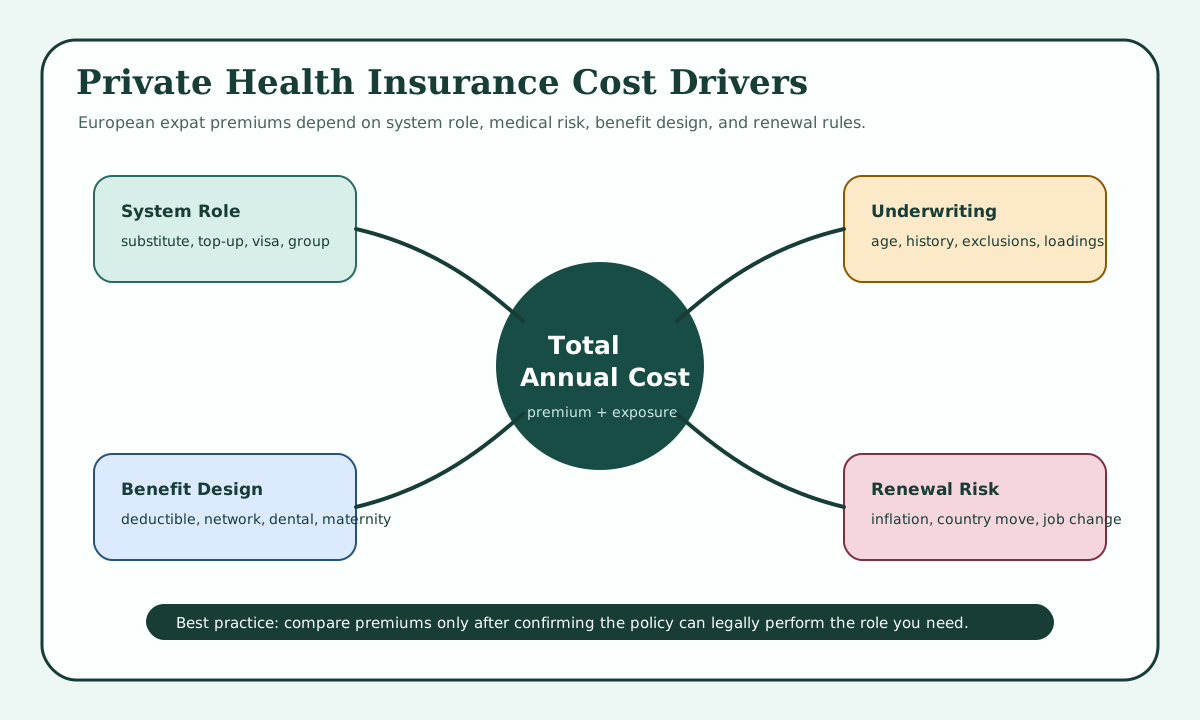
The private health insurance cost for expats in Europe cannot be reduced to a single monthly premium. Europe is not one health insurance market. Some countries rely heavily on statutory or compulsory insurance, some allow private insurance as a substitute for public coverage, and others use private policies mainly as top-up, travel, dental, hospital, or faster-access cover. A policy that is adequate for a visa file may be inadequate for residence, employment, chronic care, maternity, or long-term settlement.
This guide gives an EN-US research framework for comparing private health insurance as an expat. It focuses on cost architecture, eligibility, country differences, underwriting, exclusions, and renewal risk. It is not personal insurance advice. Use it to prepare questions for an insurer, broker, employer, immigration adviser, or national health authority.
Decision matrix: identify the health system before comparing premiums
An expat should first determine whether private insurance is primary, supplementary, temporary, or irrelevant to the legal obligation. The same monthly price can mean very different things.
| System role | What private insurance does | Cost implication | Expat risk |
|---|---|---|---|
| Substitute coverage | Replaces or substitutes for public/statutory coverage for eligible people | Premium may be high and medically underwritten | Switching back to public coverage may be difficult |
| Complementary coverage | Covers co-payments, dental, optical, private rooms, or faster access | Premium depends on add-ons | Policy may not satisfy residence or work obligations |
| Temporary visitor or visa coverage | Covers emergency or limited care during a stay | Can be cheaper but narrower | May fail after residence begins |
| Employer group coverage | Employer negotiates or pays part of premium | Lower individual underwriting friction | Coverage may end with job |
| Compulsory standard package with private insurers | Private companies administer a legally defined basic package | Price is regulated or community-rated in some systems | Optional add-ons may still be underwritten |
Your Europe guidance on health cover emphasizes that healthcare rights depend on insurance status and residence situation, not merely citizenship or travel plans. The European Health Insurance Card helps insured people during temporary stays but is not a substitute for registering in the health system of a new habitual residence. That distinction is often missed by mobile workers and remote employees.
Primary references:
Why Premiums Differ So Much Across Europe
Private health insurance pricing reflects more than healthcare quality. It reflects regulation, benefit design, age, medical underwriting, provider prices, claim inflation, administrative cost, and whether the policy is meant to replace or supplement a statutory system.
| Cost driver | Why it changes price | Questions to ask |
|---|---|---|
| Age | Older applicants usually have higher expected claims | Are premiums age-banded, community-rated, or experience-rated? |
| Medical underwriting | Pre-existing conditions can increase cost or create exclusions | Are exclusions temporary, permanent, or reviewable? |
| Benefit scope | Inpatient-only cover is cheaper than full outpatient and dental | What is excluded from routine care, maternity, mental health, prescriptions, and rehabilitation? |
| Deductible or excess | Higher out-of-pocket threshold lowers premium | Is the deductible per person, per claim, per year, or per condition? |
| Provider network | Broad private networks cost more | Are local hospitals, English-speaking doctors, and telehealth included? |
| Geographic zone | Pan-European or worldwide cover is more expensive | Does cover include the United States, Switzerland, or home-country treatment? |
| Renewal basis | assured renewal costs more than short-term travel cover | Can the insurer re-underwrite or cancel after claims? |
| Currency and inflation | Medical inflation and exchange rates affect renewal | Is premium indexed annually and in which currency? |
OECD and European Commission health-system data show that European health spending is financed through a mix of government schemes, social insurance, voluntary insurance, and out-of-pocket payments. For an expat, this means the visible private premium is only one part of total healthcare cost. Payroll contributions, co-payments, deductibles, dental bills, prescription charges, and uncovered care may be equally important.
Primary reference:
Country Models That Change The Answer
No single country example describes Europe. These simplified models show why an expat quote must be read in context.
| Country or model | How private cover usually fits | What expats should check |
|---|---|---|
| Germany | Private health insurance can be substitutive for eligible self-employed people, civil servants, and higher-income employees; statutory insurance remains central | Eligibility to choose private insurance, long-term premium increases, private long-term care insurance, employer subsidy rules |
| Netherlands | Everyone who lives or works in the Netherlands generally needs standard health insurance; insurers must accept applicants for the standard package | Basic package premium, mandatory deductible, healthcare allowance eligibility, optional supplementary underwriting |
| France | Public coverage is central; private "mutuelle" cover often supplements reimbursement gaps | Whether residence gives public coverage, waiting periods, complementary cover for dental/optical/hospital costs |
| Spain or Portugal | Public systems are central, while private cover can support visa files, faster access, or broader provider choice | Visa-specific policy requirements, no-copay clauses, pre-existing condition exclusions |
| International expat policy | Portable across countries and useful before local registration | Whether it satisfies local legal obligations after residence begins |
In Germany, BaFin explains that private health insurance is required for people resident in Germany who are not covered by compulsory or voluntary statutory health insurance. It also notes that long-term care insurance is generally obligatory when someone has private health insurance. Germany is therefore not merely a "buy any expat policy" market. The right policy depends on whether the person belongs in statutory health insurance, private comprehensive insurance, or a transitional arrangement.
In the Netherlands, the government states that everyone who lives or works there is legally obliged to take out standard health insurance. The standard package is set by government, insurers must accept applicants for the standard package, and all policyholders pay the same premium regardless of age or health for that package. That is very different from a medically underwritten international private policy.
Primary references:
- BaFin: private health insurance in Germany
- German Federal Ministry of Health: statutory health insurance
- Government.nl: standard health insurance
How To Compare Total Annual Cost
A premium-only comparison is incomplete. Build a one-year scenario and a five-year scenario.
| Cost component | Include in one-year model | Include in long-term model |
|---|---|---|
| Monthly premium | 12 months by insured person | Expected annual increases by age band and medical inflation |
| Deductible or excess | Maximum annual exposure | Whether higher excess remains affordable after income changes |
| Co-payments | Doctor visits, prescriptions, diagnostics, therapies | Chronic-care or recurring treatment assumptions |
| Exclusions | Services you would pay yourself | Probability that excluded care becomes important |
| Employer contribution | Subsidy or payroll deduction | What happens if employment ends |
| Public contributions | Statutory payroll or social insurance payments | Interaction with private add-ons |
| Dental and optical | Routine and major work | Family members, orthodontics, glasses, specialist treatment |
| Maternity and family | Waiting periods, newborn enrollment | Future children and dependent coverage |
| Repatriation and cross-border care | Medical evacuation, home-country care | Whether you will move countries again |
For a practical affordability test, use this formula:
| Test | Conservative threshold |
|---|---|
| Premium burden | Monthly premium should remain affordable after rent, tax, pension, and debt payments |
| Out-of-pocket reserve | Keep cash equal to at least the annual deductible plus predictable exclusions |
| Renewal shock | Test whether a 10 percent to 20 percent premium increase would still be manageable |
| Job-loss scenario | Know how coverage continues if employer-sponsored cover ends |
| Country move scenario | Confirm whether the policy remains valid after moving residence |
The lowest quote can be the most expensive option if it excludes conditions, has weak local networks, or must be replaced after residence registration.
Example Budget Scenarios
The numbers in a private quote are not portable across countries, but the structure of the budget is. A disciplined expat review converts the quote into a stress-tested annual cost. This is especially important for people moving from employer-sponsored systems, national health services, or US-style plans because the meaning of "premium," "deductible," and "network" can change sharply.
| Scenario | Premium review | Out-of-pocket review | Main decision |
|---|---|---|---|
| Single employee moving to Germany | Compare statutory eligibility, private eligibility, employer subsidy, and long-term private premium trajectory | Add private long-term care, dental, prescriptions, and deductible | Do not choose private cover only because the first-year price is attractive |
| Self-employed freelancer in Spain or Portugal | Check visa wording, local validity, no-copay requirements, and whether public registration is available later | Include specialist visits, diagnostics, maternity, mental health, and medication | Confirm the policy remains accepted after residence renewal |
| Family relocating to the Netherlands | Standard package is legally central for residents or workers; optional supplementary cover is separate | Add mandatory deductible exposure, dental for adults, and optional physiotherapy | Compare household cost, not only adult premium |
| Remote worker moving between countries | International private plan may bridge moves | Include exclusions for residence changes and home-country treatment | Make sure a portable policy does not replace a local legal duty |
| Retiree planning long stay | Age, chronic conditions, and renewal terms dominate | Model prescription, hospital, outpatient, and evacuation costs | assured renewal and pre-existing-condition wording matter more than perks |
Family, Maternity, And Dependent Coverage
Family coverage can reverse the apparent ranking of systems. A private quote for one healthy adult may look competitive, while the household quote for a spouse, child, maternity planning, orthodontics, and chronic medication may be very different. Some systems treat children favorably in public or standard packages. Some private plans price every dependent separately. Others impose maternity waiting periods or exclude newborn complications unless the parent had continuous cover.
| Family issue | Why it changes cost | Document to request |
|---|---|---|
| Maternity waiting period | Pregnancy-related claims may be excluded for a period after enrollment | Written waiting-period clause |
| Newborn enrollment | Automatic cover may require notification within a short window | Newborn addition rules |
| Child premiums | Children may be free, reduced, or separately priced depending on system | Family quote by person |
| Dental and orthodontics | Often outside basic medical cover | Dental schedule and annual limits |
| Mental health | Sessions, diagnosis, and provider type may be restricted | Benefit table and clinical exclusions |
| Cross-border schooling | Child may spend time in another country | Territorial scope and student rules |
For families, the safest comparison is per household per year: premiums, likely claims, worst-case deductible, uncovered care, and the administrative burden of getting reimbursed.
Underwriting And Pre-Existing Conditions
Private insurers may ask health questions, require medical records, exclude pre-existing conditions, charge loadings, impose waiting periods, or decline certain risks. In regulated standard systems, the rules may be different. For example, Dutch insurers must accept applicants for the standard package, while supplementary cover can be handled differently.
| Underwriting outcome | What it means | Review action |
|---|---|---|
| Full acceptance | Standard terms with no exclusion | Still check renewal, claim limits, and network |
| Premium loading | Higher price for risk | Compare loading against alternative systems |
| Exclusion | Specific condition or body system not covered | Assess whether exclusion makes policy unsafe |
| Waiting period | Cover delayed for maternity, dental, mental health, or planned care | Align timing before cancelling prior cover |
| Moratorium underwriting | Conditions may be excluded unless symptom-free for a period | Get the rule in writing |
| Decline | Insurer will not offer the policy | Check public/statutory route or specialist broker |
Never hide medical history. A cheaper quote obtained by incomplete disclosure can fail at claim time.
Visa And Residence Requirements
Some expat policies are designed to satisfy visa applications. Others are built for long-term healthcare. These are not necessarily the same.
| Requirement type | What officials may look for | Red flag |
|---|---|---|
| Schengen travel or visitor stay | Emergency medical cover for temporary stay | Policy ends before residence process does |
| Freelancer or self-employed visa | Comprehensive local or recognized private coverage | Travel-only policy with major exclusions |
| Student residence | Approved student or statutory cover | Home-country plan that does not cover local routine care |
| Remote worker or digital nomad route | Minimum cover, local validity, repatriation, no waiting period | Policy wording does not name the destination country |
| Permanent settlement planning | Stable, renewable, legally compliant cover | Short-term policy renewed repeatedly |
Immigration acceptance is separate from healthcare adequacy. A policy can pass a document checklist but leave the insured exposed to high costs.
Claims Friction And Language Access
Expats often focus on price and forget operational usability. A policy is only useful if the insured can find care, submit claims, and understand decisions during illness. Before paying, test the claims route as if a serious event happened in the first month.
| Operational question | Why it matters |
|---|---|
| Is direct billing available in the destination city? | Reimbursement-only policies can require large cash advances |
| Which language is used for pre-authorization? | Hospital admission can be delayed by unclear approval steps |
| Are prescriptions reimbursed at pharmacy or after claim submission? | Recurring medication can create monthly cash-flow pressure |
| How are emergency admissions handled outside the network? | Network rules may be unrealistic in emergencies |
| Are claim decisions appealable in writing? | Written appeal rights are essential for disputed exclusions |
| Can documents be submitted digitally? | Paper claims are slow for mobile residents |
For chronic conditions, ask the insurer to confirm the treatment pathway in writing before cancelling existing cover. For elective treatment, check pre-authorization rules and waiting periods. For emergency care, save the assistance number offline and share it with family members.
Build an Annual Cost Model
A useful comparison converts each quote into an annual expected cost and an annual worst-case exposure. Premium alone is not enough.
| Cost line | What to calculate |
|---|---|
| Annual premium | Monthly premium multiplied by 12, plus policy fees |
| Deductible | Maximum amount paid before reimbursement |
| Co-payments | Expected doctor, prescription, hospital, dental, or optical share |
| Excluded care | Any recurring treatment likely to be paid fully out of pocket |
| Out-of-network cost | Difference between preferred providers and reimbursed providers |
| Currency or international cost | FX, foreign claims, and cross-border care |
| Travel or repatriation add-on | Whether it is included or separate |
| Family additions | Spouse, partner, children, newborns, and maternity timing |
Then model three scenarios: a normal year, a bad year, and a transition year. A normal year includes predictable visits and prescriptions. A bad year includes hospitalization or a specialist claim. A transition year includes moving country, changing job, adding a family member, or switching into a public system.
Private Policy Roles
Do not compare policies until you know the role the policy must play.
| Role | Good fit | Warning sign |
|---|---|---|
| Bridge cover | Short gap before public or statutory enrollment | Policy used indefinitely because registration was delayed |
| Visa proof | Certificate matches consulate wording | Cheap policy lacks required country, dates, or repatriation |
| Substitutive cover | National law allows private replacement | Applicant assumes a foreign plan satisfies local compulsory rules |
| Supplemental cover | Public system remains primary | Applicant mistakes supplemental plan for full healthcare access |
| International portable plan | Frequent movers or global treatment need | High premium and uncertain local compliance |
The wrong role causes more harm than a high premium. A perfectly priced travel policy is still wrong for long-term resident care if the country requires statutory registration.
Renewal and Age Risk
Private insurance costs can change with age, claim experience, benefit design, inflation, and regulatory changes. Ask how premiums are reviewed, whether age bands apply, whether claims affect renewal, and whether the insurer can change benefits at renewal.
Families should ask how newborns are added, whether children age out, and whether maternity or fertility benefits have waiting periods. Older expats should ask whether there are age-entry limits, lifetime renewability rules, or exclusions that become more important after retirement.
Exit Plan to Public or Statutory Coverage
Many expats use private insurance temporarily. The exit plan should be written down before purchase.
| Exit event | Evidence to collect |
|---|---|
| Employment starts | Employer registration and statutory insurance confirmation |
| Residence registration accepted | Local health-system enrollment evidence |
| Student enrollment changes | University or public-system instruction |
| Country move | New country coverage start date |
| Public cover confirmed | Cancellation date and no-gap proof |
| Family joins later | Individual coverage start dates |
Do not cancel private cover based only on an application submission. Wait for written confirmation that the new cover is active and that there is no gap.
Claims Test Before Purchase
Before paying, ask the insurer or broker to explain the claim path for:
- emergency hospitalization in the destination city;
- recurring prescription medication;
- specialist referral;
- mental health treatment;
- maternity or newborn care if relevant;
- treatment while temporarily visiting another EU country;
- treatment during a visit to the United States if U.S. cover is included.
The answer should identify who to call, whether pre-authorization is needed, which documents are required, how reimbursement is calculated, and how long payment usually takes. If the answer is vague, price comparison is premature.
Frequently Asked Questions
Is private health insurance Usually more expensive than public insurance in Europe?
No. The comparison depends on country, income, age, family size, and benefit design. Young, healthy, high-income applicants may see attractive private premiums in some markets, while families, older applicants, and people with chronic conditions may find statutory or standard coverage more protective.
Does an EHIC replace private insurance for expats?
No. The EHIC is for medically necessary state-provided healthcare during temporary stays for people insured in an eligible country. It is not designed to replace local registration after moving habitual residence.
Should a US expat buy worldwide cover including the United States?
Only if the person genuinely needs US treatment access and can afford the higher premium. Policies including US cover are usually more expensive because US medical prices are high.
Are broker quotes reliable?
They can be useful, but the policy wording controls. Ask whether the broker is independent, which insurers are excluded from the panel, how commissions work, and whether the quote satisfies legal obligations in the destination country.
What is the safest first step?
Identify your residence country, work status, and legal health-insurance obligation. Then compare policies only within the category that can legally satisfy that obligation.
Final Checklist
| Question | Why it matters |
|---|---|
| Is this policy primary, supplementary, or temporary? | Prevents buying the wrong product |
| Does it satisfy residence, work, or visa rules? | Avoids immigration and compliance failures |
| Are pre-existing conditions covered? | Protects against claim denial |
| Are renewals assured? | Prevents losing cover after illness |
| What is the annual maximum out-of-pocket exposure? | Turns premium into realistic budget |
| Does the network work in my city? | Avoids a policy that is valid but impractical |
| What happens if I change country or job? | Protects mobile expats |
Run the checklist against the full policy wording, not only the quote summary. Save the quote, policy schedule, exclusions, claim form, assistance number, and cancellation rule in one folder before paying. If an authority, employer, or university needs proof of cover, ask for the certificate format before buying. Reissuing documents after purchase can delay residence, enrollment, or onboarding appointments.
Source Quality Notes
This guide relies on public and institutional sources for system-level claims. Your Europe is used for cross-border health rights and EHIC limits. OECD and European Commission material is used for comparative health-system financing context, not for individual quote prediction. BaFin and the German Federal Ministry of Health are used for Germany's statutory and private system distinction. Government.nl is used for the Netherlands because the Dutch standard package is legally structured in a way that ordinary private-insurance comparisons can misstate. Insurer brochures and broker pages should be used only after the official system role is clear.
Bottom Line
The private health insurance cost for expats in Europe is a total-risk calculation, not a quote comparison. The right policy must fit the legal system, residence status, health history, family plan, and renewal horizon. Start with the public or statutory rules of the destination country, then use private insurance only for the role it can safely perform: substitute, supplement, bridge, or portable backup.
Official source and decision check
Use this section as the practical checkpoint for Private Health Insurance Cost for Expats in Europe: Country Differences, Underwriting, and Long-Term Affordability. The reader decision is whether the available evidence is strong enough to act now, or whether the file should first be confirmed with the competent authority. Rules can change by country, status and date, so treat this guide as orientation for the file and recheck the current rule before relying on a healthcare registration, insurance decision, benefit claim or contribution deadline.
For expats, foreigners, students, workers, founders, families and other mobile readers, record the reader category, country, residence status and deadline before comparing the official source with the article checklist.
Official sources to verify first
- Your Europe healthcare abroad
- European Commission social security coordination
- EU public health policy
- EUR-Lex EU law access
- European Commission information portal
| Decision point | What to check | Reader action |
|---|---|---|
| Administrative decision | Confirm that the case is really about administrative decision, not a different category that follows another rule. | Write down the country, authority, dates, status and document number before asking for a decision. |
| File for competent authority | Keep the identity, residence and document evidence in one dated file, with originals, translations where required and proof of submission. | Save receipts, emails, appointment confirmations, payment records and authority replies in the same order as the checklist. |
| Private Health Insurance Cost for Expats in Europe: Country Differences, Underwriting, and Long-Term Affordability fallback | If the answer is refused, delayed or unclear, identify the competent authority, review window, complaint route or regulated provider escalation path. | Ask for the reason in writing and compare it with the official source before paying again, travelling, closing an account or resubmitting. |
| When the answer is unclear | What to do next |
|---|---|
| The authority, bank, insurer, employer or provider gives a verbal answer only. | Ask for the answer in writing, save the name of the office or provider, and compare it with the official source before changing travel, payroll, residence or payment plans. |
| The file depends on a deadline, appointment, payment, address or status change. | Keep the dated receipt, note the next deadline, and avoid closing the old route until the replacement document, account, policy or registration is confirmed. |
Related guides to cross-check
- First month in Europe checklist
- Living in one European country and working in another
- EU remote working guide
- Cross-border worker benefits in the EU
- Private health insurance documents in Europe
For legal, tax, medical, immigration or financial consequences, confirm the position with the competent authority or a qualified adviser. This page is designed to organize the decision, source checks and next steps; it is not a substitute for case-specific professional advice.