Last updated
How To Compare Public And Private Health Insurance In Germany
Direct answer
How To Compare Public And Private Health Insurance In Germany brings the main checks together so you can see the issue, the evidence, and the safer next step in one place. It explains matching health-insurance eligibility, public or private cover, registration evidence, and renewal risk in Germany, then shows how to separate public eligibility, private cover, emergency access, contribution rules, and the evidence needed for residence or work. The later sections connect executive answer, step 1: confirm whether you can choose, and step 2: compare pricing logic so the next step is easier to judge. Read it before submitting forms, moving money, choosing a provider, or assuming that a rule from another country applies.
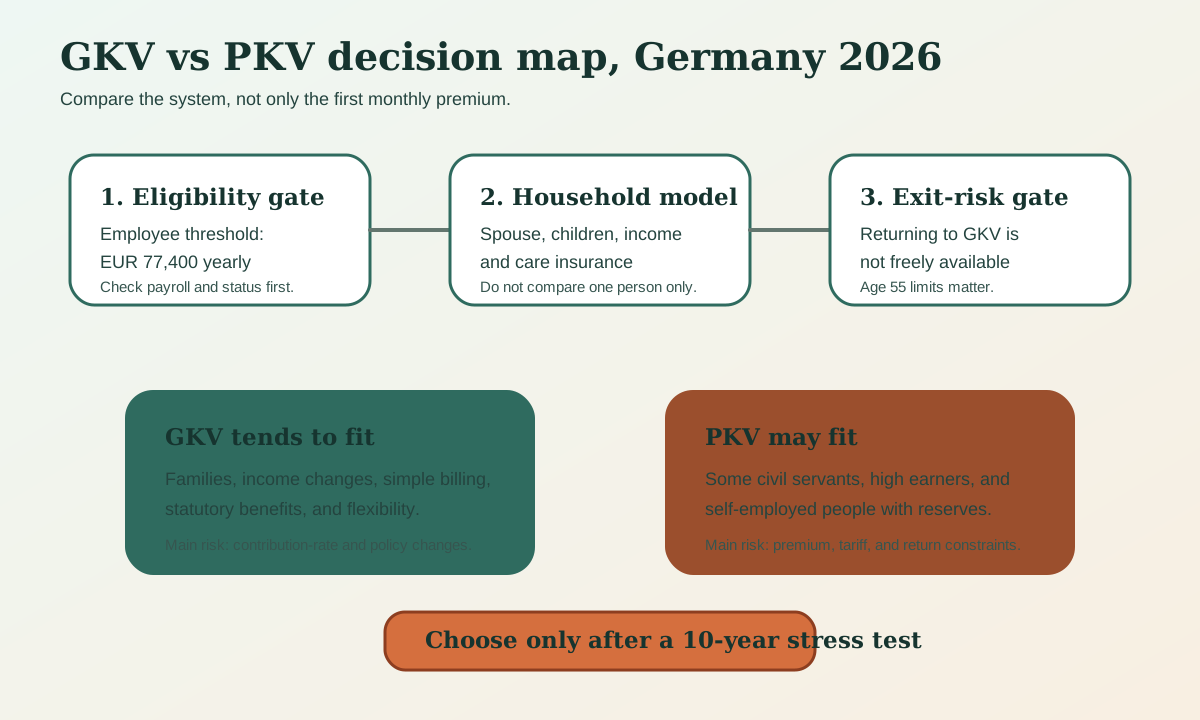
Comparing public and private health insurance in Germany is a system-design decision, not a quote-shopping exercise. Statutory health insurance, usually called gesetzliche Krankenversicherung or GKV, and private health insurance, called private Krankenversicherung or PKV, differ in eligibility, pricing, family coverage, medical-benefit definition, billing mechanics, long-term care insurance, employer subsidies, and switching constraints.
For most employees, families, and people who value predictable administration, GKV is the safer default. PKV can be rational for some civil servants, high-earning employees, and self-employed people, but only when the household can absorb long-term premium risk and understands that returning to GKV is not freely available.
Sources were checked on May 18, 2026. This guide is educational information, not legal, tax, insurance, medical, or financial advice.
Executive Answer
Start with eligibility. In 2026, ordinary employees are generally compulsory GKV members if their regular annual employment income is below the annual earnings threshold of EUR 77,400, or EUR 6,450 per month. The German Federal Ministry of Health describes this threshold on its page about switching between GKV and PKV.
Then compare total household cost, not one monthly premium. For 2026, the general GKV contribution rate is 14.6%, the reduced rate is 14.0%, the average additional contribution is 2.9%, and the GKV contribution ceiling is EUR 69,750 per year or EUR 5,812.50 per month. BMG publishes these 2026 values on its GKV contributions page.
Finally, treat PKV as a long-term commitment. BMG states that an arbitrary switch from PKV back into GKV is excluded and that narrow rules apply, especially after age 55. That switching constraint is often more important than the first-year premium difference.
Decision matrix
| Decision factor | GKV usually has the advantage when | PKV may deserve review when |
|---|---|---|
| Eligibility | You are below or near the employee compulsory-insurance threshold | You are self-employed, a civil servant, or clearly above the employee threshold |
| Household structure | You have a spouse or children who may qualify for family insurance | Each family member can be privately insured affordably |
| Income volatility | Income may fall, become part-time, or vary by year | Income is stable, high, and backed by reserves |
| Administration | You want direct billing and fewer reimbursement tasks | You can manage invoices, reimbursement claims, and tariff reviews |
| Long-term flexibility | You may need to return to GKV later | You accept PKV as a long-term system choice |
| Medical preferences | You value statutory benefit certainty and simple access | You need specific contractual benefits and understand all tariff limits |
Step 1: Confirm Whether You Can Choose
Eligibility comes before preference. Some people are required to stay in GKV, some can choose, and some are structurally closer to PKV.
| Profile | 2026 starting point | Main evidence to verify |
|---|---|---|
| Employee below EUR 77,400 regular annual income | Usually compulsory GKV | Payroll calculation, annual earnings forecast |
| Employee above EUR 77,400 | May stay voluntary GKV or switch to PKV if conditions are met | Payroll confirmation for current and next year |
| Employee privately insured on December 31, 2002 | Special EUR 69,750 threshold may apply | Historic insurance proof and payroll review |
| Self-employed person | Often can choose voluntary GKV or PKV, subject to history and access rules | Business status, prior coverage, income estimate |
| Civil servant | PKV often interacts with public aid, or Beihilfe |
Employer aid rules and residual cover quote |
| Artist or publicist under KSVG | May be compulsory in statutory systems like an employee | KSK assessment |
For employees, ask payroll how "regular annual employment income" is calculated. Bonuses, one-off payments, variable compensation, part-time changes, and future-year forecasts can matter. Do not rely on a recruiter estimate when you are close to the threshold.
Step 2: Compare Pricing Logic
GKV is mainly income-based and capped. PKV is contract-, age-, health-, tariff-, and risk-based. This is the central distinction.
| Cost issue | GKV | PKV |
|---|---|---|
| Main pricing basis | Income-based, up to the contribution ceiling | Tariff, age group, health status, benefits, deductible, risk pool |
| Employee cost sharing | Employer shares statutory contributions and individual additional contribution | Employer subsidy can apply, but only within legal limits |
| Low-income years | Contributions may fall with income | Premium does not automatically fall because income falls |
| High-income years | Contributions rise only up to the ceiling | Premium is not tied directly to salary growth |
| Spouse and children | Family insurance may cover eligible dependents without separate premium | Each insured person normally needs a separate contract |
| Premium risk | Political and contribution-rate risk | Contract adjustment, medical-cost, age, and tariff-structure risk |
For voluntary GKV members and self-employed people, the contribution base can include broader income categories, and BMG notes that voluntary members can pay contributions on income such as capital income and rental income. That makes the GKV-versus-PKV calculation different for a salaried employee, a freelancer, and a retiree.
Step 3: Model Household Cost Before Individual Cost
Family coverage is often decisive. BMG states that family-insured children, spouses, and life partners pay no contribution in GKV if the legal conditions are met. BMG's 2026 GKV page also lists the mini-job limit at EUR 603 per month, while family-insurance income limits must be checked against the current sickness-fund guidance and relevant social-insurance values.
PKV has no equivalent free family-insurance structure. Each child and adult normally requires a separate premium, and the household may also need private compulsory long-term care insurance for each privately insured person.
| Household case | Common result |
|---|---|
| Single high earner, no children | PKV may look cheaper in the first years |
| Couple with one low-income spouse | GKV often becomes stronger because of family insurance |
| Family with children | GKV frequently wins on total household cost |
| Self-employed person with volatile income | GKV can be more robust if access and contribution treatment work |
| Civil servant household | PKV may be structurally attractive because public aid covers part of medical costs |
Mixed GKV/PKV households need a specific child-insurance review. If the privately insured parent earns more than the GKV-insured parent and is above the annual earnings threshold, free GKV family insurance for the child may be excluded. That single rule can erase the apparent PKV saving.
Step 4: Compare Benefits By Legal Source
GKV benefits are defined by statute and by the statutory self-governance system. BMG explains that statutory health insurance covers medically necessary care such as medical, dental, psychotherapeutic, hospital, medicine, aids, home-nursing, and rehabilitation services, subject to the rule that services must be sufficient, appropriate, economical, and not exceed what is necessary. See BMG's GKV benefit framework.
PKV benefits are contractual. A strong tariff can improve selected benefits; a weak tariff can create reimbursement limits, exclusions, or administrative friction. Compare the full insurance terms, not the sales summary.
| Tariff item | What to inspect in a PKV quote |
|---|---|
| Outpatient care | Fee schedule limits, specialist access, referral rules, alternative-medicine terms |
| Hospital care | Ward type, chief-physician coverage, elective hospital restrictions |
| Dental care | Preventive care, implants, orthodontics, annual caps, waiting periods |
| Psychotherapy | Session limits, preapproval, provider rules, reimbursement percentage |
| Maternity and fertility | Waiting periods, covered services, exclusions |
| Aids and devices | Eligible device categories, caps, replacement cycles |
| Deductible | Annual deductible, coinsurance, no-claims refund mechanics |
| International cover | Emergency care, planned treatment abroad, repatriation |
| Premium adjustment history | Historical increases for similar tariffs, where available |
Step 5: Include Long-Term Care Insurance
Health insurance and long-term care insurance move together in Germany. People insured in GKV generally belong to the social long-term care insurance system. People insured in PKV must take out private compulsory long-term care insurance. BMG explains the social and private compulsory long-term care structure on its pages for insured persons in long-term care insurance and private compulsory long-term care insurance.
Do not compare GKV and PKV premiums without adding the mandatory long-term care layer. This is especially important for families, older applicants, and people comparing civil-service Beihilfe arrangements.
Step 6: Compare Billing And Administration
GKV normally uses direct settlement. The insured person presents the insurance card, the provider bills through the statutory system, and the patient usually does not advance the full bill for ordinary covered care.
PKV commonly operates by reimbursement. The doctor or hospital invoices the patient, the patient submits the claim, and the insurer reimburses according to the tariff.
| Administrative issue | Why it matters |
|---|---|
| Large invoices | You may need cash or credit before reimbursement |
| Partial reimbursement | A tariff cap or fee-schedule issue can leave a balance |
| Disputed medical necessity | The insurer may request medical records or explanations |
| Foreign-language invoices | Claims may need translation or coding support |
| Self-employed accounting | Claims, premiums, and deductibles should be filed cleanly |
If you dislike claim administration, GKV has a structural advantage. If you choose PKV, budget for time, document retention, and possible disputes.
Step 7: Stress-Test Switching Risk
The most expensive PKV mistake is treating it as a reversible experiment. BMG states that a free return from PKV to GKV is excluded. A return usually requires a new statutory insurance obligation, and strict restrictions apply after age 55.
Before entering PKV, write down the exact legal event that would let you return to GKV. Examples might include employment below the compulsory-insurance threshold before age 55, unemployment benefit circumstances, or other status changes. Do not assume that lower income by itself Usually solves the problem.
| Exit-risk question | Why it matters |
|---|---|
| What legal event would make me compulsory GKV again? | Without it, return may be impossible |
| Would that event happen before age 55? | After 55, barriers become much stronger |
| What happens if I become self-employed, unemployed, part-time, divorced, or retired? | Each status change has a different insurance consequence |
| Can I afford PKV if premiums rise and income falls? | PKV affordability risk is not solved by today's quote |
The PKV Basistarif Is A Safety Net, Not A Strategy
The PKV Basistarif matters, but it is not a reason to choose PKV casually. BMG explains that private insurers must offer a basic tariff whose benefits are comparable in type, scope, and amount to GKV, and that risk surcharges and exclusions are not allowed in that tariff. For 2026, BMG reports a maximum premium of about EUR 1,018 per month. See BMG: PKV Basistarif.
The Basistarif is a social-protection floor. It does not make a poor tariff choice, weak exit plan, or unaffordable long-term premium harmless.
Ten-Year Scenario Model
Use this simplified model before signing any PKV policy:
| Scenario | GKV test | PKV test |
|---|---|---|
| Year 1 single | Contribution at current income and current additional contribution | Premium, deductible, long-term care, employer subsidy |
| Married, spouse low income | Family-insurance eligibility | Separate spouse premium and underwriting |
| First child | Child family-insurance eligibility | Child premium, pediatric benefits, deductible rules |
| Income drop | Contribution drop and voluntary-member income base | Premium remains due unless tariff changes |
| Self-employment | Voluntary GKV contribution calculation | Full premium, no employer subsidy |
| Age 55+ | GKV continuity if already insured | Return barriers if privately insured |
| Retirement | Pensioner contribution treatment | Retiree PKV premium and subsidy rules |
The correct comparison is the worst acceptable outcome, not the best first-year quote.
Evidence Checklist
Keep a dated file with:
| Evidence | Why to keep it |
|---|---|
| Payroll calculation of annual income | Proves whether the employee threshold is exceeded |
| GKV contribution estimate | Shows income-based cost at current ceiling and additional contribution |
| PKV full insurance conditions | Prevents reliance on sales summaries |
| Dependent income information | Needed for family-insurance analysis |
| Long-term care premium estimate | Required for full cost comparison |
| Employer subsidy calculation | Shows actual net payroll impact |
| Medical underwriting disclosures | Critical if later disputes arise |
| Written switching-risk analysis | Documents that PKV was treated as a long-term decision |
First-Year Review After Choosing
After choosing GKV or PKV, review the decision during the first year. The first quote or first payroll estimate is not the final cost picture.
| Review point | GKV check | PKV check |
|---|---|---|
| Payroll or income changed | Contribution estimate still accurate | Premium still affordable without employer subsidy changes |
| Family status changed | Family insurance still valid | New family-member premium and underwriting |
| Medical use | Statutory access working as expected | Claims, reimbursements, and deductibles manageable |
| Employer status changed | Compulsory or voluntary route still correct | Subsidy and eligibility still correct |
| Self-employment began | Voluntary contribution basis reviewed | Full private premium still sustainable |
| Long-term care | Contribution included | Private compulsory care premium included |
| Switching route | No unexpected lock-in | Return-to-GKV route still understood |
Keep the first-year review in writing. It is especially important for expats who chose PKV after arrival because the easiest time to detect a bad fit is before family, age, income, or medical history makes switching harder.
Household Scenarios
A single high earner, a married couple with one income, a freelancer with volatile income, and a family with children should not use the same comparison.
| Household | Main issue |
|---|---|
| Single high earner | PKV may look attractive, but long-term premium and switching risk still matter |
| Couple with non-working spouse | GKV family insurance can materially change household cost |
| Family with children | PKV child premiums and family insurance rules must be modeled |
| Freelancer | Income volatility and loss of employer subsidy dominate the decision |
| Older newcomer | PKV entry age and return-to-GKV limits become more serious |
| Chronic condition | Underwriting, exclusions, and reimbursement administration need specialist review |
The correct comparison is household-specific. If a comparison tool does not ask about spouse, children, income volatility, age, prior insurance, and long-term plans, it is not enough.
Claim and Cash-Flow Difference
One practical difference is billing. In GKV, many services are handled through the statutory system. In PKV, patients often receive invoices and seek reimbursement according to the tariff. That can be manageable, but it changes cash flow and administration.
Before choosing PKV, ask:
- how hospital invoices are handled;
- whether direct billing is available;
- how long reimbursement usually takes;
- what happens if a provider charges more than the tariff reimburses;
- whether pre-authorization is required;
- how disputes are appealed;
- whether documents must be submitted digitally or by mail.
For high medical use, reimbursement workflow is not a minor detail. It can affect liquidity and stress.
Common Mistakes
| Mistake | Better approach |
|---|---|
| Comparing only the first monthly PKV quote | Compare ten-year household cost |
| Ignoring family insurance | Model spouse and child coverage first |
| Forgetting long-term care insurance | Add mandatory care insurance to both systems |
| Treating PKV as reversible | Write down the legal return route to GKV |
| Comparing generic "private" benefits | Read the exact tariff wording |
| Ignoring reimbursement administration | Test invoice, cash-flow, and claim handling |
| Assuming self-employment makes PKV cheaper | Compare employer-subsidy loss and income volatility |
| Relying on outdated thresholds | Use current BMG values for the year |
FAQ
Is private health insurance cheaper in Germany?
Sometimes at the start. A young, healthy, high-earning single person may receive a PKV quote below the maximum GKV contribution. But family size, premium adjustments, deductibles, long-term care insurance, and income changes can reverse the result.
Is public health insurance worse than private insurance?
Not categorically. GKV provides a statutory medically necessary benefit framework. PKV can provide broader contractual benefits in selected tariffs, but quality depends on the exact contract.
Can I switch back from PKV to GKV later?
Not freely. BMG states that arbitrary switching from PKV back to GKV is excluded, and the age-55 restrictions are especially important.
What is the 2026 income threshold for employees?
For ordinary employees, the 2026 annual compulsory-insurance threshold is EUR 77,400. A special EUR 69,750 threshold applies to certain people who were privately insured on December 31, 2002.
What are the 2026 GKV contribution figures?
For 2026, BMG lists the general contribution rate at 14.6%, the reduced rate at 14.0%, the average additional contribution at 2.9%, and the contribution ceiling at EUR 69,750 per year or EUR 5,812.50 per month.
Does GKV cover my family for free?
It can, if family-insurance conditions are met. Spouses, life partners, and children must satisfy the legal criteria, including residence and income rules. Mixed GKV/PKV families need special review.
Source Risks And Factual Uncertainty
The main 2026 thresholds were checked on May 14, 2026 against BMG pages. Values can change annually, especially contribution ceilings, annual earnings thresholds, average additional contribution rates, family-insurance income limits, and PKV social-tariff limits. PKV tariff quality cannot be verified from public sources; it requires the insurer's binding contract terms. Employer subsidies and payroll treatment depend on individual employment status.
Official References
- Federal Ministry of Health: Switching between GKV and PKV
- Federal Ministry of Health: GKV contributions and 2026 thresholds
- Federal Ministry of Health: Insured persons in statutory health insurance
- Federal Ministry of Health: GKV benefit framework
- Federal Ministry of Health: PKV premiums
- Federal Ministry of Health: PKV Basistarif
- Federal Ministry of Health: Long-term care insured persons
- Federal Ministry of Health: Private compulsory long-term care insurance
Related Reading
- How To Qualify For Public Health Insurance In Germany
- How To Choose Health Insurance After Moving To Germany
- Can I Buy Health Insurance Privately In Europe
Conclusion
The right comparison is not GKV premium versus PKV quote. It is eligibility, household cost, benefit certainty, reimbursement administration, mandatory long-term care insurance, and switching risk. GKV is usually the stronger default for families, employees with changing income, and people who value flexibility. PKV can be appropriate for specific high-income, civil-service, or self-employed profiles, but only when the contract and long-term affordability still work under adverse scenarios.
Official source and decision check
Use this section as the practical checkpoint for How To Compare Public And Private Health Insurance In Germany. The reader decision is whether the available evidence is strong enough to act now, or whether the file should first be confirmed with the competent authority. Rules can change by country, status and date, so treat this guide as orientation for the file and recheck the current rule before relying on an appointment, employer filing, permit change, payroll step or registration deadline.
For expats, foreigners, students, workers, founders, families and other mobile readers, record the reader category, country, residence status and deadline before comparing the official source with the article checklist.
Official sources to verify first
- Make it in Germany official portal
- Federal Foreign Office Germany
- Federal Employment Agency
- Federal Office for Migration and Refugees
- German laws online
| Decision point | What to check | Reader action |
|---|---|---|
| Administrative decision | Confirm that the case is really about administrative decision, not a different category that follows another rule. | Write down the country, authority, dates, status and document number before asking for a decision. |
| File for competent authority | Keep the identity, residence and document evidence in one dated file, with originals, translations where required and proof of submission. | Save receipts, emails, appointment confirmations, payment records and authority replies in the same order as the checklist. |
| How To Compare Public And Private Health Insurance In Germany fallback | If the answer is refused, delayed or unclear, identify the competent authority, review window, complaint route or regulated provider escalation path. | Ask for the reason in writing and compare it with the official source before paying again, travelling, closing an account or resubmitting. |
| When the answer is unclear | What to do next |
|---|---|
| The authority, bank, insurer, employer or provider gives a verbal answer only. | Ask for the answer in writing, save the name of the office or provider, and compare it with the official source before changing travel, payroll, residence or payment plans. |
| The file depends on a deadline, appointment, payment, address or status change. | Keep the dated receipt, note the next deadline, and avoid closing the old route until the replacement document, account, policy or registration is confirmed. |
Related guides to cross-check
- First month in Europe checklist
- Living in one European country and working in another
- EU remote working guide
- Cross-border worker benefits in the EU
- Private health insurance documents in Europe
For legal, tax, medical, immigration or financial consequences, confirm the position with the competent authority or a qualified adviser. This page is designed to organize the decision, source checks and next steps; it is not a substitute for case-specific professional advice.