Last updated
How To Choose Health Insurance After Moving To Germany
Direct answer
The practical question behind How To Choose Health Insurance After Moving To Germany is which facts, documents, costs, and deadlines change the next step. It explains comparing admissions, recognition, fees, visa timing, and evidence before choosing an education route in Germany, then shows how to compare admission rules, recognition, language, tuition, funding, residence timing, and documents before committing. The later sections connect start with your insurance route, not with a brand, gkv vs pkv in plain terms, and the 2026 income thresholds newcomers often confuse so the next step is easier to judge. Read it before paying fees, submitting forms, signing contracts, booking travel, or relying on a generic summary.
The answer changes when you are an employee below or above the employee threshold, self-employed, a student, joining a family member, or moving from another European system. Travel insurance, EHIC, GHIC, incoming policies, and comprehensive German health insurance do not solve the same problem and should not be treated as interchangeable.
Next step: confirm your insurance route with your employer, university, or a statutory health fund before submitting an application to any private insurer.
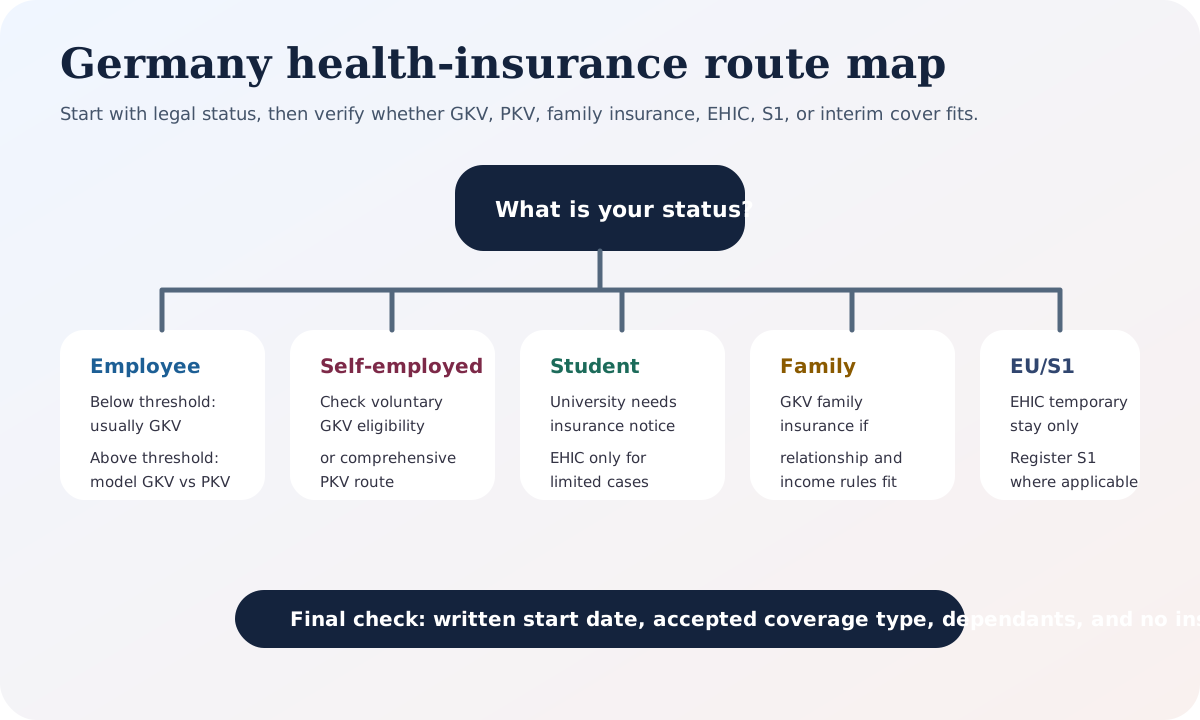
Choosing health insurance after moving to Germany is not just a price comparison. Germany has a mandatory health insurance system, and your first decision depends on your legal status: employee, self-employed person, student, family member, jobseeker, pensioner, or someone covered through another EU/EEA system.
The Federal Ministry of Health explains that people who reside in Germany must have health insurance. Coverage is normally arranged through statutory health insurance, called GKV or SHI, or through private health insurance, called PKV or PHI. The two systems are not interchangeable on demand, so the safest approach is to confirm which system you are allowed or required to use before comparing individual funds or insurers.
This guide is an editorial overview for newcomers. It is not legal, tax, immigration, or medical advice. If your case involves cross-border work, previous insurance abroad, chronic treatment, dependants, or a visa condition, confirm the details with a German statutory health insurance fund, a private insurer, your employer, the immigration authority, or a qualified adviser.
Start With Your Insurance Route, Not With A Brand
Germany's public-private split can be confusing because many comparison pages start with premiums. For newcomers, the better first question is: "What route am I in?"
Use this sequence:
- Confirm whether you are subject to statutory health insurance as an employee, student, trainee, or another compulsory category.
- Check whether you may choose between voluntary GKV and PKV because your status allows it.
- Identify whether a family member can be co-insured in GKV or needs separate cover.
- Make sure your insurance starts when your German residence, job, studies, or visa status requires it.
- Treat travel insurance, incoming insurance, EHIC, GHIC, or an S1 document as specific tools, not universal substitutes for German health insurance.
Make it in Germany, the German government's official portal for skilled workers, states that Germany distinguishes between statutory and private health insurance and that people cannot switch freely between the two systems. It also notes that international health insurance may be useful for the first days or weeks before German coverage is in place, especially where proof is needed for a visa.
GKV Vs PKV In Plain Terms
GKV is Germany's statutory health insurance system. Contributions are generally income-based, medical necessity and statutory benefit rules matter, and eligible family members may be covered without their own contribution. The Federal Ministry of Health states that the general GKV contribution rate is 14.6 percent, with a reduced rate of 14.0 percent for members without entitlement to sickness benefit, plus a fund-specific additional contribution. Employers and employees generally share employee contributions, including the additional contribution.
PKV is private comprehensive health insurance. It can be the correct route for certain people, but it is not just a cheaper alternative to GKV. BaFin, Germany's financial supervisory authority, explains that private health insurance contributions are calculated per insured person and depend on factors such as age, health at entry, and selected tariff. BaFin also warns that returning from PKV to GKV is generally not possible unless the person becomes subject to statutory insurance again, especially later in life.
That means the practical comparison is not "public is good, private is bad" or the other way around. The real comparison is:
- Whether your status allows PKV at all.
- Whether GKV family insurance is important for a spouse, registered partner, or children.
- Whether PKV medical underwriting, individual premiums, and tariff conditions fit your long-term plans.
- Whether you may later need to switch jobs, reduce income, start a family, become self-employed, or stay in Germany long term.
- Whether a specific private policy is comprehensive German health insurance or only travel, incoming, or supplemental cover.
| Decision factor | GKV / statutory insurance | PKV / private comprehensive insurance | Newcomer reviewer note |
|---|---|---|---|
| Pricing method | Contributions are generally income-based up to the contribution ceiling, plus fund-specific additional contribution | Premiums are calculated per insured person using age, health at entry, benefits, and tariff | Compare household cost, not only the main applicant's premium |
| Dependants | Eligible family members may be covered without their own contribution | Each person usually needs a separate policy and premium | Families should model spouse and child coverage before considering PKV |
| Medical access | Statutory benefits and provider rules apply | Tariff terms define reimbursement, deductibles, and benefit limits | Read the policy terms, not only the sales summary |
| Switching risk | Fund switching inside GKV is usually administratively easier | Returning from PKV to GKV can be restricted, especially later in life | Treat PKV as a long-term status decision |
| Administrative fit | Employer and university processes often expect a statutory fund confirmation | Private coverage must be accepted as comprehensive German cover for the relevant purpose | Get written confirmation before relying on an incoming or foreign policy |
The 2026 Income Thresholds Newcomers Often Confuse
Two official thresholds matter in 2026, and they do different jobs.
The first is the annual income threshold for compulsory statutory insurance for employees, called the Jahresarbeitsentgeltgrenze or Versicherungspflichtgrenze. The Federal Ministry of Health gives the 2026 general threshold as EUR 77,400 per year, or EUR 6,450 per month. Employees whose regular annual employment income is above that threshold may generally choose between voluntary GKV and PKV; employees below it are generally compulsorily insured in GKV if they are not in a special exception.
The second is the contribution assessment ceiling, called the Beitragsbemessungsgrenze. The Federal Ministry of Health gives the 2026 ceiling for health and long-term care insurance as EUR 69,750 per year, or EUR 5,812.50 per month. This is the income cap used for calculating GKV contributions. It is not the same as the employee threshold for choosing PKV.
The GKV-Spitzenverband 2026 figures sheet also lists the 2026 figures, including the EUR 77,400 general annual employee threshold, the EUR 69,750 contribution ceiling, and family insurance income limits.
There is also a lower special employee threshold for certain people who were already privately insured on 31 December 2002. That legacy figure is not the normal newcomer rule. New arrivals should use the general 2026 employee threshold unless their employer, statutory fund, or adviser confirms that a special rule applies.
| 2026 figure | Amount | What it does | What it does not do |
|---|---|---|---|
| General employee annual earnings threshold | EUR 77,400 per year / EUR 6,450 per month | Helps determine whether many employees may choose between voluntary GKV and PKV | It is not the income cap for calculating GKV contributions |
| Health and long-term care contribution ceiling | EUR 69,750 per year / EUR 5,812.50 per month | Caps the income base used for GKV contribution calculations | It does not by itself give permission to leave compulsory GKV |
| General GKV contribution rate | 14.6% | Standard statutory rate for members with sickness-benefit entitlement | It excludes the fund-specific additional contribution |
| Reduced GKV contribution rate | 14.0% | Applies to members without sickness-benefit entitlement | It does not include sickness benefit from the 43rd day |
| Average additional contribution rate | 2.9% | Reference average for 2026; individual fund rates can differ | It is not necessarily your chosen fund's actual rate |
If You Move To Germany For A Job
Most employees moving to Germany will enter GKV. Make it in Germany says most employees in Germany have statutory health insurance, and the Federal Ministry of Health explains that employees under the annual earnings threshold are generally compulsory statutory members.
Before your first payroll run, choose a statutory health insurance fund if you are entering GKV. The GKV-Spitzenverband Krankenkassenliste provides an official list of statutory funds and their additional contribution rates. For a newcomer, the useful comparison points are:
- Is the fund open in your federal state or nationwide?
- What additional contribution rate does it currently charge?
- Does it offer English-language service if you need it?
- How does it handle digital membership certificates, eGK health card delivery, and dependants?
- Are any optional services, bonus programs, or local support relevant to you?
If your regular salary exceeds the 2026 employee threshold of EUR 77,400, do not assume PKV is automatically better. You may generally have a choice, but the choice has long-term consequences. Compare voluntary GKV with PKV using the same household assumptions: spouse or partner, children, future income changes, time in Germany, and retirement expectations.
If You Are Self-Employed Or Freelance
Self-employed newcomers often have more complicated decisions because there may be no employer to handle registration and no employer share of contributions in the same way as for employees. Make it in Germany notes that private health insurance is particularly relevant for the self-employed, high earners, and civil servants.
However, "self-employed" does not automatically mean "must use PKV." Some self-employed people may be able to remain or become voluntary GKV members, especially where previous statutory insurance history or EU coordination rules apply. Others may need private comprehensive coverage. The correct route depends on your previous insurance, residence status, activity, and whether a statutory fund accepts you as a voluntary member.
For self-employed people, compare:
- Whether you are eligible for voluntary GKV.
- How GKV contributions will be calculated from your income.
- Whether you need sickness benefit coverage and from when.
- Whether PKV underwriting, exclusions, deductibles, and premium increases are acceptable.
- Whether each family member needs separate PKV cover.
- Whether your policy also includes the required long-term care insurance component.
BaFin's private health insurance guidance is especially important here because it explains that private insurance is priced per person and that switching private insurers can involve new health checks and loss of part of the ageing provisions.
If You Are A Student, Trainee, Or Intern
Students, apprentices, and interns should not rely on travel insurance alone unless it is clearly accepted for the exact visa or enrolment phase. Make it in Germany says apprentices, students, and interns are generally required to take out statutory health insurance, with exceptions such as students over age 30.
Universities normally require proof of health insurance status during enrolment, often through an electronic notification from a German statutory fund. If you are an EU/EEA student and already insured in another member state, your EHIC may be relevant for a temporary study stay where your habitual residence remains abroad, but it is not a universal answer for long-term residence or work. If you take a job, change residence status, become self-employed, turn 30, or stay beyond a temporary study arrangement, ask a German statutory fund or your home insurer whether your status changes.
If You Are Jobseeking Or Between Statuses
People who arrive before employment starts, come on a jobseeker route, or pause between study and work should avoid assuming that travel insurance, EHIC, or an incoming policy will cover the whole period. Make it in Germany states that jobseekers who are EU citizens can use their European Health Insurance Card, while non-EU and non-EEA citizens who are not employed, for example with a jobseeker visa, must take out private health insurance.
This is a transition category, not a permanent decision rule. Before the first job, enrolment, self-employment registration, or family insurance application, ask the insurer or fund for written confirmation of the exact start and end dates and whether the cover is accepted for your visa or residence purpose.
If You Move With A Spouse, Partner, Or Children
Family coverage is one of the biggest differences between GKV and PKV. In GKV, eligible spouses, registered partners, and children can be family-insured without their own contribution if the legal conditions are met. The Federal Ministry of Health describes non-contributory family insurance as part of the statutory system, and the GKV-Spitzenverband 2026 figures sheet lists 2026 family insurance income limits of EUR 565 per month, or EUR 603 per month for marginal employment.
In PKV, each insured person normally needs their own contract and premium. That can make PKV attractive for some single high earners but less attractive for some families. Do the household math, not just the individual math.
GKV family insurance is not automatic just because one household member has GKV. The fund checks each dependant's relationship, residence, own insurance status, and income. Children can also be affected by the insurance and income status of both parents, especially where one parent is privately insured.
Before choosing, ask:
- Will a non-working spouse or registered partner qualify for GKV family insurance?
- Will children be in GKV or PKV, and under whose status?
- Does a dependant have income above the family insurance limit?
- Are there planned moves, parental leave, part-time work, or school changes that affect coverage?
Registration Steps After Arrival
A practical newcomer sequence usually looks like this:
- Before arrival, arrange acceptable interim coverage if you need proof for a visa or the first days in Germany.
- As soon as your job, study, or residence status is clear, identify whether you are entering GKV, voluntary GKV, PKV, or an EU coordination route such as S1.
- If you are entering GKV, choose a statutory fund and apply for membership before payroll or enrolment needs confirmation.
- Give your employer the fund details, or ask the fund to send the required university insurance notification.
- If you choose or need PKV, confirm that it is comprehensive German health insurance and includes compulsory long-term care insurance.
- Register dependants promptly if you expect family insurance.
- Keep written confirmation of start dates, because gaps can create premium back-payments or visa problems.
If you do not have health insurance coverage, the Federal Ministry of Health says people should contact their last health insurance fund, its legal successor, or a statutory fund to clarify whether they belong in statutory or private insurance. BaFin also notes that private insurers may charge premium supplements where someone had no sufficient cover and was not exempt from the insurance obligation.
Route Map For Common Newcomer Scenarios
Use this route map before buying a policy. The goal is to identify the competent route, then verify the provider.
| Arrival scenario | Likely first route to check | Primary verification | Red flag |
|---|---|---|---|
| Employee below the annual employee threshold | Compulsory GKV through a chosen statutory fund | Employer payroll registration and fund membership confirmation | Broker sells private incoming cover as if it were permanent employee insurance |
| Employee above the annual employee threshold | Choice between voluntary GKV and eligible PKV | Employer confirmation of regular annual pay and written insurer/fund acceptance | Decision made on first-year premium without family or retirement modeling |
| Self-employed newcomer | Voluntary GKV eligibility or PKV, depending on prior insurance and status | Written answer from a statutory fund or comprehensive PKV offer | Assuming self-employment automatically excludes GKV |
| Student under standard student route | Student GKV route or recognized EU coverage where applicable | University electronic insurance notification or fund confirmation | Travel policy accepted for visa but not enrollment |
| EU temporary stay | EHIC for medically necessary care during temporary stay | Home insurer confirmation and temporary-stay facts | Using EHIC after habitual residence shifts to Germany |
| Pensioner or cross-border case | S1 or other EU coordination route where competent state remains abroad | S1 registration with a German statutory fund | Treating an unregistered S1 as operational cover |
| Family member joining main applicant | GKV family insurance or separate PKV | Family insurance application and income check | Assuming dependants are covered automatically |
Newcomer Gaps To Avoid
The riskiest cases are often not people choosing between two clear options. They are people who assume one document covers everything.
Avoid these common gaps:
- Travel insurance used as if it were long-term German health insurance.
- Incoming policies that are valid for a visa application but not for later employment or permanent residence.
- EHIC used after Germany has become your habitual residence.
- S1 assumed to apply without registration with a German statutory fund.
- A private policy that covers emergencies but does not meet German comprehensive health insurance expectations.
- A family member left uninsured because the main applicant assumed family coverage was automatic.
- A salary above the contribution ceiling being mistaken for permission to leave GKV.
- A delayed GKV application after employment starts.
When in doubt, ask for written confirmation that the coverage meets your current purpose: visa, employment, university enrolment, residence registration, or ongoing German health insurance obligation.
EU, EEA, Switzerland, EHIC, GHIC, And S1
EU health documents are useful, but each has limits.
The European Commission says the European Health Insurance Card gives access to medically necessary state-provided healthcare during a temporary stay in another EU country, as well as Iceland, Liechtenstein, Norway, Switzerland, or the United Kingdom, under the same conditions as people insured there. It also states that EHIC is not an alternative to travel insurance and does not cover private healthcare, repatriation, lost property, or travel for the purpose of obtaining treatment.
Your Europe explains the same temporary-stay principle and warns that EHIC does not cover planned treatment or private healthcare. For people who move to another country and make it their habitual residence, the European Commission says they should register using an S1 form instead of relying on EHIC for medical care.
An S1 can be relevant where one country remains responsible for your healthcare while you live in another country, such as some pensioners, posted workers, or cross-border situations. The DVKA is Germany's liaison body for international social security coordination, and its materials describe S1 and EHIC use in cross-border cases. If your work, pension, or family situation spans countries, do not guess. Ask your competent institution or a German statutory health insurance fund how to register the S1 and what it covers.
DVKA also explains that EHIC, GHIC, or a provisional replacement certificate can be used in Germany for medically necessary statutory benefits during a temporary stay, and that questions or problems are handled through the chosen German assisting statutory fund. That is different from becoming a regular GKV member after moving to Germany.
How To Compare Statutory Health Insurance Funds
Within GKV, the core statutory benefits are broadly regulated, so the comparison is usually practical rather than dramatic. Use the official GKV-Spitzenverband list to check current funds and additional contribution rates. Then compare:
- Availability in your region.
- Additional contribution rate.
- English or multilingual support.
- Digital application and employer certificate handling.
- Family insurance process.
- Service access by phone, app, branch, or email.
- Optional benefits allowed under the fund's statutes, such as certain prevention or bonus programs.
Avoid claims that one fund is the "best" for everyone. The better question is which fund fits your language needs, dependants, doctor access expectations, administrative preferences, and budget.
How To Compare Private Health Insurance Policies
If PKV is available and you are seriously considering it, compare more than the first-year premium.
Review:
- Whether the policy is comprehensive private health insurance for Germany, not only travel or incoming cover.
- Deductibles and whether they apply per year, per person, or per category.
- Outpatient, inpatient, dental, psychotherapy, medicines, aids, rehabilitation, and pregnancy benefits.
- Waiting periods, exclusions, risk surcharges, and medical underwriting.
- Long-term care insurance.
- Premium development, tariff-switching rights, and what happens if income falls.
- Whether each family member needs a separate premium.
- Whether your employer will subsidize the specific policy if you are employed.
BaFin's consumer guidance says insurers are generally not obliged to accept new private health insurance applications except in the basic tariff, and that a new insurer may conduct a health check when you switch private insurers. That makes the entry decision more significant than a normal annual subscription.
A Practical Decision Checklist
Use this checklist before you sign anything:
- My employment, self-employment, study, family, or EU coordination status is clear.
- I know whether I am compulsory GKV, voluntary GKV, eligible for PKV, or covered through S1.
- I have not confused the 2026 employee threshold of EUR 77,400 with the 2026 GKV contribution ceiling of EUR 69,750.
- My coverage start date matches my move, job start, enrolment, or visa requirement.
- Dependants are either family-insured in GKV or separately insured.
- I understand whether my current document is EHIC, S1, travel insurance, incoming insurance, GKV membership, or PKV.
- I have written confirmation from the insurer or fund, not only a broker summary.
- I know what happens if my job, income, family situation, or residence plan changes.
FAQ
Is health insurance mandatory after moving to Germany?
Yes. The Federal Ministry of Health states that people residing in Germany are required to have health insurance. The correct route may be GKV, PKV, or an EU coordination route, depending on your status.
Is GKV or PKV better for newcomers?
There is no universal answer. GKV is usually the default route for employees below the annual employee threshold and is often important for families because eligible dependants may be covered without extra contributions. PKV can fit some high earners, self-employed people, and civil servants, but it is priced per person and can be difficult to leave.
What is the German health insurance income threshold in 2026?
For employees, the 2026 general annual earnings threshold for compulsory statutory health insurance is EUR 77,400. The 2026 contribution assessment ceiling for health and long-term care insurance is EUR 69,750. The first affects whether many employees may choose PKV; the second caps the income used to calculate GKV contributions.
Can I use EHIC after moving to Germany?
EHIC is for medically necessary public healthcare during a temporary stay. The European Commission says that if you move to another country and make it your habitual residence, you should register using an S1 form instead of relying on EHIC. If you live, work, study, or settle in Germany, confirm your status with your insurer or a German statutory fund.
Temporary study can be different if your habitual residence remains in your home country and your home insurer confirms EHIC use. Do not apply that student rule to employment, self-employment, or permanent relocation without written confirmation.
Does travel insurance satisfy German health insurance rules?
Sometimes it may help during the first days or weeks, and it may be requested for a visa stage. It should not be assumed to satisfy ongoing German health insurance requirements. Ask for written confirmation that the policy is accepted for your exact purpose.
Can my spouse and children be covered for free?
In GKV, eligible spouses, registered partners, and children may be family-insured without their own contribution if the legal conditions are met, including income limits. In PKV, each person normally needs their own policy and premium.
Can I switch from PKV back to GKV later?
Sometimes, but not freely. BaFin says returning to GKV is generally only possible if you again become subject to statutory health insurance, and that a return is generally excluded in many cases, especially later in life. Treat PKV as a long-term decision.
Which statutory health insurance fund should I choose?
Use the official GKV-Spitzenverband list to check funds and current additional contribution rates. Then compare practical factors such as service language, digital onboarding, family insurance handling, regional availability, and optional benefits.
Official Sources
- Federal Ministry of Health: Statutory health insurance
- Federal Ministry of Health: Contributions and 2026 thresholds
- Federal Ministry of Health: Switching between GKV and PKV
- Make it in Germany: Health insurance
- GKV-Spitzenverband: Official statutory fund list
- GKV-Spitzenverband: 2026 figures and thresholds
- BaFin: Private health and compulsory long-term care insurance
- DVKA: FAQ for insured people and EHIC/GHIC use in Germany
- DVKA: EHIC/GHIC temporary-stay benefits in Germany
- European Commission: European Health Insurance Card
- Your Europe: Health cover for temporary stays