Last updated
How to Qualify for Public Health Insurance in Germany
Direct answer
The practical question behind How to Qualify for Public Health Insurance in Germany is which facts, documents, costs, and deadlines change the next step. It explains matching health-insurance eligibility, public or private cover, registration evidence, and renewal risk in Germany, then shows how to separate public eligibility, private cover, emergency access, contribution rules, and the evidence needed for residence or work. The later sections connect what "public health insurance" means in germany, 2026 eligibility snapshot, and route 1: you qualify as an employee so the next step is easier to judge. Read it before submitting forms, moving money, choosing a provider, or assuming that a rule from another country applies.
The decisive proof is written confirmation from a statutory sickness fund or the institution that reviews your case. Before cancelling private or foreign cover, confirm the route, start date, dependant status, contribution basis, and any missing evidence.
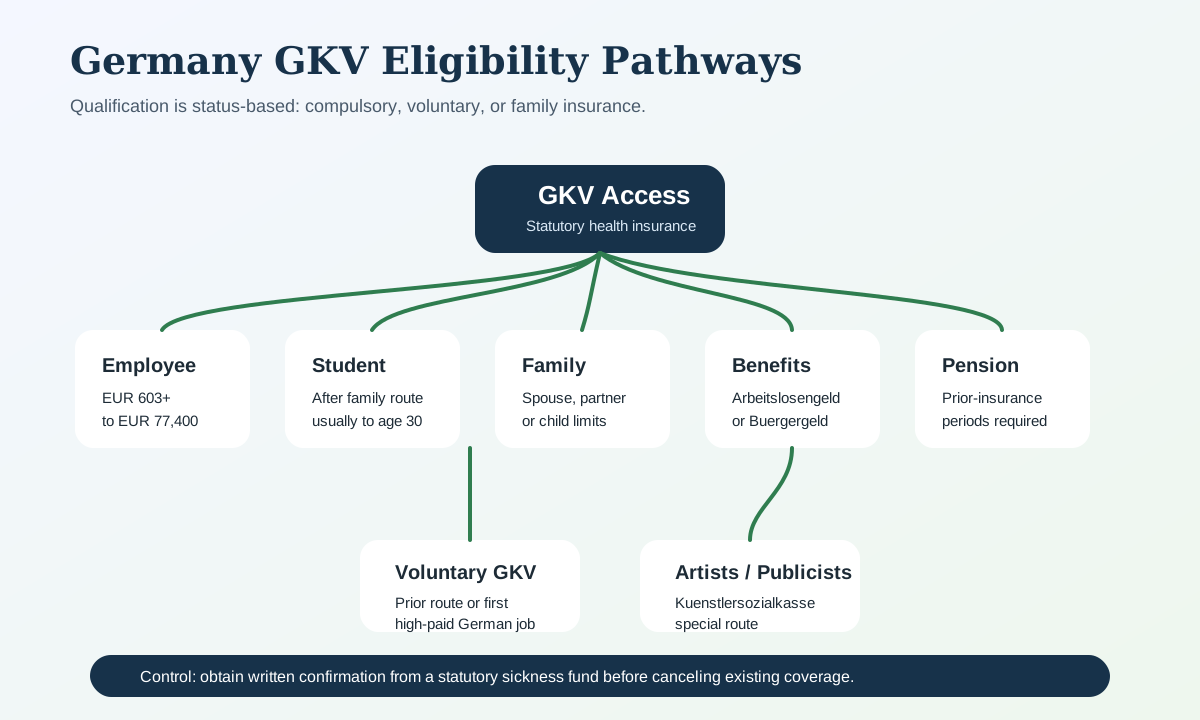
If you are asking how to qualify for public health insurance in Germany, you are usually asking whether you can join the statutory health insurance system, called gesetzliche Krankenversicherung or GKV. Germany does not treat public health insurance as a simple open-enrollment product. You qualify because your employment, study status, family relationship, benefits status, pension history, artist status, or prior insurance connection puts you inside the statutory system.
The short answer for 2026 is this: you usually qualify automatically if you are an employee earning more than EUR 603 per month and not more than EUR 77,400 per year, a qualifying student, an apprentice, a recipient of certain German benefits, an eligible pensioner, or an eligible family member of a GKV member. You may qualify voluntarily if you have the required prior connection to GKV or if you are starting your first job in Germany above the compulsory insurance threshold.
What "Public Health Insurance" Means in Germany
Germany has two main health-insurance branches:
| System | German term | Basic idea |
|---|---|---|
| Statutory health insurance | Gesetzliche Krankenversicherung, GKV | Public-law sickness funds with income-based contributions |
| Private health insurance | Private Krankenversicherung, PKV | Private contracts priced by individual risk and tariff terms |
The Federal Ministry of Health states that there are three main ways to be insured in GKV: compulsory membership, voluntary membership, and family insurance. It also reports 2026 GKV population figures and explains that many people are insured because of their status, not because they freely selected any system: Federal Ministry of Health: insured persons in GKV.
2026 Eligibility Snapshot
| Route | Who it covers | 2026 rule or threshold |
|---|---|---|
| Compulsory employee insurance | Employees above mini-job level and below the annual earnings threshold | More than EUR 603 monthly and not above EUR 77,400 annually |
| Student insurance | Students after family coverage ends, generally up to age 30 | Student health contribution EUR 87.38 monthly plus fund-specific additional contribution |
| Family insurance | Spouses, registered partners, and children of GKV members | Monthly income limit EUR 565, or EUR 603 for marginal employment |
| Voluntary insurance | People with prior GKV/family coverage or certain first-job cases | Eligibility depends on statutory route |
| Unemployment benefits | Recipients of Arbeitslosengeld and certain Buergergeld cases | Compulsory route under SGB rules |
| Pensioner insurance | Pensioners meeting prior-insurance periods | Not automatic for every retiree |
| Artists and publicists | Self-employed artists and publicists under KSVG | Special compulsory route through artists' social insurance |
The GKV-Spitzenverband's 2026 factsheet lists the annual earnings threshold for health insurance at EUR 77,400, the health and long-term care contribution assessment ceiling at EUR 69,750 annually or EUR 5,812.50 monthly, family insurance income limits, and student contribution figures: GKV-Spitzenverband 2026 figures and thresholds.
Route 1: You Qualify as an Employee
This is the most common route for international workers.
In 2026, employees are generally compulsory members of GKV if their employment income is:
| Income point | 2026 amount |
|---|---|
| More than the marginal employment threshold | EUR 603 per month |
| Not above the general annual earnings threshold | EUR 77,400 per year |
If you start a normal German employment contract inside that band, your employer usually registers you after you choose a statutory sickness fund. Make it in Germany, the official federal portal for skilled workers, explains that most employees in Germany have statutory health insurance and can choose from a range of statutory providers: Make it in Germany: health insurance.
| Situation | Likely GKV result |
|---|---|
| Salary is EUR 50,000 per year | Compulsory GKV membership |
| Salary is EUR 77,400 or below and above EUR 603 monthly | Compulsory GKV membership |
| Salary is above EUR 77,400 | Not compulsory under the general rule, but voluntary GKV may be possible |
| Mini-job only at or below the marginal threshold | Not the normal employee route into GKV |
| Self-employed with no prior GKV route | Not automatically eligible for GKV |
Route 2: You Earn Above the Threshold but Start Your First Job in Germany
High earners often assume they must choose private insurance. That is not necessarily correct.
The Federal Ministry of Health explains that employees who first take up employment in Germany and whose income is above the annual earnings threshold are exempt from compulsory insurance from the start of employment, but they may still join GKV voluntarily. The Ministry states this can apply even if they were previously privately insured and do not meet the usual prior-insurance periods: Federal Ministry of Health: voluntary membership and first employment in Germany.
This is a key rule for foreign hires. If you are a high-paid employee moving to Germany, ask a statutory sickness fund to confirm voluntary GKV eligibility before signing a private policy.
Route 3: You Qualify as a Student, Apprentice, or Intern
Students are often insured through family insurance first, then through student statutory insurance. The Federal Ministry of Health states that students are compulsory insured after family insurance ends, generally up to age 30. For 2026, the student health-insurance contribution is EUR 87.38 per month plus the fund-specific additional contribution. Long-term care insurance is separate.
| Student status | Typical insurance position |
|---|---|
| Under family insurance age and income limits | Free family insurance may apply |
| After family insurance ends and under normal student age rules | Student GKV route |
| Over age 30 | Exceptions are limited; verify directly with a sickness fund |
| Applicant before formal enrollment | May need temporary private or travel-stage cover until enrollment creates the student route |
Make it in Germany notes that apprentices, students, and interns are generally required to take statutory health insurance, with exceptions such as students over 30: Make it in Germany: health insurance without an employer.
Route 4: You Qualify Through Family Insurance
Family insurance is one of the most valuable parts of GKV because eligible dependents can be covered without separate contributions.
The Federal Ministry of Health states that children, spouses, and registered partners of GKV members are covered contribution-free if they live or ordinarily stay in Germany and do not regularly exceed the income limit. For 2026, the monthly income limit is EUR 565. If the family member's income is only from marginal employment, the relevant monthly figure is EUR 603.
| Family member | Typical age or income rule |
|---|---|
| Spouse or registered partner | Must meet residence and income requirements |
| Child under 18 | Usually eligible if other conditions are met |
| Child under 23 | Usually eligible if not employed |
| Child under 25 | Usually eligible if in education or certain voluntary service |
| Disabled child unable to support themselves | May be covered without age limit if disability conditions are met |
Family insurance can be blocked in specific mixed-insurance household cases, especially where one parent is privately insured and has income above the relevant threshold. Confirm with the sickness fund before assuming children are automatically free-covered.
Route 5: You Qualify Through German Benefits
The Federal Ministry of Health lists recipients of unemployment benefit under SGB III and, under certain conditions, recipients of Buergergeld among compulsory-insured groups.
This matters because a person who loses work in Germany may remain in or enter the statutory system through benefit status rather than through employment. The exact result depends on the benefit, prior insurance, and Jobcenter or employment-agency handling.
Route 6: You Qualify as a Pensioner
Pensioner access to GKV is not based only on age or residence. The Federal Ministry of Health lists pensioners as compulsory insured only if specific prior-insurance periods are met.
For international retirees, this is a major planning issue. A person who moves to Germany after a career outside the German or EU statutory systems may not automatically qualify for GKV as a pensioner. Retirees should obtain written confirmation from a statutory sickness fund before relocating or terminating foreign/private coverage.
Route 7: You Qualify as a Self-Employed Artist or Publicist
Ordinary self-employment does not automatically qualify you for GKV. But self-employed artists and publicists may fall under a special statutory route.
The Federal Ministry of Health states that self-employed artists and publicists are insured under the Artists' Social Insurance Act in statutory health, long-term care, and pension insurance in a way similar to employees. Contributions are shared through the Kuenstlersozialkasse mechanism: Federal Ministry of Health: artists and publicists in GKV.
Who Usually Does Not Qualify Automatically
| Profile | Why GKV may not be automatic |
|---|---|
| Newly arrived self-employed person | Self-employment alone does not create compulsory GKV membership |
| Jobseeker from outside the EU/EEA without employment | Official guidance says private insurance is generally needed |
| Retiree with no qualifying prior-insurance periods | Pensioner route depends on insurance history |
| High earner who misses the voluntary-entry window | Above-threshold employment must be handled carefully |
| Person using travel insurance | Travel cover is not the same as German statutory membership |
Make it in Germany states that non-EU/EEA citizens who are not employed, for example on a jobseeker visa, must take out private health insurance: Make it in Germany: jobseekers and health insurance.
Documents to Prepare
| Route | Documents commonly needed |
|---|---|
| Employee | Passport, residence/work status, employment contract, salary details, chosen sickness fund |
| High earner voluntary entry | Employment contract, salary evidence, first-employment-in-Germany facts, prior insurance history |
| Student | Enrollment certificate, passport, residence status, prior family insurance details if relevant |
| Family insurance | Marriage or partnership evidence, birth certificates for children, residence proof, income declarations |
| Benefits route | Benefit notice, prior insurance details, identity and residence records |
| Pensioner | Pension award, insurance-history evidence, foreign pension details, residence proof |
| Artist/publicist | KSK route evidence, activity proof, income forecast, identity and residence documents |
Practical Application Process
- Identify your route into GKV.
- Choose a statutory sickness fund.
- Ask the fund to confirm eligibility in writing.
- Submit identity, residence, employment, enrollment, family, benefit, pension, or KSK evidence.
- If employed, give your employer the fund confirmation.
- Keep confirmation of start date and membership.
- Recheck eligibility when salary, family income, student status, employment, or residence status changes.
First 60 Days After Enrollment
Enrollment is not finished when the application is submitted. During the first 60 days, confirm that the membership is active, the employer has the sickness fund details, the electronic employer notification has worked, and dependants are correctly registered if family insurance is used.
| Control | Why it matters |
|---|---|
| Membership certificate received | Proves the fund accepted the route |
| Employer has fund details | Prevents payroll and contribution errors |
| Start date matches employment or study | Avoids insurance gaps |
| Health card issued or in progress | Enables routine care access |
| Family insurance confirmed separately | Prevents spouse or child coverage assumptions |
| Long-term care contribution checked | Avoids underestimating deductions |
| Previous cover not cancelled too early | Prevents gaps during transition |
If the fund requests more evidence, respond with documents, not general statements. German statutory eligibility is route-based. A student, employee, voluntary member, family member, pensioner, and artist may all need different evidence.
When Eligibility Changes
GKV status should be reviewed after salary increases, job loss, student-status changes, self-employment launch, family income changes, marriage, childbirth, retirement, or a move abroad. A person who was compulsory insured as an employee may later become voluntary. A spouse who was family-insured may need separate insurance after income increases. A student may leave the student tariff after age or study-status changes.
Create a small review file:
| Event | Evidence to keep |
|---|---|
| Salary crosses threshold | Employer notice and payroll records |
| Job ends | Termination, unemployment, or new insurance confirmation |
| Self-employment begins | Business registration and fund correspondence |
| Family income changes | Income declaration and fund response |
| Child born | Birth certificate and family-insurance confirmation |
| Study ends | University notice and next insurance route |
Do not assume the fund automatically has the latest facts. Notify the fund when the change affects eligibility, contribution, or family insurance.
Contribution Concepts You Should Know
| Concept | Meaning |
|---|---|
| General contribution rate | Statutory percentage applied to contribution-relevant income |
| Additional contribution | Fund-specific add-on contribution |
| Contribution assessment ceiling | Maximum income considered for contributions |
| Long-term care insurance | Separate mandatory contribution layer |
| Employer share | For employees, employer generally contributes to statutory health insurance |
| Voluntary-member income base | Voluntary members may have broader income counted than compulsory employees |
The Federal Ministry of Health's contribution page states that in 2026 income is considered up to EUR 5,812.50 per month or EUR 69,750 per year for statutory health and long-term care contributions. It also confirms the 2026 annual earnings threshold of EUR 77,400 for compulsory insurance: Federal Ministry of Health: GKV contributions.
Decision matrix
| Situation | Evidence to prepare | Authority or reviewer | Risk and fallback | Next step |
|---|---|---|---|---|
| German employee above mini-job level and not above the 2026 annual threshold | Employment contract, salary calculation, start date, chosen sickness fund, and employer payroll contact. | Employer payroll and statutory sickness fund. | Wrong salary classification can delay membership; fallback is payroll-confirmed salary and fund confirmation before work starts. | Send the fund confirmation to HR and keep the start-date proof. |
| High earner starting first employment in Germany | Employment contract, annual salary, prior insurance history, arrival date, and first-employment facts. | Statutory sickness fund, employer, and adviser if private insurance is also considered. | Choosing PKV too early can close off a useful GKV route; fallback is written voluntary-GKV assessment before signing PKV. | Ask a fund to confirm voluntary eligibility in writing. |
| Spouse, registered partner, or child seeking family insurance | Relationship documents, residence proof, income declaration, and main member's GKV details. | Statutory sickness fund. | Income or mixed-insurance household rules can block family insurance; fallback is separate cover or corrected evidence. | Verify each family member by name and income status. |
| Student, apprentice, or intern | Enrollment or training evidence, age, prior family insurance, university instruction, and contribution information. | University and statutory sickness fund. | A visa-stage policy may not unlock enrollment; fallback is recognized statutory confirmation or valid exemption route. | Follow the university's insurance confirmation process before semester deadlines. |
| Self-employed person, artist, or publicist | Prior GKV evidence, business registration, activity description, income forecast, or KSK route evidence. | Statutory fund, Kuenstlersozialkasse where relevant, and private insurer if GKV is unavailable. | Self-employment alone does not create automatic GKV access; fallback is private comprehensive cover or a confirmed special statutory route. | Get route confirmation before cancelling existing insurance. |
| Retiree or benefits recipient | Pension notice, benefit notice, prior-insurance periods, foreign pension context, and residence proof. | Statutory fund, pension authority, employment agency or Jobcenter where relevant. | Age or residence alone may not qualify; fallback is private cover or EU coordination route if confirmed. | Ask the fund to assess eligibility from full insurance history. |
| Non-EU jobseeker or newcomer before a qualifying route starts | Visa-stage policy, arrival date, job-search status, future employment evidence if available, and cancellation terms. | Consulate, residence office, insurer, and later employer or sickness fund. | Travel or private cover may be temporary only; fallback is transition to GKV once qualifying employment starts. | Calendar the reassessment date and keep bridge cover active until GKV start is confirmed. |
FAQ
Is public health insurance in Germany free?
No. GKV is contribution-funded. Some family members can be covered without separate contributions, but the system itself is funded through member and employer contributions plus federal subsidies.
Can any expat choose public health insurance in Germany?
No. You need a qualifying route such as employment below the threshold, student status, family insurance, benefit status, pensioner eligibility, voluntary membership, or a special route such as artists' social insurance.
What is the 2026 salary threshold for public insurance in Germany?
For 2026, the general annual earnings threshold for compulsory statutory health insurance is EUR 77,400. Employees above that are generally exempt from compulsory insurance, but voluntary GKV may still be possible in specific cases.
Can a spouse join GKV for free?
A spouse or registered partner can be covered through family insurance if the statutory conditions are met, including residence in Germany and the income limit.
Can self-employed expats join public health insurance?
Sometimes, but not automatically. A self-employed person often needs a prior GKV connection, voluntary-membership eligibility, or a special statutory route such as the artists' social insurance system.
Can students get public health insurance?
Generally yes, within the statutory student rules. After family insurance ends, students are usually compulsory insured up to age 30, subject to exceptions.
Is travel insurance enough for Germany?
Travel insurance may help for visa or arrival purposes, but it is not the same as full German statutory health insurance. Long-term residents need coverage that satisfies German requirements.
Final Decision Checklist
- Are you an employee, student, family member, benefit recipient, pensioner, artist, or voluntary applicant?
- Is your 2026 salary above EUR 603 per month and not above EUR 77,400 per year?
- If above EUR 77,400, are you starting your first job in Germany and eligible for voluntary GKV?
- If applying through family insurance, is monthly income within the EUR 565 or EUR 603 limit?
- If a student, are you under the normal age rules or inside an exception?
- If self-employed, do you have prior GKV eligibility or a special statutory route?
- If retired, do you meet the required prior-insurance periods?
- Has a statutory sickness fund confirmed your eligibility in writing?
- Does your coverage start date match your employment, enrollment, residence, or benefit start date?
- Have you avoided canceling existing cover before German coverage is confirmed?
Application Evidence by Route
| Route | Evidence to prepare |
|---|---|
| Employee compulsory insurance | Employment contract, salary, start date, chosen sickness fund |
| Voluntary employee route | Salary, prior insurance history, first-employment facts, fund confirmation |
| Student | Enrollment, age, prior cover, university instruction |
| Family insurance | Marriage or birth evidence, residence, income declaration |
| Self-employed voluntary route | Prior GKV evidence, business registration, income estimate |
| Artist or publicist | KSK-related activity evidence and income forecast |
| Pensioner | Pension notice, prior-insurance periods, foreign pension context |
Submit the route-specific evidence instead of sending a generic bundle. A sickness fund can review a clear route faster than a mixed file with unexplained documents.
Common Rejection or Delay Reasons
| Problem | Practical response |
|---|---|
| Salary threshold unclear | Ask employer for regular annual salary calculation |
| Prior insurance missing | Request certificate from previous insurer |
| Family income unclear | Submit income declaration and supporting proof |
| Student age or status issue | Ask university and fund for route confirmation |
| Self-employed route weak | Confirm voluntary eligibility before canceling private cover |
| Residence document pending | Provide appointment or application receipt if accepted |
If eligibility is uncertain, do not cancel existing cover. Keep bridge coverage until the fund confirms start date in writing.
For urgent employer onboarding, send the fund confirmation to payroll and keep the original response. If payroll, the fund, and a private insurer give conflicting answers, pause and ask each reviewer which rule or document it is applying before changing cover.
Factual Uncertainty and Source Risks
This article uses official 2026 figures available as of May 18, 2026. German thresholds are updated regularly, and sickness funds may request different evidence depending on the route. Family insurance, voluntary membership, pensioner insurance, and self-employed cases can be fact-specific, so written confirmation from a statutory sickness fund is more reliable than general guidance.
Policy discussions and future legislation may change contribution rules or family-insurance rules after 2026. Use the official Ministry and GKV-Spitzenverband pages for the final current figures before making an insurance decision.
Official and Primary Sources
- Federal Ministry of Health: insured persons in statutory health insurance
- Federal Ministry of Health: GKV contributions and 2026 thresholds
- GKV-Spitzenverband: 2026 contribution figures and thresholds
- Make it in Germany: health insurance
- Federal migration health portal: German health care system
- German Social Code Book V statutory text
Official source and decision check
Use this section as the practical checkpoint for How to Qualify for Public Health Insurance in Germany. The reader decision is whether the available evidence is strong enough to act now, or whether the file should first be confirmed with the competent authority. Rules can change by country, status and date, so treat this guide as orientation for the file and recheck the current rule before relying on an appointment, employer filing, permit change, payroll step or registration deadline.
For expats, foreigners, students, workers, founders, families and other mobile readers, record the reader category, country, residence status and deadline before comparing the official source with the article checklist.
Official sources to verify first
- Make it in Germany official portal
- Federal Foreign Office Germany
- Federal Employment Agency
- Federal Office for Migration and Refugees
- German laws online
| Decision point | What to check | Reader action |
|---|---|---|
| Administrative decision | Confirm that the case is really about administrative decision, not a different category that follows another rule. | Write down the country, authority, dates, status and document number before asking for a decision. |
| File for competent authority | Keep the identity, residence and document evidence in one dated file, with originals, translations where required and proof of submission. | Save receipts, emails, appointment confirmations, payment records and authority replies in the same order as the checklist. |
| How to Qualify for Public Health Insurance in Germany fallback | If the answer is refused, delayed or unclear, identify the competent authority, review window, complaint route or regulated provider escalation path. | Ask for the reason in writing and compare it with the official source before paying again, travelling, closing an account or resubmitting. |
| When the answer is unclear | What to do next |
|---|---|
| The authority, bank, insurer, employer or provider gives a verbal answer only. | Ask for the answer in writing, save the name of the office or provider, and compare it with the official source before changing travel, payroll, residence or payment plans. |
| The file depends on a deadline, appointment, payment, address or status change. | Keep the dated receipt, note the next deadline, and avoid closing the old route until the replacement document, account, policy or registration is confirmed. |
Related guides to cross-check
- First month in Europe checklist
- Living in one European country and working in another
- EU remote working guide
- Cross-border worker benefits in the EU
- Private health insurance documents in Europe
For legal, tax, medical, immigration or financial consequences, confirm the position with the competent authority or a qualified adviser. This page is designed to organize the decision, source checks and next steps; it is not a substitute for case-specific professional advice.