Last updated
Can I Buy Health Insurance Privately in Europe? A Practical Guide for Foreigners and Expats
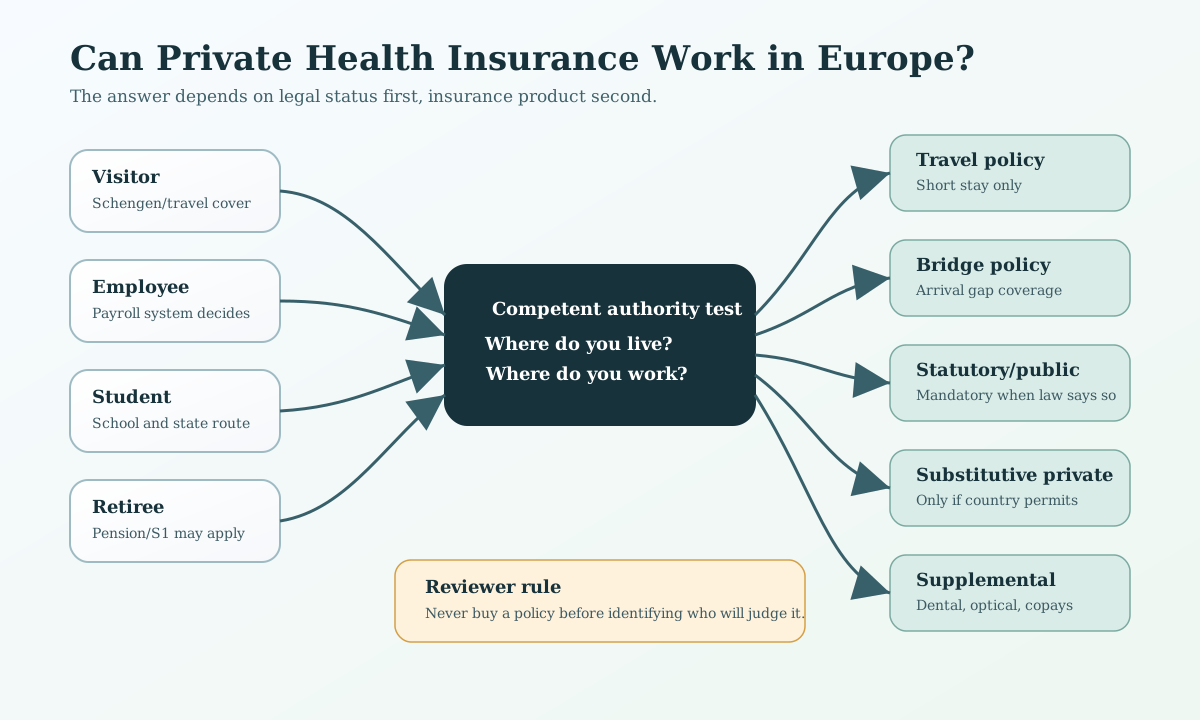
For readers, the hard part of Can I Buy Health Insurance Privately in Europe? A Practical Guide for Foreigners and Expats is knowing which fact changes the answer. It explains matching health-insurance eligibility, public or private cover, registration evidence, and renewal risk across Europe, then shows how to separate public eligibility, private cover, emergency access, contribution rules, and the evidence needed for residence or work. The later sections connect the legal baseline: europe is not one health-insurance market, schengen travel insurance is not resident health insurance, and country patterns: where private insurance fits so the next step is easier to judge. Read it before submitting forms, moving money, choosing a provider, or assuming that a rule from another country applies.
For most foreigners, private health insurance in Europe falls into one of five roles:
| Role | What it does | What it usually does not do |
|---|---|---|
| Travel medical insurance | Supports short-stay Schengen visa or visitor requirements | Create long-term resident healthcare rights |
| Visa or residence private insurance | Satisfies a specific consulate or residence-permit requirement | Replace public enrollment once local law requires it |
| Bridge insurance | Covers the gap before statutory registration is active | Override payroll, social-security, or residency rules |
| Substitutive private insurance | Replaces statutory coverage only where national law permits it | Apply automatically across Europe |
| Supplemental insurance | Covers copays, dental, optical, private rooms, faster access, or private networks | Replace mandatory public or statutory insurance |
The core rule is simple: private insurance is a product; health coverage eligibility is a legal status question. In Europe, the competent health system usually depends on where you live, where you work, whether you are economically active, and whether EU social-security coordination documents apply.
Last source check: May 14, 2026.
Short answer
You can buy private health insurance in Europe if an insurer will sell it to you and the policy is lawful for your situation. But you cannot assume that buying private insurance lets you avoid local statutory health insurance, payroll contributions, or residence-registration obligations.
A private policy may be enough if you are:
| Situation | Private insurance may be enough? | Main caveat |
|---|---|---|
| Short-stay Schengen visitor | Yes | Must meet visa medical-insurance requirements if a visa is required |
| Long-stay visitor or non-working resident | Sometimes | Depends on the specific national visa or residence category |
| Employee in a European country | Usually no | Payroll and statutory social-security rules often control |
| Self-employed resident | Sometimes | Many countries still require public or statutory enrollment or contributions |
| Student | Sometimes | Depends on age, employment, country, and school requirements |
| Retiree | Sometimes | EU/EEA/Swiss/UK coordination documents such as S1 may matter |
| Digital nomad or remote worker | Sometimes | Immigration approval does not automatically settle tax, social security, or healthcare classification |
| Permanent resident | Usually not as sole coverage | Host-country statutory or residence-based rules normally become more important |
The legal baseline: Europe is not one health-insurance market
The European Union coordinates social-security systems, but it does not create one universal European health insurer. The EU's public guidance says that the country responsible for your social security and health coverage depends on your economic status and place of residence, not simply your nationality. See Your Europe: health insurance cover in your host country.
That matters because a U.S. citizen, Canadian citizen, UK citizen, EU citizen, or dual citizen can face different documentation paths even inside the same city.
The first question is not "Which private insurer is best?" It is:
Which authority will judge my coverage?
| Authority | What it checks | Example evidence |
|---|---|---|
| Consulate or visa center | Whether coverage meets visa rules | Insurance certificate, coverage territory, validity dates, exclusions |
| Immigration authority | Whether residence conditions are met | Residence-permit category, proof of resources, insurance certificate |
| Employer or payroll | Whether statutory social-security contributions are required | Employment contract, payroll registration, A1/S1 where relevant |
| Public health fund | Whether you must enroll locally | Residence proof, work proof, tax or social-security number |
| School or university | Whether students meet enrollment conditions | Student status, EHIC/S1/private insurance certificate |
| Tax or social-security authority | Which country is competent | Work location, employer location, self-employment records, treaty documents |
Schengen travel insurance is not resident health insurance
For short-stay Schengen visas, the European Commission lists medical insurance among the required documents, covering emergency medical care, hospitalization, and repatriation. See European Commission: applying for a Schengen visa.
That requirement is narrow. It supports a temporary visit of up to 90 days in any 180-day period. It is not proof that you are entitled to resident healthcare, and it does not settle what happens after you move, work, register, or become tax resident.
Use this distinction:
| Insurance type | Designed for | Typical duration | Resident substitute? |
|---|---|---|---|
| Schengen travel policy | Short temporary visit | Trip period | No |
| Long-stay visa medical policy | Initial immigration file | Often 3-12 months | Sometimes temporarily |
| International expat policy | Cross-border private access | Annual renewable | Only if accepted for status |
| Local private medical insurance | Private hospitals and doctors | Annual renewable | Country-specific |
| Public or statutory coverage | Resident or work-based legal entitlement | Ongoing | Usually primary once required |
Country patterns: where private insurance fits
France
France's public system is built around stable and regular residence or work. Ameli states that anyone who works or resides in France in a stable and regular manner has the right to coverage of health costs under PUMa. See Ameli: protection universelle maladie.
Private insurance can still matter in France, but usually as:
| Use case | Private insurance role |
|---|---|
| Long-stay visitor visa | Proof of medical cover may be required before arrival |
| First months before PUMa activation | Bridge coverage |
| After French public enrollment | Supplemental mutuelle or top-up |
| Private provider preference | Access and comfort layer |
| Non-covered or partially covered expenses | Dental, optical, private-room, and copay management |
France is a good example of why sequence matters: classify eligibility first, then buy private coverage for gaps.
Germany
Germany has a dual statutory/private structure, but insurance is still compulsory. The Federal Ministry of Health explains that health coverage is provided through statutory health insurance and private health insurance. See Germany Federal Ministry of Health: statutory health insurance.
Germany is one of the countries where private health insurance can be a lawful primary route for some people. But it is not a casual opt-out. Eligibility depends on category, income/employment status, prior insurance, student status, and whether the policy meets German requirements.
Important risk: BaFin notes that it does not decide whether a foreign EU/EEA health insurance contract satisfies Germany's statutory health-insurance obligation. See BaFin: private health and compulsory long-term care insurance.
Netherlands
The Netherlands is stricter than many expats expect. The Dutch government states that everyone who lives or works in the Netherlands must take out basic health insurance. See Government.nl: taking out compulsory health insurance.
Private "international expat insurance" generally does not replace the compulsory Dutch basic package once Dutch law says you must enroll. Additional insurance is optional; basic insurance is mandatory.
Spain
Spain uses public healthcare eligibility, regional health cards, and visa-specific private-insurance rules. The Ministry of Health describes the individual health card as the official document for accessing National Health System services after the right to public healthcare is accredited. See Spain Ministry of Health: Tarjeta Sanitaria Individual.
For some Spanish residence visas, private insurance must be contracted with an insurer authorized to operate in Spain and may need to cover risks insured by Spain's public system with no deductible, copay, waiting period, or coverage limit. For example, see Spanish Consulate Los Angeles: non-working residence visa.
Spain is therefore a dual-check country: the consulate may require private insurance for a visa, while later public access depends on residence, work, social-security, or regional registration rules.
Portugal
Portugal's public system is the SNS. The Portuguese government says legally resident foreigners can obtain an SNS user number, but also warns that having a health user number alone does not guarantee that healthcare expenses will be covered by the SNS. See gov.pt: healthcare in Portugal for migrants and gov.pt: obtain the SNS user number.
Private insurance is common for visa filing, transition periods, faster private access, and supplemental coverage. But the SNS user number, legal residence, social-security registration, and cost-coverage status should be confirmed separately.
Private insurance decision framework
Use this order before buying a policy.
| Step | Question | Evidence to collect |
|---|---|---|
| 1 | Am I a visitor, student, employee, self-employed person, retiree, or non-working resident? | Visa category, employment contract, school acceptance, pension records |
| 2 | Which country is responsible for my healthcare? | Residence location, work location, EU coordination documents, employer payroll advice |
| 3 | Is statutory or public enrollment mandatory? | Official national health-system guidance |
| 4 | If private insurance is allowed, must it be local or authorized? | Consulate wording, insurer authorization, regulator register |
| 5 | Does the policy match the authority's wording? | Certificate, exclusions, deductible/copay terms, territory, start date |
| 6 | What happens when status changes? | Renewal plan, employment start date, registration deadline |
| 7 | What residual costs remain? | Dental, optical, chronic care, prescriptions, private hospital access |
Evidence checklist before you purchase
A policy that looks good in a comparison table can still fail at a visa, employer, or health-fund checkpoint. Ask for written answers to the following:
| Evidence item | Why it matters |
|---|---|
| Full legal name matching passport | Prevents visa-file mismatch |
| Coverage start date | Must align with entry or residence date |
| Coverage territory | "Europe" may not equal Schengen area or a specific country |
| Repatriation coverage | Required for many short-stay visa files |
| Emergency and hospitalization coverage | Core visa and medical-risk requirement |
| Deductible and copay wording | Some visas reject deductible or copay structures |
| Waiting periods | Can create early-claim gaps |
| Chronic or pre-existing condition treatment | Major risk for ongoing medication |
| Maternity coverage | Often excluded or waiting-period restricted |
| Direct billing | Practical hospital-access issue |
| Cancellation terms | Needed if statutory coverage begins mid-policy |
| Regulator authorization | Critical where only authorized insurers are accepted |
Common failure modes
| Failure mode | Why it happens | Prevention |
|---|---|---|
| Buying travel insurance for a residence case | The policy is designed for temporary travel | Match policy type to visa or residence status |
| Assuming "private" means "legal substitute" | National systems decide eligibility | Check official country rules first |
| Ignoring payroll obligations | Employment often triggers statutory contributions | Confirm employer and social-security classification |
| Using a foreign insurer where local authorization is required | Some visas require authorized local insurers | Verify the exact consular wording |
| Missing family-member rules | Dependents may need separate proof | Build a person-by-person coverage matrix |
| Allowing a gap between arrival and registration | Public enrollment may take time | Buy bridge coverage and document submissions |
| Treating EHIC as resident coverage | EHIC is for temporary necessary care | Use EHIC only within its intended scope |
How to choose between public, private, and supplemental coverage
| Your priority | Better starting point |
|---|---|
| Legal compliance | Official national health-system or immigration page |
| Visa approval | Consulate checklist for your jurisdiction |
| Long-term cost control | Statutory or public system plus supplemental cover |
| Fast access to private doctors | Local private plan or international expat plan |
| Chronic-care continuity | Public eligibility plus specialist-access plan |
| Short stay only | Schengen-compliant travel medical policy |
| Remote-worker move | Immigration, tax, social-security, and health review together |
Decision Workflow Before Buying
Use this sequence before paying for a private policy.
| Step | Question | Why it matters |
|---|---|---|
| 1 | Are you visiting, moving, working, studying, retiring, or joining family? | The policy role depends on status |
| 2 | Which country will be your residence or work country? | National law controls mandatory coverage |
| 3 | Is there a visa or residence checklist? | Authorities may require specific wording |
| 4 | Are you economically active? | Employment or self-employment can trigger statutory obligations |
| 5 | Is public registration available or mandatory? | Private cover may be temporary only |
| 6 | Are family members included? | Dependants may need separate proof |
| 7 | Does the policy cover routine resident care? | Travel cover is often too narrow |
| 8 | Can the insurer issue accepted certificates? | Document format can block applications |
| 9 | What is the exit plan? | You may need to switch to public coverage later |
Private insurance is safest when it is assigned a precise job: short-stay visa proof, bridge cover, supplemental benefits, or legal substitute where national law allows it. It is risky when bought as a generic answer to a legal status problem.
Documents to Request From the Insurer
Before purchase, ask for more than a quote.
| Document | Why it matters |
|---|---|
| Policy wording | Shows exclusions, limits, and claim rules |
| Certificate of insurance | Used for visa, employer, university, or residence file |
| Country validity statement | Confirms the destination country is covered |
| Waiting-period schedule | Shows delayed benefits |
| Pre-existing condition rule | Prevents surprise claim denial |
| Deductible and co-payment table | Converts premium into real cost |
| Cancellation and renewal rule | Shows whether cover is stable |
| Emergency assistance procedure | Shows what to do during hospitalization |
| Claims appeal process | Gives a path for disputed reimbursement |
Save these documents before filing a visa or residence application. If the authority rejects the policy, a complete document set makes it easier to diagnose whether the problem is certificate wording, benefit scope, insurer authorization, duration, deductible, or local legal status.
Practical Examples
A U.S. retiree applying for a long-stay visitor visa may need private medical cover because there is no local employer or immediate statutory contribution route. The same person may later become eligible for a public system depending on residence country and duration. The private policy is not wrong, but its role may change.
A software employee moving to Germany for payroll work should not assume an international private policy replaces German compulsory health insurance. The employer, statutory fund, or private-insurance eligibility rules must be checked under German law.
A student in France may use a private policy for a visa or arrival gap, but the longer-term route may involve French health registration depending on status and stay. The question is not whether private insurance exists; it is when it is acceptable.
A digital nomad visa applicant may satisfy an immigration checklist with private cover, but tax residence, social-security obligations, and local healthcare access can still change after arrival.
First 90 Days After Moving
The first 90 days after arrival should be treated as a verification period. A policy that was useful for visa filing may become insufficient after residence, employment, study, or self-employment begins.
| Timing | Action | Why it matters |
|---|---|---|
| Arrival week | Confirm policy start date, emergency number, and country validity | Prevents immediate access problems |
| First month | Identify whether public or statutory registration is required | Private cover may be temporary only |
| First month | Ask employer, university, or residence office what proof they need | Reviewers may require different documents |
| Days 30 to 60 | Submit public-system or statutory registration if applicable | Avoids accidental long-term reliance on bridge cover |
| Days 60 to 90 | Decide whether private cover remains primary, bridge, or supplemental | Aligns cover with actual status |
| Before renewal | Compare premium, deductible, exclusions, and legal role again | Prevents auto-renewing the wrong product |
Do not wait for a claim to discover that the policy is not accepted for resident care. Verify while you are healthy and still have time to change course.
Private Insurance Refusal File
If a private policy is rejected by an authority, employer, university, or residence office, keep a short refusal file.
| Evidence | Why it helps |
|---|---|
| Policy certificate | Shows what was submitted |
| Policy wording | Shows benefit scope and exclusions |
| Rejection message | Shows exact reason if provided |
| Reviewer checklist | Shows controlling requirement |
| Insurer response | Shows whether certificate can be corrected |
| Replacement proof | Shows how the gap was solved |
The fix depends on the reason. A missing certificate date is different from an unauthorized insurer, a high deductible, a travel-only policy, or an applicant who is legally required to join a statutory system.
Country-Specific Confirmation
Before buying, ask for country-specific confirmation in writing. The phrase "valid in Europe" is too broad. You need to know whether the policy is valid for the destination country, the visa or residence purpose, the applicant's status, and the likely treatment setting.
For Germany, ask whether the policy satisfies the relevant German obligation or only provides temporary incoming cover. For France, ask whether it is visa/bridge/supplemental cover or whether Assurance Maladie registration is the actual long-term route. For the Netherlands, verify compulsory basic insurance rules before assuming a private international plan is enough. For Spain or Portugal, separate visa proof from later public-health registration or private-policy adequacy.
When Private Insurance Is a Bad Shortcut
Private insurance becomes a bad shortcut when it is used to avoid a legal registration step, hide employment status, postpone social-security compliance, or cover a family member who needs a different route. It can also be risky when the applicant has chronic conditions and buys a policy with exclusions without understanding the out-of-pocket exposure.
Use private insurance as a precise tool. Do not use it as a vague substitute for official status analysis.
FAQ
Can an American buy private health insurance in Europe?
Yes. Americans can often buy international or local private health insurance. But a private policy may not satisfy residence, work, or statutory health-insurance requirements. Always check the official rule for the country and visa category.
Can I live in Europe with only private health insurance?
Sometimes, but not everywhere and not for every status. Long-stay visitors, retirees, or digital nomads may use private insurance for visa or residence purposes in some countries. Employees and long-term residents are more often pulled into statutory or public systems.
Does Schengen travel insurance cover me if I move to Europe?
No. Schengen travel insurance is designed for temporary stays. It may help with entry or short-stay visa requirements, but it is not a full resident healthcare plan.
Is private health insurance mandatory for European visas?
For many visa categories, yes. Short-stay Schengen visa applicants generally need travel medical insurance. Some long-stay visas also require private medical insurance. The exact terms depend on the consulate and visa route.
Can private insurance replace public health insurance in Germany?
For some people, yes, but only under German rules. Germany has statutory and private health insurance systems, and eligibility depends on status. Do not assume an international expat policy meets German compulsory-insurance standards.
Can private insurance replace basic health insurance in the Netherlands?
Usually no once you live or work there and Dutch law requires basic health insurance. Additional insurance is optional, but the basic package is compulsory for people within the obligation.
Do I need private insurance in France?
You may need it for a visa, transition period, or supplemental coverage. But if you work or reside in France stably and regularly, the main question is eligibility for French Assurance Maladie/PUMa, not which private insurer to buy first.
Is private insurance useful if I already have public coverage?
Yes. Supplemental insurance can reduce out-of-pocket costs and improve access to private providers, dental, optical, private rooms, or specialist networks. It should be designed around the gaps left by your base system.
Factual uncertainty and source risks
| Risk | Practical implication |
|---|---|
| National healthcare rules change | Recheck official portals before filing a visa or residence renewal |
| Consulates apply wording differently | Use the checklist for the exact jurisdiction handling the application |
| Insurance acceptance is fact-specific | A policy accepted for one visa category may fail for another |
| Germany's compulsory-insurance analysis is technical | Ask whether the specific policy satisfies the relevant German obligation |
| Portugal and Spain separate registration from cost coverage | A health number or visa-compliant policy may not answer every reimbursement question |
Sources
- Your Europe: health insurance cover in your host country
- European Commission: applying for a Schengen visa
- EIOPA: register of insurance undertakings
- Ameli: protection universelle maladie
- Germany Federal Ministry of Health: statutory health insurance
- BaFin: private health and compulsory long-term care insurance
- Government.nl: taking out compulsory health insurance
- Spain Ministry of Health: Tarjeta Sanitaria Individual
- Spanish Consulate Los Angeles: non-working residence visa
- gov.pt: healthcare in Portugal for migrants
- gov.pt: obtain the SNS user number