Last updated
Health Insurance for Freelancers in Europe
Direct answer
The practical question behind Health Insurance for Freelancers in Europe is which facts, documents, costs, and deadlines change the next step. It explains matching health-insurance eligibility, public or private cover, registration evidence, and renewal risk across Europe, then shows how to separate public eligibility, private cover, emergency access, contribution rules, and the evidence needed for residence or work. The later sections connect executive answer, the core rule: insurance follows economic status and place of work, and main health-insurance models for freelancers so the next step is easier to judge. Read it before submitting forms, moving money, choosing a provider, or assuming that a rule from another country applies.
The answer changes when you work in more than one country, move mid-year, keep clients in another state, or fall into a national split system such as Germany's statutory-versus-private choice for some self-employed people. In those cases, the key question becomes which country is competent for your social-security coverage and whether your residence country will accept that setup for healthcare access.
Next step: write down where you physically perform the work, where you live, and whether you work in one country or several, then use that fact pattern to confirm the competent system before you buy any policy.
Source-check date: May 14, 2026. This guide is general information, not legal, tax, immigration, insurance, medical, or social-security advice.
Freelancers in Europe do not enter one unified "European health insurance system." They enter a national health system, while EU social-security coordination determines which country is responsible when work, residence, clients, or temporary assignments cross borders. The practical question is not "public or private?" It is: which country covers you, whether coverage is automatic or contribution-based, whether private insurance is mandatory or supplementary, and whether your self-employed status creates social-security obligations.
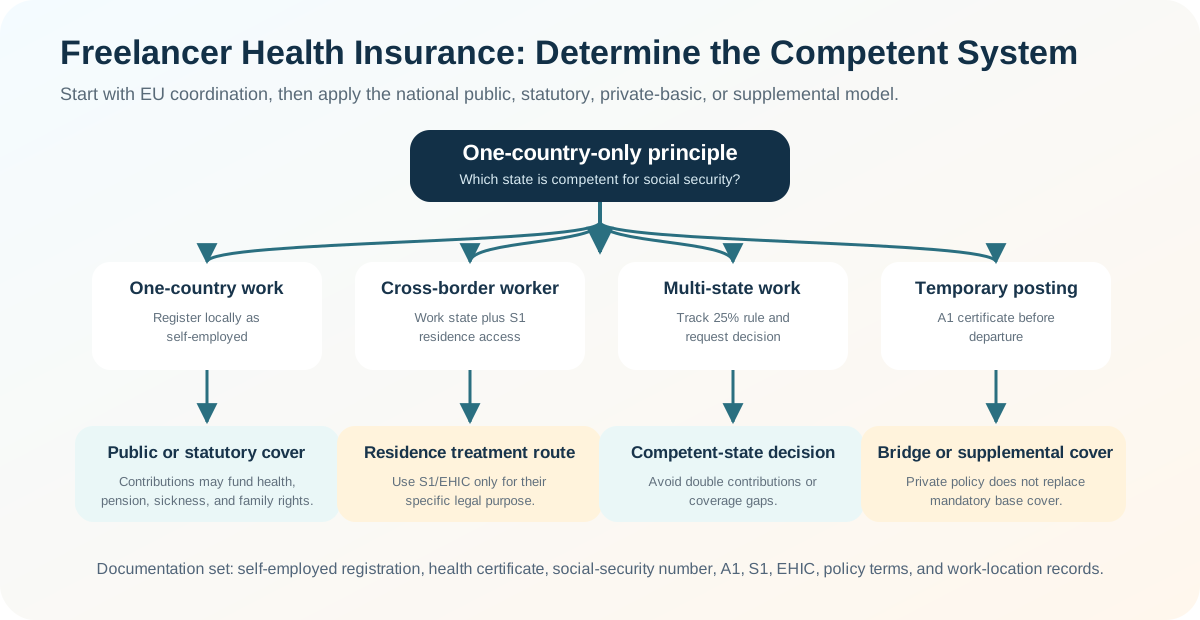
Executive Answer
Most freelancers living and working in one European country must join that country's health-insurance or social-security system. In countries with statutory or public systems, self-employed contributions may fund health coverage directly or through the broader social-security system. In countries with mandatory private basic insurance, freelancers still need statutory-compliant insurance. In countries with a public-private split, such as Germany, self-employed people may need to choose between statutory and private coverage, subject to national rules and previous insurance status.
EU coordination rules matter if you live in one country and work in another, work in several countries, are temporarily posted as self-employed, or move after already being insured elsewhere. The European Commission states that mobile workers are generally subject to the legislation of only one country at a time, and the basic rule is coverage in the country where the work is actually performed. See European Commission: Which rules apply to you.
The Core Rule: Insurance Follows Economic Status and Place of Work
Your Europe explains that, in the EU, the country responsible for social security and health cover depends on economic status and place of residence, not nationality. See Your Europe: Health insurance cover in your host country.
For a freelancer, that means four facts drive the answer:
| Fact | Why it matters |
|---|---|
| Where you physically perform the work | Often determines applicable social-security law |
| Where you reside | Relevant for healthcare access, S1 registration, and multi-state work |
| Whether you are truly self-employed | Misclassification can move you into employee coverage |
| Whether you work in multiple countries | EU coordination may assign one competent country |
The European Commission's coordination page states that people moving within the EU, Iceland, Liechtenstein, Norway, or Switzerland are subject to the legislation of only one country. It also states that if you are self-employed in one country, you are generally covered by that country, and that special rules apply for posted self-employed people and people working in more than one country. See European Commission: EU social-security coordination.
Main Health-Insurance Models for Freelancers
| Model | Countries where the pattern appears | How freelancers usually experience it | Main risk |
|---|---|---|---|
| Tax-funded or residence-based public health service plus social contributions | Some national-health-service systems | Register as resident and self-employed; pay tax or social contributions | Assuming residence alone is enough when self-employed registration is still required |
| Statutory social-insurance system | France, Spain, Belgium, Austria, others in different forms | Self-employed registration triggers contributions and healthcare rights | Underpaying or failing to register contributions |
| Statutory/private split | Germany is the major example | Self-employed people may face statutory voluntary insurance or private insurance choices | Choosing private coverage without understanding age, family, pre-existing-condition, and re-entry consequences |
| Mandatory private basic insurance under public rules | Netherlands, Switzerland | Buy compliant basic insurance from an insurer; may also pay income-related contribution | Buying travel or expat insurance that is not legally compliant |
| Hybrid public system plus voluntary top-up | Common across Europe | Public/statutory coverage is primary; private top-up covers speed, amenities, or private providers | Confusing supplemental cover with mandatory base cover |
EU Coordination Tools: EHIC, S1, A1, and "One Country Only"
| Tool or principle | What it does | What it does not do |
|---|---|---|
| One-country-only principle | Prevents normal double social-security coverage inside the coordinated area | Does not let you choose any country you prefer |
| EHIC | Covers medically necessary care during temporary stays, under public-system rules | Not a substitute for residence-based health insurance |
| S1 form | Lets certain insured people register healthcare rights in a residence country when insured elsewhere | Not available in every freelancer scenario |
| A1 certificate | Shows which country's social-security law applies during posting or multi-state work | Does not replace immigration, tax, or business registration |
| Aggregation of periods | Helps preserve rights when moving between systems | Does not harmonize contribution rates or benefit levels |
Your Europe states that cross-border workers can be entitled to medical treatment in both the country of work and the country of residence and should register with an S1 form where applicable. It also states that people working in more than one country may be covered in the residence country if they carry out at least 25% of professional activity there. See Your Europe: Health insurance cover.
Country System Snapshots
These examples are not substitutes for local advice, but they show how different "freelancer health insurance" can be across Europe.
| Country | Freelancer health-insurance pattern | Official source to verify |
|---|---|---|
| Germany | Health insurance is provided through statutory health insurance and private health insurance. Self-employed people often need to assess voluntary statutory coverage, private coverage, previous insurance status, family coverage, and long-term care insurance. | German Federal Health Ministry: Statutory health insurance |
| Germany contribution example | A statutory insurer's 2026 table shows self-employed contribution calculations using minimum and maximum monthly income bases and separate long-term care contributions. | TK: Health care contributions for self-employed persons |
| France | Individual entrepreneurs obtain social protection by paying social-security contributions; protection includes health insurance rights, maternity/paternity, and retirement. | Service-Public Entreprendre: Social protection of individual entrepreneurs |
| Netherlands | Everyone who lives or works in the Netherlands must take out standard health insurance; self-employed people may also face income-related healthcare contributions. | Government.nl: Standard health insurance and Business.gov.nl: Healthcare insurance |
| Spain | Self-employed workers fall under the Special Regime for Self-Employed Workers and are responsible for registration and contributions. | Spanish Social Security: Special Regime for Self-Employed Workers |
| EU/EEA/Switzerland comparison | MISSOC provides comparative tables and country guides covering healthcare, sickness, financing, and self-employed social protection. | European Commission: MISSOC |
Public vs Private: The Freelancer Decision Framework
| Decision factor | Public/statutory system | Private basic or private substitute | Supplemental private cover |
|---|---|---|---|
| Legal role | Often mandatory or default | May be mandatory in some countries or optional in split systems | Usually optional |
| Pricing | Often income-related | Often risk, age, deductible, or plan-based | Plan-based |
| Family coverage | May include dependent family rules | Often priced per person | Usually per person |
| Pre-existing conditions | Statutory systems are generally more predictable | Medical underwriting may matter where private substitute coverage is allowed | Exclusions may apply |
| Long-term stay risk | Usually more stable | Can become expensive with age depending on country and contract | Less critical because base coverage remains public |
| Tax treatment | Contributions may be deductible under national rules | Premium deductibility varies | Deductibility varies |
| Best use | Long-term residents, families, uncertain income, chronic care needs | Countries where basic private insurance is mandatory or high-income/self-employed cases where private is legally suitable | Faster access, private rooms, dental, vision, international add-ons |
Common Freelancer Scenarios
| Scenario | Likely insurance question | Practical answer |
|---|---|---|
| You move to one EU country and freelance locally | Which national system covers self-employed residents? | Register self-employment, social security, and health insurance in the host country |
| You live in country A and freelance physically in country B | Which country is competent for social security? | Start with the country of work; examine S1 and cross-border-worker rules |
| You work online for clients abroad while living in Europe | Does client location decide health insurance? | Usually no; physical work location and residence are more important for social security |
| You split time between two or more countries | Does the 25% rule apply? | Track working time and income by country; request competent-institution guidance |
| You temporarily post yourself to another country | Can you remain insured at home? | Possible for limited postings if conditions are met; request A1 before departure |
| You are a non-EU freelancer on a visa | Is private travel insurance enough? | Usually no for long-term residence; check visa and national health-insurance rules |
| You are misclassified as a contractor | Are you actually an employee? | Employment reclassification can change social-security, health, tax, and client obligations |
What Travel Insurance and Expat Insurance Usually Do Not Solve
Many freelancers arrive with travel insurance, international private medical insurance, or a policy required for visa issuance. That can be useful for entry or temporary gaps, but it may not satisfy national health-insurance obligations after residence or self-employment begins.
Before relying on a private policy, confirm:
| Test | Question |
|---|---|
| Legal compliance | Is this policy accepted by the residence authority and health-insurance regulator? |
| Duration | Does it cover long-term residence, not just emergency travel? |
| Scope | Does it cover primary care, prescriptions, hospital care, maternity, mental health, and pre-existing conditions? |
| Waiting periods | Are important services delayed? |
| Deductibles | Could a high deductible violate visa or insurance requirements? |
| Cancellation | Can the insurer cancel or refuse renewal after claims? |
| Social contributions | Does buying this policy reduce, replace, or have no effect on mandatory social-security contributions? |
Documentation Checklist
| Document | Why it matters |
|---|---|
| Residence permit or EU registration certificate | Shows right to reside and possibly work |
| Self-employed registration | Triggers social-security and tax classification |
| Health-insurance certificate | Needed for immigration, municipal registration, or client onboarding |
| Social-security number | Needed for contributions and benefits |
| A1 certificate | Evidence of applicable legislation for postings or multi-state work |
| S1 form | Healthcare registration in residence country when insured elsewhere |
| EHIC | Temporary public healthcare access during short stays |
| Proof of previous insurance periods | Helps with continuity and aggregation |
| Invoices and work-location records | Supports multi-country social-security analysis |
| Policy terms in full | Necessary to prove legal adequacy, not just marketing claims |
First-Year Freelancer Insurance Workflow
Freelancers should handle health insurance as part of business setup, not as a separate consumer purchase. The first year usually includes registration, first invoices, contribution estimates, possible residence paperwork, tax classification, and changes in work pattern. Each step can affect the correct insurance route.
| Timing | Action | Practical evidence |
|---|---|---|
| Before arrival or launch | Identify the country where work will physically be performed | Residence plan, client work plan, calendar |
| Before issuing invoices | Register self-employment or business activity where required | Registration certificate or application receipt |
| Before choosing a policy | Confirm whether statutory, public, mandatory private, or optional private cover applies | Official health or social-security guidance |
| First month | Obtain proof of health cover and social-security number where applicable | Certificate, membership letter, contribution notice |
| First quarter | Compare projected income with contribution base | Bookkeeping export, invoices, bank receipts |
| Mid-year | Recheck cross-border work and client travel | Workday log, A1 or institution correspondence |
| Year-end | Align insurance, tax, and social-security records | Annual statements, accountant notes, renewal letters |
The key control is consistency. If you tell the immigration authority that you are a resident freelancer, tell the tax office that you operate locally, but keep only a travel policy, the file is internally inconsistent. If you claim multi-state work, keep a calendar and ask the competent institution how it should be treated.
Pricing Is Not the Same as Compliance
Freelancers often compare insurance by monthly premium because cash flow matters in the first year. That is understandable, but premium is only one part of the decision. A low premium can be unsafe if it excludes chronic care, has high deductibles, does not satisfy residence rules, lacks maternity cover when needed, or can be cancelled after claims.
Compare total risk:
| Cost component | Question |
|---|---|
| Monthly premium or contribution | Is it fixed, income-based, age-based, or risk-based? |
| Deductible | How much must be paid before reimbursement? |
| Co-payment | Does each visit, prescription, or hospital stay create additional cost? |
| Waiting period | Are important services delayed? |
| Exclusions | Are pre-existing conditions, mental health, maternity, dental, or occupational risks excluded? |
| Renewal risk | Can the insurer change terms or refuse renewal? |
| Family cost | Are dependants included or priced separately? |
| Administrative proof | Will the policy produce documents accepted by authorities? |
For many self-employed people, the cheapest first-month option becomes expensive once income rises, family members arrive, or a health condition appears. A compliant and stable route may be more valuable than a narrow short-term saving.
Cross-Border Work Log
If work crosses borders, keep a simple work log from the start. Record the date, country where the work was physically performed, client, invoice reference, and whether travel was temporary or recurring. This log supports social-security analysis, A1 requests, tax discussions, and insurance classification.
Do not rely only on where clients are located. A freelancer living in Belgium and working online for German, French, and U.S. clients may still have Belgian social-security obligations. A freelancer living in France but physically working part of each month in Luxembourg may need a more detailed multi-state analysis. Citizenship rarely answers the question by itself.
When to Escalate to Official Guidance
Request guidance before assuming the answer if:
- you work in two or more countries on a recurring basis;
- you are temporarily posted as self-employed;
- you moved mid-year after being insured elsewhere;
- you are both employee and freelancer;
- your spouse or children rely on your coverage;
- your visa requires private insurance but national law may require public registration;
- a client asks for an A1 certificate or proof of social-security status.
Written guidance from a competent institution, insurer, or qualified adviser is stronger than informal forum advice. Keep the response with your business records.
Annual Review for Freelancers
Health-insurance classification should be reviewed at least once a year because freelance work changes quickly. Revenue can grow, client countries can change, a side business can become the main activity, a spouse or child can arrive, or a temporary move can become normal residence. Each change can affect contributions, eligibility, family coverage, and the documents needed for renewal.
Use an annual review checklist:
| Review item | Question |
|---|---|
| Residence | Did your habitual residence or registration country change? |
| Work location | Did you physically work in another country more often than expected? |
| Income | Did actual income differ from the contribution estimate? |
| Employment mix | Did you add or leave an employee job? |
| Family | Did dependants arrive, leave, study, work, or need separate coverage? |
| Private cover | Did premiums, exclusions, deductibles, or renewal terms change? |
| Public cover | Did statutory contribution notices, reimbursements, or rights change? |
| Documents | Do you have current certificates for clients, authorities, or visa renewals? |
Keep the annual review with invoices, tax filings, social-security notices, and insurance certificates. If an authority later asks why you were insured in a particular country, contemporaneous records are more persuasive than a reconstruction made after a problem appears.
Proof for Clients and Platforms
Some clients, marketplaces, and regulated projects ask freelancers to prove insurance or social-security status. Do not send more information than necessary. A certificate of coverage, A1 certificate where relevant, professional-liability certificate, or tax/social-security registration proof may be enough. Avoid sending full medical policy documents, health details, or family records unless there is a clear legal or contractual need.
When a client asks for "European insurance," clarify the type: health insurance, social-security coverage, professional liability, accident insurance, or travel cover. These are different products and legal concepts. Supplying the wrong proof can delay onboarding and expose sensitive data.
First Client Contract Checklist
Before signing the first client contract after moving, check whether the contract changes the insurance position.
| Contract feature | Insurance question |
|---|---|
| Work performed in another country | Does this affect social-security coordination or A1 evidence? |
| On-site work at client premises | Is accident or professional liability cover required? |
| Regulated professional service | Is mandatory professional insurance needed? |
| Handling client funds or data | Is cyber, professional indemnity, or fidelity cover needed? |
| Long-term exclusive client | Could employment misclassification affect social security? |
| Travel requirement | Does health cover apply during business travel? |
| Platform work | Does the platform provide any cover, and what is excluded? |
Freelancers should not wait for a claim or audit to discover that the contract required a different insurance layer.
Cash-Flow Reserve
Even with valid insurance, freelancers need a medical cash-flow reserve. Reimbursement delays, deductibles, co-payments, contribution reconciliations, and income-based adjustments can create short-term pressure.
Build a reserve for:
- one to three months of premiums or contributions;
- the annual deductible or likely co-payment exposure;
- delayed reimbursement for specialist or hospital invoices;
- unexpected contribution adjustment after income assessment;
- translation, certificates, or administrative fees;
- a temporary private policy while public registration is pending.
This reserve is not optional for mobile freelancers. It is part of staying compliant while income and location are still stabilizing.
If You Stop Freelancing
Stopping freelance work can change health insurance. A person may become an employee, unemployed, a student, a family member, a pensioner, or a resident without economic activity. Each route has different rules. Notify the health insurer, social-security institution, tax adviser, and residence authority where relevant.
Do not assume the old freelance policy or contribution status continues safely after activity ends. Keep proof of the end date, final invoices, deregistration, new employment, benefits application, or new residence country.
Red Flags
| Red flag | Why it is dangerous |
|---|---|
| "I only have foreign clients, so I do not need local insurance." | Client location usually does not eliminate local self-employed obligations |
| "My visa insurance is valid for one year, so I am covered." | Visa insurance may not equal statutory health coverage |
| "I can choose the cheapest country for contributions." | EU coordination assigns legislation; it is not pure choice |
| "I will register later once revenue grows." | Some systems require registration from the start of activity |
| "Private insurance is always cheaper." | It may be cheaper short-term but costly for families, age, or chronic conditions |
| "EHIC is enough." | EHIC is for temporary stays, not a substitute for residence coverage |
Bottom Line
Freelancer health insurance in Europe is a compliance issue, not just a benefits decision. First determine the competent country under EU coordination and national law. Then identify whether that country uses a statutory, public, mandatory private, or mixed model. Finally, verify registration, contributions, and proof documents before issuing invoices. If your work crosses borders, request written guidance from the relevant social-security institution before assuming that client location, citizenship, or a private policy controls the answer.