Last updated
Credit Cards for Expats in Spain: Eligibility, Documents, Credit Risk, and Card Strategy
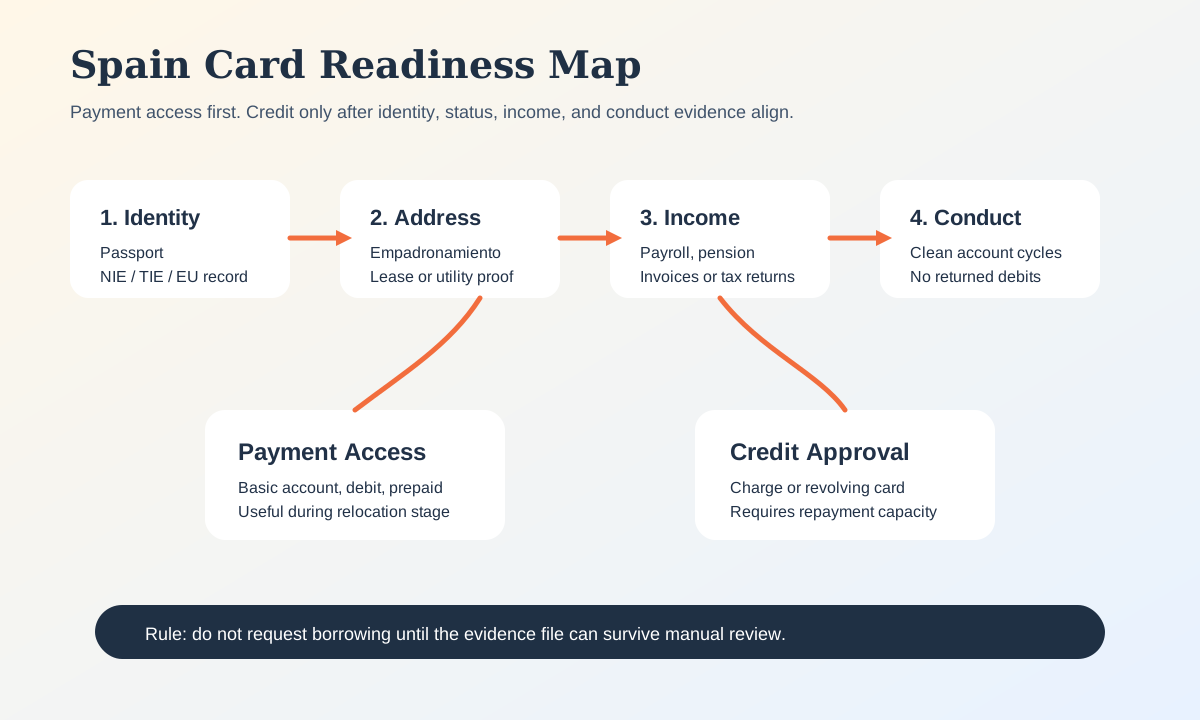
For new arrivals, expats, remote workers, and cross-border households, the hard part of Credit Cards for Expats in Spain: Eligibility, Documents, Credit Risk, and Card Strategy is knowing which fact changes the answer. It explains opening or using accounts, identity numbers, KYC evidence, cards, credit history, and payment access across Europe, then shows how to prepare identity, address, tax, income, source-of-funds, and card or credit evidence before an application is refused. The later sections connect executive summary, who this guide is for, and the core distinction: payment access is not credit approval so the next step is easier to judge. Read it before submitting forms, moving money, choosing a provider, or assuming that a rule from another country applies.
The practical answer is this: many expats can get card access in Spain, but not necessarily a true credit card immediately. A debit card, prepaid card, charge-style card, or low-limit credit card may be the right first step while your NIE, TIE, address, income, and local bank-history profile mature.
This guide is written for foreign residents, digital nomads, retirees, students, employees, self-employed workers, and relocation advisers who need a defensible card strategy rather than a superficial list of offers. It is current for planning use as of May 14, 2026.
Executive Summary
Payment access and credit approval are different decisions. Spain's basic-payment-account framework can help a legally eligible person obtain essential payment services, but it does not guarantee revolving credit, overdrafts, premium cards, high limits, or rewards products.
| Decision | What it answers | Typical expat outcome |
|---|---|---|
| Identity and onboarding | Can the bank verify the applicant under banking and AML rules? | Passport, NIE/TIE or EU documents, address evidence, and tax data are checked |
| Payment access | Can the applicant hold an account and use a payment card? | Debit or prepaid access is often easier than credit |
| Credit underwriting | Should the lender extend borrowing capacity? | Local income, account conduct, debt exposure, and residence continuity matter |
| Product fit | Which card settlement model matches the use case? | Debit, prepaid, charge, or revolving credit may be appropriate |
| Risk control | Can the user manage fraud, fees, FX, and repayment? | Alerts, written repayment rules, and evidence retention are essential |
Banco de Espana explains that a basic payment account can include account opening and closing, deposits, cash withdrawals, direct debits, card payments using debit or prepaid cards, online payments, and transfers within the EU. That is a payments-access framework, not a guarantee of borrowing capacity. See Banco de Espana basic payment account guidance. The legal basis for Spain's basic payment account regime is Royal Decree-law 19/2017, published in the official state gazette BOE consolidated text for Real Decreto-ley 19/2017.
Who This Guide Is For
| Profile | Most likely first card path | Main approval risk |
|---|---|---|
| Newly arrived EU citizen | Spanish account plus debit card, then low-limit credit after income and address stabilize | Thin Spanish account history |
| Non-EU resident in NIE/TIE process | Account-first approach, then credit after residence and income evidence align | Legal-status and address mismatch |
| Digital nomad or remote worker | Debit or charge card first, then conservative credit if income is verifiable | Foreign income may be harder to underwrite |
| Student | Debit or prepaid first; credit only with income, guarantor, or bank-specific policy | Limited repayment evidence |
| Retiree | Pension-flow documentation plus conservative limits | Foreign pension evidence and residency continuity |
| Self-employed professional | More scrutiny of invoices, tax registration, recurring income, and contribution history | Volatile income and weak tax trail |
The Core Distinction: Payment Access Is Not Credit Approval
Spain separates two questions that expats often combine.
| Question | What it means | Typical result |
|---|---|---|
| Can I access basic payment services? | Can I hold an account, receive funds, make transfers, and use a debit or prepaid card? | Often possible if identity and legal checks are satisfied |
| Can I borrow through a credit-card limit? | Will a lender extend revolving or deferred credit? | Depends on underwriting, income, risk databases, residence continuity, and product policy |
The distinction is important because a rejected credit-card application does not necessarily mean the applicant cannot bank in Spain. It may mean the applicant should first build a local payment footprint, route salary or pension into the account, avoid returned direct debits, and ask later for a smaller credit exposure.
Documents Spanish Card Issuers Commonly Care About
Exact requirements vary by bank and product, but a strong application file usually includes the following.
| Evidence category | What it proves | Strong examples |
|---|---|---|
| Identity | You are the applicant and can pass onboarding checks | Passport, national ID, NIE certificate, TIE where applicable |
| Spanish address | You can be contacted and tied to a local customer profile | Empadronamiento, lease, utility bill, bank-accepted address proof |
| Legal status | Your stay and activity in Spain are explainable | EU registration certificate, residence card, visa, work authorization, digital-nomad authorization |
| Income | You can repay credit | Spanish payroll, foreign payroll, pension letter, tax returns, invoices, bank statements |
| Banking conduct | You can manage payments reliably | Salary deposits, direct debits, no returned payments, account age |
| Credit exposure | Existing borrowing is understood | CIRBE data where relevant, bank statements, loan agreements |
| Use case | The product fits your need | Travel, hotel deposits, car-rental holds, business expenses, emergency liquidity |
For immigration and legal-status context, use official Spanish government sources rather than private summaries. Spain's Ministry of Foreign Affairs describes the telework visa for non-EU remote workers and states that a NIE is needed before applying through the consular route: Spanish telework visa guidance. Spain's national digitalization portal also describes the international teleworker route under Law 14/2013: ONE.gob.es digital nomad procedure.
How Spanish Credit Assessment Works in Practice
Spanish card approval is usually a risk decision, not a nationality decision. A newcomer with strong foreign income but no Spanish account history may still be treated as less predictable than a lower-income applicant with stable Spanish payroll and clean payment behavior.
Banco de Espana describes CIRBE, also known as CIR, as a database that collects information on loans, credits, guarantees, and other risks reported by declaring entities. It is not only a default register. It can be used by lenders when you apply for a credit operation: Banco de Espana CIRBE guidance.
Approval Readiness Score
Use this internal readiness score before applying.
| Factor | Weight | Strong signal |
|---|---|---|
| Identity and legal-status clarity | 25% | NIE/TIE or EU registration aligned with passport and bank profile |
| Spanish address continuity | 20% | Same address across bank, tax, employer, and municipal records |
| Income reliability | 30% | Recurring payroll, pension, or verifiable client income |
| Account conduct | 15% | No returned direct debits, regular inflows, responsible balance management |
| Product fit | 10% | Requested limit and repayment method match real use case |
| Score | Interpretation | Best next step |
|---|---|---|
| 80-100 | Credit-ready | Apply for a conservative limit with full documentation |
| 65-79 | Conditionally ready | Start with debit or charge-style card and reapply after one to three account cycles |
| 50-64 | Weak file | Build bank history before requesting borrowing |
| Under 50 | High rejection risk | Fix documents, address, income evidence, or legal-status gaps first |
Card Types in Spain: Choose the Settlement Logic Before the Brand
| Card type | How it works | Best for | Main risk |
|---|---|---|---|
| Debit card | Transaction debits your account directly | Daily spending, local payments, subscriptions | May fail for some deposits or rental holds |
| Prepaid card | You load funds before use | Transition period, limited exposure, budget control | Lower acceptance for deposits and some travel use |
| Charge or end-of-month credit card | Monthly spending is paid in full on a set date | Travel, hotels, controlled expense management | Requires enough account balance on settlement date |
| Revolving credit card | Balance can roll over with interest | Short-term liquidity only | High interest, long repayment periods, debt drift |
Banco de Espana explains that Spanish cards may allow immediate payment, full monthly payment, or deferred/revolving repayment. It warns that late-payment rates are usually much higher than ordinary interest rates: Banco de Espana payment methods and interest guidance. For revolving cards, Banco de Espana warns that small monthly payments can make repayment take a long time while generating substantial interest: Banco de Espana revolving credit-card guidance.
Recommended Application Strategy by Relocation Stage
| Stage | What to do | What to avoid |
|---|---|---|
| Before arrival | Prepare passport, NIE plan, income proof, apostilles/translations if needed, and Spanish address plan | Applying for credit without a Spanish identity/address story |
| First 30 days | Open account where eligible, activate debit card, verify contact details, test online banking | Using credit products to solve document gaps |
| 30-90 days | Route salary or recurring income, set direct debits, avoid returned payments | Multiple card applications across banks |
| 90-180 days | Apply for low-limit credit if income and residence evidence are stable | Revolving balances as a lifestyle tool |
| After status change | Update bank records immediately after TIE, work contract, tax registration, or address changes | Letting old passport, address, or phone records remain active |
Practical Product Decision Framework
Ask these questions in order.
| Question | If yes | If no |
|---|---|---|
| Do you need borrowing, or only payment acceptance? | Consider low-limit credit or charge card | Use debit or prepaid |
| Do you need hotel or car-rental preauthorizations? | Test acceptance before travel | Do not overpay for unnecessary credit |
| Can you repay the full balance monthly? | Prefer full-settlement mode | Avoid revolving credit |
| Is your income paid into a Spanish account? | Apply after a few clean cycles | Build bank history first |
| Are your legal status and address fully synchronized? | Submit normal application | Fix records before applying |
Cost Checklist Before You Accept a Card
Ask the issuer for the full cost picture, not just the headline card name.
| Cost or control point | Why it matters |
|---|---|
| APR or TAE for deferred balances | Main cost driver on revolving products |
| Annual fee | May outweigh rewards for low spenders |
| FX markup | Important for expats paid or traveling outside the euro area |
| Cash withdrawal fee | Credit-card cash advances can be expensive |
| Late-payment rate | Usually much higher than ordinary interest |
| Over-limit fee or rate | Can apply if you exceed the card limit |
| Replacement card fee | Relevant for frequent travelers |
| Insurance bundle | Often conditional and not a substitute for separate travel or health cover |
Spain's consumer-credit law is also in motion. In April 2026, Spain's European Consumer Centre reported that a draft consumer-credit bill approved by the Council of Ministers would update rules for consumer credit, including revolving credit cards, and introduce measures around cost limits and creditworthiness assessment. Because this was described as a draft bill, treat it as a source risk until enacted and implemented: European Consumer Centre in Spain on 2026 consumer-credit proposals.
Fraud, Disputes, and Chargeback Evidence
Your fraud-response protocol should be ready before your first high-value transaction.
| Incident | First action | Evidence to preserve |
|---|---|---|
| Lost or stolen card | Notify issuer immediately through official channel | Time of notice, case number, screenshot or written confirmation |
| Unrecognized transaction | File complaint with bank customer service | Transaction ID, card status, location evidence, device logs |
| Goods not received | Contact merchant, then bank if unresolved | Invoice, delivery record, merchant messages |
| Suspected scam | Block card, notify issuer, consider police report | Messages, URLs, phone numbers, payment authorization details |
Banco de Espana states that issuers must provide a way to report loss, theft, or unauthorized use, and that after reporting, the bank assumes liability for transactions not authorized by the customer from that moment onward. It also points consumers to bank customer service and Banco de Espana escalation channels: Banco de Espana fraudulent card-use guidance.
EU payment-services law also matters because PSD2 created a common framework for electronic and non-cash payments, including card payments, across the EEA: European Commission payment-services framework.
Operational Risk Controls
| Risk | Trigger | Control |
|---|---|---|
| Application rejection | Applying before identity, income, address, and status evidence align | Apply first with the bank that sees your income and request a conservative limit |
| Debt drift | Using a revolving card for lifestyle spending | Prefer full settlement and disable revolving where possible |
| FX leakage | Paying outside the euro area without checking markup | Pay in local currency and compare issuer FX terms |
| Deposit failure | Using debit/prepaid cards for hotels or rentals that require credit preauthorization | Test the specific card before critical travel |
| Account freeze | Large unexplained transfers or weak source-of-funds story | Keep salary, pension, contract, invoice, and tax evidence ready |
| Fraud delay | No saved issuer support channel | Enable app controls, alerts, and immediate card-freeze access |
Evidence Checklist
- Passport or national ID is current.
- NIE/TIE or EU registration status is consistent across documents.
- Address proof matches the bank profile.
- Income documents show recurring repayment capacity.
- Bank account has at least one clean cycle of activity, preferably more.
- Direct debits are not bouncing.
- Credit-card settlement mode is understood in writing.
- Revolving option is disabled or capped if not needed.
- Fraud-reporting phone number and app controls are saved.
- Travel and deposit use cases are tested before relying on the card.
FAQ
Can an expat get a credit card in Spain without Spanish residency?
Sometimes, but it is harder and bank-specific. Basic account or debit-card access may be more realistic than credit. A true credit card usually requires stronger identity, address, income, and risk evidence.
Is a NIE enough to get a Spanish credit card?
No. A NIE helps identify you for Spanish administrative and financial purposes, but it does not prove income, repayment ability, address continuity, or creditworthiness by itself.
Is a debit card enough in Spain?
For daily life, often yes. For hotels, car rentals, and some travel deposits, a debit card may be less reliable than a credit or charge card. Test your specific merchant category before relying on it.
Should I use a revolving credit card in Spain?
Only if you understand the repayment mechanics and total cost. Banco de Espana specifically warns that small monthly payments can prolong repayment and increase interest cost.
Will foreign credit history transfer to Spain?
Usually not automatically in a simple consumer-friendly way. Foreign bank statements, tax returns, employer letters, and income contracts can still help, but local underwriting depends heavily on the Spanish issuer.
How many cards should a new expat have?
Usually one primary debit card and one backup payment method are enough at first. Add credit only when the use case is clear and repayment is controlled.
Application strategy for new arrivals
New arrivals should treat credit-card approval as a staged process. First, open a current account and make sure identity, NIE or TIE, address, tax status, and income records are consistent. Second, route salary, pension, freelance income, or regular transfers through that account for several months. Third, apply for a conservative card limit with the bank that already sees account behavior. A lower limit approved cleanly is better than repeated declined applications for premium cards.
Employees should prepare employment contract, recent payslips, employer letter if still in probation, tax data, and bank statements. Self-employed applicants should prepare tax filings, Modelo records where relevant, invoices, business registration, social-security contribution evidence, and bank-flow history. Retirees should prepare pension statements, tax residence evidence, and regular income proof. Students may need enrollment, scholarship, family support, or guarantor evidence.
If the applicant is a digital nomad or remote worker, the bank may ask for foreign income, Spanish residence status, and source-of-funds clarity. The card file should match the visa, tax, and bank-account story. For broader remote-work context, compare remote work Europe tax.
Debit, charge, credit, and revolving cards
Expats should understand the Spanish product labels before using a card. A debit card spends from the bank account. A credit or charge card may settle monthly in full. A revolving card allows repayment over time and can become expensive if only small monthly payments are made. Some cards allow the repayment mode to be changed, so the applicant should confirm the default setting in writing.
For daily life in Spain, debit may be enough. For hotels, car rentals, travel deposits, emergencies, and online purchases, a credit or charge card can be useful. For borrowing, a personal loan may be cheaper and clearer than revolving card debt. Do not use a revolving card as a lifestyle-funding tool unless the total cost and repayment timeline are modeled.
The safest expat setup is usually one primary debit card, one controlled credit or charge card, app alerts, full monthly repayment, and a separate backup payment method. Card limits should fit cash flow, not aspiration.
Spain-specific evidence and creditworthiness
Spanish issuers assess creditworthiness through internal banking history, income, debt, repayment behavior, CIRBE where relevant, employment stability, residence status, and product rules. A NIE identifies the person but does not prove repayment capacity. Foreign credit history may help indirectly through statements and bank references, but it usually does not transfer as a complete local score.
Applicants should avoid mismatched documents. The name, address, NIE/TIE, employer, income amount, and tax data should align across bank profile, payslips, contracts, residence documents, and applications. A mismatch can slow KYC or credit review even when income is adequate.
If the application is refused, ask whether the issue is missing evidence, insufficient account history, income instability, existing debt, product eligibility, residency status, or risk policy. Wait and correct the file before applying elsewhere.
Travel, deposits, and foreign-currency use
A Spanish card may work well inside the euro area but still have costs outside it. Check foreign transaction fees, exchange-rate markup, ATM fees, cash-advance rules, insurance conditions, and emergency replacement. If the card will be used for travel, test it before relying on it for hotel or car-rental deposits.
For purchases outside the euro area, choose local currency at the terminal and avoid dynamic currency conversion. Keep receipts for hotels, rentals, and high-value purchases. If the card includes travel insurance, read the activation conditions; some policies require the trip to be paid with the card and exclude pre-existing conditions or long stays.
Fraud and dispute workflow
Enable instant transaction alerts and card-freeze controls before using the card heavily. Keep the bank's official support channel saved outside the banking app. If a transaction is unauthorized, report quickly and preserve time, amount, merchant, card status, location, screenshots, and case number.
For merchant disputes, contact the merchant first unless fraud is obvious. Preserve invoices, delivery evidence, cancellation terms, emails, photos, and refund promises. Spanish bank complaint routes require a clean chronology.
Annual card review
Once a year, review whether the card still fits. Check annual fee, interest rate, repayment mode, limit, insurance, FX costs, fraud controls, and whether a cheaper or safer product is available. If income or residence status changed, update the bank proactively. A card approved for one profile may be reviewed later under updated KYC or credit rules.
Card approval timeline
A realistic approval timeline for a new expat is three phases. In the first month, focus on account opening, debit card, identity consistency, address proof, and app access. In months two to six, build account behavior: salary or pension inflows, clean direct debits, rent payments, no unpaid fees, and stable balance history. After that, request a modest card or charge product that matches the observed income.
Applying too early can be counterproductive. A bank that cannot see income, address stability, or repayment behavior has little reason to extend unsecured credit. If the applicant needs a card immediately for deposits, a home-country no-FX credit card or a secured/low-limit route may be safer while Spanish history builds.
Self-employed and freelancer applicants
Self-employed expats face more documentation. Banks may ask for business registration, tax filings, quarterly payments, social-security contributions, invoices, accountant letters, and bank statements. Income volatility can reduce approved limits even when annual income is strong. A freelancer should apply after several months of visible Spanish account activity where possible.
The application should distinguish gross turnover from net income. Card underwriting cares about repayment capacity, not invoice volume alone. If expenses, VAT, tax, and contributions consume a large part of turnover, the applicant should request a conservative limit.
Freelancers using foreign clients should prepare contracts and payment evidence. If funds arrive from platforms or payment processors, reconcile platform statements to bank deposits so the income source is understandable.
Non-resident, student, and retiree cases
Non-residents may have narrower choices. Some banks will offer debit or basic accounts but not unsecured credit. Others may consider private-banking or secured relationships if assets are significant. A non-resident should ask directly whether the product requires Spanish residence before submitting a full application.
Students may qualify through student packages, low limits, or debit-first products. The evidence may be enrollment, scholarship, parental support, address, and bank conduct rather than salary. Retirees should provide pension statements, tax residence, bank inflows, and healthcare/residence documents. For retirees, stability can matter more than employment status.
Limit management and repayment discipline
Once approved, set the repayment mode intentionally. If the card allows full monthly settlement, revolving, fixed installment, or percentage repayment, choose the mode that avoids expensive debt unless borrowing is deliberate. Keep proof of the chosen mode and review statements for changes.
Use limits conservatively. High utilization can create stress even if payments are current. Expats with foreign income should keep extra liquidity for exchange-rate swings, delayed transfers, tax payments, and relocation costs. A credit card should not be the emergency fund.
If the bank offers limit increases, accept only if the use case is clear. More limit can help with travel deposits, but it can also make revolving debt easier. A good card setup is controlled, not maximized.
Merchant holds, hotels, and car rentals
Hotels and car rentals may place preauthorization holds that reduce available credit. A low-limit card can fail even when the final charge is affordable. Before travel, check expected deposit amounts and keep enough unused limit. If using a debit card, confirm the merchant accepts debit for deposits and understand how long funds may be blocked.
Keep check-in documents, rental inspections, fuel receipts, return photos, and release confirmations. Disputes over car damage or hotel charges are easier with evidence. If a merchant offers dynamic currency conversion outside the euro area, choose local currency.
Account closure and moving away
If leaving Spain, decide whether to keep or close the card. Keep it until refunds, disputes, subscriptions, and deposits are settled. Update the bank with the new address and tax residence if required. If closing, download statements and proof of closure. If keeping, confirm the bank allows non-resident maintenance and foreign contact details.
Minimum safe card setup
The minimum safe setup for most expats is simple: one Spanish debit card for local daily spending, one controlled credit or charge card for travel and deposits, instant alerts, full monthly repayment, and a second payment method stored separately. The goal is continuity, not maximum borrowing.
Keep a card file with the agreement, fee table, repayment mode, limit, support number, fraud-reporting route, and statement archive. If a dispute arises, the cardholder should know which product they have, how repayment works, and which evidence the bank will request.
Factual Uncertainty and Source Risks
Spanish banks apply internal risk policies that are not fully public, so no article can guarantee approval. Requirements also vary by product, branch, residency status, and whether the applicant is employed, self-employed, retired, or a student.
The 2026 Spanish consumer-credit reform referenced above was reported as a draft bill, not as a fully implemented rule at the time of this update on May 14, 2026. Confirm the final enacted text and effective dates before relying on any new cap or lender-supervision rule.
Official and Primary Sources
- Banco de Espana: basic payment account features
- BOE: Real Decreto-ley 19/2017 on basic payment accounts
- Banco de Espana: CIRBE credit-risk database
- Banco de Espana: card payment methods and interest
- Banco de Espana: revolving credit cards
- Banco de Espana: fraudulent card use
- European Commission: payment services and PSD2
- European Consumer Centre in Spain: 2026 consumer-credit proposal
- Spanish Ministry of Foreign Affairs: telework visa guidance
- ONE.gob.es: digital nomad application pathway
Official source and decision check
Use this section as the practical checkpoint for Credit Cards for Expats in Spain: Eligibility, Documents, Credit Risk, and Card Strategy. The reader decision is whether the available evidence is strong enough to act now, or whether the file should first be confirmed with the competent authority. Rules can change by country, status and date, so treat this guide as orientation for the file and recheck the current rule before relying on an appointment, payment, journey or application deadline.
For expats, foreigners, students, workers, founders, families and other mobile readers, record the reader category, country, residence status and deadline before comparing the official source with the article checklist.
Official sources to verify first
- Your Europe citizen rights portal
- European Commission social security coordination
- EUR-Lex EU law access
- EURES mobility and work portal
- European Commission information portal
| Decision point | What to check | Reader action |
|---|---|---|
| Administrative decision | Confirm that the case is really about administrative decision, not a different category that follows another rule. | Write down the country, authority, dates, status and document number before asking for a decision. |
| File for competent authority | Keep the identity, residence and document evidence in one dated file, with originals, translations where required and proof of submission. | Save receipts, emails, appointment confirmations, payment records and authority replies in the same order as the checklist. |
| Credit Cards for Expats in Spain: Eligibility, Documents, Credit Risk, and Card Strategy fallback | If the answer is refused, delayed or unclear, identify the competent authority, review window, complaint route or regulated provider escalation path. | Ask for the reason in writing and compare it with the official source before paying again, travelling, closing an account or resubmitting. |
| When the answer is unclear | What to do next |
|---|---|
| The authority, bank, insurer, employer or provider gives a verbal answer only. | Ask for the answer in writing, save the name of the office or provider, and compare it with the official source before changing travel, payroll, residence or payment plans. |
| The file depends on a deadline, appointment, payment, address or status change. | Keep the dated receipt, note the next deadline, and avoid closing the old route until the replacement document, account, policy or registration is confirmed. |
Related guides to cross-check
- First month in Europe checklist
- Living in one European country and working in another
- EU remote working guide
- Cross-border worker benefits in the EU
- Private health insurance documents in Europe
For legal, tax, medical, immigration or financial consequences, confirm the position with the competent authority or a qualified adviser. This page is designed to organize the decision, source checks and next steps; it is not a substitute for case-specific professional advice.