Last updated
Cheapest Countries in Europe for Expats: Cost, Visas, Healthcare and Tradeoffs
Cost-of-living decision map
Cheapest Countries in Europe for Expats: Cost, Visas, Healthcare and Tradeoffs helps compare places by the practical constraints that matter after arrival, not by lifestyle slogans alone. It explains comparing places by jobs, rent, schools, healthcare, transport, language access, visa or tax pressure, and day-to-day fit, then shows how to compare locations by the constraints that matter after arrival: documents, work, housing, schools, healthcare, tax, transport, and language access. The later sections connect cost-of-living decision map, executive shortlist, and why expats need a different cost model so the next step is easier to judge. Read it before choosing a city or country so the trade-offs are tied to documents, budgets, schools, healthcare, work, and daily services.
| Cost layer | Evidence to compare | Tradeoff exposed |
|---|---|---|
| Monthly essentials | Rent, utilities, food, transport, insurance and realistic one-off setup costs. | A low headline rent is offset by deposits, agency fees or transport. |
| Legal and financial setup | Visa route, residence paperwork, bank access, tax registration and healthcare coverage. | A cheap destination becomes expensive because the administrative path is slow or uncertain. |
| Income and lifestyle fit | Remote-work rules, local salary, language needs, school/family costs and return-travel budget. | The country is cheap only if the reader's income and daily needs fit the place. |
Direct answer
If you are choosing Europe mainly on cost, start with Bulgaria, Romania, and Poland. Bulgaria is the cheapest EU country on Eurostat household-consumption price levels, Romania is close behind with stronger big-city options, and Poland is often the best value if you need larger-city infrastructure, transport, and services rather than the absolute lowest sticker prices.
The answer changes when you need more than a low local price basket. Families, non-EU residents who need visas or private insurance, remote workers paid from abroad, and expats targeting capital cities can face much higher housing, school, tax-advice, and setup costs than the national averages suggest.
Next step: build a city-level budget for three realistic destinations using rent, deposits, health coverage, residence costs, and flights home, then compare that budget against your after-tax income rather than against country averages alone.
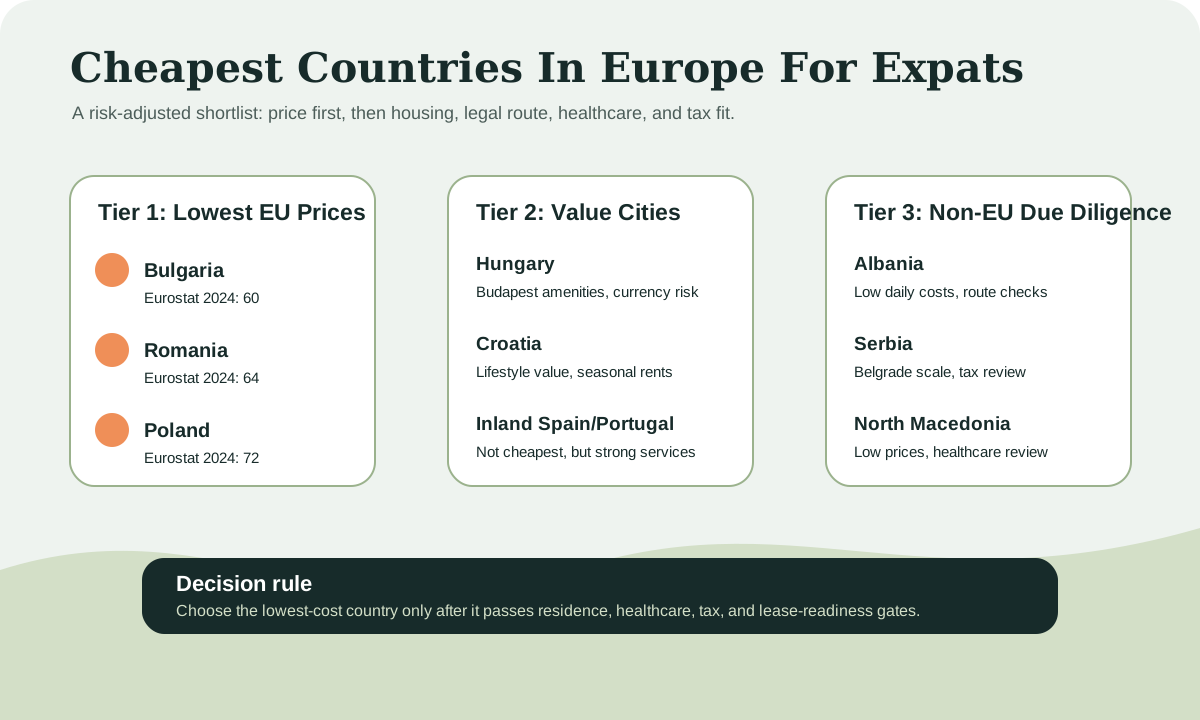
The cheapest countries in Europe for expats are not simply the countries with the lowest restaurant prices. Expats face additional costs that local households may not face: residence permits, private insurance, translation, international banking, flights home, tax advice, imported goods, school fees, deposits, and higher friction when renting without local documents.
Using official EU price-level evidence, the lowest-cost EU countries are Bulgaria, Romania, and Poland. Eurostat reported that 2024 household consumption price levels were lowest in Bulgaria at 60 percent of the EU average, Romania at 64 percent, and Poland at 72 percent. See Eurostat: Household consumption price levels in 2024.
Source check date: 2026-06-01. This guide is informational and not legal, tax, immigration, investment, medical, or relocation advice.
Executive Shortlist
| Rank type | Country | Why it belongs | Main expat caveat |
|---|---|---|---|
| Lowest EU consumer prices | Bulgaria | Lowest EU household consumption price level | Healthcare, language, and city selection matter |
| Low-cost EU with larger urban markets | Romania | Second-lowest EU consumer price level and strong cities | Bucharest and Cluj can be much pricier than national averages |
| Best value infrastructure | Poland | Low prices plus large cities, transport, jobs, and services | Major-city rents have risen |
| Low-cost capital lifestyle | Hungary | Budapest offers strong cultural infrastructure at below Western prices | Currency and policy risk require planning |
| Low-cost Balkan lifestyle | Albania, Serbia, Bosnia and Herzegovina, North Macedonia | Often low daily costs | Non-EU residence, healthcare, banking, and data comparability require due diligence |
This is not a universal ranking. It is a risk-adjusted shortlist. Bulgaria may be the cheapest EU country by price level, while Poland may be the better all-around value for a family, employee, or student who needs a larger city ecosystem.
Why Expats Need A Different Cost Model
A local household and a newly arrived expat do not buy the same basket.
| Cost item | Local household | Expat household |
|---|---|---|
| Housing | May own property or have local network | Often rents in visible, higher-priced market |
| Healthcare | Knows public system | May need private insurance or proof of cover |
| Administration | Uses local language | May pay translators, lawyers, or agents |
| Food | Buys local brands | May buy imported goods while adapting |
| Transport | Knows local routes | May rely on taxis, car rental, or car purchase early |
| Tax | Established filing pattern | Needs cross-border tax analysis |
| Banking | Existing accounts | May face onboarding friction |
| Schools | Public system knowledge | May need bilingual or private options |
That is why a serious expat comparison must combine official price data with legal, healthcare, tax, and practical filters.
Core Evidence: EU Consumer Price Levels
Eurostat's household final consumption price-level indicator is the best official starting point inside the EU.
| Country | Eurostat 2024 household consumption price level | Expat interpretation |
|---|---|---|
| Bulgaria | 60 percent of EU average | Lowest EU price level; strongest budget signal |
| Romania | 64 percent of EU average | Very low price level with larger urban options |
| Poland | 72 percent of EU average | Strong value with better infrastructure depth |
| Hungary | Lower than many Western EU peers | Useful Budapest-based value option |
| Croatia | Mixed | Attractive lifestyle, but tourist and coastal markets distort costs |
| Greece | Mixed | Food and lifestyle can be affordable; housing pressure can be high |
| Portugal | Not among lowest by EU price level | Popular, but no longer a cheapest-Europe default |
| Spain | Not among lowest by EU price level | Strong lifestyle value outside major and tourist areas |
Eurostat's price data is national. It does not prove that Sofia, Bucharest, Warsaw, Budapest, Split, Lisbon, Barcelona, or Athens is cheap for a foreign renter.
Housing Filter
Housing is the most common reason a cheap country stops being cheap. Eurostat's Housing in Europe publication tracks housing cost overburden, tenure, quality, overcrowding, and other housing indicators. See Eurostat: Housing in Europe 2024.
| Housing factor | Why expats should care |
|---|---|
| Capital-city premium | Most expats search in the most expensive city first |
| Tourist-season pressure | Coastal rentals may disappear or reprice in summer |
| Lease registration | Needed for residence, tax, utilities, or school enrollment |
| Heating and cooling | Energy-inefficient homes can erase rent savings |
| Deposit norms | Foreign tenants may be asked for more proof or upfront rent |
| Furnishing quality | Cheap apartments may require setup spending |
Before picking a country, build a rental sample from current listings in the exact city and neighborhood. A national price index is a screening tool, not a lease estimate.
The Five Strongest EU Budget Options
Bulgaria
Bulgaria is the cleanest cheap-Europe answer inside the EU.
| Category | Assessment |
|---|---|
| Consumer prices | Lowest in EU by Eurostat 2024 household consumption price levels |
| Cities to research | Sofia, Plovdiv, Varna, Burgas |
| Best for | Budget expats, remote workers with legal status, retirees who want EU residence |
| Watchouts | Healthcare navigation, language, winter heating, local wages, currency |
Bulgaria works best for people with stable foreign income who are not dependent on local salaries. It is less ideal for expats who need a large English-speaking job market or highly specialized healthcare access in every region.
Romania
Romania combines very low consumer prices with larger cities and a growing professional ecosystem.
| Category | Assessment |
|---|---|
| Consumer prices | Second-lowest EU price level in Eurostat 2024 data |
| Cities to research | Bucharest, Cluj-Napoca, Timisoara, Brasov, Iasi |
| Best for | Remote workers, tech workers, families seeking value |
| Watchouts | Major-city rents, traffic, healthcare selection, tax status |
Romania can be more practical than Bulgaria for some expats because of city scale and professional services, even if Bulgaria is cheaper on the headline indicator.
Poland
Poland is a value country rather than the cheapest country.
| Category | Assessment |
|---|---|
| Consumer prices | Third-lowest EU household consumption price level in Eurostat 2024 data |
| Cities to research | Warsaw, Krakow, Wroclaw, Gdansk, Poznan, Lodz |
| Best for | Working expats, students, families, remote workers |
| Watchouts | Major-city rent, winter costs, tax and residence documentation |
Poland is often the stronger choice when infrastructure, flights, schools, public transport, and job-market depth matter more than the lowest possible grocery basket.
Hungary
Hungary is especially relevant for expats who want a large cultural capital at a lower cost than Western Europe.
| Category | Assessment |
|---|---|
| Consumer prices | Lower than much of Western and Northern Europe |
| Cities to research | Budapest, Szeged, Debrecen, Pecs |
| Best for | City lifestyle, culture, students, remote workers with compliant status |
| Watchouts | Currency risk, inflation, policy uncertainty, healthcare route |
Budapest is not cheap in the same way as smaller Balkan cities, but it can be strong value for people who want capital-city amenities.
Croatia
Croatia is not a simple cheapest-country pick, but it can be cost-effective outside peak tourist areas.
| Category | Assessment |
|---|---|
| Consumer prices | Not among the absolute lowest EU countries |
| Cities to research | Zagreb, Osijek, Rijeka, Split, Zadar |
| Best for | Lifestyle-focused expats, EU citizens, remote workers checking residence routes |
| Watchouts | Seasonal rent spikes, coastal pricing, tourist-market distortion |
Croatia should be treated as a lifestyle-value option, not a guaranteed budget option.
Non-EU Budget Options
Some of Europe's lower daily costs are outside the EU. Albania, Serbia, Bosnia and Herzegovina, and North Macedonia can be attractive, but they require more legal due diligence.
| Country type | Cost appeal | Due diligence needed |
|---|---|---|
| Albania | Low daily costs, coast and mountains | Residence rules, healthcare, rental legality |
| Serbia | Larger city ecosystem in Belgrade | Tax residence, healthcare, banking, currency |
| Bosnia and Herzegovina | Low housing and services in many areas | Administrative fragmentation, healthcare, insurance |
| North Macedonia | Low daily costs | Residence, healthcare, banking, and flight access |
For broader international comparisons, PPP data can help normalize price levels. The World Bank explains that PPPs compare purchasing power across countries and that private consumption PPPs relate to household consumption. See World Bank: Why PPP series are used.
Visa And Residence Filter
A country is not cheap if you cannot legally live there.
| Expat type | Residence issue |
|---|---|
| EU citizen | Free movement helps, but registration and health cover may still apply |
| U.S., Canadian, UK, Australian retiree | Needs national long-stay route or residence permit |
| Digital nomad | Needs remote-work permission, tax review, and employer compliance check |
| Freelancer | Needs business registration, VAT, social contributions, and residence basis |
| Student | Tuition, health insurance, work limits, and housing availability matter |
| Family | School access and dependent residence rules matter |
Your Europe explains rights around residence within the EU, including different rules for stays under and over three months. See Your Europe: Residence rights.
Healthcare Filter
Healthcare can change the entire budget.
| Situation | Budget effect |
|---|---|
| Public system access after residence | Lower recurring cost but possible waiting times |
| Mandatory private insurance | Higher monthly cost but clearer visa evidence |
| Chronic condition | Specialist availability matters more than rent |
| Retiree | Prescription, hospital, and supplemental cover must be modeled |
| Family | Pediatric care and emergency access matter |
| Non-EU country | Private insurance may be central to risk control |
Your Europe provides guidance on health insurance cover when living abroad in the EU. See Your Europe: Health insurance in the host country.
Tax Filter
Cheap rent is irrelevant if your income is taxed unexpectedly.
| Income type | Tax question |
|---|---|
| Salary | Where is work physically performed? |
| Pension | Which country taxes it under domestic law and treaty? |
| U.S. Social Security | Special treaty and citizenship rules may apply |
| Dividends | Withholding tax and residence tax matter |
| Rental income | Source-country and residence-country taxation may both arise |
| Freelance income | VAT, permanent establishment, and social contributions matter |
| Capital gains | Exit tax and timing rules may apply |
U.S. citizens should remember that U.S. tax filing obligations generally continue while abroad. See IRS: U.S. citizens and resident aliens abroad.
Practical Monthly Budget Template
| Category | Budget estimate | Evidence source |
|---|---|---|
| Rent | Local listing average for target neighborhood | 20 current listings |
| Utilities | Winter and summer estimate | Prior bills or landlord evidence |
| Groceries | Local basket | Supermarket check |
| Eating out | Monthly frequency | Local menus |
| Health insurance or contributions | Status-specific | Public fund or insurer |
| Transport | Pass, car, fuel, parking | City transit and insurer |
| Tax and administration | Monthly reserve | Tax adviser estimate |
| Flights home | Annual cost divided by 12 | Airline search |
| Setup costs | Deposit, furniture, translations | One-time reserve |
| Emergency buffer | 10 to 20 percent | Personal risk margin |
Decision Matrix
| Country | Price score | Infrastructure score | Residence complexity | Best-fit expat |
|---|---|---|---|---|
| Bulgaria | Very strong | Medium | Medium | Budget-first EU resident |
| Romania | Very strong | Medium-high | Medium | Remote worker or family seeking EU value |
| Poland | Strong | High | Medium | Working expat or family |
| Hungary | Strong | High in Budapest | Medium | City lifestyle at lower cost |
| Croatia | Medium | Medium-high | Medium | Lifestyle expat outside peak markets |
| Albania | Very strong | Medium | Higher due diligence | Flexible non-EU budget expat |
| Serbia | Strong | Medium-high in Belgrade | Higher due diligence | Balkan city expat |
| Portugal inland | Medium | High | Medium | Retiree prioritizing visa and healthcare over lowest price |
| Spain inland | Medium | High | Medium | Retiree or family prioritizing services |
Common Mistakes
| Mistake | Better method |
|---|---|
| Ranking countries by social media budgets | Use official price data plus real listings |
| Comparing capitals to villages | Compare like-for-like locations |
| Ignoring visa rules | Confirm lawful stay before budgeting |
| Treating low rent as total affordability | Add utilities, healthcare, tax, transport |
| Assuming public healthcare is automatic | Check status-specific access |
| Ignoring inflation | Use HICP and add a buffer |
| Moving without tax analysis | Model worldwide income and treaty position |
| Trusting one rental listing | Build a sample from multiple live listings |
FAQ
What are the cheapest EU countries for expats?
By Eurostat household consumption price levels, Bulgaria, Romania, and Poland are the strongest low-cost EU candidates.
Is Portugal one of the cheapest countries in Europe for expats?
Portugal can be good value, especially outside Lisbon, Porto, and prime coastal areas, but it is not one of the lowest EU countries by Eurostat consumer price levels. It is better described as a lifestyle and residence-route option than a cheapest-country option.
Is Spain cheap for expats?
Spain can be cost-effective outside Madrid, Barcelona, the Balearics, and premium coastal areas. It is not the lowest-cost EU country, but it can offer strong infrastructure, healthcare, and lifestyle value.
Should expats choose Bulgaria or Romania?
Choose Bulgaria if lowest EU price level is the priority. Choose Romania if you want a broader urban and professional ecosystem while keeping costs low.
Are non-EU Balkan countries worth considering?
Yes, but only after checking residence permits, healthcare, tax residence, currency risk, banking, and local legal protections.
Build an expat affordability model
Expats should compare countries using a monthly net-cost model, not a list of cheap destinations. Start with income after tax and social contributions. Then subtract rent, utilities, groceries, transport, healthcare, insurance, childcare, school costs, coworking, accounting, visa renewals, flights home, and savings. A country is cheap only if the remaining margin is stable under realistic assumptions.
Use three budgets: arrival month, normal month, and stress month. Arrival month includes deposits, temporary accommodation, furniture, agency fees, translations, apostilles, immigration fees, insurance, SIM cards, transport setup, and emergency cash. Normal month reflects recurring life. Stress month tests rent increases, exchange-rate movement, medical costs, delayed income, or travel emergencies.
The model should be city-specific. Bulgaria may be cheapest nationally, but Sofia is not the same as smaller Bulgarian cities. Romania's Bucharest, Cluj, and Timisoara differ from smaller towns. Poland's Warsaw and Krakow differ from Lodz or secondary cities. Portugal and Spain are highly location-sensitive, especially near capitals and coastal markets. National averages are useful filters, not final budgets.
Residence route before price ranking
Legal stay comes before cost. EU citizens can compare EU countries more directly because free movement reduces immigration friction, though residence registration, healthcare, and tax still matter. Non-EU citizens need a visa or residence route that fits income, work, family, and duration. A low-cost country is not a serious option if the person can only stay 90 days or cannot work legally.
Retirees, freelancers, employees, students, and investors need different routes. A retiree may prioritize passive-income visas and healthcare. A freelancer may need self-employment permission, tax registration, and social contributions. A remote employee may need employer approval and tax/payroll analysis. A student may need tuition, health insurance, and work-hour limits. A family may need school access and dependant residence.
The cheapest country for one legal status can be expensive or impossible for another. A US retiree, EU remote employee, Brazilian freelancer, UK family, Indian student, and German pensioner do not have the same constraints. The article's country list should therefore be used as a shortlist, not a decision.
Healthcare, tax, and housing adjustments
Healthcare can change the ranking quickly. Public access may depend on employment, residence registration, social-security contributions, or private-insurance periods. Private insurance may be required for visas or practical during transition. People with chronic conditions should price medication, specialists, language access, and travel to care rather than relying on general healthcare reputation.
Tax can outweigh low consumer prices. A freelancer may face social contributions, VAT, bookkeeping, and advance payments. A retiree may face pension taxation or reporting. A remote worker may become tax resident or create employer obligations. A US citizen has a US tax overlay even when living in Europe. Compare countries on net outcome, not rent alone.
Housing is the most volatile category. Newcomers may pay more than locals because they need furnished units, short leases, English-speaking agents, residence-registration support, or properties near international schools. Before choosing a country, gather real listings from the target city, verify deposit norms, and check whether the lease can support residence registration.
Country fit by expat profile
Bulgaria is strongest for budget-first EU living, remote workers with clear income, and people comfortable with more administrative self-sufficiency. It may be less suitable for expats who need extensive English-language services, international schooling, or a very large global business ecosystem.
Romania can offer a stronger urban professional ecosystem while remaining relatively low cost. Bucharest, Cluj, and Timisoara may suit remote workers, families, and professionals who want EU access with better infrastructure than the cheapest towns. Costs can rise quickly in preferred neighborhoods.
Poland is often the value compromise: not the absolute cheapest, but strong infrastructure, cities, transport, services, and employment markets. For expats who may need local work or family infrastructure, Poland can beat cheaper countries on total practicality.
Hungary can be attractive for Budapest lifestyle at lower cost than many Western capitals, but tax, residence, healthcare, and political/legal comfort should be reviewed. Croatia can work for lifestyle and coastal access, but tourist-market housing and seasonality can weaken the budget. Albania and Serbia may be cheaper but require more non-EU due diligence on residence, healthcare, banking, and legal predictability.
Trial stay and decision gate
Before relocating, run a trial stay in the target city if legally possible. Track actual spending, test supermarkets, transport, coworking, healthcare access, internet, apartment searches, government offices, and language friction. A two-week holiday is not enough; the trial should mimic ordinary life.
After the trial, update the budget and apply a decision gate. Proceed only if legal stay is clear, healthcare is viable, housing is obtainable, tax is understood, income is stable, and the budget has a stress margin. If one of those gates fails, the country may still be cheap but not suitable.
For a single-country decision model, compare this with cheapest country to live in Europe. For broader monthly budgeting, use cost of living for expats in Europe.
Hidden costs that change the ranking
Several costs are easy to miss in cheap-country comparisons. Heating can be material in colder regions and older buildings. Air conditioning can matter in hotter regions. Car ownership can erase savings in towns with weak transit. International school fees can overwhelm lower rent. Private healthcare, dental care, prescriptions, and specialist visits can matter for retirees and families. Translation, legal, and accounting costs can recur more often than expected.
Banking and currency costs also matter. Expats paid from abroad may face transfer fees, exchange-rate spreads, card charges, ATM limits, and difficulty proving income to landlords or banks. Non-euro countries can be cheaper but add currency exposure. A budget should include a monthly foreign-exchange buffer if income and expenses are in different currencies.
Red flags before moving
Pause the move if the budget depends on one unusually cheap apartment, if the residence route is unclear, if healthcare access is not confirmed, if the tax position is based on forum advice, if the worker has no employer approval, or if the family has not checked schools. These issues do not mean the country is bad; they mean the move is not yet evidence-based.
The better decision is to keep two or three candidate countries until the practical constraints are tested. Expats often optimize too early around headline cost and then discover that the second-cheapest option is more stable, easier to administer, and cheaper after tax and healthcare.
Practical comparison sequence
Use a fixed sequence when comparing countries. First, eliminate countries where legal stay or healthcare is not viable. Second, remove countries where the tax result would make the budget unstable. Third, compare real housing in the exact city or region. Fourth, test transport and daily services. Only after those filters should headline consumer-price rankings decide between finalists.
This sequence prevents a common mistake: choosing the cheapest national price level and then trying to force legal, medical, tax, and housing facts to fit. Expats should reverse the process. The country must first support the life they need to live; then the cost ranking can identify the best-value version of that life.
If the answer changes after real apartment searches or tax advice, trust the updated model. A cheap-country article is a starting map, not a substitute for current local due diligence.
Final shortlist test
Before choosing, compare the top three countries against the same household facts: exact visa route, monthly net income, target city, rental evidence, healthcare route, tax treatment, transport needs, language ability, and emergency reserve. If a country only wins because one assumption is optimistic, downgrade it.
The best low-cost country is usually not the absolute cheapest. It is the country where the legal route, housing market, healthcare system, income source, and daily life remain affordable at the same time. If that balance fails, the lower headline price is not a real saving. The final choice should survive paperwork, winter bills, medical needs, and a realistic housing search before the move becomes permanent and financially durable long term.
Source Risks And Factual Uncertainty
Price-level data is national and retrospective. It cannot predict your rent, visa outcome, tax residence, healthcare eligibility, or personal spending habits. Housing markets in capitals and tourist regions can move faster than official annual data. Non-EU countries may be cheaper but require more legal and healthcare due diligence.
Official And Primary Sources
- Eurostat: Household consumption price levels in 2024
- Eurostat: Housing in Europe 2024
- Eurostat: Harmonised Indices of Consumer Prices
- Eurostat: Actual individual consumption per capita in 2024
- Your Europe: Residence rights
- Your Europe: Health insurance in the host country
- IRS: U.S. citizens and resident aliens abroad
- World Bank: Purchasing power parity explanation
Related Reading
- Cheapest Country To Live In Europe
- Cost Of Living For Expats In Europe
- Best Cities In Europe For American Expats
How to Use This Shortlist Without Mistakes
The national ranking helps you begin, not decide. A robust decision sequence is:
- Select two legal routes.
- Validate healthcare and coverage transfer.
- Build a housing-first budget.
- Run tax residency stress test with realistic income.
- Simulate 90 days of practical spending by profile.
If one country passes step 1 but fails step 3, it is a data point, not a destination.
The fastest mistake is to compare countries before comparing profile constraints. Before you compare rent and groceries, compare the person.
Cost Profile Filters You Cannot Ignore
Use this filter table as a pre-decision control.
| Constraint | Questions to answer | If no, then |
|---|---|---|
| Legal stay | Do you have a stable residence route for year-long life? | Drop from primary shortlist. |
| Healthcare coverage | Can you access care reliably in your expected profile? | Recalculate total costs or remove location. |
| Income route | Can income be paid and documented where expected? | Do not use this country as a final option. |
| Housing realism | Can you get legal housing where you can live and register? | Do not finalize budget only on capital averages. |
| Banking readiness | Can you operate local payments and rent flows from day one? | Treat as a medium-term relocation only. |
| Language friction | Can you operate for basic services in year one? | Add translation/administrative budget. |
| Family logistics | Schools, childcare, elder support, elder-friendly care | Add service-cost buffer or reconsider ranking. |
These filters remove 50 percent of unrealistic "cheap" options before you reach final ranking.
Profile models: what changes country priority
1) Single professional with employer salary
This profile usually needs predictable banking, a stable legal route, and short transit times. The ranking often moves from "cheapest EU average" to "best city utility."
In many cases:
- A country with lower nominal costs but slow school or visa administration can become expensive during setup.
- A medium-priced country with reliable payroll and healthcare can win in month two and month twelve.
- If your employer pays salary directly to a local account, SEPA and direct-debit reliability matters as much as food inflation.
2) Remote worker with multi-currency payments
For remote workers, add foreign exchange buffering and transfer costs immediately. A low-rent city can still be expensive after:
- receiving irregular client transfers,
- paying local compliance fees,
- carrying translator/accounting support,
- and managing cross-border tax filing obligations.
If your main income is not in EUR, include FX spread and transfer costs in the monthly model.
3) Student with temporary status
Students often need:
- legal migration certainty around enrollment and residence,
- local emergency and medical access,
- and short-term housing options that include lease continuity.
Even if cost numbers are attractive, visa-linked residence duration can invalidate a low-cost option if the route is unstable.
4) Family relocating with kids
Children add hidden structure:
- school language support,
- pediatric care access,
- school transport and childcare costs,
- larger minimum utility footprint.
In many countries the raw rent gap closes once family-level housing and school costs are added.
5) Retiree with pension income
Retirees often over-index on everyday costs and under-index on:
- medication, specialist visits, and routine preventive care,
- long-term continuity of treatment,
- mobility and winter heating costs,
- insurance coordination with home-country status.
Your shortlist should include treatment continuity, not only food and rent.
12-month practical comparison framework
Compare candidate countries over 12 months with one stable model:
- Month 1 setup costs: deposits, travel, registration, furniture, document certification.
- Month 2-3 operating costs: utilities, rent, transport, school enrollment if needed.
- Month 4-6 tax and banking operations: withholding, invoices, transfer fees, account changes.
- Month 7-9 healthcare and emergency stress costs: medication, specialist access, delays.
- Month 10-12 service migration costs: insurance reviews, tax filing, legal renewals, license transfers.
Use one shared template so every candidate uses the same assumptions:
- same household size,
- same income currency,
- same healthcare coverage type,
- same expected mobility needs,
- same climate adaptation assumptions.
Country stack and practical use-case notes
Bulgaria
Bulgaria remains the strongest one-factor price leader by official EU price index. It tends to work well for:
- simple households,
- predictable rent and food patterns,
- and people who can handle lower language support costs.
Watch out for:
- administrative consistency risk before moving,
- private care routing,
- and potential transport friction in less-served zones.
Romania
Romania often offers the next step up in urban access while preserving a low cost baseline.
- Good for: professionals who value service and can absorb moderate capital-city pricing.
- Common stress points: local onboarding complexity and sector-specific service variation.
- Good fit when: your life includes urban commuting and service dependency.
Poland
Poland frequently becomes the best practical compromise for mixed priorities.
- Good for: families and workers who need language ecosystem depth and broad services.
- Common stress points: city-level rent variation and service competition in desirable districts.
- Best use: when low-to-mid costs matter but not at the expense of urban resilience.
Hungary
Hungary can be effective for city-based convenience with moderate costs.
- Good for: people valuing Budapest-level access with lower price relative to Western capitals.
- Common stress points: policy and compliance review cycles for newcomers.
- Best use: when you can tolerate occasional regulatory learning and still stay budget-focused.
Portugal and Spain
These are typically better in lifestyle and service density than pure cheapest ranking implies.
- Good for: people prioritizing climate and international mobility.
- Common stress points: regional price variation and tax optimization complexity for remote income.
- Best use: when utility quality and connectivity are valued above narrow CPI ranking.
Western Europe variants (France, Germany, Benelux, Nordics)
These are not usually first in EU price ranking but can dominate for:
- legal predictability,
- advanced public service reliability,
- and stronger short-to-mid-term family outcomes.
Use only if your priorities justify higher baseline costs.
Common errors in cheap-country planning (and fixes)
Error: Using one source only
Fix: cross-check Eurostat consumer prices, official housing data, visa status notes, and healthcare requirements.
Error: Ignoring seasonality
Fix: add a winter and summer adjustment in rent, utilities, energy, and travel.
Error: Comparing cities and countries directly
Fix: build at least two city-level variants per country.
Error: Underpricing onboarding
Fix: budget for translations, official filings, tax advisors, and travel for appointments.
Error: Choosing only on salary equivalence
Fix: compare post-tax, post-transfer, and post-service net.
Error: Missing tax-of-income profile
Fix: model tax burden for your legal and residency status before finalizing.
Operational checklist for final ranking
- Confirm legal route and expected duration (not just current visa concept).
- Validate healthcare eligibility and emergency fallback.
- Verify internet, transport, and essential utility access in target city.
- Confirm banking onboarding channel and timeline.
- Confirm housing pipeline and tenant protection structure.
- Compute three-budget scenario: good month, normal month, worst month.
- Confirm school or elder-care needs where applicable.
- Keep migration/legal review time in the model.
Internal links for next decisions
- How to open a bank account as a foreigner in Europe
- Bank account in Belgium for non-residents
- Bank account in Germany for non-residents
- Cheapest country to live in Europe
- Cost of living for expats in Europe
Example decision sheet you can use now
Use this one-page format during final selection:
Household profile:
- Adults:
- Children/dependents:
- Language plan:

Legal route:
- Residency status:
- Validity and renewal risks:

Financial model:
- Expected net monthly income:
- Main transfer route:
- Currency mismatch:
- Banking strategy:

Top 3 costs:
- Rent and deposits:
- Transport:
- Healthcare:

Risk checks:
- Visa or residence uncertainty:
- Schooling/healthcare mismatch:
- Housing access realism:

Final outcome:
- Shortlist A (best net cost)
- Shortlist B (best reliability)
- Decision date:
The value is not in perfect prediction. The value is in reducing wrong moves early, while still allowing a fast switch if the first country proves too constrained.
Country-to-country decision ladder by operational need
Most expats confuse "cost of living ranking" with "monthly operating stability." Use the ladder:
- Legal feasibility: If the legal route cannot be opened with confidence, the country is not in shortlist.
- Setup solvency: If first two months require uncertain extra costs, apply a higher buffer.
- Income path compatibility: If transfers and taxation add hidden drag, lower the rank.
- Housing reproducibility: If the target neighborhoods are saturated or legally difficult, reduce the ranking.
- Resilience under change: If one blocked requirement collapses the plan, keep a fallback.
A country can stay in shortlist only if it remains coherent in at least three of the five layers.
Two-country scenario planning sheet
Use a direct pairwise test:
Scenario A: Salary-backed family move
- Include spouse work flexibility.
- Add school/child care opening time.
- Model utility escalation in month 1.
Scenario B: Remote worker + visa-limited duration
- Include transfer frequency.
- Add compliance and tax filing cost.
- Add local support time per month.
Score each scenario on ranking, legal certainty, and failure recovery. Pick A only if scenario-level logic holds after two rent searches and one bank-onboarding check.
Practical mistakes that distort country choice
Mistake: Ranking only on apartment forum prices
Correction: include official fees, deposits, onboarding, and transfer friction.
Mistake: Ignoring seasonal demand
Correction: run separate summer and winter baskets.
Mistake: Not planning healthcare continuity
Correction: include first-contact care and prescription continuity.
Mistake: Using gross income without transfer method
Correction: compare post-tax, post-transfer net disposable.
Mistake: Not timing visa and banking in the same workflow
Correction: include both dependencies before confirming shortlist.
Internal execution stack for quick decision
- One legal route (primary), one temporary legal fallback.
- One housing plan for short-term and one for 90+ day.
- One banking route for salary + one backup route for rent and utility.
- One healthcare continuity path.
- One emergency contingency budget item for document delays.
Then finalize:
- final shortlist of 2 countries max,
- relocation deadline,
- weekly review checkpoint.
If your shortlist changes after this matrix, treat the first choice as invalid.
Practical country-switch strategy (if your first choice becomes difficult)
Some expats choose the best-priced country on paper and then discover visa, housing, healthcare, or banking reality changes on month one. The strongest plan includes a switch lane, not a single irreversible move.
Switch-lane decision rule
Keep a pre-agreed fallback country in the same region that is slightly more expensive but has better process reliability.
| Signal | Keep first country | Move to fallback |
|---|---|---|
| Visa processing delay | No appointment or legal delay beyond your tolerance | Temporary relocation to a country with smoother initial administrative flow |
| Housing access | Lease not signable with realistic deposit or documents | Move to city with lower entry friction and higher match availability |
| Banking access | Repeated onboarding blocks for basic transfers and payroll | Shift to a country where your account and payroll stack are confirmed |
| Healthcare access | Recurrent barriers to care enrollment or coverage | Choose a country where onboarding and billing route is stable |
| Language and support | Persistent communication deadlocks | Use a better-networked, higher-availability location |
Switch-lane checklist
- Confirm whether the move-out date of the first country can be executed within contract windows.
- Keep copies of all rental, tax, and residency interactions so you can transfer evidence quickly.
- Verify short-hold penalties, deposit recovery, and account closure timelines before moving.
- Keep one month of fallback budget for travel and immediate settlement costs.
- Run your budget template again with a fixed transition cost.
The goal is not to avoid commitment. It is to avoid being trapped by a single assumption.
Cost profile templates by life phase
Use different profiles, then choose your country and timing method:
| Life phase | Primary budget constraint | What to prioritize |
|---|---|---|
| First 90 days | Cash flow and immediate setup | Housing onboarding speed, local account access, healthcare registration window |
| Months 3–6 | Stability of recurring costs | Utilities, transport pattern, child schooling, local services |
| 6–12 months | Long-tail sustainability | Tax filing quality, rent escalators, legal residence path, career opportunity |
For each phase, update only two inputs every month: housing and healthcare, then rerun the final ranking.
Common misreads in cheap-country ranking and how to correct them
Misread: Low national price means low lived cost
Fix: build city, visa route, and housing-tier scenarios before ranking.
Misread: “Cheapest” is independent of income stability
Fix: model currency of salary, transfer method, and tax residency first.
Misread: Healthcare and onboarding can be solved later
Fix: include medical and administrative onboarding as hard constraints, not optional upgrades.
Misread: One-country best answer for all profiles
Fix: separate profile matrix for students, remote workers, families, retirees, and startup founders.
Internal linking for your next action
- Cheapest country to live in Europe
- Cost of living for expats in Europe
- How to open a bank account as a foreigner in Europe
- Bank account in Belgium for non-residents
- Credit cards for expats in Europe
Practical decision architecture before signing any lease
The cheapest country list is not final until the first rent payment, first bank setup, and first healthcare registration are verified together.
Step 1: rank by constraint, not slogan
Use a three-layer score:
- mandatory constraint score (visa, legal entry, residency),
- practical constraint score (banking, health, utilities),
- sustainability score (tenancy renewals and local support).
You should only shortlist countries where mandatory constraints are already realistic.
Step 2: build an execution budget
Execution cost is not the same as monthly rent.
- transport booking windows,
- local legal appointment delays,
- minimum reserve for temporary accommodation,
- fees for reattempts, translations, or support services.
Ignoring execution budget is why cheap-looking plans become costly in month two.
Step 3: stress test with one-time-to-first-30-day scenario
Before final selection, run each shortlisted country with one realistic timeline:
- first housing action,
- first local account setup,
- one recurring payment in month one,
- one contingency branch if one step stalls.
If any country cannot pass this scenario, it is not truly cheap at implementation.
Detailed country filters for budget models
Resident route timing
Short residency windows can be cheaper administratively but can also increase costs through delays and repeated document requests.
Healthcare continuity
Healthcare registration delay or repeated enrollment steps can create indirect costs that overshadow housing.
Tax + social route certainty
Tax assumptions must match your income profile, especially for remote and cross-border workers.
Expanded checklist by profile
Digital nomad or remote expat
- prioritize card and transfer friction first,
- prioritize bank access path second,
- prioritize housing flexibility third.
Family relocation
- prioritize continuity of residency and school-related routes,
- prioritize healthcare and pediatric access,
- prioritize dispute/recovery support.
Retirement with fixed income
- prioritize stable medical and administrative access,
- prioritize predictable housing costs,
- prioritize short-interval complaint and support quality.
Practical model for switching country after preselection
Thresholds for keeping a country
- 30-day route pass without a block, and
- a written reason plan for unresolved steps, and
- no hidden escalation cost above a set tolerance.
Thresholds for abandonment
- repeated unresolved refusals,
- non-recoverable support channel,
- no reliable route from legal and banking channels.
When one threshold breaks, move to alternate country while preserving core evidence.
3 mistakes that destroy shortlists
Mistake: Ignoring legal eligibility changes
If legal status may change in 6–12 months, use dynamic scoring rather than static ranking.
Mistake: Using only headline rent
Rent often rises or drops with hidden fees and deposit conditions; include all first-month friction.
Mistake: No operational backup
Every shortlist should include one backup country with lower friction even if rent is higher.
Country comparison template you can reuse
Country:
Legal entry feasibility:
Healthcare setup:
Banking onboarding success:
Monthly fixed costs:
First-payment risk:
Support responsiveness:
Contingency reserve needed:
Fill this for each shortlisted country and choose based on execution score, not only price.
Internal links for deeper execution
- How to open a bank account as a foreigner in Europe
- Bank account in Belgium for non-residents
- Cheapest countries in Europe for expats
- Best credit card for foreign transactions in Europe
- Germany bank account before anmeldung for expats
Deep cost modeling before signing anything
After a shortlist is created, the next mistake is usually contracting before stress testing.
Use this practical runbook before locking rent, utility, or travel links:
Step 1: Build one realistic baseline
- Household size
- Dependency count
- Work or study commute pattern
- Transfer origin and card usage pattern
- Housing profile (studio/shared apartment/family)
- Healthcare access window
Step 2: Normalize non-obvious costs
Add three categories that people forget:
- account and card setup friction,
- transaction reversal/fraud costs,
- residency-related re-registration or legal update costs.
Step 3: Create a transition scenario
Test each country with a delay scenario: documents delayed by 2–4 weeks, first paycheck delayed by 1 month, and first rent contract extension.
This avoids ranking only the “fastest normal path” and forces recovery planning.
Country-specific decision cards by expat profile
Student profile
Most important constraints are health coverage timing and first salary/income timing. A low rent city is useful only if legal paperwork support is realistic.
Remote professional profile
Transfer cost and tax handling are often more expensive than rent in first 6 months. Ranking should treat transfer friction as fixed monthly cost, not a one-off.
Family profile
Prioritize schools, pediatric access, and emergency care flow over small differences in nominal rent. A cheaper apartment with recurring logistics friction usually becomes more expensive.
Founder profile
Prioritize service stability and contractor billing clarity. Banking reliability and document support speed are often worth higher base costs.
Practical mistake bank for cheapest-country plans
Mistake: Assuming one tax system interpretation
One country’s net income can look expensive until tax treatment and pension/health components are treated as mandatory spend.
Mistake: Ignoring first 30-day account access risk
If you cannot operate payroll, rent, or subscriptions in week one, the “cheapest” option becomes a carry cost.
Mistake: Underestimating relocation logistics
Temporary storage, transport, and early legal appointments are recurring if the process is not realistic.
12-week affordability stress template
Run this template before signing:
- Week 1–4: housing + onboarding costs
- Week 5–8: transfer and recurring utility pattern
- Week 9–12: healthcare and support reliability check
- Include one fallback country rerun at week 4 and week 8
If rerun results differ by more than 15%, keep the country as “contingency” unless the legal path is clear.
Operational checklist for final ranking confidence
- Are all legal prerequisites understood and time-ordered?
- Is account onboarding feasible in month one?
- Are health, rent, and transport costs both predictable and recurring?
- Is there a contingency plan if one onboarding step stalls?
- Is your decision reversible without penalties?
Multi-country fallback architecture
When a top pick fails, do not restart from zero. Keep two layers:
- Primary country based on budget and legal path
- Secondary country based on operational resilience
Re-evaluate every 90 days if the first country is blocked by administrative friction.
Country-by-country error correction examples
Example: Low rent but unstable documentation chain
An expat chooses a low-rent city but stalls on account opening. First fix is to map legal onboarding dependencies before rent finalization, then reopen ranking.
Example: Higher nominal price but faster onboarding
Higher rent city with reliable digital and bank support often wins when first three payments are high-risk.
Example: Tax-dependent profile with changing residence
Profiles where residence shifts between countries every 12–24 months usually need a country with predictable cross-border continuity rather than raw lowest rent.
Practical links for execution
- How to open a bank account as a foreigner in Europe
- Bank account in Belgium for non-residents
- Best credit card for foreign transactions in Europe
- Cheapest country to live in Europe
- Cost of living for expats in Europe
- Germany bank account before anmeldung for expats
Final affordability governance before committing to a country
The most reliable cheapest-country decision is not a single ranking. It is a controlled operating decision with a written baseline, a fallback trigger, and a review date. Before signing a lease, accepting a school place, or moving salary payments, create one affordability memo with three numbers: the realistic monthly cost, the first 90-day setup cost, and the cost of leaving if the paperwork chain fails. This memo prevents a low headline rent from hiding expensive uncertainty.
Define the minimum viable country file
Your country file should include the documents you already hold, the documents you still need, and the first authority or bank that can block the plan. If a country requires a tax number before banking, an address before tax registration, or health coverage before residence, the cheapness score must be discounted until that dependency has a practical route. Treat each unresolved dependency as a temporary monthly cost because it can create hotel nights, courier fees, extra transfers, and missed work time.
Use a threshold instead of a winner
Do not choose a country because it is 5% cheaper in a spreadsheet. Choose it only if it remains cheaper after a bad first month. A practical threshold is: the country should still be affordable after one delayed salary payment, one temporary accommodation extension, and one unexpected document appointment. If that stress test removes the saving, the country is not truly cheap for your profile; it is only cheap in a clean scenario.
Keep a review date after arrival
Set a 30-day and 90-day review after arrival. At day 30, verify that housing, banking, tax, phone, insurance, and transport are stable enough for normal life. At day 90, compare actual recurring costs against the original memo. If actual costs are more than 15% above the baseline, decide whether the gap is temporary onboarding friction or a permanent mismatch. This turns the country choice into an adjustable plan instead of a sunk-cost decision.
Keep the cheapest option reversible
The cheapest country should also be reversible. Avoid plans where leaving requires expensive contract penalties, unresolved tax status, or documents trapped with one institution. Cheap is only durable when exit costs stay visible.
Add one exit line to the budget before you treat the country as affordable.
That line should include lease exit, account closure, tax deregistration, banking transition, and one temporary accommodation reserve.