Last updated
Can I Work Remotely in Europe? Legal, Tax, Visa, and Employer Guide
Direct answer
Can I Work Remotely in Europe? Legal, Tax, Visa, and Employer Guide brings the main checks together so you can see the issue, the evidence, and the safer next step in one place. It explains checking tax position, payroll evidence, social-security exposure, net pay, and cross-border filing questions across Europe, then shows how to separate residence, treaty, payroll, contribution, withholding, and filing questions before signing or moving money. The later sections connect the six legal layers, tourist status is not a remote-work strategy, and eu, eea, and swiss citizens: easier movement, not zero compliance so the next step is easier to judge. Read it before submitting forms, moving money, choosing a provider, or assuming that a rule from another country applies.
The next step is to run a country-specific gate before starting work: confirm your nationality and residence route, the host-country rule for productive remote work, the employer's payroll and labor-law exposure, tax residence risk, social-security coverage, and whether a digital-nomad or other work-authorized route is required.
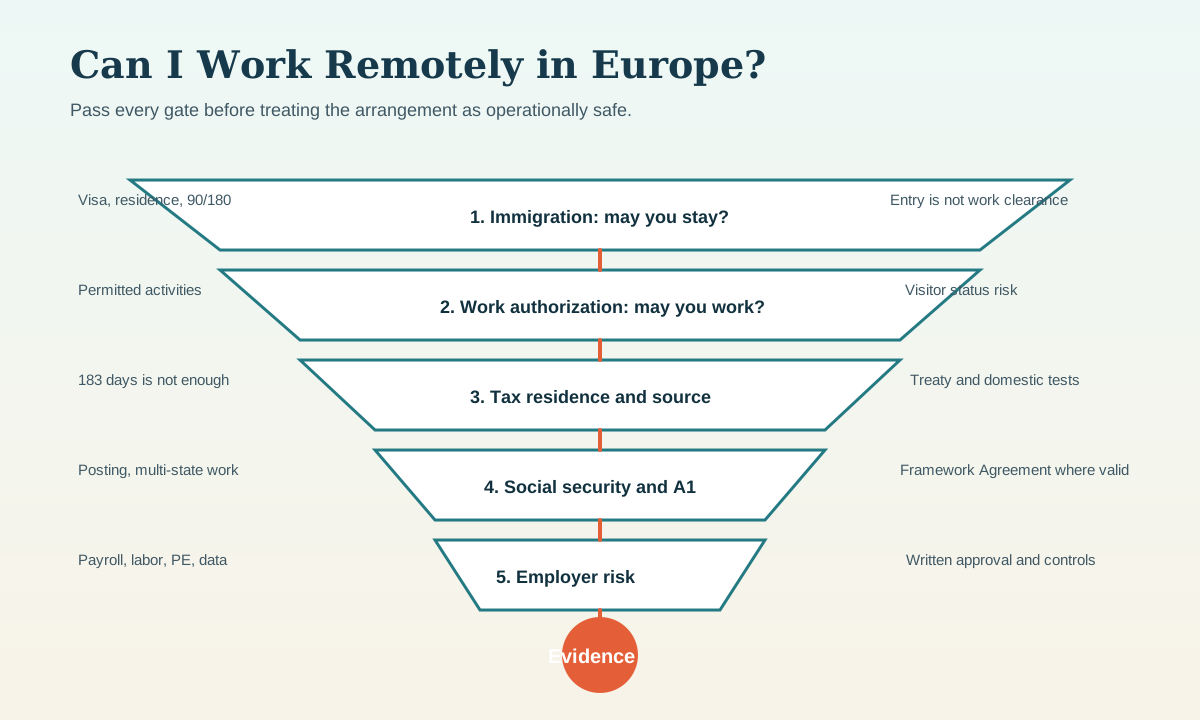
The answer to "Can I work remotely in Europe?" is not one universal yes or no. It depends on where you physically sit while working, your nationality, your visa or residence status, whether you are an employee or self-employed, where your employer or clients are located, and which country has the right to tax or require social-security contributions.
The safest short answer is this: remote work in Europe is legal only when the immigration, work-authorization, tax, payroll, social-security, and employer-risk layers all point to a defensible arrangement. A tourist stay, a Schengen 90/180 calculation, or a company "work from anywhere" email is not enough by itself.
This guide is current for planning use as of May 14, 2026. It is not legal or tax advice; it is a compliance framework for deciding when remote work is low risk, when it needs restructuring, and when it should not start.
The Six Legal Layers
| Layer | Question to answer | Why it matters |
|---|---|---|
| Immigration | May you enter and remain in the country? | Entry permission is the baseline |
| Work authorization | Does your status allow productive work from that country? | Visitor status may not permit ongoing work |
| Tax residence | Which country can tax your income? | The 183-day rule is not a universal safe harbor |
| Social security | Which system receives contributions? | EU/EEA/Swiss rules can override private arrangements |
| Payroll and labor law | Must the employer register locally or comply with local employment rules? | Employer exposure can arise even if the worker is lawful |
| Permanent establishment and corporate tax | Could the worker's activity create a taxable business presence? | Sales, management, contracting authority, and home-office facts matter |
EU guidance on working abroad, residence rights, and work permits is a useful starting point, but it does not replace country-specific legal analysis: Your Europe working abroad, Your Europe residence rights, and Your Europe work permits.
Tourist Status Is Not a Remote-Work Strategy
For non-EU travelers, Schengen short-stay rules determine how long you may remain in the Schengen area, usually measured through the 90-days-in-any-180-days framework. That is an entry and stay calculation, not a blanket remote-work authorization. The official calculator is here: European Commission Schengen short-stay calculator.
A person can be compliant with the 90/180-day rule and still create problems if the host country treats remote work as work requiring authorization, local registration, tax reporting, or employer compliance.
| Activity while visiting | Risk level | Why |
|---|---|---|
| Checking email during a vacation | Low to medium | Incidental activity is often tolerated but still country-specific |
| Working full-time for a foreign employer for several weeks | Medium to high | Productive work is being performed in the host country |
| Managing staff, negotiating contracts, or signing deals from the host country | High | Employer tax, labor, and permanent-establishment issues may arise |
| Serving local clients while on visitor status | Very high | May conflict with immigration and business-registration rules |
The UK is not in the EU or Schengen, but it is a useful cautionary example because its visitor rules explicitly list permitted and excluded activities. Check the national rule, not a generic Europe blog: UK visitor permitted activities and UK Appendix V visitor rules.
EU, EEA, and Swiss Citizens: Easier Movement, Not Zero Compliance
EU/EEA/Swiss citizens generally have stronger rights to live and work across participating European states than third-country nationals. But those rights do not eliminate tax residence, employer payroll, labor-law, or social-security questions.
| Situation | Common misconception | Better framing |
|---|---|---|
| EU citizen works remotely from another EU country | "I have free movement, so no compliance issue exists." | Free movement helps immigration, but payroll, tax, residence registration, and social security still need analysis |
| EU employee works from country of residence for foreign EU employer | "The employment contract can stay unchanged." | Social-security and payroll attribution may change |
| EU citizen rotates monthly among countries | "Short stays avoid all rules." | Workday tracking, tax ties, and employer exposure still matter |
Your Europe explains that residence registration may be required after three months in another EU country: Your Europe residence registration after three months.
Social Security: A1 Certificates and Telework Rules
For EU/EEA/Swiss situations, social-security coordination is often the decisive layer. Your Europe states that the PD A1 form proves that a posted worker remains covered by the home country's social-security system while posted to another EU country, generally for up to 24 months: Your Europe social-security coverage abroad.
For habitual cross-border telework, the Framework Agreement on cross-border telework can allow an employee to remain subject to the employer-state social-security legislation if conditions are met. Belgium acts as the depository state and publishes the agreement and signatory list. The published conditions include that the residence state differs from the employer's state, cross-border telework in the residence state is less than 50% of total working time, and the request is made with employer and employee consent: Framework Agreement on cross-border telework.
| Work pattern | Likely control point |
|---|---|
| Temporary posting to another EU country | A1 posting certificate |
| Working in several EU countries | Multi-state social-security assessment |
| Living in one EU country and teleworking for employer in another | Residence-state activity percentage and possible Framework Agreement request |
| Self-employed remote worker | Home-state activity, host-state registration, and country-specific rules |
| Non-EU worker in Europe | Visa route plus bilateral social-security agreements, if any |
Tax: The 183-Day Rule Is Not Enough
Many remote workers overuse the phrase "183 days." Tax treaties often use day counts, but tax residence can also depend on home, family, habitual abode, center of vital interests, business activity, or domestic statutory tests. A short period can still create payroll or corporate-tax issues, and a long period can create residence even if the worker expected to remain "foreign."
Your Europe provides the EU-level starting point for income taxes abroad: Your Europe income taxes abroad.
The OECD's 2025 update to the Model Tax Convention added guidance on cross-border remote work and taxable business presence, including when home-office facts may matter for permanent establishment analysis: OECD 2025 Model Tax Convention update.
Digital Nomad and Remote-Work Visas
Several European countries have created remote-work or digital-nomad pathways, but these routes are not interchangeable. They usually restrict local employment, require income evidence, require health insurance or social-security proof, and may impose tax consequences.
| Country example | Official route signal | Important limitation |
|---|---|---|
| Spain | Telework visa or international teleworker authorization | Employees generally work only for non-Spanish companies; self-employed applicants may have limited Spanish-client activity |
| Croatia | Temporary stay of digital nomads | For third-country nationals working through technology for a company or own company not registered in Croatia |
| Italy | Digital nomad or remote worker national visa | Intended for non-EU highly skilled workers; consular requirements are detailed and document-heavy |
| Greece | Digital Nomad Visa | Non-EU professionals may apply through the Greek framework |
| UK | Visitor route is not a digital-nomad route | Productive remote work is constrained by visitor rules |
Official country sources:
- Spain telework visa guidance
- Croatia temporary stay of digital nomads
- Italy digital nomad and remote worker visa guidance
- Greece Digital Nomad Visa guidance
Employee, Contractor, Founder: Different Risk Profiles
| Worker type | Key risk | Evidence needed before work begins |
|---|---|---|
| Employee | Employer payroll, social security, labor law, PE exposure | Employer approval, A1 or local registration analysis, work-location calendar |
| Contractor | Self-employment registration, VAT, disguised employment | Client contracts, tax registration analysis, invoice location policy |
| Company director or founder | Management and control, PE, board decisions | Corporate governance log, signing authority rules, tax counsel memo |
| Freelancer with local clients | Local business activity | Visa permission, tax/VAT registration, client-location analysis |
| Student | Work-hour and status restrictions | Student residence rules, employer letter, university or authority confirmation |
Compliance Gate Before You Work
Do not start with "Where do I want to live?" Start with "Which authority could object?"
| Gate | Pass condition | Fail signal |
|---|---|---|
| Immigration | Status allows stay for intended period | Tourist time only, no residence route |
| Work authorization | Productive remote work is allowed or tolerated under documented rules | Status only permits tourism or study |
| Tax | Residence and source rules mapped | No country-day log |
| Social security | A1, local registration, or bilateral path identified | Employer assumes home payroll is enough |
| Employer risk | Labor, payroll, PE, data, and insurance reviewed | HR approval without tax/legal review |
| Operational control | Written policy, work calendar, and document retention | Informal "work from anywhere" message |
Employer Checklist
Employers should approve cross-border remote work only after documenting:
- Worker nationality and immigration status.
- Exact country and dates of physical work.
- Whether the employee will serve local customers.
- Whether the employee can negotiate, sign, or manage contracts.
- Payroll withholding position.
- Social-security certificate or local registration path.
- Health and workplace insurance coverage.
- Data-transfer and cybersecurity review.
- Local labor-law applicability.
- End date and reapproval trigger.
Worker Checklist
Remote workers should keep:
- Passport and visa or residence permit.
- Written employer permission naming the country.
- Workday calendar by country.
- A1 certificate, certificate of coverage, or local social-security evidence where relevant.
- Tax-residence memo or advisor letter.
- Payroll and payslip records.
- Rental or accommodation records.
- Travel records matching the workday calendar.
- Client contracts or employment agreement.
- Proof of health insurance if required by status.
Risk Register
| Risk | Severity | Trigger | Control |
|---|---|---|---|
| Unauthorized work | Very high | Productive work under a status that does not permit it | Confirm national permitted-activity rules before starting |
| Social-security misallocation | High | Employee works across borders without A1 or local registration review | Obtain competent-institution confirmation |
| Employer permanent establishment | High | Worker habitually negotiates, signs, or manages from host country | Limit authority or register appropriately after tax review |
| Tax residence mismatch | High | Worker relies only on 183-day assumption | Keep day count, home ties, and treaty analysis |
| Payroll non-compliance | High | Employer continues home payroll despite local work | Confirm withholding and employer registration duties |
| Data and security breach | Medium | Cross-border system access without policy review | Apply cybersecurity and data-transfer controls |
| Evidence failure | Medium | Worker cannot prove dates, status, or approval | Maintain a dated work-location and document log |
FAQ
Can I work remotely in Europe on a tourist visa?
Sometimes incidental work may be low risk, but ongoing productive work on tourist status is not universally legal. The answer depends on the country, activity, duration, and whether local clients or employer functions are involved.
Does Schengen 90/180 compliance make remote work legal?
No. The 90/180 rule is a short-stay calculation. It does not answer tax, payroll, social-security, employment-law, or work-authorization questions.
Does staying under 183 days avoid European tax?
Not automatically. The 183-day concept is only one part of many domestic and treaty analyses. Home, family, habitual abode, income source, employer location, and permanent-establishment facts may matter.
Can my U.S. employer let me work from Europe?
Possibly, but the employer must analyze host-country payroll, labor law, social security, tax, data security, and permanent-establishment exposure. A private company policy cannot override local law.
Are digital nomad visas tax-free?
No. A digital nomad visa is an immigration route. Tax residence and tax rates are separate questions.
Do EU citizens need an A1 certificate?
For posted or cross-border work situations, an A1 certificate may be needed to prove which social-security system applies. Free movement does not eliminate social-security coordination.
Factual Uncertainty and Source Risks
Remote-work rules change quickly. This guide is current to May 14, 2026, but individual consulates and local authorities can interpret requirements differently. Digital-nomad visa pages are especially operationally unstable because income thresholds, document lists, appointment systems, insurance requirements, and family rules can change without broad notice.
EU social-security coordination is also evolving. Until revised rules are legally in force and implemented, rely on current A1, multi-state, posting, and Framework Agreement rules and confirm with the competent institution.
Official and Primary Sources
- Your Europe: working abroad
- Your Europe: work permits
- Your Europe: residence rights
- Your Europe: residence registration
- European Commission: Schengen short-stay calculator
- Your Europe: income taxes abroad
- Your Europe: social-security coverage abroad
- Cross-border telework Framework Agreement depository page
- OECD: 2025 Model Tax Convention update
- Spain: telework visa guidance
- Croatia: temporary stay of digital nomads
- Italy: digital nomad and remote worker visa
- Greece: Digital Nomad Visa
- UK: visitor permitted activities
Decision matrix
Remote work in Europe should be assessed as a layered permission model. The mistake is asking only whether the work is "remote" or whether the worker is under the Schengen 90/180 limit. A better question is whether the full arrangement is authorized, taxable, insurable, and administratively traceable.
Layer 1: immigration permission
Start with the legal basis for physical presence:
- EU free-movement residence,
- national residence permit,
- digital nomad or remote-worker visa,
- posted-worker route,
- short-stay visitor route,
- family or student residence route.
Each route has a different work-permission perimeter. Some routes allow local employment; some allow only foreign-employer remote work; some allow study with limited work; some visitor routes allow only business meetings and incidental activities. The route must be checked before the laptop opens.
Layer 2: employer and payroll permission
Even if the individual can enter Europe, the employer must decide whether it can legally tolerate the work location. The review should cover:
- payroll withholding exposure,
- local employment-law protections,
- health and safety obligations,
- permanent-establishment risk,
- data-security and export-control issues,
- employer social-security registration.
This is why an internal "work from anywhere" policy is not enough. Company policy is a permission layer inside the company, not a substitute for host-country law.
Layer 3: personal tax residence
Tax residence can arise from day counts, home, family, habitual abode, center of vital interests, or domestic deeming rules. The 183-day idea is not a universal safe harbor. Treat it as one possible test inside a larger analysis.
Build a tax-residence file with:
- arrival and departure dates,
- housing evidence,
- employment contract and employer country,
- family location,
- local registrations,
- income source and payment records.
Layer 4: social security and health coverage
Social security is separate from income tax. For EU, EEA, Switzerland, and UK-linked cases, A1 certificates and coordination rules can be decisive. For non-EU nationals or non-covered arrangements, local social-security or private-insurance rules may apply.
The practical control is simple: do not assume tax payment and social-security coverage move together.
Layer 5: commercial and VAT exposure
Freelancers and company owners need an extra layer:
- where services are performed,
- whether local registration is required,
- whether VAT applies,
- whether local clients are served,
- whether the foreign company has a dependent-agent or fixed-place risk.
An employee doing occasional remote work has a different risk profile from a founder negotiating contracts from a rented apartment abroad.
Remote Work Scenario Matrix
| Scenario | Main risk | Better first action |
|---|---|---|
| EU citizen working from another EU country for a home-country employer | social security, tax residence, payroll | classify residence duration and obtain employer approval |
| Non-EU citizen visiting Schengen and working online | immigration and visitor-permitted activity | verify national visitor rules before working |
| Digital nomad visa applicant | visa conditions versus tax outcome | separate immigration approval from tax analysis |
| Employee relocates without employer registration | payroll and labor-law exposure | pause arrangement and run employer-country review |
| Freelancer serving EU clients | VAT, business registration, income tax | map customer location and invoicing model |
| Founder managing a foreign company from Europe | permanent establishment and management control | document decision location and authority |
Evidence File For A Defensible Arrangement
Create one folder per remote-work episode. Include:
- travel dates and address history,
- legal basis for stay,
- employer or client approval,
- work-location policy,
- tax-residence analysis,
- social-security coverage proof,
- health-insurance proof,
- payroll or invoice records,
- data-security approvals where relevant.
If the arrangement lasts more than a few weeks, add a monthly review note. A dated note is better than reconstructing the file from calendar memory later.
Red-Flag Triggers
Escalate before continuing remote work if:
- the stay exceeds the original plan,
- the worker signs a local lease,
- local clients are added,
- the worker manages staff or negotiates contracts abroad,
- payroll remains in one country while work pattern shifts to another,
- social-security coverage is unknown,
- visa status does not clearly authorize productive work.
These triggers do not necessarily mean the arrangement is illegal. They mean the risk profile changed.
Practical Scorecard
Use a 25-point score:
| Factor | Score 0-5 | Ready-state meaning |
|---|---|---|
| immigration route | 0-5 | stay and work activity are covered |
| employer approval | 0-5 | company has approved location and duties |
| tax analysis | 0-5 | personal and employer tax issues are mapped |
| social security | 0-5 | coverage and A1/coordination status are clear |
| evidence quality | 0-5 | records can survive an authority request |
Use the score as a triage tool, not as permission to work. A low or uneven score means the arrangement needs country-specific review before it becomes routine; a stronger score still depends on the host-country rule, employer approval, and current tax and social-security analysis.
Internal Links For Next Steps
- Remote work Europe tax
- Digital nomad visa requirements in Europe
- EU remote working
- Live in one European country and work in another
- Income tax for non-residents in Europe
Country-Change Playbook
Before changing countries, run a simple gate review. Confirm whether the worker is entering as a visitor, resident, posted worker, local employee, freelancer, student, family member, or digital nomad. Then confirm whether the intended work is allowed under that status. These are separate questions. A person can have legal residence but still breach work-permit conditions, and a person can have visa-free entry but no clear right to perform productive work.
For stays under one month, focus on immigration fit, employer permission, secure access, and evidence of temporary travel. For stays of one to three months, add tax-residence screening, social-security review, payroll allocation, and client-activity limits. For stays beyond three months, treat the arrangement as a relocation unless counsel confirms otherwise. The review should also cover local registration, health insurance, housing, dependants, school enrollment, and whether the worker is building facts that look permanent.
Employers should maintain a country register showing approved destinations, maximum default duration, prohibited work types, and escalation contacts. The register should not be static. It should be updated when countries change digital nomad visa rules, registration thresholds, tax authority guidance, social-security coordination positions, sanctions rules, or data-transfer restrictions. Remote-work approvals based on old assumptions become weak quickly.
Workers should keep their own parallel file. It should include the approval email, travel evidence, accommodation evidence, local registration if any, insurance, day ledger, payslips or invoices, and notes explaining non-work days. If an authority later asks why the stay was lawful, the answer should come from documents created at the time, not from a reconstructed narrative.
The strongest remote-work setup is not the one with the most optimistic interpretation. It is the one where every layer produces the same story: the person was allowed to stay, allowed to perform the activity, taxed consistently, insured correctly, and not silently relocating an employer or business function.
Final Operating Standard
Working remotely in Europe is safest when the person can prove four things at the same time: lawful stay, lawful work activity, coherent tax treatment, and valid social-security or insurance coverage. If one layer is missing, the arrangement needs review before it becomes routine.
Official source and decision check
Use this section as the practical checkpoint for Can I Work Remotely in Europe? Legal, Tax, Visa, and Employer Guide. The reader decision is whether the available evidence is strong enough to act now, or whether the file should first be confirmed with the competent authority. Rules can change by country, status and date, so treat this guide as orientation for the file and recheck the current rule before relying on an appointment, payment, journey or application deadline.
For expats, foreigners, students, workers, founders, families and other mobile readers, record the reader category, country, residence status and deadline before comparing the official source with the article checklist.
Official sources to verify first
- Your Europe citizen rights portal
- European Commission social security coordination
- EUR-Lex EU law access
- EURES mobility and work portal
- European Commission information portal
| Decision point | What to check | Reader action |
|---|---|---|
| Administrative decision | Confirm that the case is really about administrative decision, not a different category that follows another rule. | Write down the country, authority, dates, status and document number before asking for a decision. |
| File for competent authority | Keep the identity, residence and document evidence in one dated file, with originals, translations where required and proof of submission. | Save receipts, emails, appointment confirmations, payment records and authority replies in the same order as the checklist. |
| Can I Work Remotely in Europe? Legal, Tax, Visa, and Employer Guide fallback | If the answer is refused, delayed or unclear, identify the competent authority, review window, complaint route or regulated provider escalation path. | Ask for the reason in writing and compare it with the official source before paying again, travelling, closing an account or resubmitting. |
| When the answer is unclear | What to do next |
|---|---|
| The authority, bank, insurer, employer or provider gives a verbal answer only. | Ask for the answer in writing, save the name of the office or provider, and compare it with the official source before changing travel, payroll, residence or payment plans. |
| The file depends on a deadline, appointment, payment, address or status change. | Keep the dated receipt, note the next deadline, and avoid closing the old route until the replacement document, account, policy or registration is confirmed. |
Related guides to cross-check
- First month in Europe checklist
- Living in one European country and working in another
- EU remote working guide
- Cross-border worker benefits in the EU
- Private health insurance documents in Europe
For legal, tax, medical, immigration or financial consequences, confirm the position with the competent authority or a qualified adviser. This page is designed to organize the decision, source checks and next steps; it is not a substitute for case-specific professional advice.