Last updated
Relocation Services for Expats in Europe: Due Diligence, Costs, and Workflow
Direct answer
Use Relocation Services for Expats in Europe: Due Diligence, Costs, and Workflow to understand the moving parts before you pay, apply, sign, book, or rely on a third-party summary. It explains checking tax position, payroll evidence, social-security exposure, net pay, and cross-border filing questions across Europe, then shows how to separate residence, treaty, payroll, contribution, withholding, and filing questions before signing or moving money. The later sections connect what relocation services usually cover, when a relocation provider is worth paying for, and the legal boundary: concierge help is not regulated advice so the next step is easier to judge. Read it before submitting forms, moving money, choosing a provider, or assuming that a rule from another country applies.
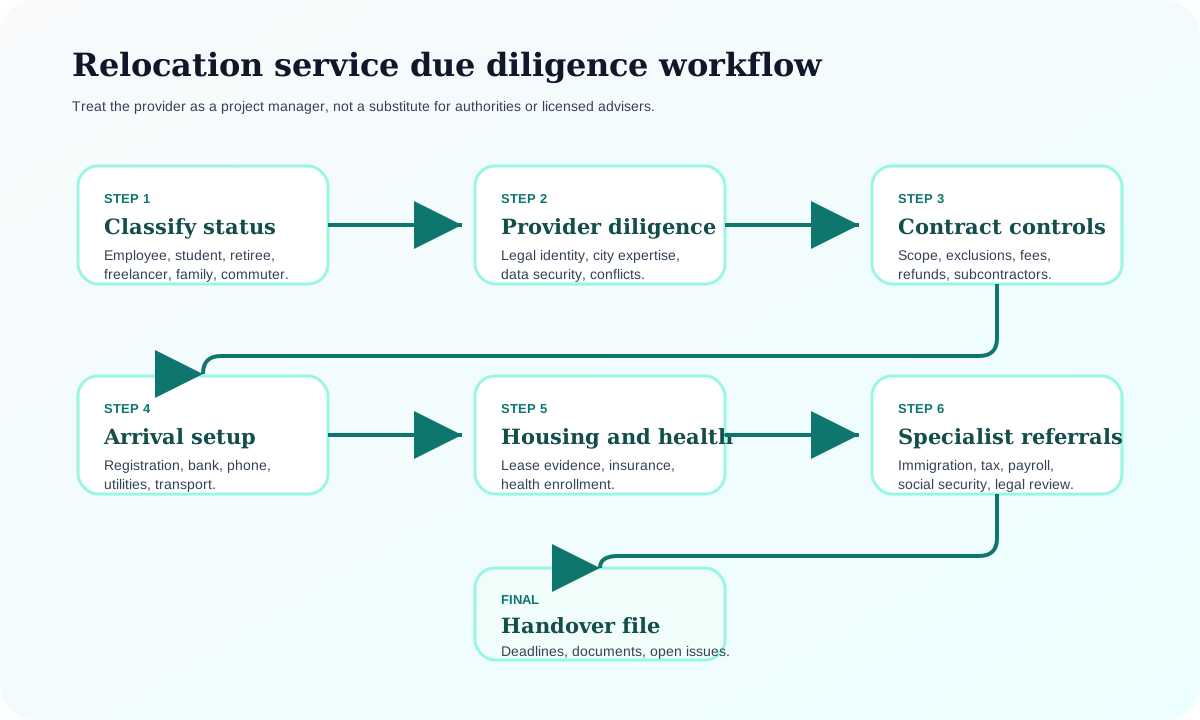
Before paying, ask for a written scope, price schedule, cancellation rule, data-handling process, handover file, and a boundary list showing what the provider will not decide. The best next step is to compare providers on evidence and workflow, not brochure breadth.
Source-check date: May 14, 2026.
Relocation services for expats in Europe can save weeks of administrative friction, but they can also create expensive false confidence. A relocation company may help with home search, school search, utilities, registration appointments, banking introductions, moving logistics, and local orientation. It may not be legally qualified to give immigration, tax, social-security, employment, or regulated financial advice.
The right provider is not the one with the broadest brochure. It is the one that clearly separates concierge support from regulated advice, documents what it will do, explains what it will not do, protects your personal data, and gives you a realistic timetable based on the country and city where you are actually moving.
If you are still mapping the move itself, start with the first month in Europe expat checklist before paying for relocation support. It shows how housing, registration, banking, insurance, tax, and work status affect each other during the first 30 days.
This guide explains how to evaluate relocation support before paying a retainer or handing over passports, payslips, tax documents, lease files, health records, school records, or work contracts.
This article is educational information, not legal, tax, immigration, employment, insurance, or financial advice.
What Relocation Services Usually Cover
Relocation services are practical coordination services. They are useful because European moves often involve several systems at once: residence, work authorization, social security, tax registration, healthcare, housing, schools, utilities, transport, banking, and insurance.
| Service area | Typical tasks | What must still be verified |
|---|---|---|
| Pre-move planning | Timeline, document checklist, neighborhood shortlist | Whether the advice is based on official current rules |
| Immigration coordination | Appointment booking, document formatting, translations, consulate checklist | Whether a licensed immigration professional is required |
| Housing search | Rental search, viewing coordination, lease support | Whether the lease terms, deposits, and guarantees are lawful |
| Registration | City registration, tax number, health insurance enrollment support | Which authority makes the decision |
| Moving logistics | Shipment quotes, customs coordination, inventory lists | Insurance coverage, customs documents, delivery liability |
| School search | International, local, bilingual, or private school options | Admissions deadlines, language support, special-needs capacity |
| Settling-in support | Utilities, mobile phone, transport card, bank introductions | Contract duration, cancellation fees, language of terms |
| Departure support | Lease exit, deregistration, utility closure, deposit follow-up | Tax, social-security, and residence consequences of leaving |
When a Relocation Provider Is Worth Paying For
Relocation support is most valuable when the move has friction that cannot be solved by a simple checklist.
| Situation | Why help may be worth it |
|---|---|
| You are moving to a high-demand rental market | Local viewing speed, landlord expectations, and document formats matter |
| You do not speak the local language | Registration, utilities, school, and lease steps may become slower |
| You have children | School deadlines and neighborhood constraints can dominate the move |
| You are a non-EU national | Immigration sequencing and document proof can be unforgiving |
| You are self-employed | Banking, tax, health coverage, and business registration may overlap |
| You are a cross-border worker | Residence, social security, tax, and employer payroll may point to different countries |
| You are relocating executives or staff | Employer duty of care, payroll, posted-worker, and immigration coordination may be required |
| You have pets, vehicles, or household goods | Import, registration, insurance, and customs steps add complexity |
A relocation provider is less valuable if you already have local language fluency, a confirmed employer process, simple housing, no dependents, and a clear public registration route.
The Legal Boundary: Concierge Help Is Not Regulated Advice
The most important due diligence question is whether the provider is allowed to do what it is selling.
| Topic | Relocation company can often help with | Specialist may be needed |
|---|---|---|
| Immigration | Gather documents, book appointments, explain public checklist | Legal strategy, appeal, complex eligibility, employer sponsorship |
| Tax | Introduce accountants, explain filing deadlines generally | Tax residence, treaty position, stock options, double taxation |
| Social security | Identify competent institutions, gather forms | Formal determination, multi-state worker analysis, A1/S1 issues |
| Employment | Explain local onboarding steps | Contract review, dismissal law, posted-worker compliance |
| Insurance | Collect quotes, explain certificate requirements | Regulated insurance advice, coverage suitability |
| Real estate | Arrange viewings, translate practical terms | Legal review of lease or purchase contract |
| Banking | Introduce banks and prepare documents | Financial advice, investment, credit, mortgage suitability |
For EU residence and work rights, Your Europe is a primary starting point. EU citizens can move to another EU country to live, work, study, look for work, or retire, but registration after the first three months and supporting documents depend on status and country: Your Europe residence rights. Residence document formalities are summarized here: Your Europe residence documents and formalities.
Due Diligence Checklist Before You Hire
Use this table before signing the service agreement.
| Check | Ask for | Red flag |
|---|---|---|
| Legal identity | Registered company name, address, VAT or business number | Only a social media profile or personal bank account |
| Scope of work | Written list of included and excluded services | "We handle everything" without detail |
| Fee structure | Fixed fee, hourly fee, success fee, cancellation terms | Large upfront payment with vague deliverables |
| Regulated boundaries | Written statement on legal, tax, insurance, and immigration limits | Provider promises visa approval or tax savings |
| Data handling | Privacy policy, data-retention period, secure transfer method | Requests passports by insecure chat without explanation |
| Local expertise | Named city consultant and language capacity | Generic country PDF reused for every client |
| Housing process | How viewings, offers, deposits, and guarantees are handled | Pressure to transfer deposits before lease verification |
| Complaint path | Named manager, escalation process, refund rules | No written complaint process |
| Third-party fees | Which costs are external: translators, notaries, couriers, agents | less visible commissions or undisclosed referral fees |
| Insurance | Professional indemnity or liability cover if relevant | No answer on errors, omissions, or mishandled documents |
Practical Service Packages
Relocation firms often package services by move complexity.
| Package | Good fit | Core deliverables |
|---|---|---|
| Document-only support | Independent movers who need structure | Checklist, timeline, form review, appointment list |
| Home-search package | Renters entering a competitive city | Area briefing, viewings, application dossier, lease coordination |
| Family settling-in | Families with children | School search, healthcare orientation, registration, utilities |
| Corporate relocation | Employer-sponsored move | Immigration coordination, payroll timeline, housing, compliance routing |
| Cross-border worker setup | Commuters and hybrid workers | Residence, tax, social-security, healthcare, and employer checklist |
| Departure package | Leaving Europe or moving country | Deregistration, lease exit, utility closure, final document pack |
The Cross-Border Work Problem
A relocation provider should not treat cross-border work as a simple housing issue. If you live in one country and work in another, employment law, social security, tax, residence, and registration may be separated.
Your Europe explains that cross-border commuters are people who work in one EU country but live in another and return home daily or at least weekly: Your Europe cross-border commuters. The same EU guidance distinguishes between laws in the work country and laws in the residence country.
| System | Often linked to | Why the relocation plan must separate it |
|---|---|---|
| Residence | Country where you live | Determines address registration, local documents, family status |
| Employment law | Country where work is performed | Affects working conditions, dismissal, workplace rights |
| Social security | Usually one competent state under coordination rules | Affects healthcare, pensions, unemployment, family benefits |
| Tax | Domestic law plus treaty rules | Can differ from social-security result |
| Healthcare access | Competent state and residence state procedures | May require forms, registration, and insurer coordination |
The European Commission's social-security coordination pages are essential for this analysis: EU social security coordination. Tax should be checked separately through official tax and treaty guidance. The European Commission overview of EU taxpayers and cross-border tax issues is a useful starting point: EU taxpayers and cross-border tax issues.
Housing Support: Where Expats Lose Money
Housing is often the most emotionally charged relocation service. It is also where bad incentives appear.
| Housing issue | What good support does | What you should control |
|---|---|---|
| Neighborhood advice | Explains commute, schools, safety, transport, local amenities | Visit if possible and test commute at real times |
| Application dossier | Formats documents in local style | Do not provide unnecessary sensitive documents |
| Lease review coordination | Flags unusual clauses and refers to legal help if needed | Get legal review for high-value or unclear leases |
| Deposit handling | Explains normal deposit channel and timing | Avoid transfers to unverified accounts |
| Inventory check-in | Documents condition with photos and written report | Keep timestamped evidence |
| Utilities | Helps open electricity, gas, internet, water | Check contract duration and cancellation charges |
| Tenant insurance | Identifies whether proof is required | Confirm coverage before key handover |
A relocation company should not pressure you to accept a property because the consultant is busy, because the viewing slot is ending, or because a landlord is supposedly waiting for an immediate transfer.
Data Protection and Document Security
Relocation files can include passports, birth certificates, marriage certificates, employment contracts, tax records, bank statements, health documents, school records, pet records, and visas. Treat the provider as a high-risk data processor.
| Document type | Risk | Better practice |
|---|---|---|
| Passport and visa scans | Identity theft | Secure portal, limited retention, watermark if acceptable |
| Payslips and bank statements | Financial exposure | Share only required pages and redact where allowed |
| Children's school files | Sensitive family data | Use encrypted transfer and named recipient |
| Health insurance records | Medical privacy | Send only to parties that truly need them |
| Lease and address records | Physical safety and fraud | Confirm recipient and purpose |
| Tax and employer records | Financial and employment risk | Use accountant or lawyer where appropriate |
Ask who can access your file, where it is stored, when it is deleted, whether subcontractors are used, and how a data breach is handled.
Complaints and Consumer Protection
If the relocation provider is a consumer-facing trader in the EU, ordinary consumer complaint routes may matter. The European Commission summarizes consumer complaint options, including alternative dispute resolution and the European Consumer Centres Network: European Commission consumer complaint resolution. Your Europe also explains informal dispute resolution for consumers: Your Europe informal dispute resolution.
For problems with a public authority applying EU rights incorrectly, SOLVIT may be relevant. The European Commission describes SOLVIT as an informal problem-solving network for EU rights issues involving public authorities: SOLVIT.
What a Strong Relocation Contract Should Say
| Clause | Why it matters |
|---|---|
| Exact services | Prevents vague "settling-in support" from replacing deliverables |
| Country and city scope | Avoids assumptions about local knowledge |
| Timeline assumptions | Clarifies what depends on public authority appointments |
| Client duties | Lists documents and deadlines you must provide |
| Exclusions | Separates legal, tax, immigration, financial, and insurance advice |
| Subcontractors | Identifies movers, agents, translators, lawyers, consultants |
| Fees and refunds | Shows what happens if the move is cancelled or delayed |
| Conflict of interest | Discloses referral commissions from landlords, insurers, movers, schools |
| Data protection | Explains storage, access, deletion, and breach process |
| Liability limit | Shows what happens if the provider makes an error |
| Complaint procedure | Provides escalation before litigation or ADR |
Relocation Workflow for Expats in Europe
| Phase | Main task | Relocation support | Specialist support |
|---|---|---|---|
| 90 to 180 days before move | Define status, country, family needs, work model | Timeline and document map | Immigration, tax, employer mobility review |
| 60 to 90 days before move | Housing and school shortlist | Neighborhood research, school contact | Legal review if signing early |
| 30 to 60 days before move | Visa, insurance, shipment, temporary housing | Appointment coordination, vendor quotes | Immigration lawyer or insurer if route is complex |
| Arrival week | Registration, bank, mobile, utilities, transport | Accompanied appointments and setup | Tax/social-security adviser if cross-border |
| First 30 days | Health enrollment, lease inventory, school start | Follow-up and document tracking | Accountant, lawyer, payroll specialist |
| First 90 days | Confirm no unresolved status gaps | Handover file and deadline reminders | Tax residence and social-security confirmation |
| Departure | Deregister, close utilities, settle deposit | Exit checklist | Tax and social-security departure filings |
Questions to Ask Before Paying
| Question | Good answer |
|---|---|
| Which official sources do you use for residence and registration rules? | Named authority pages, date-checked, country-specific |
| Are you legally authorized to give immigration advice? | Clear yes with credentials, or clear no with referral |
| Do you receive commissions from landlords, movers, schools, banks, or insurers? | Transparent disclosure |
| How do you handle passport and bank documents? | Secure portal, restricted access, deletion policy |
| What happens if no suitable housing is found? | Written fallback and fee rule |
| What is not included? | Tax advice, legal advice, government fees, translation, courier, deposits |
| Who is my day-to-day contact? | Named consultant, backup contact, language coverage |
| Can I see a sample timeline for this city? | Realistic, authority-dependent, not assured |
| How do you handle complaints? | Written escalation and response timetable |
Cost Control Without False Economy
Relocation support should reduce friction, not become an uncontrolled subscription. Ask for a fee schedule that separates fixed package fees, hourly fees, third-party costs, government fees, translation, courier charges, housing-search extensions, school-search support, accompanied appointments, and emergency support.
| Cost item | Control question |
|---|---|
| Package fee | What exact deliverables are included? |
| Hourly overage | What triggers extra billing? |
| Government fees | Are they paid directly to the authority or via the provider? |
| Housing support | How many viewings, applications, and neighborhoods are included? |
| Temporary housing | Are commissions disclosed? |
| Movers and storage | Are quotes competitive and itemized? |
| School search | Does support include application preparation or only shortlisting? |
| Registration appointments | Is success assured or only scheduling support? |
| Translation and notarization | Are third-party providers optional? |
| Cancellation | What happens if visa, job, or housing falls through? |
Cheap relocation support can be expensive if it creates missed appointments, bad leases, duplicate insurance, unsafe document handling, or poor sequencing. Expensive support can be worth it if it prevents administrative failure during a high-stakes move. The decision should be based on deliverables and risk reduction, not brochure language.
Handover File at the End of the Move
Before closing the engagement, request a handover file. It should give the expat enough control to operate without the provider.
| Handover item | Why it matters |
|---|---|
| Registration confirmations | Needed for banks, employers, schools, and tax |
| Lease, inventory, and deposit evidence | Protects housing position |
| Utility contracts and cancellation dates | Prevents billing surprises |
| Insurance certificates | Needed for housing, vehicle, health, or school files |
| Bank and payment setup notes | Helps confirm salary, rent, and direct debits |
| School enrollment records | Supports family continuity |
| Tax and social-security referral notes | Shows unresolved specialist issues |
| Public authority deadlines | Prevents missed renewals |
| Provider contact list | Helps resolve post-move problems |
Do not let the provider keep the only organized copy of your relocation file. Store your own version in a secure folder with dates, account numbers where appropriate, and renewal reminders.
When Relocation Support Is Not Enough
Escalate beyond relocation support when the issue involves legal interpretation, regulated advice, or liability. Immigration lawyers, tax advisers, social-security specialists, insurance brokers, notaries, employment counsel, school admissions officers, and public authorities each have roles the relocation provider may not be qualified to replace.
Typical escalation triggers include rejected visa files, cross-border employment, posted-worker status, dual tax residence, family-law documents, regulated professions, high-value leases, property purchases, company formation, unusual insurance requirements, and disputes with authorities or landlords.
The best relocation provider will tell you early when a specialist is needed. A provider that tries to answer every legal, tax, and financial question internally may be creating risk.
First 30 Days Control Board
After arrival, create a control board. It should show what is done, what is pending, who owns it, and what proof exists.
| Workstream | Done when | Evidence |
|---|---|---|
| Address registration | Appointment completed or receipt saved | Registration certificate or receipt |
| Housing | Lease, inventory, deposit, utilities, insurance active | Lease, photos, certificates |
| Banking | Account works for salary, rent, and direct debit | IBAN proof and test transactions |
| Health insurance | Accepted proof or public registration route active | Certificate, card, submission receipt |
| School | Enrollment confirmed and documents filed | School letter |
| Mobile and internet | Contracts active and cancellable terms known | Contract PDFs |
| Tax and payroll | Employer or adviser has required data | Payroll onboarding confirmation |
| Vehicle or transport | Registration, insurance, permit, or pass complete | Policy and registration proof |
A relocation provider can maintain this board, but the client should have access. If the provider disappears, the move should still be auditable.
Red Flags During Delivery
Watch for delivery problems after the contract is signed.
| Red flag | Why it matters |
|---|---|
| Provider cannot cite official sources | Advice may be outdated or anecdotal |
| Documents requested without purpose | Privacy and fraud risk |
| Cash transfers to personal accounts | Fraud and recovery risk |
| Pressure to sign a lease unseen | Housing and deposit risk |
| No written record of appointments | Missed deadline risk |
| Commissions not disclosed | Conflict of interest |
| "assured approval" language | Public authorities decide legal outcomes |
| Refusal to hand over files | Client loses control of move evidence |
If these appear, slow the process and move critical decisions back to official sources or qualified advisers.
Service-Level Agreement
For corporate moves or high-cost personal moves, ask for service levels. They do not guarantee public-authority outcomes, but they can make provider performance measurable.
| Service level | Practical standard |
|---|---|
| Response time | Same business day for urgent issues, 24 to 48 hours for routine items |
| Source updates | Official-source checks dated before advice is delivered |
| Document handling | Secure portal, named recipients, deletion timetable |
| Appointment tracking | Calendar entries with owner and backup plan |
| Escalation | Named manager and written complaint path |
| Handover | Complete file at engagement close |
Do not accept vague "full support" wording if the move depends on specific deliverables.
Decision matrix
Families need a person-by-person matrix.
| Person | Key checks |
|---|---|
| Principal worker or student | Visa, contract, insurance, bank, tax, registration |
| Spouse or partner | Residence rights, work rights, insurance, tax, language support |
| Child | School, health records, vaccination, guardianship, transport |
| Elderly dependent | Healthcare, medication, accessibility, residence status |
| Pet | Import rules, housing permission, insurance, transport |
Family files fail when the relocation plan focuses only on the principal applicant. Each person can create a separate document or deadline.
Bottom Line
Relocation services for expats in Europe are useful when they reduce administrative friction without pretending to replace official authorities or qualified advisers. The best providers act like project managers: they clarify status, sequence documents, coordinate appointments, translate local practice, and tell you when a lawyer, accountant, insurer, employer, or public authority must make the actual decision.
Hire slowly, verify official sources, keep control of payments and documents, and treat vague promises as a risk.
Specific next steps
Before signing, send each shortlisted provider the same move brief: destination city, nationality and residence route, employer or school timeline, family members, pets, vehicle, housing target, documents already available, and the decisions that must come from authorities or qualified advisers. Compare the written replies for scope clarity, exclusions, data handling, refund terms, and handover quality.
After choosing a provider, create a shared action board with owner, authority, document, dependency, and proof for each task. Keep passports, tax papers, health records, contracts, and school records under your control, and require written confirmation before the provider submits documents or pays third parties on your behalf.
Official source and decision check
Use this section as the practical checkpoint for Relocation Services for Expats in Europe: Due Diligence, Costs, and Workflow. The reader decision is whether the available evidence is strong enough to act now, or whether the file should first be confirmed with the competent authority. Rules can change by country, status and date, so treat this guide as orientation for the file and recheck the current rule before relying on an appointment, payment, journey or application deadline.
For expats, foreigners, students, workers, founders, families and other mobile readers, record the reader category, country, residence status and deadline before comparing the official source with the article checklist.
Official sources to verify first
- Your Europe citizen rights portal
- European Commission social security coordination
- EUR-Lex EU law access
- EURES mobility and work portal
- European Commission information portal
| Decision point | What to check | Reader action |
|---|---|---|
| Administrative decision | Confirm that the case is really about administrative decision, not a different category that follows another rule. | Write down the country, authority, dates, status and document number before asking for a decision. |
| File for competent authority | Keep the identity, residence and document evidence in one dated file, with originals, translations where required and proof of submission. | Save receipts, emails, appointment confirmations, payment records and authority replies in the same order as the checklist. |
| Relocation Services for Expats in Europe: Due Diligence, Costs, and Workflow fallback | If the answer is refused, delayed or unclear, identify the competent authority, review window, complaint route or regulated provider escalation path. | Ask for the reason in writing and compare it with the official source before paying again, travelling, closing an account or resubmitting. |
| When the answer is unclear | What to do next |
|---|---|
| The authority, bank, insurer, employer or provider gives a verbal answer only. | Ask for the answer in writing, save the name of the office or provider, and compare it with the official source before changing travel, payroll, residence or payment plans. |
| The file depends on a deadline, appointment, payment, address or status change. | Keep the dated receipt, note the next deadline, and avoid closing the old route until the replacement document, account, policy or registration is confirmed. |
Related guides to cross-check
- First month in Europe checklist
- Living in one European country and working in another
- EU remote working guide
- Cross-border worker benefits in the EU
- Private health insurance documents in Europe
For legal, tax, medical, immigration or financial consequences, confirm the position with the competent authority or a qualified adviser. This page is designed to organize the decision, source checks and next steps; it is not a substitute for case-specific professional advice.