Last updated
Double Taxation Rules for U.S. Expats in Europe: FEIE, FTC, Treaties, FBAR, and Filing Strategy
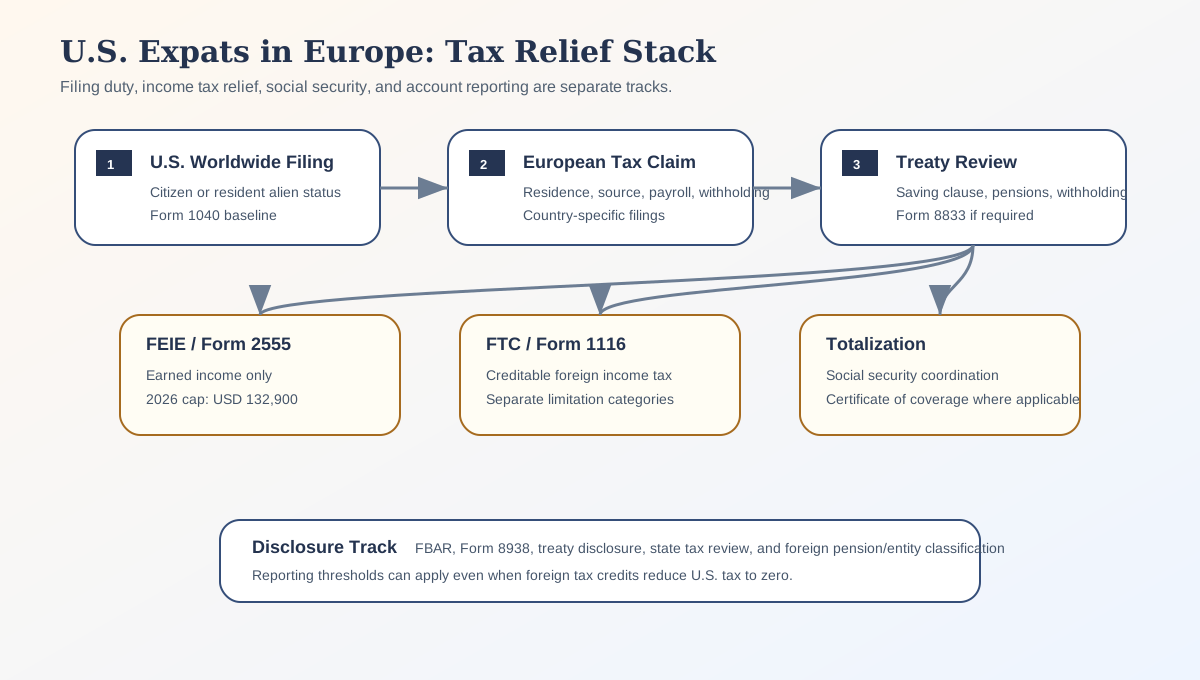
The practical question behind Double Taxation Rules for U.S. Expats in Europe: FEIE, FTC, Treaties, FBAR, and Filing Strategy is which facts, documents, costs, and deadlines change the next step. It explains checking tax position, payroll evidence, social-security exposure, net pay, and cross-border filing questions across Europe, then shows how to separate residence, treaty, payroll, contribution, withholding, and filing questions before signing or moving money. The later sections connect quick answer, the core rule: u.s. worldwide taxation continues abroad, and tool 1: foreign earned income exclusion so the next step is easier to judge. Read it before submitting forms, moving money, choosing a provider, or assuming that a rule from another country applies.
The main U.S. tools for reducing double taxation are the foreign earned income exclusion, the foreign tax credit, treaty-based positions, and social security totalization agreements. These tools are powerful, but they are not interchangeable, and they do not eliminate filing duties by themselves.
Source check date: May 14, 2026. This article is tax information, not U.S. or European tax advice. U.S. citizens, green-card holders, dual citizens, and long-term residents should obtain qualified cross-border tax advice before relying on a filing position.
Quick Answer
A U.S. citizen or U.S. resident alien living in Europe generally still files a U.S. federal income tax return if income exceeds the filing threshold. Double taxation is usually reduced by claiming the foreign earned income exclusion on Form 2555, foreign tax credits on Form 1116, or a treaty-based position when available. The right choice depends on income type, foreign tax rate, U.S. tax rate, residence country, self-employment status, and future planning.
| Tool | Best suited for | Main limitation |
|---|---|---|
| Foreign earned income exclusion | Salary or self-employment earned income from work performed abroad | Does not apply to pensions, dividends, capital gains, or passive income |
| Foreign tax credit | Income taxed by a European country | Credit is limited and cannot be claimed on income excluded under FEIE |
| Tax treaty | Special rules for pensions, students, teachers, residence tie-breakers, re-sourcing, and reduced withholding | Saving clause often preserves U.S. taxation of citizens |
| Totalization agreement | Avoiding dual social security taxation | Applies only if the agreement and certificate rules fit |
| FBAR and FATCA reporting | Foreign account and asset disclosure | Reporting is separate from income tax owed |
The IRS states that U.S. citizens and resident aliens living abroad generally must file and pay tax in the same way as those residing in the United States. See IRS: U.S. citizens and resident aliens abroad filing requirements.
The Core Rule: U.S. Worldwide Taxation Continues Abroad
Living in Europe does not automatically end U.S. filing obligations.
| Person | Typical U.S. tax status issue |
|---|---|
| U.S. citizen in Europe | Generally taxed by the U.S. on worldwide income |
| Green-card holder in Europe | Usually treated as U.S. resident until status is properly ended for tax purposes |
| Dual U.S.-EU citizen | U.S. citizenship still matters for U.S. tax |
| U.S. citizen married to non-U.S. spouse | Filing status, joint election, and foreign account reporting need careful review |
| Former long-term resident | Expatriation rules may be relevant |
The IRS foreign earned income exclusion page states that if you are a U.S. citizen or resident alien living abroad, you are taxed on worldwide income but may qualify for exclusions. See IRS: Foreign earned income exclusion.
Tool 1: Foreign Earned Income Exclusion
The foreign earned income exclusion, or FEIE, can exclude qualifying earned income from U.S. income tax.
For tax year 2026, the maximum FEIE is USD 132,900 per qualifying person. The IRS also states that the 2026 foreign housing expense limitation is generally 30% of the maximum FEIE, or USD 39,870 before location-specific adjustments. See IRS: Figuring the foreign earned income exclusion.
| FEIE requirement | Practical meaning |
|---|---|
| Foreign earned income | Wages, salaries, professional fees, or other compensation for services performed abroad |
| Foreign tax home | Your tax home must be in a foreign country |
| Bona fide residence test or physical presence test | You must satisfy one of the qualifying tests |
| Form 2555 | The exclusion is claimed, not automatic |
Foreign earned income does not include pensions, annuities, Social Security benefits, capital gains, dividends, interest, or U.S. government employee pay. See IRS: What is foreign earned income?.
Bona Fide Residence Versus Physical Presence
| Test | Main concept | Common risk |
|---|---|---|
| Bona fide residence | Residence in a foreign country for an uninterrupted period including an entire tax year | Facts and intent matter; short presence alone is not enough |
| Physical presence | At least 330 full days in foreign countries during a 12-month period | Travel days and U.S. days can break qualification |
See IRS: Bona fide residence test and IRS: Physical presence test.
Tool 2: Foreign Tax Credit
The foreign tax credit, or FTC, is often the central tool for U.S. expats in high-tax European countries.
The IRS explains that foreign tax credits are claimed on Form 1116 for individuals and that treaty rules may affect the computation. See IRS: Foreign tax credit and IRS: How to figure the foreign tax credit.
| FTC issue | Why it matters |
|---|---|
| Creditable tax | The foreign levy must qualify as an income tax or tax in lieu of income tax |
| Separate limitation categories | Passive, general, and other categories are computed separately |
| Source rules | U.S.-source versus foreign-source classification matters |
| Carryovers | Unused foreign taxes may be carried back 1 year and forward 10 years in some cases |
| FEIE interaction | You cannot claim a credit for foreign tax paid on income excluded under FEIE |
IRS Publication 514 states that foreign taxes allocable to excluded income must be reduced and cannot be used for the credit. See IRS Publication 514: Foreign Tax Credit for Individuals.
FEIE Versus FTC: Which Is Better?
There is no universal answer. High-tax European residents often use foreign tax credits because the local tax may exceed U.S. federal tax. FEIE can be useful for lower-tax countries, early-year movers, workers with income below the exclusion ceiling, or people whose foreign tax is low.
| Factor | FEIE may be better when... | FTC may be better when... |
|---|---|---|
| Income type | Mostly earned income | Earned and passive income both matter |
| Local tax rate | Low or no foreign income tax | High European income tax |
| U.S. child tax credit | Refundability planning is not central | Preserving taxable earned income matters |
| Retirement contributions | U.S. planning is simple | Treaty and pension classification matter |
| Future carryovers | Not important | Foreign tax credit carryovers are valuable |
| Self-employment | Income tax reduction is useful | Self-employment tax and totalization need separate handling |
Do not choose FEIE just because it sounds simpler. It can waste foreign tax credits in high-tax countries and may create planning problems for credits, retirement contributions, and future income categories.
Tax Treaties: Useful But Limited For U.S. Citizens
The United States has income tax treaties with many European countries. Treaties can reduce withholding, resolve residence conflicts, allocate pension taxation, and provide special rules for students, teachers, researchers, government workers, business profits, and certain re-sourcing situations.
The IRS provides a treaty list and explains that most U.S. income tax treaties contain a saving clause that prevents U.S. citizens or residents from using the treaty to avoid U.S. taxation in many cases. See IRS: United States income tax treaties A to Z. Treasury publishes treaty texts and technical explanations. See U.S. Treasury: Tax treaties.
| Treaty feature | Practical impact |
|---|---|
| Saving clause | Often preserves U.S. taxation of citizens |
| Residence tie-breaker | Can decide treaty residence in dual-resident cases |
| Pension article | Can change taxation of private pensions, government pensions, or Social Security |
| Re-sourcing article | May allow foreign tax credit relief in specific treaty cases |
| Reduced withholding | Can reduce tax on dividends, interest, or royalties |
| Mutual agreement procedure | Can help if countries tax contrary to the treaty |
A treaty-based return position may require disclosure on Form 8833. The IRS states that Form 8833 is used to disclose treaty-based return positions under Section 6114 and certain dual-resident positions. See IRS: About Form 8833.
European Residence-Country Tax Still Matters
European countries generally apply their own domestic residence and source rules. If you live in France, Germany, Spain, Italy, the Netherlands, Portugal, Ireland, or another European country, that country may tax residents on worldwide income.
Your Europe notes that tax residence is defined by national rules, and if you live and work in another country for more than six months, you will probably be considered tax resident there and taxable on total income. See Your Europe: Income taxes abroad and Your Europe: Double taxation FAQs.
| European issue | U.S. expat action |
|---|---|
| Local tax residence | Determine when residence begins and ends |
| Local worldwide income | Report U.S. investment income if required locally |
| Treaty relief | Apply the correct U.S.-country treaty article |
| Local wealth or asset reporting | Check country-specific disclosure duties |
| Local pension wrappers | Review U.S. classification before investing |
| Local mutual funds | Consider PFIC risk under U.S. rules |
Social Security And Totalization Agreements
Income tax and social security are separate. A U.S. expat employee or freelancer can avoid income double taxation but still face dual social security issues.
The IRS explains that totalization agreements are intended to avoid double taxation with respect to social security taxes. See IRS: Totalization agreements. The Social Security Administration publishes U.S. international agreement information. See SSA: International Programs.
| Worker type | Social security question |
|---|---|
| U.S. employee sent temporarily to Europe | Does a certificate of coverage keep the worker under U.S. Social Security? |
| Locally employed U.S. citizen | Is the worker covered only by the European system? |
| Self-employed U.S. citizen abroad | Does the totalization agreement assign coverage to the U.S. or foreign system? |
| Contractor for U.S. clients | Is U.S. self-employment tax still due? |
The IRS states that self-employed individuals may need a certificate of coverage to establish exemption from U.S. self-employment tax under a totalization agreement. See IRS: Self-employment tax.
FBAR And FATCA Are Not Double Taxation Relief
Foreign account reporting does not mean you owe extra tax, but penalties can be severe if reporting is missed.
The IRS states that an FBAR must be filed if a U.S. person has a financial interest in, or signature authority over, foreign financial accounts whose aggregate value exceeds USD 10,000 at any time during the calendar year. See IRS: FBAR. FinCEN gives the same core filing rule. See FinCEN: Report foreign bank and financial accounts.
| Form or report | Filed with | Purpose |
|---|---|---|
| Form 1040 | IRS | U.S. income tax return |
| Form 2555 | IRS | Foreign earned income exclusion |
| Form 1116 | IRS | Foreign tax credit |
| Form 8833 | IRS | Treaty-based return position disclosure |
| FinCEN Form 114 | FinCEN | FBAR foreign account reporting |
| Form 8938 | IRS | FATCA specified foreign financial asset reporting |
FBAR and Form 8938 are different regimes. Filing one does not automatically satisfy the other.
Common U.S. Expat Double Taxation Scenarios
| Scenario | Usual problem | Likely tools |
|---|---|---|
| U.S. citizen employed in Germany | German payroll tax plus U.S. worldwide taxation | FTC or FEIE; treaty review |
| U.S. freelancer in Spain | Spanish income tax and social security plus U.S. income and self-employment tax analysis | FTC, totalization, Form 2555 review |
| U.S. retiree in France | Pension and Social Security treaty classification | Treaty article, FTC, Form 8833 if required |
| U.S. investor in Italy | Local tax on U.S. dividends and U.S. tax on same dividends | FTC, treaty withholding, local reporting |
| U.S. citizen with European mutual funds | PFIC compliance and local investment tax | Specialist review before investing or filing |
| U.S. citizen married to non-U.S. spouse | Filing status, joint election, account reporting | Form 1040 strategy, FBAR/FATCA review |
Evidence Checklist
Keep a permanent cross-border tax file.
| Evidence | Why it matters |
|---|---|
| U.S. passport and citizenship/residence status | Confirms U.S. filing basis |
| European residence certificate | Supports treaty and local residence analysis |
| Local tax returns and assessments | Supports foreign tax credits |
| Wage statements and payslips | Supports earned income and withholding |
| Workday calendar | Supports source and FEIE tests |
| Foreign bank annual maximum balances | Supports FBAR |
| Foreign tax payment receipts | Supports Form 1116 |
| Pension plan documents | Supports treaty and U.S. classification |
| Treaty article memo | Supports Form 8833 decisions |
| Certificate of coverage | Supports social security totalization position |
Common Mistakes
| Mistake | Better approach |
|---|---|
| Assuming European tax residence ends U.S. tax filing | U.S. citizens generally still file |
| Claiming FEIE and FTC on the same excluded income | Allocate taxes correctly |
| Ignoring passive income | FEIE does not cover dividends, interest, pensions, or capital gains |
| Forgetting FBAR | Foreign account reporting is separate from income tax |
| Treating a treaty as eliminating all U.S. tax | Check the saving clause |
| Ignoring state tax | Some U.S. states have separate residency rules |
| Missing social security totalization | Income tax relief does not solve payroll tax |
| Using local tax software only | U.S. reporting may classify foreign products differently |
FAQ
Do U.S. expats in Europe pay tax twice?
They may have filing obligations in both places, but double tax is often reduced by foreign tax credits, FEIE, treaties, or totalization agreements. The result depends on income type and country.
Is FEIE Usually better than foreign tax credits?
No. In high-tax European countries, foreign tax credits often produce a better long-term result. FEIE only applies to qualifying earned income and can waste credits.
Does a tax treaty stop the United States from taxing citizens abroad?
Usually not completely. Most U.S. treaties include a saving clause that preserves U.S. taxation of citizens and residents, with specific exceptions.
What is the 2026 foreign earned income exclusion?
For tax year 2026, the maximum FEIE is USD 132,900 per qualifying person, according to current IRS guidance checked on May 14, 2026.
Do I need FBAR if I owe no U.S. tax?
Possibly. FBAR is based on foreign financial account balances, not whether U.S. income tax is owed.
Can I use foreign taxes paid to reduce U.S. self-employment tax?
Usually no. Foreign tax credits reduce income tax, not U.S. self-employment tax. Totalization agreements are the relevant tool for social security coordination.
U.S.-Europe tax planning workflow
The safest workflow starts before the move. Identify U.S. citizenship or green-card status, expected European residence country, arrival date, employment or business income, pensions, investments, bank accounts, housing, spouse status, and state-tax ties. Then decide which systems are likely to tax each income item. U.S. federal tax, U.S. state tax, European national tax, local tax, social security, and reporting regimes should be mapped separately.
The second step is to choose a primary U.S. relief strategy. Foreign earned income exclusion can be useful for lower-tax countries or when foreign tax is limited, but it does not cover passive income and can reduce foreign tax credit flexibility. Foreign tax credits are often stronger in high-tax European countries because local tax can offset U.S. income tax on the same income. The choice should be modeled across several years, not only the arrival year.
The third step is to identify treaty limits. U.S. treaties often contain saving clauses that preserve U.S. taxation of citizens. Some treaty provisions still help, but they must be identified by article and exception. A broad statement that a treaty prevents double taxation is too weak for a U.S. expat file.
The fourth step is to build a reporting calendar. U.S. Form 1040, Form 2555, Form 1116, Form 8938, FBAR, Form 8833, estimated taxes, state filings, foreign returns, local wealth or property reports, and social-security certificates can have different deadlines. Missing an information return can be worse than owing a small tax balance.
Income category mapping
U.S. expats should map each income item separately. Salary, freelance income, director fees, dividends, interest, capital gains, rental income, pensions, stock options, RSUs, Social Security, and business profits can all be treated differently. A relief method that works for salary may not work for investment income. FEIE does not solve dividends, interest, pensions, or most capital gains.
Employment income needs workday evidence. The relevant facts include where the employee physically worked, who paid the salary, where payroll withheld tax, whether a European employer or permanent establishment bore the cost, and whether social security was covered by a totalization agreement. A remote employee in Europe should keep a day-level calendar and employer letters.
Freelance income needs an even stronger file. A U.S. freelancer in Europe may owe European income tax, VAT, social contributions, U.S. income tax, and possibly U.S. self-employment tax unless a totalization agreement and certificate of coverage support a different result. The freelancer should coordinate U.S. and local bookkeeping so gross receipts, expenses, and foreign taxes reconcile.
Investment income is often the trap. European funds, ETFs, pensions, savings plans, and insurance wrappers may have U.S. classifications that differ from local tax treatment. PFIC exposure can make ordinary European investment products expensive to report. U.S. expats should review investments before buying local funds, not after tax season.
State tax and domicile cleanup
U.S. state tax can survive the move if domicile facts are not cleaned up. Some states are more aggressive than others. Keep evidence of departure: lease termination or home sale, new foreign lease, voter registration changes where relevant, driver's license decisions, mailing address, employment location, family relocation, and intent to remain abroad. If the person keeps a U.S. home, vehicle, professional license, or dependent family in a state, the state analysis becomes harder.
State-tax planning should not be reduced to changing a mailing address. The taxpayer should document why the prior state no longer has residency or domicile claims, and whether any state-source income remains. Remote work performed from Europe for a U.S. employer may still require state review depending on the state and employer setup.
Social security and totalization
Income-tax relief does not solve social-security tax. Employees and self-employed people should check whether a U.S.-country totalization agreement applies. The relevant document may be a certificate of coverage or foreign equivalent. Without it, a worker can face U.S. self-employment tax or local contributions in ways that foreign tax credits do not fix.
Self-employed U.S. citizens should be especially careful. Foreign tax credits generally do not offset U.S. self-employment tax. If the person is covered by a European system under a totalization agreement, the file should include the certificate and contribution evidence. If no agreement applies, get specialist review before assuming the result.
Filing evidence and reconciliation
After both U.S. and European returns are prepared, reconcile them. Gross wages, foreign taxes paid, exchange rates, pension contributions, investment income, and bank balances should be explainable across systems. Foreign tax credits usually require proof of foreign tax paid or accrued. If the European assessment changes later, the U.S. credit position may need review.
Exchange-rate methodology should be consistent and documented. Some items use transaction-date rates, average rates, or official yearly rates depending on form and facts. Keep the source and method. Exchange-rate differences can create unexpected U.S. gains, especially on foreign mortgages, accounts, or investments.
Arrival-year and departure-year issues
Move years are the easiest years to misfile. A U.S. citizen moving to Europe may have part-year European residence, local payroll beginning midyear, foreign housing costs, U.S. employer income before and after the move, investment income in both periods, and state-tax questions. The taxpayer should create a timeline with departure date, arrival date, residence registration, employment start, foreign tax registration, lease start, family move, and workdays by country.
The foreign earned income exclusion requires either a bona fide residence test or physical presence test. Those tests do not necessarily align neatly with a calendar-year move. Foreign tax credits may be more flexible, but they require foreign tax evidence and income-category matching. The arrival-year choice between FEIE and FTC should be modeled before filing because it can affect carryovers and later years.
Departure from Europe creates another set of issues. The taxpayer may have final local payroll, severance, bonus payments, pension withdrawals, local investments, home sale, rental income, deregistration, and closing bank balances. U.S. reporting may continue even after local residence ends if foreign accounts, pensions, or investments remain.
European pensions and employer plans
European pensions are often beneficial locally but complex for U.S. tax. Employer pensions, personal pensions, occupational schemes, insurance-based wrappers, and tax-favored savings accounts may not receive the same treatment under U.S. law as under local law. Contributions, employer contributions, growth, distributions, and reporting can each require separate analysis.
Before joining optional pension or investment products, U.S. expats should ask whether the account creates PFIC, foreign trust, Form 3520, Form 8621, Form 8938, or other reporting exposure. Some mandatory employer plans are unavoidable, but optional products should be reviewed before purchase. Local advisers may not understand U.S. classification.
Keep plan documents, annual statements, contribution records, employer communications, and local tax treatment. If a treaty article is used for pension treatment, document the article and whether the saving clause affects the result.
Housing, accounts, and asset reporting
Foreign housing can affect U.S. filing through FEIE housing exclusion or deduction, rental income, mortgage interest, foreign exchange gain, and account reporting. A home purchase abroad can create local property taxes and U.S. reporting questions. A foreign mortgage denominated in euros, francs, pounds, or another currency can produce U.S. tax effects if exchange rates move.
Foreign account reporting should be tracked throughout the year. FBAR uses maximum account balances, not year-end balances. Include checking, savings, securities, certain pensions, and accounts with signature authority where required. Form 8938 has different thresholds and definitions. Keep monthly statements or year-end bank reports showing maximum values.
Joint accounts with a non-U.S. spouse need special attention. The U.S. person may have reporting obligations even if the money is mostly the spouse's. Filing-status choices, gift rules, and joint-election decisions should be reviewed before adding a non-U.S. spouse to U.S. reporting.
Local-country coordination examples
In Germany, high income tax can make foreign tax credits more useful than FEIE, but German social-security and pension treatment must be reviewed separately. In Spain, remote workers and freelancers should coordinate Spanish residence, social security, and U.S. self-employment tax. In France, pension and investment treatment can be treaty-sensitive. In Portugal or Italy, special regimes may reduce local tax but can change the U.S. credit picture.
The point is that a lower European tax bill does not necessarily reduce U.S. complexity. If local tax is low, U.S. residual tax may rise. If local tax is high, credits may solve income tax but not reporting, PFIC, social security, or state issues.
Professional review triggers
Specialist review is strongly recommended before buying European funds, joining optional pensions, forming a foreign company, marrying a non-U.S. spouse with joint accounts, exercising stock options, selling a home, moving between European countries, claiming treaty positions on Form 8833, or renouncing citizenship. These are not routine wage-return issues.
The review package should include U.S. and foreign returns, wage statements, investment statements, pension documents, account balances, residence dates, workday calendar, local assessments, and questions to answer. A precise package reduces cost and errors.
Source Risks And Factual Uncertainty
U.S. tax thresholds, forms, treaty interpretations, and foreign country rules change. European pension, investment, and social security systems can be classified differently under U.S. tax law than under local law. Source check date: May 14, 2026.
Official And Primary Sources
- IRS: U.S. citizens and resident aliens abroad filing requirements
- IRS: Foreign earned income exclusion
- IRS: Figuring the foreign earned income exclusion
- IRS: What is foreign earned income?
- IRS: Foreign tax credit
- IRS Publication 514
- IRS: U.S. income tax treaties A to Z
- U.S. Treasury: Tax treaties
- IRS: Form 8833
- IRS: Totalization agreements
- SSA: International Programs
- IRS: FBAR
- FinCEN: FBAR
- Your Europe: Income taxes abroad
- Your Europe: Double taxation FAQs
Official source and decision check
Use this section as the practical checkpoint for Double Taxation Rules for U.S. Expats in Europe: FEIE, FTC, Treaties, FBAR, and Filing Strategy. The reader decision is whether the available evidence is strong enough to act now, or whether the file should first be confirmed with the tax authority or treaty adviser. Rules can change by country, status and date, so treat this guide as orientation for the file and recheck the current rule before relying on a payroll decision, treaty position, certificate request or filing deadline.
For expats, foreigners, students, workers, founders, families and other mobile readers, record the reader category, country, residence status and deadline before comparing the official source with the article checklist.
Official sources to verify first
- European Commission taxation and customs
- Your Europe taxes
- EUR-Lex EU law access
- European Commission information portal
- OECD tax treaties overview
| Decision point | What to check | Reader action |
|---|---|---|
| Double-taxation allocation | Confirm that the case is really about double-taxation allocation, not a different category that follows another rule. | Write down the country, authority, dates, status and document number before asking for a decision. |
| File for tax authority or treaty adviser | Keep the residence, workdays, source income and treaty evidence in one dated file, with originals, translations where required and proof of submission. | Save receipts, emails, appointment confirmations, payment records and authority replies in the same order as the checklist. |
| Double Taxation Rules for U.S. Expats in Europe: FEIE, FTC, Treaties, FBAR, and Filing Strategy fallback | If the answer is refused, delayed or unclear, identify the competent authority, review window, complaint route or regulated provider escalation path. | Ask for the reason in writing and compare it with the official source before paying again, travelling, closing an account or resubmitting. |
| When the answer is unclear | What to do next |
|---|---|
| The authority, bank, insurer, employer or provider gives a verbal answer only. | Ask for the answer in writing, save the name of the office or provider, and compare it with the official source before changing travel, payroll, residence or payment plans. |
| The file depends on a deadline, appointment, payment, address or status change. | Keep the dated receipt, note the next deadline, and avoid closing the old route until the replacement document, account, policy or registration is confirmed. |
Related guides to cross-check
- First month in Europe checklist
- Living in one European country and working in another
- EU remote working guide
- Cross-border worker benefits in the EU
- Private health insurance documents in Europe
For legal, tax, medical, immigration or financial consequences, confirm the position with the competent authority or a qualified adviser. This page is designed to organize the decision, source checks and next steps; it is not a substitute for case-specific professional advice.