Last updated
Cross-Border Taxi Work in Europe: Licensing, Platform Governance, and the Single-Market Debate
Direct answer
This article treats Cross-Border Taxi Work in Europe: Licensing, Platform Governance, and the Single-Market Debate as a decision file rather than a generic overview. It explains working through Cross-Border Taxi Work in Europe: Licensing, Platform Governance, and the Single-Market Debate with the facts, documents, authorities, timing, and risks that usually decide the outcome, then shows how to identify the controlling source, evidence, deadline, cost, and fallback route before acting. The later sections connect the core debate, taxi, phv, ride-hailing: the terms matter, and the legal stack so the next step is easier to judge. Read it before paying fees, submitting forms, signing contracts, booking travel, or relying on a generic summary.
The practical next step before cross-border operations is to verify the host-country and municipal licensing rule for each ride pattern, document whether the trip is a genuine cross-border journey or recurring local work, and keep ride-level evidence for pickup, dispatch, driver status, insurance, tax, and social-security treatment.
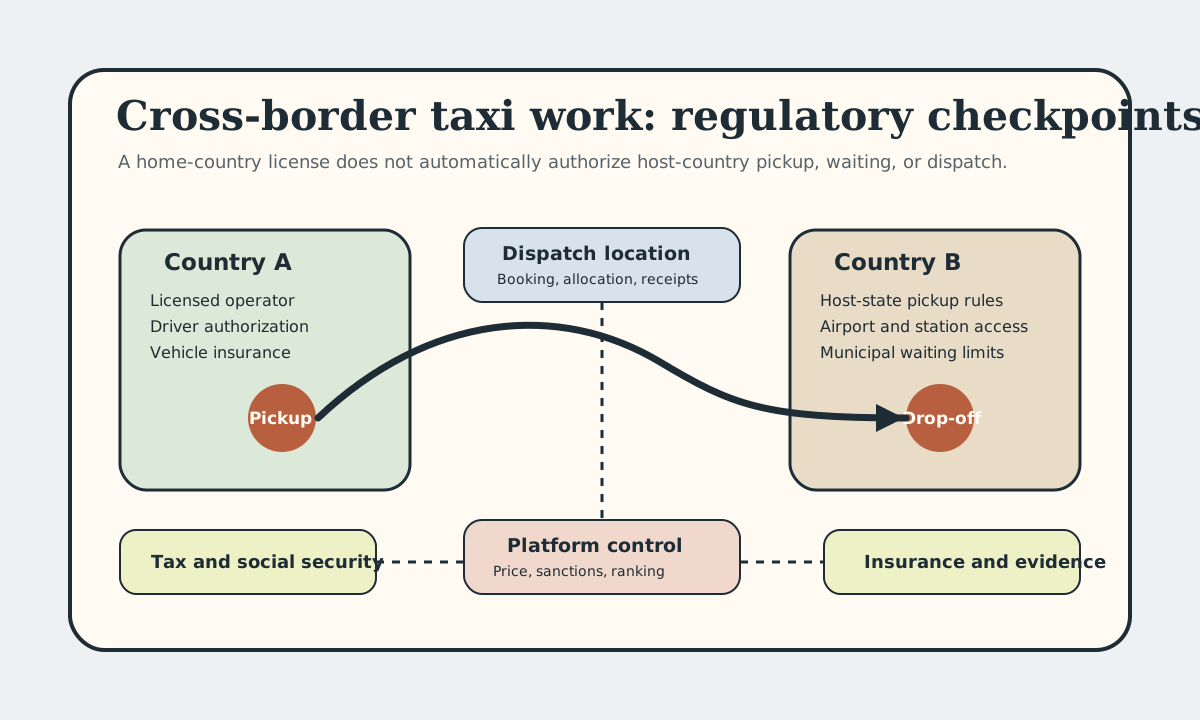
Cross-border taxi work in Europe sits at the fault line between the single market and local transport control. A driver may cross a border easily. A taxi license usually does not. The legal question is not only where the vehicle is registered. It is where the passenger is picked up, where the vehicle waits, who dispatches the ride, who sets the price, which authority licenses the service, and whether the platform controls the driver like a transport operator or employer.
The result is a hard operational rule: a taxi or private-hire authorization in one European country rarely creates a general right to pick up, wait for, or solicit passengers in another country. Cross-border transport may be lawful in specific situations, but recurring local operations usually trigger host-state and municipal rules.
The core debate
The debate has three sides.
| Position | Argument | Weakness |
|---|---|---|
| Single-market argument | Operators should be able to provide services across borders with fewer local barriers | Transport services and local passenger safety remain heavily regulated |
| Local-control argument | Cities need licensing power over taxis, PHV, ranks, congestion, safety, and accessibility | Over-restriction can protect incumbents and reduce supply |
| Platform-governance argument | Apps can improve availability and transparency | If platforms control price, allocation, and discipline, they may be treated as transport operators or employers |
The European Commission's taxi and private-hire guidance recognizes that passenger transport on demand has an EU dimension because platforms and travelers operate across Member States, but it also treats local passenger transport as an area where national, regional, and local authorities retain a central role Commission Notice on taxis and PHV.
Taxi, PHV, ride-hailing: the terms matter
| Term | Typical meaning | Regulatory consequence |
|---|---|---|
| Taxi | Licensed vehicle that may often use ranks, street hailing, regulated fares, or local taxi privileges | Strong municipal control |
| PHV or private-hire vehicle | Pre-booked vehicle with driver, often barred from street hailing or taxi ranks | Requires operator, driver, and vehicle authorization |
| Ride-hailing | App-based booking and matching of passenger and driver | Platform control can affect legal classification |
| Dispatch operator | Entity that receives booking and assigns rides | May need host-state authorization |
| Transport platform | App that controls access, matching, price, quality, and sanctions | May be classified as part of the transport service |
The labels used in contracts are less important than the operational facts.
The legal stack
Cross-border taxi legality is a stack, not a single rule.
| Layer | Main question |
|---|---|
| EU internal-market law | Is a national or local rule compatible with freedom of establishment and proportionality? |
| Transport law | Is the ride a regulated taxi, PHV, occasional passenger service, or another category? |
| National law | Does the operator, vehicle, and driver need authorization in the host country? |
| Municipal rules | Can the vehicle wait, use ranks, approach airports, or accept local bookings? |
| Platform law | Does the app merely connect parties or control the transport service? |
| Labor law | Are drivers genuinely independent or effectively workers/employees? |
| Tax and social security | Where are workdays, income, VAT, payroll, and contributions triggered? |
| Data and evidence | Can the operator prove compliance ride by ride? |
EU law does not erase local taxi licensing
The Commission's 2022 Notice describes local passenger transport on demand as transport with a car and driver occurring at the passenger's request, usually by taxis and PHV. It recognizes major changes caused by ride-hailing and platform technology, but it does not create a passport allowing any taxi to work anywhere in Europe Commission Notice on well-functioning and sustainable local passenger transport on demand.
EU road passenger transport rules also distinguish international passenger transport markets from local taxi and PHV activity. The Commission's passenger-transport portal explains that operators with a valid Community license have access to the international EU road passenger transport market for certain services, such as regular and occasional coach or bus services, but taxi and PHV pickup markets remain a distinct local regulatory issue European Commission passenger transport portal.
The practical implication: cross-border movement is not the same as cross-border local-market access.
CJEU platform cases: control decides classification
The Court of Justice of the European Union has drawn an important line between neutral digital intermediation and transport-service control.
| Case | Practical lesson |
|---|---|
| Elite Taxi v. Uber Spain, C-434/15 | A platform that creates and controls an urban transport service can be treated as a transport service, not merely an information society service |
| Uber France, C-320/16 | Member States may enforce transport-service rules against certain platform models |
| Star Taxi App, C-62/19 | An app connecting passengers with already-authorized taxi drivers may remain an information society service where it does not control the underlying transport service in the same way |
The decisive factors are operational control: pricing, driver access, allocation, standards, incentives, sanctions, and whether the app creates a transport offer that would not exist in the same form without it. Official case materials are available through the Court's database for C-434/15 Elite Taxi and C-62/19 Star Taxi App.
The platform-work layer is becoming harder to ignore
Directive (EU) 2024/2831 on platform work aims to support correct employment-status determination and improve transparency around algorithmic management, including in cross-border situations. It requires Member States to establish procedures for an effective rebuttable legal presumption of employment where facts indicating control and direction are found, and it creates rules on automated monitoring and decision-making systems Directive (EU) 2024/2831 on platform work.
For taxi and PHV platforms, the compliance question is no longer only, "Are the vehicles licensed?" It is also:
| Platform behavior | Labor and governance risk |
|---|---|
| Platform sets fare unilaterally | Evidence of control |
| Platform assigns rides automatically | Evidence of operational management |
| Platform ranks drivers by performance | Algorithmic-management concern |
| Platform deactivates drivers without meaningful review | Employment-status and due-process risk |
| Platform controls customer access and pricing | Transport-operator classification risk |
| Platform claims neutrality but imposes service rules | Contract may contradict reality |
Pickup, waiting, and dispatch: the three critical moments
Cross-border taxi disputes usually turn on three moments.
| Moment | Legal sensitivity |
|---|---|
| Pickup | Host jurisdiction may require local taxi or PHV authority |
| Waiting or staging | Airports, stations, ranks, and city centers often have special rules |
| Dispatch | Accepting or allocating bookings inside another jurisdiction may require operator authorization |
A driver licensed in Country A who drops a passenger in Country B may be in a different legal position from a driver licensed in Country A who waits at an airport in Country B for app-dispatched local customers.
National examples: local rules still dominate
France treats taxis, VTC, motorized two- or three-wheel passenger transport, and other personal public transport categories under the transport public particulier de personnes framework. The French transport ministry's guidance is updated for the taxi and VTC regulatory structure France transport ministry taxi and VTC regulation.
The Netherlands requires taxi businesses to meet licensing and vehicle/driver obligations. Business.gov.nl states that a taxi operator license is needed to start a taxi business and that additional rules apply to vehicles, entrepreneur cards, and registration systems Netherlands taxi operator license.
Germany regulates passenger transport through the Personenbeförderungsgesetz, or Passenger Transport Act, with separate treatment for taxis and hire cars with drivers. The federal transport ministry provides reference material on passenger transport law Germany passenger transport law reference.
Belgium also treats taxi activity as a regulated mobility category, with regional and local implementation Belgium taxi guidance.
These examples show why a cross-border taxi strategy must be jurisdiction-specific. The EU debate sets the frame; the city inspector checks the vehicle.
Operational scenarios
| Scenario | Usually lower risk | Usually higher risk |
|---|---|---|
| Drop-off across a border after a lawful booking in home state | Single outbound trip, no waiting, no local solicitation | Driver waits in host city for return passengers |
| Pre-booked airport transfer | Permit and airport rules checked in advance | Informal pickup queue or app staging without authorization |
| Platform expands to a border region | Local operator licenses, driver permits, geo-fenced rules | Same app rules copied into another country without legal redesign |
| Occasional tourist transfer | Proper passenger transport documentation | Repeated same route resembling organized local service |
| Cross-border commuter corridor | Bilateral legal review and ride logs | Daily local pickups in host state under home-state license |
Compliance evidence: what serious operators keep
A cross-border taxi or PHV operator needs an evidence ledger, not a folder of PDFs.
| Evidence category | Minimum artifact |
|---|---|
| Operator authorization | License, scope, issuing authority, expiration date |
| Driver authorization | Driver card, professional qualification, background checks where required |
| Vehicle authorization | Registration, inspection, insurance, taxi/PHV equipment |
| Booking record | Booking time, passenger request, pickup, drop-off, dispatcher |
| Location evidence | GPS logs for pickup, waiting, staging, and drop-off |
| Fare evidence | Fare method, meter/app calculation, receipt |
| Airport or station permission | Rank access, terminal pickup rules, permit conditions |
| Platform governance | Matching logic, pricing rules, deactivation policy |
| Labor status | Contracts, actual control map, working-time records |
| Tax and social security | Workday allocation, payroll treatment, VAT analysis |
Platform control audit
Use this control map before launching a cross-border ride model.
| Control question | Low-risk answer | High-risk answer |
|---|---|---|
| Who sets the price? | Licensed operator or regulated fare system | Platform sets and changes price unilaterally |
| Who chooses the driver? | Passenger selects among authorized taxis or neutral dispatch | Algorithm assigns work and penalizes rejection |
| Who controls service standards? | Legal minimums and transparent marketplace rules | Platform dictates behavior beyond neutral intermediation |
| Who can remove the driver? | Regulator or operator under due process | Automated deactivation with limited review |
| Who owns the customer relationship? | Licensed transport provider is visible | Platform presents itself as the transport provider |
| Are drivers already authorized? | Yes, independent local authorization exists | Platform creates market access for unauthorized drivers |
Risk register
| Risk | Severity | Trigger | Control |
|---|---|---|---|
| Unauthorized host-state pickup | Very high | Driver accepts local passengers in another country | Confirm host-state taxi/PHV permission before launch |
| Illegal airport staging | Very high | Driver waits near airport or station without local authorization | Obtain facility-specific rules and geofence waiting zones |
| Platform classified as transport operator | High | App controls price, access, quality, and sanctions | Redesign governance or obtain transport authorization |
| Employment-status reclassification | High | Platform controls work like an employer | Labor audit under national law and Directive 2024/2831 trajectory |
| Tax and social-security mismatch | High | Drivers work recurring days in another state | Maintain workday ledger and obtain payroll advice |
| Insurance gap | High | Cross-border commercial carriage not covered | Confirm policy territory and activity scope |
| Evidence failure | Medium | Operator cannot reconstruct trip facts | Use immutable ride logs and permit index |
| Consumer complaint escalation | Medium | Passenger disputes fare, pickup, or identity | Standard receipts, complaint handling, and local-language support |
Decision matrix
- Define the service: taxi, PHV, dispatch, platform, occasional transport, or another category.
- Map jurisdictions: home state, pickup state, waiting location, destination, and dispatch location.
- Identify permissions: operator, driver, vehicle, airport, station, municipal, and platform permissions.
- Test platform control: price, allocation, quality rules, ranking, sanctions, and customer relationship.
- Test labor status: independence, working time, exclusivity, equipment, supervision, and deactivation.
- Confirm insurance: commercial carriage, cross-border territory, passengers, platform activity.
- Build ride evidence: timestamp, geolocation, booking source, fare, receipt, and driver ID.
- Set stop rules: suspend operations if enforcement notices, complaints, or permit gaps appear.
- Review monthly: compare actual trip behavior with licensed permissions.
- Re-authorize expansion: every new city, airport, or station needs its own legal gate.
A scoring model for expansion
| Category | Weight | Pass standard |
|---|---|---|
| Transport permissions | 30 | All required operator, vehicle, driver, and local permissions documented |
| Pickup and waiting legality | 20 | Host-state and facility rules confirmed |
| Platform governance | 15 | Control model reviewed and documented |
| Labor classification | 15 | Worker-status risk assessed under national law |
| Insurance and tax | 10 | Cross-border commercial activity covered |
| Evidence quality | 10 | Ride-level records can prove compliance |
| Score | Decision |
|---|---|
| 85 to 100 | Launch with monitoring |
| 70 to 84 | Limited pilot with weekly review |
| 50 to 69 | Legal redesign required before scale |
| Under 50 | Do not launch |
Policy tension: why the debate will continue
The market wants seamless mobility. Cities want safety, accessibility, congestion control, tax compliance, and consumer protection. Platforms want scale. Drivers want income and legal certainty. Incumbent taxi operators want rules enforced equally. Passengers want availability and price transparency.
The European debate is not whether apps should exist. It is whether technology can be allowed to route around licensing systems built for safety, accountability, and local mobility planning. The answer emerging from EU law is nuanced: restrictions must be justified and proportionate, but transport and labor protections still matter.
FAQ
Can a taxi licensed in one EU country pick up passengers in another?
Not automatically. Cross-border drop-offs may be different from local pickups, waiting, or dispatch in the host country. Host-state and municipal rules often control pickup and staging.
Does the EU single market give taxi drivers a right to work anywhere in Europe?
No general taxi passport exists. EU freedoms matter, but taxi and PHV services remain heavily shaped by national, regional, and local transport rules.
Are ride-hailing apps treated as transport companies?
Sometimes. If an app controls the transport service through pricing, driver access, allocation, standards, and sanctions, it may be treated as part of the transport service. If it neutrally connects passengers with already-authorized taxi drivers, classification may differ.
What is the biggest compliance mistake?
Assuming that a home-country license authorizes host-country pickup and waiting. The most dangerous facts are repeated local pickups, airport staging, and app-dispatched rides in a jurisdiction where the operator has no authorization.
How does the Platform Work Directive affect taxi platforms?
Directive (EU) 2024/2831 increases pressure on platforms to address employment status, algorithmic management, transparency, human review, and cross-border work declarations. Taxi and PHV platforms that rely on independent drivers need a documented control and labor-status audit.
What evidence should a cross-border operator keep?
Keep licenses, ride logs, GPS evidence, fare receipts, booking records, driver documents, vehicle documents, insurance evidence, platform governance policies, and tax/social-security workday records.
Operator compliance file
A cross-border taxi or PHV operator needs one compliance file per operating pattern, not one generic license folder. The file should identify the home license, vehicle license, driver authorization, dispatch model, pickup jurisdictions, waiting locations, airports, rail stations, ports, fare rules, complaint procedure, insurance territory, tax registration, and platform relationship. Each country or city where pickups occur should have its own permission note.
The most important distinction is between carrying a passenger across a border and operating locally after crossing it. A driver who lawfully takes a passenger from country A to country B may still be prohibited from waiting in country B, accepting a local app dispatch in country B, or picking up a passenger in country B for another trip. The compliance file should define what the driver may do after drop-off: return empty, accept pre-booked return trips, wait in a designated area, or stop operating.
Ride evidence should be preserved at trip level. Keep booking timestamp, pickup address, destination, dispatch source, driver ID, vehicle ID, license numbers, fare, route, receipt, GPS trail if available, and passenger complaint record. Evidence matters because enforcement often turns on factual patterns: repeated local pickups, airport staging, street hailing, app dispatch, or waiting in a restricted area.
Platform governance and driver status
Platforms should document how they control drivers. Pricing, allocation, acceptance-rate pressure, deactivation, customer ratings, route monitoring, branding, exclusivity, and performance rules can affect whether the platform is treated as a neutral intermediary, transport service participant, or employer-like controller. The legal result depends on national implementation and facts, but the risk should be assessed before scale.
The Platform Work Directive adds pressure to document algorithmic management and worker-status assumptions. A platform that says drivers are independent should be able to explain how drivers set availability, accept or reject work, choose routes, use their own equipment, serve other platforms, and bear business risk. If the platform effectively controls the work, labor-status and social-security exposure increase.
Drivers also need transparency. They should know which licenses are required, which territories are allowed, which trips are prohibited, how pricing works, how complaints are handled, how deactivation decisions are reviewed, and what evidence they must preserve. A platform cannot rely on drivers to solve local transport law without giving them precise operating rules.
Insurance, tax, and social-security controls
Insurance is a hard gate. The policy should cover commercial passenger transport, the vehicle, the driver, the countries involved, platform-dispatched trips, airport or station operations if relevant, and cross-border carriage. Personal auto insurance, domestic taxi insurance, or generic business insurance may not cover all of these facts. Operators should obtain written confirmation, not assume territorial coverage.
Tax and social security depend on work pattern. A driver living in one country, licensed in another, and accepting rides across borders may create income-tax, VAT, payroll, or social-security questions. The operator should keep a workday and revenue ledger by country. If the driver is an employee or economically dependent contractor, employer obligations may arise.
Platform commissions, driver payouts, tips, cancellation fees, and passenger receipts should reconcile. If the booking platform, driver, and passenger are in different countries, the VAT and income-recording trail should be clear. Unclear money flows create tax and consumer-dispute risk.
City and facility-specific controls
Airports, rail stations, ports, hospitals, event venues, and city centers often have stricter pickup and waiting rules than ordinary addresses. A national or regional authorization may not give access to a specific facility. Operators should maintain a facility index showing whether pickup, drop-off, staging, signage, app-dispatch acceptance, and pre-booked returns are allowed.
Local-language consumer information may also be required. Receipts, complaint channels, fare explanations, driver identity, lost-property process, and accessibility information should be understandable to passengers and regulators. Cross-border operators often fail because passenger-facing documents are designed for the home market only.
Enforcement response plan
If a driver receives an enforcement notice, fine, complaint, or platform warning, the operator should pause the affected operating pattern and preserve evidence. Do not continue scaling while the legal basis is uncertain. Review ride logs, location data, license scope, insurance, platform dispatch settings, and driver instructions. If the issue concerns one city or airport, isolate that jurisdiction instead of assuming the whole cross-border model is invalid.
The response file should include the notice, ride evidence, driver statement, platform records, license copies, insurance confirmation, and legal analysis. Patterns matter. One mistaken pickup may be corrected with training; repeated unauthorized pickups suggest the operating model is wrong.
Border-region operating scenarios
Border regions create recurring patterns that should be classified before launch. Airport transfer services may lawfully take passengers from one country to another but still face restrictions on standing, queueing, or accepting return rides at the destination airport. Tourist-city operators may receive app requests from visitors just across a border, but that does not automatically authorize host-city pickup. Commuter-region drivers may cross borders daily and create tax, social-security, and licensing facts that look permanent rather than occasional.
Each scenario needs a written operating rule. For example, "drop-off only, return empty unless pre-booked from the home jurisdiction" is different from "accept app bookings in the destination city." "Pre-booked hotel transfer" is different from "waiting near a station for app demand." Regulators usually care about what the operator actually does, not the marketing label.
Operators should test the first 30 days of trip logs against the written rule. If drivers routinely do something the rule does not allow, either the rule is unrealistic or the dispatch settings are wrong. Compliance should be embedded in the app, dispatch process, and driver instructions, not left to memory.
Driver training and instructions
Drivers need practical instructions, not only license copies. Training should cover where pickup is allowed, where waiting is prohibited, how to handle passenger requests for unbooked rides, what to do after a cross-border drop-off, which airports or stations are restricted, how to issue receipts, how to respond to inspections, and when to contact dispatch before accepting a trip.
The training should also cover documents carried in the vehicle: driver license, professional card, vehicle authorization, insurance certificate, platform authorization if relevant, booking evidence, and emergency contact. If local law requires documents in a specific language or format, the operator should provide them.
Driver incentives must match the compliance policy. If the platform rewards high acceptance rates while prohibiting certain pickups, drivers may accept unlawful trips to avoid ranking penalties. Compliance rules should override acceptance metrics and deactivation logic.
Consumer protection and accessibility
Taxi regulation is partly about consumer protection. Cross-border services should provide clear fare information, driver identity, vehicle identity, complaint channels, lost-property process, cancellation terms, accessibility information, and payment receipts. Passengers should know whether the service is a licensed taxi, PHV, platform ride, pre-booked transfer, or another category.
Accessibility is often overlooked in cross-border models. Cities may require wheelchair-accessible vehicles, service-animal policies, local complaint procedures, or specific passenger rights. A platform that expands across borders without checking accessibility obligations can create discrimination and licensing risk.
Data and algorithmic evidence
Platforms should preserve dispatch logic, pricing rules, driver rankings, deactivation notices, complaint decisions, and human-review records. These records may matter under platform-work rules and labor-status disputes. If a driver challenges deactivation or worker classification, the platform needs to show how decisions were made.
Trip records should be tamper-resistant and retained long enough to support tax, insurance, consumer, and licensing inquiries. If the operator cannot reconstruct where the driver was, what license covered the trip, and how the fare was calculated, the compliance model is weak.
Expansion governance
Every new city, airport, station, country, vehicle class, or dispatch channel should trigger reauthorization. A platform that is compliant for local pre-booked transfers may not be compliant for airport staging. A taxi cooperative authorized in one municipality may not be authorized for app-based pickups in another. Expansion should require legal, insurance, tax, social-security, and operational signoff.
The governance file should include launch assumptions, permission index, driver instructions, insurance confirmation, consumer terms, complaint process, and monthly monitoring results. If complaints or enforcement increase, pause expansion and review the operating facts.
Minimum launch memo
Before launch, write a one-page memo for the exact route or territory. It should state which entity operates, which drivers and vehicles are authorized, where pickups are allowed, where waiting is prohibited, how return trips are handled, which insurance applies, which tax and social-security records are kept, and who can suspend operations.
The memo should be updated when the platform adds a city, airport, station, new driver category, or pricing model. A cross-border mobility business fails when expansion outruns the permission map. The memo gives managers and drivers a clear stop line before enforcement creates the map for them.
Official and primary sources
- European Commission Notice on taxis and PHV
- European Commission passenger transport portal
- CJEU C-434/15 Elite Taxi v. Uber Spain
- CJEU C-62/19 Star Taxi App
- Directive (EU) 2024/2831 on platform work
- France transport ministry: Taxi and VTC regulation
- Netherlands Business.gov.nl: Taxi operator license
- Germany federal transport ministry: Passenger Transport Act reference
- Belgium.be: Taxi guidance
Official source and decision check
Use this section as the practical checkpoint for Cross-Border Taxi Work in Europe: Licensing, Platform Governance, and the Single-Market Debate. The reader decision is whether the available evidence is strong enough to act now, or whether the file should first be confirmed with the competent authority. Rules can change by country, status and date, so treat this guide as orientation for the file and recheck the current rule before relying on a payroll, workday, social-security certificate, tax-residence or cross-border employment deadline.
For expats, foreigners, students, workers, founders, families and other mobile readers, record the reader category, country, residence status and deadline before comparing the official source with the article checklist.
Official sources to verify first
- Your Europe work in another EU country
- European Commission social security coordination
- EURES mobility and work portal
- Your Europe taxes abroad
- EUR-Lex EU law access
| Decision point | What to check | Reader action |
|---|---|---|
| Administrative decision | Confirm that the case is really about administrative decision, not a different category that follows another rule. | Write down the country, authority, dates, status and document number before asking for a decision. |
| File for competent authority | Keep the identity, residence and document evidence in one dated file, with originals, translations where required and proof of submission. | Save receipts, emails, appointment confirmations, payment records and authority replies in the same order as the checklist. |
| Cross-Border Taxi Work in Europe: Licensing, Platform Governance, and the Single-Market Debate fallback | If the answer is refused, delayed or unclear, identify the competent authority, review window, complaint route or regulated provider escalation path. | Ask for the reason in writing and compare it with the official source before paying again, travelling, closing an account or resubmitting. |
| When the answer is unclear | What to do next |
|---|---|
| The authority, bank, insurer, employer or provider gives a verbal answer only. | Ask for the answer in writing, save the name of the office or provider, and compare it with the official source before changing travel, payroll, residence or payment plans. |
| The file depends on a deadline, appointment, payment, address or status change. | Keep the dated receipt, note the next deadline, and avoid closing the old route until the replacement document, account, policy or registration is confirmed. |
Related guides to cross-check
- First month in Europe checklist
- Living in one European country and working in another
- EU remote working guide
- Cross-border worker benefits in the EU
- Private health insurance documents in Europe
For legal, tax, medical, immigration or financial consequences, confirm the position with the competent authority or a qualified adviser. This page is designed to organize the decision, source checks and next steps; it is not a substitute for case-specific professional advice.