Last updated
How To Compare Mortgage Offers In Luxembourg
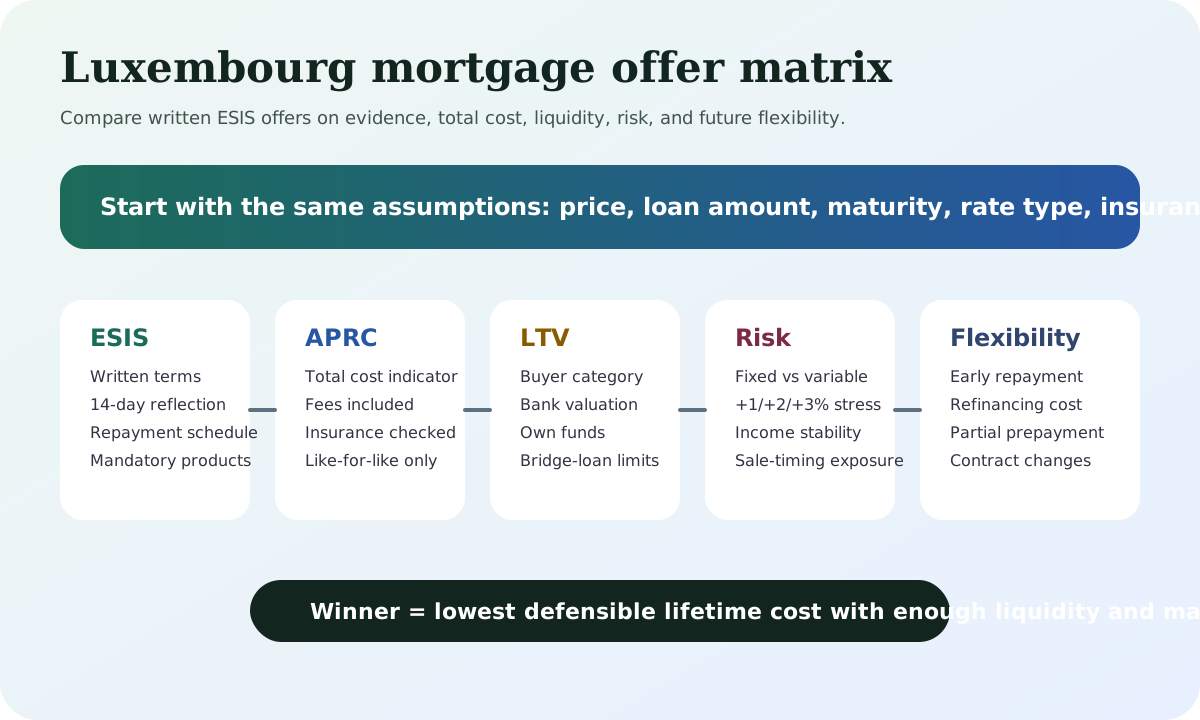
For new residents, tenants, owners, and relocating families, the hard part of How To Compare Mortgage Offers In Luxembourg is knowing which fact changes the answer. It explains checking rent, accommodation evidence, property costs, insurance, contracts, and payment risk in Luxembourg, then shows how to check documents, deposits, insurance, ownership or tenancy terms, payment timing, and the authority or counterparty that controls the result. The later sections connect quick answer, comparison model at a glance, and 1. start with the esis so the next step is easier to judge. Read it before paying fees, submitting forms, signing contracts, booking travel, or relying on a generic summary.
For a residential mortgage, the key document is the European Standardised Information Sheet, usually called the ESIS. The CSSF explains that lenders must provide personalised information before a mortgage credit agreement is concluded, and that this information is provided in particular through the ESIS so consumers can compare available credits and understand their implications.
This guide is general information for home buyers and refinancing borrowers. It is not legal, tax, investment or mortgage advice. For a binding decision, use the bank's written offer, the notary's cost statement, official aid eligibility rules, and qualified professional advice where needed.
Quick Answer
To compare mortgage offers in Luxembourg, ask each lender for an ESIS and compare:
- the APRC or TAEG, not only the nominal rate;
- whether the rate is fixed, variable or split into fixed and variable tranches;
- the loan-to-value ratio and the cash contribution required;
- bridge-loan conditions if you are buying before selling another property;
- bank arrangement fees, valuation fees, account fees and mortgage registration costs;
- insurance requirements, especially outstanding-balance life insurance and property insurance;
- early-repayment rights and compensation;
- how the bank treats cross-border income, foreign-currency income, variable bonuses and probation periods;
- the complaint route and CSSF consumer-protection framework.
The best offer is the one with the strongest total package for your situation, not necessarily the one with the lowest first-year rate.
Comparison Model At A Glance
Use a structured scorecard before negotiating. The same mortgage can look different depending on whether the buyer is optimizing monthly cash flow, total lifetime cost, resale flexibility, or approval probability.
| Comparison layer | What to normalize across banks | Why it changes the result | Evidence to keep |
|---|---|---|---|
| Loan structure | Same purchase price, loan amount, maturity, repayment type, and tranche split | Different assumptions can make a lower-rate offer look artificially better | ESIS, repayment schedule, bank simulation |
| Price | Nominal rate, APRC/TAEG, arrangement fees, account fees, valuation fees, and insurance costs | APRC is only meaningful if the underlying products are comparable | ESIS section on costs, insurance quote, fee schedule |
| Risk | Fixed-rate period, variable-rate exposure, bridge-loan term, income assumptions, and LTV category | The cheapest initial rate can create rate, liquidity, or sale-timing risk | Stress-test table, bridge-loan term sheet, income documents |
| Liquidity | Own funds after notary costs, registration duties, reserves, and renovation allowance | A technically approved mortgage can still leave the buyer undercapitalized | Notary estimate, savings statement, works budget |
| Flexibility | Early repayment, partial prepayment, refinancing cost, portability, and restructuring fees | Flexibility has option value when jobs, family needs, or rates change | Contract clause, bank email, ESIS early-repayment section |
Treat each row as a pass/fail evidence question. If a bank cannot provide written assumptions, keep the offer in a separate "indicative only" column until the file is complete.
1. Start With The ESIS
Do not compare a verbal quote from one bank with a formal offer from another. Luxembourg mortgage credit rules are built around pre-contractual information. The CSSF mortgage credit page says the ESIS includes key features such as the mortgage amount, duration, interest rate, and repayment instalments.
Use the ESIS as the base document for every offer. If one lender has not provided one yet, treat that quote as preliminary.
When reading an ESIS, check:
- the total amount borrowed;
- the duration;
- the borrowing rate and whether it is fixed or variable;
- the repayment schedule;
- the total amount payable;
- one-off fees;
- recurring fees;
- required ancillary products;
- early-repayment terms;
- whether the offer is binding and when the reflection period starts.
The CSSF states that consumers have a 14-calendar-day reflection period during which the conditions of the offer remain binding on the creditor. Do not use that period only to decide whether to sign. Use it to compare the ESIS line by line against other offers.
2. Compare APRC / TAEG Before The Headline Rate
In Luxembourg, mortgage discussions often use the French term TAEG, or "taux annuel effectif global". EU mortgage-credit terminology uses APRC, or annual percentage rate of charge. In practical comparison, both point to the annualised total cost indicator, not just the nominal interest rate.
The European Commission explains that APRC is the annual cost of a loan to the consumer, expressed as a percentage of the total value of the loan. The Mortgage Credit Directive, which Luxembourg transposed through its consumer-credit framework, sets harmonised rules for ESIS information and APRC calculation.
Use APRC / TAEG to compare offers with similar structure. It is most useful when:
- the loan amount is identical;
- the duration is identical;
- the repayment method is identical;
- required insurance and fees are treated consistently;
- the rate type is comparable.
It is less useful when one offer is fixed for 25 years and another is variable from year one. In that case, APRC still matters, but you also need a rate-risk comparison.
| Metric | Good use | Limitation | Reviewer note |
|---|---|---|---|
| Nominal borrowing rate | Fast screening of the interest component | Excludes fees, mandatory products, and insurance | Never rank final offers by this alone |
| APRC / TAEG | Standardized total-cost comparison for similar loans | Can hide future rate uncertainty in variable structures | Use only with identical amount, term, and product assumptions |
| Total amount payable | Lifetime cash-cost view | Sensitive to maturity and future rate assumptions | Useful for fixed-rate or clearly modeled offers |
| Monthly payment | Household cash-flow planning | Does not show acquisition costs or long-run cost | Stress-test variable-rate tranches |
| Cash-to-close | Liquidity and completion risk | Depends on notary/tax treatment and bank valuation | Recalculate after the notary estimate |
3. Fixed, Variable And Mixed-Rate Mortgages
A fixed rate gives payment visibility during the fixed period. The trade-off is that you may not benefit if market rates fall, and early repayment can be more expensive depending on the contract and the law's compensation limits.
A variable rate can move up or down during the mortgage. It may look cheaper at the start, but the repayment can increase if interest rates rise. The comparison should include a stress test: what happens to the monthly payment if the variable rate rises by 1, 2 or 3 percentage points?
A mixed structure splits the loan into tranches. For example, part of the loan may be fixed for a long period while another part is variable or fixed for a shorter period. This can reduce all-or-nothing exposure, but it also makes comparison harder. Compare each tranche separately and then compare the weighted total.
For market context, the BCL's 8 May 2026 interest-rate release reported that, for March 2026, the average variable mortgage rate for households remained at 3.07%, while average fixed rates differed by initial fixation period. These are market averages from a sample of banks, not a guarantee of the rate any individual borrower will receive.
| Rate design | Best suited for | Main advantage | Main risk | Question to ask the bank |
|---|---|---|---|---|
| Fully fixed | Buyers who need predictable payments | Budget stability during the fixed period | Less benefit if rates fall; early-repayment cost may matter | What is the exact compensation formula for partial and full early repayment? |
| Fully variable | Buyers with high liquidity and rate-risk tolerance | Can benefit if rates decline | Payment shock if rates rise | Show the payment at +1, +2, and +3 percentage points |
| Mixed tranches | Buyers balancing stability and flexibility | Diversifies rate exposure | Harder to compare and refinance | What happens if I repay or refinance only one tranche? |
| Bridge plus main mortgage | Buyers selling one property after buying another | Enables timing flexibility | Sale-price and sale-date risk | What is the fallback if the old property sells late or below forecast? |
4. Loan-To-Value: How Much Equity Do You Need?
Loan-to-value, or LTV, compares the loan amount with the value of the property. It matters because Luxembourg applies borrower-based measures for residential real estate credit.
The CSSF's technical FAQ on Regulation No 20-08 explains that the borrower must satisfy own-funds requirements for mortgage loans used to purchase residential real estate in Luxembourg. The FAQ describes "L" as the loan amount and "V" as the value of the property purchased.
The same CSSF FAQ gives the core LTV limits:
- first-time buyers: up to 100% LTV;
- non-first-time buyers financing a primary residence: up to 90% LTV, with a limited lender portfolio allowance that can go above this but not above 100% for the individual loan;
- other residential real estate loans, including buy-to-let: up to 80% LTV.
For this rule, the CSSF FAQ defines a first-time buyer as a borrower who has never contracted a residential real estate loan to finance residential real estate in Luxembourg. In a joint application, all borrowers must meet that definition for the loan to be treated as a first-time-buyer loan. The same FAQ says that, until 31 March 2027, the State guarantee can be considered as own funds for LTV purposes where the initial LTV requirement does not exceed 100%, subject to the conditions in the FAQ.
Do not treat these limits as a promise that a bank will lend the maximum. The bank still performs its own creditworthiness assessment, and the CSSF says lenders must assess whether the borrower has sufficient financial means to repay the credit.
When comparing offers, calculate:
- purchase price;
- eligible property value used by the bank, noting that the CSSF FAQ treats "V" as the lower of transaction value and independently estimated value;
- loan amount;
- renovation amount, if financed;
- your own funds;
- expected notary, registration and bank fees;
- minimum cash left after completion.
A lower rate can be less attractive if it requires a larger cash contribution that leaves you with no reserve.
5. Bridge Loans When Buying Before Selling
A bridge loan can help when you buy a new property before selling an existing one. It is useful, but it adds timing and market risk.
The CSSF technical FAQ describes bridge loans as non-amortising real estate loans used to facilitate a transaction until an existing property is sold. It also states that, where a bridge loan is used, both a global LTV and an expected final LTV must comply with the applicable LTV limit.
Compare bridge-loan offers on:
- maximum bridge-loan amount;
- maturity;
- interest-only cost during the bridge period;
- renewal policy;
- what happens if the old property sells late or below the expected price;
- whether the bank has a contractual claim on the sale proceeds;
- whether the main mortgage offer remains valid if the bridge loan changes.
The CSSF FAQ says bridge loans should not generally exceed 18 months and should be non-renewable, with up to 24 months for new constructions and documented exceptions. That makes the sale timeline central to the comparison.
6. Notary, Registration And Purchase Costs
Mortgage affordability is not only the monthly payment. Luxembourg property purchases involve acquisition costs that can be large enough to change the mortgage comparison.
Guichet.lu explains that the standard tax rate for purchasing real estate is 7%: 6% registration fees and 1% transcription fees. The same Guichet page explains the "Bëllegen Akt" tax credit for buyers acquiring a property for personal housing purposes, subject to conditions, with a minimum EUR 100 registration fee still collected.
Do not reuse old online examples without checking the deed date. Guichet.lu's 7 July 2025 update says the temporary increase from EUR 30,000 to EUR 40,000 applied only to deeds signed between 1 January 2024 and 30 June 2025. Check the current amount and eligibility again with the notary before signing, because this is a tax benefit with formal occupancy and residence conditions and does not apply to secondary residences, weekend homes, rental properties or trade buildings.
The CSSF mortgage credit page also lists notary fees, registration and recording fees, mortgage agreement fees, mortgage arrangement fees and insurance as costs that borrowers should consider in a financing plan.
When comparing offers, separate:
- acquisition taxes and notary-related costs;
- mortgage registration costs;
- bank arrangement or dossier fees;
- valuation fees;
- insurance premiums;
- account or package fees required by the bank;
- broker or intermediary fees, if any;
- moving, renovation and contingency costs.
Do not finance a purchase to the maximum LTV and then discover that fees must still be paid from cash.
7. Bank Fees And Product Conditions
Two banks can offer the same rate and still have different total costs. Ask each lender to list all mandatory and optional charges in writing.
Check whether the offer assumes:
- a bank arrangement fee;
- property valuation;
- a current account with monthly fees;
- salary domiciliation;
- a debit or credit card package;
- life insurance through a specific provider;
- home insurance through a specific provider;
- investment or savings products;
- penalties for changing repayment dates or restructuring the loan.
If a product is optional, ask for the mortgage price with and without it. If it is required for approval or for a preferential rate, include its cost in your comparison.
8. Insurance: Protection And Cost
Insurance is often one of the most misunderstood parts of a mortgage comparison.
The CSSF notes that repayment insurance can cover the outstanding balance of a mortgage debt if the insured party dies, with the bank typically being the beneficiary. This can protect the household, but it also adds cost and depends on age, health, insured amount, term and coverage level.
Compare:
- whether outstanding-balance life insurance is required or optional;
- insured amount per borrower;
- whether the premium is paid upfront or periodically;
- exclusions and medical underwriting;
- whether disability or incapacity cover is included;
- whether property insurance is required;
- whether the bank accepts external insurance.
If two mortgage offers differ mainly because one includes an insurance quote and another does not, the comparison is incomplete.
9. Cross-Border Income And Non-Resident Borrowers
Luxembourg banks often deal with cross-border workers, but income location still matters. A borrower living in France, Belgium or Germany may have Luxembourg salary income, foreign rental income, self-employment income, bonuses, or income in another currency.
The CSSF states that lenders may request the information needed to assess income, expenses and financial commitments, and must refuse credit if the borrower's creditworthiness is not guaranteed. For cross-border borrowers, that means the practical comparison should include documentation and risk treatment, not only rate.
Ask each bank how it treats:
- Luxembourg salary paid to a non-resident;
- probation periods and temporary contracts;
- variable bonuses, overtime and commissions;
- foreign tax obligations;
- foreign debts and maintenance payments;
- rental income from another country;
- income in a currency other than euro;
- residence status and planned move-in date.
If income is in a non-euro currency, also ask how the lender reflects exchange-rate risk. A euro mortgage funded by non-euro income can become more expensive in real household terms if the income currency weakens.
10. Early Repayment And Refinancing Flexibility
Early repayment matters if you expect to sell, refinance, receive a bonus, inherit money, or repay part of the loan ahead of schedule.
The CSSF explains that consumers have the right to repay all or part of a mortgage early. The lender may be entitled to compensation, but that compensation must be fair, objectively justified, linked to costs directly caused by early repayment, and cannot exceed the lender's financial loss.
For a main residence occupied for at least two consecutive years, the CSSF explains that the Consumer Code caps early-repayment compensation at the value of six months of interest on the repaid capital, calculated at the applicable borrowing rate on the day of early repayment. The CSSF also notes that this cap does not apply to the fraction of aggregate early repayments above EUR 450,000.
Compare:
- whether partial repayments are allowed;
- minimum partial repayment amounts;
- notice requirements;
- compensation formula;
- whether the cap applies to your situation;
- fees for refinancing with another bank;
- fees for changing rate type or maturity.
Flexibility can be worth paying for if your job, family or property plans are likely to change.
11. Consumer Protection And Complaints
Mortgage credit in Luxembourg is regulated through the Consumer Code framework, and the CSSF is the relevant authority for mortgage credit agreements. The CSSF states that it is competent to facilitate out-of-court dispute resolution between a consumer and a creditor or mortgage credit intermediary for mortgage-credit disputes.
Before signing, keep:
- all ESIS documents;
- the formal offer;
- fee schedules;
- emails with explanations of rate conditions;
- insurance quotations;
- valuation reports, if provided;
- proof of documents submitted to the bank.
If there is a dispute, start with the bank's written complaint process. If that does not resolve the issue, review the CSSF out-of-court complaint route and deadlines.
Mortgage Offer Comparison Checklist
Use this checklist for every bank:
- Same loan amount and maturity?
- Same property price and valuation assumption?
- Same own-funds contribution?
- APRC / TAEG shown?
- Fixed, variable or mixed-rate structure clear?
- Stress-tested monthly payment if variable?
- Bridge loan included or excluded?
- LTV category confirmed?
- Bank fees listed?
- Notary and registration costs included in the budget?
- Insurance requirements priced?
- Early-repayment rules written clearly?
- Cross-border income accepted on what basis?
- Offer validity and 14-day reflection period clear?
- Complaint route identified?
Common Mistakes
The first mistake is comparing only the nominal rate. A lower rate with high fees, expensive required insurance or poor repayment flexibility may not be cheaper.
The second mistake is ignoring acquisition costs. Registration, transcription, notary and mortgage-related fees can create a cash gap even when the mortgage itself is approved.
The third mistake is assuming the maximum LTV is automatic. LTV limits are regulatory boundaries, not guaranteed bank approvals.
The fourth mistake is treating a bridge loan as a formality. If the existing property sells late or at a lower price, the financing plan can change quickly.
The fifth mistake is not documenting cross-border income clearly. For non-residents and frontaliers, the bank's treatment of salary, tax, debts and currency risk can be decisive.
FAQ
What is the most important document for comparing Luxembourg mortgage offers?
The ESIS is the most important comparison document. The CSSF explains that it provides personalised pre-contractual information so consumers can compare mortgage credits and make an informed decision.
Is APRC the same as TAEG?
APRC is the English EU mortgage-credit term for annual percentage rate of charge. TAEG is the French term commonly used in Luxembourg. In a mortgage comparison, it is the annualised total-cost indicator, not just the nominal interest rate.
Is a fixed mortgage safer than a variable mortgage?
It depends on the borrower's risk tolerance, income stability and plans. A fixed rate gives payment visibility during the fixed period. A variable rate can fall, but it can also rise and increase monthly payments.
Can first-time buyers borrow 100% in Luxembourg?
CSSF Regulation No 20-08 allows a 100% LTV category for first-time buyers, according to the CSSF technical FAQ. This does not mean every first-time buyer will receive 100% financing. The bank still assesses creditworthiness and may require more own funds.
What is a bridge loan?
A bridge loan is a short-term, usually non-amortising real estate loan used when buying a new property before selling an existing one. The CSSF FAQ says bridge loans should generally not exceed 18 months, or 24 months for new constructions, except in documented exceptional circumstances.
Who usually pays notary fees in Luxembourg?
Guichet.lu explains that the parties can agree who pays notary fees, but in practice they are usually borne by the buyer. The agreement should be clear before signing the compromis de vente.
What is the standard registration and transcription cost?
Guichet.lu states that the standard tax rate for buying real estate is 7%, made up of 6% registration fees and 1% transcription fees. The Bëllegen Akt tax credit may reduce these costs for eligible personal-residence buyers.
Do cross-border workers qualify for Luxembourg mortgages?
They can, but approval depends on the lender's assessment. Banks may review Luxembourg and foreign income, residence, tax position, debts, employment stability, and currency risk where relevant.
Can I repay a Luxembourg mortgage early?
Yes. The CSSF explains that consumers have the right to repay all or part of a mortgage early. Compensation may apply, and specific Consumer Code caps may apply for eligible main-residence cases.
Where can I complain about a Luxembourg mortgage dispute?
Start with the bank's written complaint process. If unresolved, the CSSF is competent to facilitate out-of-court resolution for disputes involving mortgage credit agreements, creditors or mortgage credit intermediaries.
Official Sources
- CSSF: Mortgage credit agreements
- CSSF: Technical FAQ on Regulation No 20-08 on borrower-based measures for residential real estate credit
- BCL: Interest rates, 8 May 2026 release
- Guichet.lu: Tax credit on notarial instruments, Bëllegen Akt
- Guichet.lu: Legal content and value of a preliminary sales agreement
- European Commission: Mortgage credit and APRC
- EUR-Lex: Directive 2014/17/EU on residential mortgage credit