Last updated
How To Compare Digital Banking Fees In Luxembourg
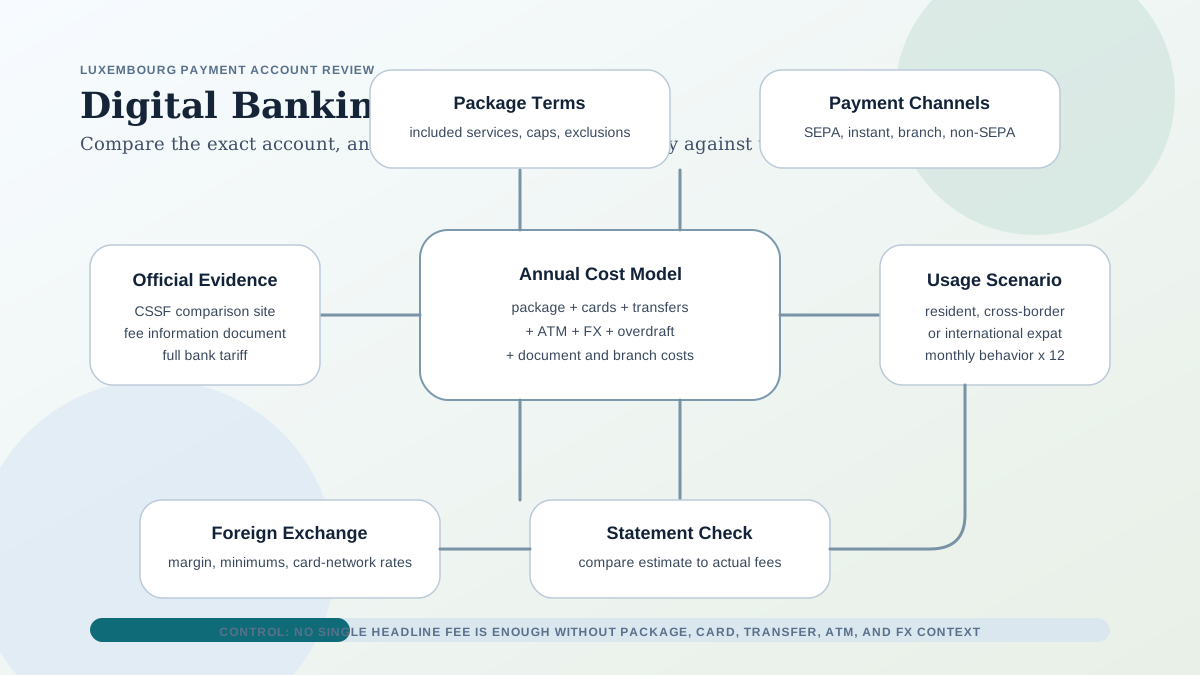
Use How To Compare Digital Banking Fees In Luxembourg when a CSSF-facing question needs a structured file rather than a loose policy summary. It explains understanding the Luxembourg regulatory obligation, supervisory evidence, internal ownership, and escalation points in How To Compare Digital Banking Fees In Luxembourg, then shows how to map the controlling rule, prepare board or compliance evidence, and know when a CSSF-facing specialist should review the file. The later sections connect quick answer, the evidence hierarchy, and step 1: identify the exact account and package so the next step is easier to judge. Read it before assigning owners or responding to a supervisory request, so the evidence file matches the regulatory question.
That distinction matters because Luxembourg banking fees are often bundled. A package may include account maintenance, online banking, one debit card, a credit card, electronic statements, SEPA transfers, branch support, or preferential terms for other products. Another account may have a lower monthly fee but higher card, transfer, cash-withdrawal, or document charges. A cross-border worker paid in Luxembourg, a resident who mostly uses digital SEPA transfers, and an investor who also keeps securities at the same bank can all face different annual costs from the same institution.
Sources checked for this review: May 14, 2026. This guide is informational, not financial advice, and does not rank or endorse any bank.
Quick Answer
To compare digital banking fees in Luxembourg, collect the official fee information document for the exact account, the bank's full tariff document, the account-package conditions, and the CSSF comparison-site data. Convert recurring charges to an annual cost, separate package fees from card and transaction fees, model your own monthly usage, and validate the estimate against the annual statement of fees after one year.
The most reliable starting point is the Luxembourg regulator. The CSSF explains that consumers must receive a fee information document before entering into a payment-account contract and a statement of fees at least annually and free of charge. See CSSF: Payment accounts. The CSSF also operates a fee comparison website for representative payment-account services, but the regulator warns that fees shown there may not match package pricing. See CSSF payment-account fee comparison website.
The Evidence Hierarchy
Use the following evidence order when comparing Luxembourg banking costs:
| Evidence source | Reliability | Use it for | Limitation |
|---|---|---|---|
| Fee information document | Highest | Standardized payment-account services | May not include every exceptional or non-standard service |
| Full tariff or price brochure | High | Cards, FX, non-SEPA transfers, overdrafts, documents, branch services | Longer and harder to compare |
| Account-package terms | High | Bundled services, allowances, eligibility, exclusions | Easy to double-count if not decomposed |
| CSSF comparison website | High | Official market-level comparison of representative payment-account services | May not reflect package pricing |
| Annual statement of fees | Highest for existing customers | Actual fees charged over the year | Available only after account use |
| Marketing account page | Medium | Product positioning and included features | Not enough for fee comparison |
| Forum or anecdotal reports | Low | Usability signals only | Not reliable for current fees |
The legal policy behind this structure comes from EU and Luxembourg payment-account transparency rules. CSSF Circular 18/700 references Luxembourg's Law of June 13, 2017 on payment accounts and the transposition of Directive 2014/92/EU on comparability of payment-account fees, account switching, and access to basic payment accounts. See CSSF Circular 18/700.
Step 1: Identify The Exact Account And Package
Do not compare banks by brand name. Compare the exact account configuration.
Record these details before entering numbers in a spreadsheet:
| Item | What to write down | Why it matters |
|---|---|---|
| Provider name | Bank or payment service provider | Different entities may use similar product names |
| Account name | Exact current account or payment account name | Fee documents are product-specific |
| Package name | Bundle or service plan, if any | Included services can change the calculation |
| Customer segment | Student, standard retail, premium, private banking, business | Tariffs can differ by segment |
| Currency setup | EUR only or multi-currency | FX costs can dominate for international users |
| Delivery channel | Digital only, branch supported, adviser supported | Manual services may be priced differently |
| Eligibility | Resident, non-resident, cross-border worker, age-based, salary domiciliation, asset threshold | An attractive tariff is irrelevant if you cannot qualify |
Luxembourg banks publish fee documents in different formats. For example, Spuerkeess maintains a transparency page with fee information documents and main banking fees. See Spuerkeess: Transparency and comparability of banking fees. Banque Raiffeisen publishes rates and prices documents. See Raiffeisen: Rates and prices. These provider pages are examples of primary sources, not recommendations.
Step 2: Convert Every Recurring Fee To An Annual Number
Most consumers underestimate banking fees because they compare monthly account prices while ignoring card, transfer, cash, paper-service, and foreign-use costs.
Use this formula:
Annual account cost = account/package fees + card fees + payment fees + cash withdrawal fees + FX/non-SEPA costs + overdraft costs + document/branch costs + unusual event costs
A practical comparison should include:
| Fee category | What to capture | Why it matters |
|---|---|---|
| Account maintenance | Monthly, quarterly, or annual base cost | Recurring baseline |
| Package fee | Bundle cost and included services | Prevents double-counting |
| Debit card | Annual fee, replacement fee, withdrawal conditions | Core everyday payment tool |
| Credit card | Annual fee, insurance bundle, limit rules | Often priced separately |
| Online banking | Included or paid | Digital access may be bundled |
| Account statements | Electronic vs paper | Paper statements can create recurring costs |
| SEPA transfers | Online, instant, branch, standing order | Digital and manual channels may differ |
| Direct debits | Setup, execution, refusal | Utility and subscription payments |
| ATM withdrawals | Own network, domestic, euro-area, non-euro | Cross-border users need this line |
| FX and non-SEPA | Transfer fee, exchange margin, minimums | Often the largest hidden cost |
| Overdraft | Arrangement fee, debit interest, unauthorized overdraft | Expensive if used accidentally |
| Account closure or switching | Exit cost and operational work | Relevant when changing provider |
When a bank quotes a monthly package price, multiply by 12 and then add the non-included costs. When a bank quotes an annual card fee, add it once. When a transaction fee is per event, multiply it by your expected annual event count.
Step 3: Separate Packages From Pay-As-You-Go Fees
The CSSF notes that comparison-site fees may not correspond to fees applied inside service packages. That means a package must be decomposed before comparison.
Ask five questions:
- What services are included without additional charge?
- Are included services unlimited or capped?
- What happens after the allowance is used?
- Are digital transactions priced differently from branch or paper transactions?
- Which services remain outside the package?
Example: if an account package includes one debit card and unlimited online SEPA transfers, do not add those fees again unless the tariff says the allowance is limited or conditional. But if the package excludes credit cards, paper statements, manual transfers, non-SEPA payments, or urgent documents, keep those as separate lines.
Step 4: Treat SEPA, Instant Payments, And Manual Transfers Separately
Most Luxembourg residents and cross-border workers rely on SEPA payments for rent, utilities, salary transfers, savings, and family payments. But not all transfer actions are priced the same way.
Separate these transfer types:
| Transfer type | Compare separately because |
|---|---|
| Online SEPA credit transfer | Often cheaper than branch execution |
| Instant SEPA credit transfer | Availability and fee treatment changed under EU instant-payment rules |
| Standing order | Setup, amendment, and execution may differ |
| Direct debit | Refusal or refund handling can have conditions |
| Manual branch transfer | Usually more expensive |
| Non-SEPA transfer | May include higher fixed fees and intermediary-bank costs |
| Non-EUR transfer | Adds exchange-rate and currency-conversion issues |
The EU Instant Payments Regulation expanded instant euro payment availability and requires instant-payment charges to be no higher than charges for corresponding non-instant euro credit transfers. The European Commission also highlights free payee verification under the new rules. See European Commission: New EU rules make instant euro payments faster and safer and ECB: Instant Payments Regulation.
Important: this does not mean every payment channel is free. Branch handling, paper forms, non-SEPA transfers, currency conversion, and account-package conditions can still matter.
Step 5: Model Your Real Usage
A useful comparison is scenario-based. Create at least one realistic annual scenario.
Resident Digital-First Scenario
| Monthly behavior | Example input |
|---|---|
| Salary receipts | 1 |
| Online SEPA transfers | 5 |
| Standing orders | 2 |
| Direct debits | 6 |
| Debit-card payments | 40 |
| ATM withdrawals in Luxembourg | 2 |
| ATM withdrawals outside Luxembourg but in the euro area | 1 |
| Paper statements | 0 |
| Branch transfers | 0 |
| Non-SEPA transfers | 0 |
Cross-Border Worker Scenario
| Monthly behavior | Example input |
|---|---|
| Luxembourg salary receipt | 1 |
| Rent or mortgage transfer to country of residence | 1 |
| Transfers to savings or family | 3 |
| Card payments in Luxembourg | 20 |
| Card payments in country of residence | 25 |
| ATM withdrawals outside Luxembourg | 2 |
| Instant payments | 2 |
| Paper or branch services | 0-1 |
| Non-EUR payments | Depends on residence and travel |
International Expat Scenario
| Monthly behavior | Example input |
|---|---|
| Salary or pension receipt | 1 |
| SEPA transfers | 4 |
| Non-SEPA transfers | 1 |
| Non-EUR card payments | 5-15 |
| ATM withdrawals outside the euro area | 1-3 |
| Replacement card risk | Annual event estimate |
| Bank documents for tax or visa use | Annual event estimate |
The goal is not a perfect forecast. It is to prevent a misleading comparison where a low account fee hides higher transfer, card, or foreign-use costs.
Step 6: Keep Foreign Exchange Outside The Basic Fee Line
FX should never be buried under "transfer fee." A non-euro payment can involve several cost layers:
| FX cost layer | What to ask |
|---|---|
| Transfer fee | What fixed or percentage fee applies? |
| Exchange rate | Which reference rate is used? |
| FX margin | Is the margin disclosed or embedded? |
| Minimum and maximum fee | Are there floors or caps? |
| Intermediary charges | Who pays correspondent-bank fees? |
| Card-network conversion | Which card scheme rate applies? |
| ATM operator fee | Is there a local ATM surcharge outside the bank tariff? |
If you earn and spend in euros, FX may be minor. If you send money outside SEPA, travel often, maintain non-EUR balances, or support family abroad, FX can dominate the annual cost.
Step 7: Do Not Mix Current-Account Fees With Investment Custody
Luxembourg banks often offer current accounts, cards, savings, brokerage, custody, investment funds, and advisory services under the same relationship. Do not combine these too early.
Use two separate tables:
| Everyday banking | Investment and custody |
|---|---|
| Account maintenance | Securities custody |
| Cards | Brokerage commissions |
| SEPA transfers | Fund subscription or redemption fees |
| ATM withdrawals | Advisory or management fees |
| FX and non-SEPA payments | Tax-reporting packages |
| Statements | Corporate-action fees |
Only combine totals after each table is separately understood. A current account can be competitive while custody is expensive, and a strong investment service does not make payment-account fees low.
Decision Framework: Which Account Is Economically Better?
Use this scoring model after the annual-cost calculation:
| Decision factor | Weight | Question |
|---|---|---|
| Annual total cost | 35% | Which account is cheapest for your actual behavior? |
| Fee predictability | 20% | Are included services clear and stable? |
| Cross-border fit | 15% | Are transfers, cards, address rules, and documents suitable? |
| Digital reliability | 10% | Does the bank support the app, authentication, and alerts you need? |
| Compliance fit | 10% | Can you satisfy identity, residence, tax, and source-of-funds requests? |
| Exit flexibility | 10% | Can you switch accounts without excessive operational disruption? |
A cheaper account is not automatically better if it creates high friction for salary receipt, authentication, card use, or compliance documentation.
How to Use the Annual Statement of Fees
The annual statement of fees is the best reality check for an existing account. It shows what the customer actually paid over the year. Compare it with the estimate you made before opening or switching. If the difference is large, identify the driver: card fees, cash withdrawals, branch services, FX, non-SEPA transfers, paper statements, overdraft interest, or package services you did not use.
Build a three-column review:
| Line | Estimated cost | Actual statement cost |
|---|---|---|
| Account/package | ||
| Debit card | ||
| Credit card | ||
| SEPA transfers | ||
| Instant payments | ||
| Cash withdrawals | ||
| FX and non-SEPA | ||
| Paper and documents | ||
| Overdraft or incident fees |
Then decide whether to keep the account, change package, reduce expensive behaviours, or switch provider. A fee comparison should improve behaviour, not just produce a one-time ranking.
Fee Comparison for Founders
Business founders need a different comparison. The cheapest retail account is irrelevant if the company needs payroll, VAT payments, international suppliers, card acquiring, multi-user access, accounting exports, or higher transfer limits. Business accounts may charge for outgoing transfers, account maintenance, cards, payment files, cash handling, certificates, compliance documents, FX, and account statements.
Founders should model:
| Business fee driver | Why it matters |
|---|---|
| Monthly account fee | Baseline operating cost. |
| User and signatory access | Teams need controlled access. |
| SEPA batch or payroll files | Payroll and supplier payments. |
| International wires | Cross-border suppliers or investors. |
| FX margin | Non-euro revenue or expenses. |
| Cards | Travel, SaaS subscriptions, employee spending. |
| Accounting export | Bookkeeping efficiency. |
| Compliance document fees | Certificates and bank letters. |
| Support channel | Slow support can become operational cost. |
For company onboarding, read business bank account in Luxembourg for non-resident founders and how to apply for a business bank account in Luxembourg.
Final Fee Rule
The best account is the one whose fees are predictable for your real behaviour. A low monthly price can become expensive when your life includes foreign cards, non-SEPA transfers, paper documents, branch support, or business payments. Compare documents, model usage, then verify against the annual statement.
Practical Monthly Usage Model
Build the comparison with a realistic month, not an ideal month. A resident who receives one salary, pays rent, uses a card in Luxembourg only, and never withdraws cash has a different cost profile from a cross-border worker who spends in several countries and sends money outside SEPA. Put the expected behaviour in rows and the providers in columns.
| Monthly action | Quantity to model | Fee source |
|---|---|---|
| Salary or pension received | 1 | Account terms |
| Rent or mortgage transfer | 1 | SEPA transfer tariff |
| Standing orders | 1 to 5 | Online payment tariff |
| Direct debits | 2 to 8 | Account package terms |
| Debit-card payments | 20 to 60 | Card tariff and package |
| ATM withdrawals in Luxembourg | 0 to 4 | Cash withdrawal schedule |
| ATM withdrawals abroad | 0 to 4 | Foreign ATM and currency terms |
| Instant transfers | 0 to 5 | Instant-payment tariff |
| Non-SEPA transfers | 0 to 2 | International transfer tariff |
| Currency conversion | Estimated monthly spend | FX margin and card terms |
| Paper documents | As needed | Document tariff |
Then add a stress month. Include a replacement card, one urgent transfer, a foreign ATM withdrawal, one paper certificate, and one support interaction that requires branch or manual processing. The stress month shows whether a low-cost account remains low-cost when life is inconvenient.
Switching Without Losing Control
Do not switch accounts only because a comparison table shows a lower price. Before closing the old account, move one recurring payment at a time. Keep a checklist of salary, rent, utilities, tax payments, insurance direct debits, subscriptions, cards, mobile phone, employer reimbursement, government portals, and investment deposits.
After the new account works for one full billing cycle, download statements and fee documents from both accounts. Check whether the new account accepts all normal payments, whether customer support is reachable, and whether the app works abroad. Closing the old account too early can create late rent, missed insurance, failed tax payment, or salary-return problems.
For families, freelancers, and founders, run a second review after three months. Actual use often differs from the original estimate once school fees, travel, supplier payments, or cross-border expenses appear.
Evidence Checklist Before Opening Or Switching
Keep a dated copy of:
- Fee information document for the account.
- Full tariff brochure or price list.
- Package terms and eligibility conditions.
- Card fee schedule.
- SEPA, instant-payment, and non-SEPA transfer schedule.
- FX and currency-conversion terms.
- Overdraft terms, even if you do not plan to use overdraft.
- Paper-statement and document fees.
- Account-switching instructions.
- Customer-support and fraud-reporting contacts.
- Your annual cost spreadsheet.
If you already have a Luxembourg account, compare the estimate with your annual statement of fees. The CSSF says the statement of fees lists fees relating to the payment account charged over the year. See CSSF: Payment accounts.
Common Mistakes
| Mistake | Better approach |
|---|---|
| Comparing only the monthly account fee | Compare annual total cost |
| Ignoring card fees | Separate debit, credit, and replacement fees |
| Treating all SEPA transfers as identical | Separate online, instant, standing order, and branch transfers |
| Ignoring paper statements | Choose electronic statements if suitable |
| Forgetting ATM use outside Luxembourg | Model withdrawals by country and currency |
| Mixing custody with banking | Compare investment services separately |
| Relying only on marketing pages | Use fee information documents and full tariffs |
| Assuming current fees will remain unchanged | Recheck tariffs before opening or switching |
FAQ
What is the best official source for comparing digital banking fees in Luxembourg?
Start with the bank's fee information document and the CSSF payment-account comparison website. The CSSF site is official, but package pricing may differ from comparison-site figures, so you still need the bank's current tariff documents.
Are digital banks always cheaper than Luxembourg branch banks?
Not necessarily. Digital providers may have lower account fees, but the comparison depends on cards, cash withdrawals, FX, transfers, customer-support needs, account eligibility, and whether you need local documents, branch services, or bundled products.
Should I include credit-card fees in the comparison?
Yes. Include credit-card annual fees, replacement fees, optional insurance, foreign-currency charges, and cash-advance terms. Keep them separate from the account-maintenance line so you can see what drives the total.
Are instant payments free in Luxembourg?
Not automatically. EU rules require the fee for an instant euro transfer not to exceed the fee for a corresponding regular euro credit transfer, and payee verification must be provided free of charge under the instant-payment framework. Branch handling, paper instructions, package limits, non-SEPA transfers, and currency conversion may still involve fees.
How should cross-border workers compare accounts?
Model where your salary arrives, where rent or mortgage payments go, how often you use cards in each country, where you withdraw cash, and whether you ever send non-euro or non-SEPA payments. Cross-border workers should also check whether the bank accepts their residence address and tax-residence documentation.
How often should I update my comparison?
Update it before opening an account, before switching, after receiving a tariff-change notice, and after your usage changes. At minimum, compare your actual annual statement of fees with your estimated cost once per year.
Source Risks And Factual Uncertainty
Bank tariffs can change quickly, and package terms can differ by customer segment. The CSSF comparison site is official but may not capture every package or non-standard service. Bank examples in this article are used only to illustrate where primary fee documents may be found. Readers should verify the current fee information document and full tariff before making a decision.
Official And Primary Sources
- CSSF: Payment accounts
- CSSF payment-account fee comparison website
- CSSF Circular 18/700
- ABBL: Bank account and payment services in Luxembourg
- European Commission: Instant euro payments
- ECB: Instant Payments Regulation
- Spuerkeess: Transparency and comparability of banking fees
- Raiffeisen: Rates and prices