Last updated
New EU Import Rules for Purchases Worth Up to EUR 150: What Changes for Luxembourg Residents From July 2026
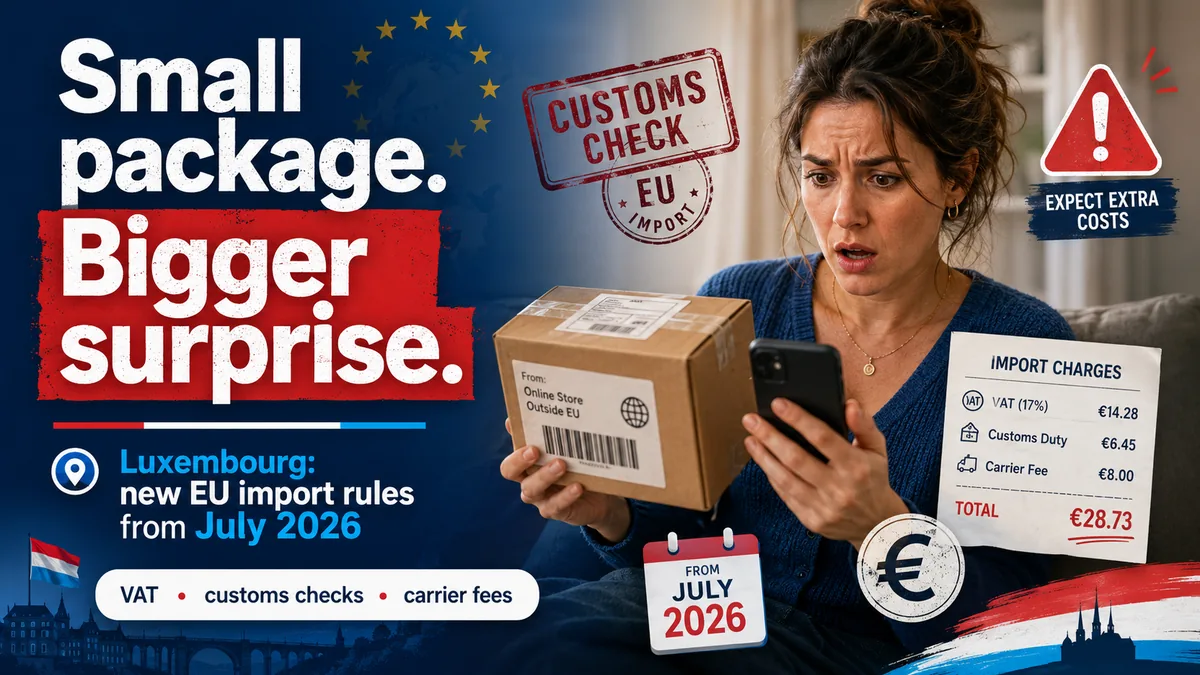
From 1 July 2026, Luxembourg residents buying low-value goods from non-EU sellers should stop treating the old EUR 150 threshold as a simple duty-free safe zone. EU guidance and Luxembourg customs communications say the low-value customs-duty exemption has been removed and a temporary EUR 3 customs duty applies to distance-sale consignments up to EUR 150 until 1 July 2028. This guide explains what changes at checkout and delivery, how VAT and IOSS still work, why the EUR 3 duty is not the same as VAT or carrier handling fees, how Temu, AliExpress, Shein, Amazon Global and eBay orders can differ, and what evidence to keep if customs or the carrier asks questions.
Useful related guides
Use these two site guides with this article before ordering from a non-EU seller:
What changed on 1 July 2026
The previous shorthand was that goods in a consignment worth up to EUR 150 were generally outside customs duty, although import VAT still applied. From 1 July 2026, that exemption is removed for e-commerce distance sales from outside the EU. The EU introduced a temporary flat EUR 3 customs duty, while the longer customs reform and EU Customs Data Hub are still being phased in.
The EUR 3 amount is described by EU and Luxembourg sources as applying by item type or tariff classification within the low-value parcel, not as a simple percentage of the order price. POST Luxembourg gives practical examples: different item types can produce several EUR 3 charges in the same parcel, while multiple identical items can be treated by type. The seller or importer is responsible for declaration and payment as part of customs processing, but the buyer may see the cost through checkout pricing, an import-fee line, or a carrier process depending on the route.
VAT, IOSS and the EUR 3 duty are separate
VAT remains due on imported goods. IOSS can still help a marketplace or seller collect VAT at checkout for qualifying imported goods up to EUR 150, so the buyer is less likely to receive a separate VAT demand at delivery. But IOSS is a VAT simplification, not a shield against customs inspection, product-safety checks, wrong declarations, carrier fees or the new customs duty.
Luxembourg Customs explains that if a foreign supplier is not registered under IOSS, the Luxembourg consumer can pay duties and VAT at import, plus possible customs-clearance fees from the carrier. If IOSS is used correctly, VAT may already be handled, but the temporary customs duty and carrier handling still need to be understood separately.
Marketplace comparison
| Marketplace | What to verify at checkout | Luxembourg delivery risk |
|---|---|---|
| Temu | VAT included wording, seller/importer information, parcel split and import-fee language. | Platform logistics can feel prepaid, but customs and carrier messages remain possible. |
| AliExpress | Seller location, warehouse, VAT line, shipping method and whether one cart becomes multiple parcels. | Risk varies by seller and fulfilment route; keep each order and parcel record. |
| Shein | VAT, shipping origin, return terms and whether items are consolidated by type. | Usually platform-managed, but item-type duty and carrier handling can still affect the final cost. |
| Amazon / Amazon Global | Whether the seller is EU-based, whether Amazon estimates import fees, and where the item ships from. | EU stock and global imports are different; do not rely on the Amazon logo alone. |
| eBay | Private or business seller, seller country, shipping programme, invoice and tracking owner. | Highest evidence need because seller practices and declarations vary widely. |
Cost examples
These examples are planning scenarios, not official calculations. Final amounts depend on product classification, parcel structure, VAT treatment, carrier fees and the actual customs process.
| Order | What can happen | Evidence to keep |
|---|---|---|
| EUR 18 accessory from a non-EU seller. | VAT may be collected at checkout. The EUR 3 duty can apply if the parcel is within the low-value distance-sale rules. A carrier handling fee may still be separate. | VAT line, product page, item type, payment proof and tracking. |
| EUR 75 clothing order with several items. | Several item types can create several EUR 3 duty charges. If the seller splits the order, each parcel can be processed separately. | Invoice, item list, parcel split, VAT/IOSS evidence and carrier messages. |
| EUR 145 electronics order. | Value, product compliance, battery rules and safety markings can matter more than the old threshold. | Technical description, CE/safety evidence, invoice, payment proof and return terms. |
| Multiple small parcels. | Handling fees and data checks can multiply even when each product is cheap. | One folder per tracking number with checkout and payment evidence. |
Practical checklist before buying
- Confirm whether goods ship from inside or outside the EU.
- Look for VAT included or IOSS-related wording at checkout.
- Check whether the parcel contains one item type or several item types.
- Read the carrier's customs-clearance and handling-fee terms for Luxembourg delivery.
- Keep the invoice, product page, payment proof, tracking and return policy.
- Do not accept false value, false gift or vague product declarations.
- For electronics, toys, cosmetics, supplements, batteries or branded goods, prefer sellers with clear compliance evidence.
Myth vs reality
| Myth | Reality |
|---|---|
| Everything under EUR 150 is banned. | No. The change concerns import treatment, duty, data and checks, not a blanket ban. |
| IOSS means no customs check. | No. IOSS handles VAT simplification; customs can still inspect, correct value or check product compliance. |
| The EUR 3 charge replaces VAT. | No. Luxembourg VAT can still be due in addition to the temporary customs duty. |
| Splitting orders avoids costs. | Splitting can multiply parcel handling and does not remove customs data obligations. |
Frequently asked questions
Will I always pay the EUR 3 directly at the door?
Not necessarily. The seller or importer is responsible for declaring and paying as part of customs processing, but the buyer may experience the cost through price, import-fee wording, or carrier handling depending on the route.
Does Luxembourg VAT still apply?
Yes. Luxembourg guidance says VAT is due for release for consumption in Luxembourg, in addition to the flat duty where applicable.
Can customs ask for proof of payment?
Yes. Keep payment proof, invoice, order page and any discounts or shipping charges visible.
Are EU warehouses affected?
If goods are genuinely already in free circulation in the EU and shipped from an EU warehouse, the low-value import step may not apply to you as final buyer. Verify seller, invoice and shipping origin.
Can I refuse the parcel?
You can usually refuse delivery, but refund of product price, shipping, duty, VAT or handling fees depends on seller and carrier terms.
Official sources to verify
- European Commission guidance on the temporary flat fee for low-value imports, checked July 19, 2026.
- European Commission news on EUR 3 customs duty, checked July 19, 2026.
- Luxembourg Customs parcels and shipments guidance, checked July 19, 2026.
- POST Luxembourg customs formalities for parcels, checked July 19, 2026.
- European Commission VAT One Stop Shop and IOSS, checked July 19, 2026.
Bottom line
For Luxembourg residents, the safer July 2026 buying rule is to compare the landed cost, not the sticker price. VAT, the temporary EUR 3 duty by item type, product checks and carrier handling are separate, so the best protection is a clean checkout record and a seller that provides accurate import data.