Last updated
Credit Cards for Foreign Transactions in Europe: How to Compare FX Fees, DCC, ATMs and Acceptance
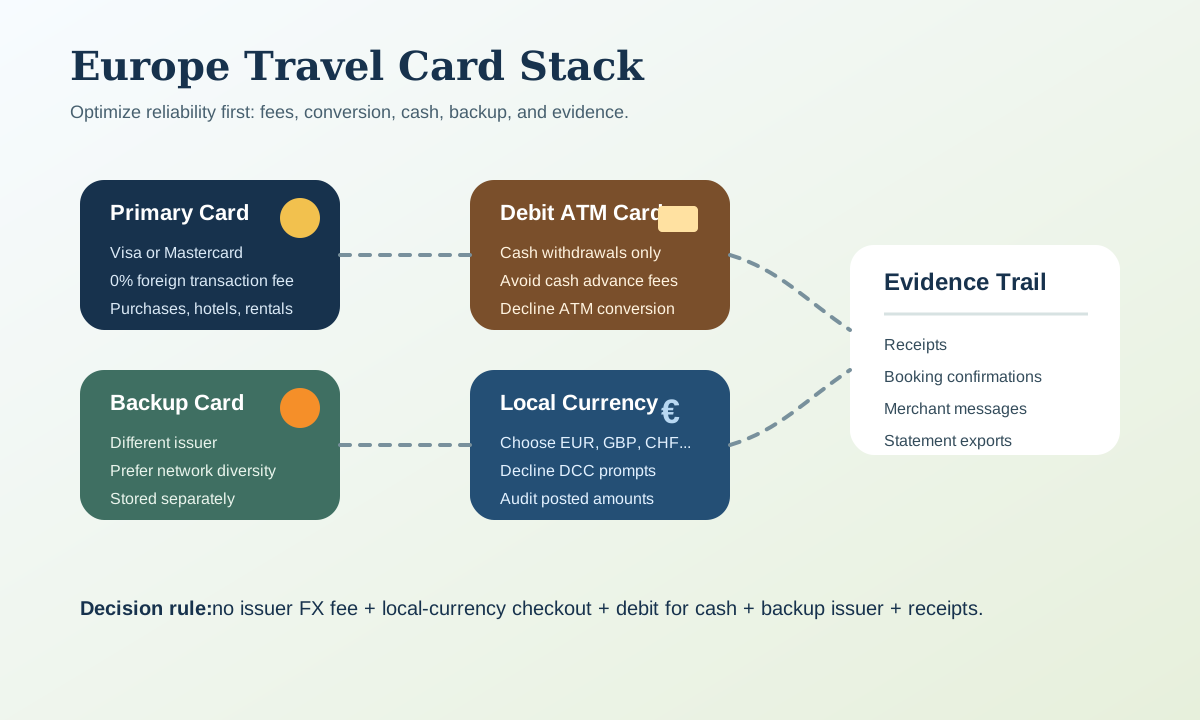
The right credit card for foreign transactions in Europe is the one that keeps total payment friction low, not the one that advertises the largest headline reward. For many itineraries, a widely accepted Visa or Mastercard is the more practical primary card, while American Express can be a useful secondary card where merchant acceptance matches the trip. Acceptance still varies by country, merchant, terminal and issuer. Compare cards by issuer foreign-transaction fee, the exchange-rate path used by the card scheme, dynamic currency conversion prompts at terminals and ATMs, cash-withdrawal costs, merchant acceptance, fraud controls, dispute rights, mobile-wallet reliability, and the quality of evidence on the statement. This guide explains how to build a practical card stack for travel or relocation without naming unsupported winners that may not fit your country, issuer, income, credit file, or itinerary.
For most travelers, the stronger default is a no-foreign-transaction-fee Visa or Mastercard credit card for purchases, a backup card from a different issuer, a debit card reserved for cash withdrawals, and a strict rule to pay in the local currency whenever a terminal asks whether to convert the charge.
This guide is general consumer information, not individualized financial, legal, or tax advice. Card terms change, issuer practices differ, and travel insurance benefits depend on the exact card agreement.
Direct answer
Start with fees, not rewards. A practical Europe setup normally uses one no-foreign-transaction-fee Visa or Mastercard credit card for purchases, one backup credit card from a different issuer or network, and a separate debit card for ATM withdrawals. That setup still needs local-currency discipline: a card with no issuer FX fee can become expensive if the merchant, hotel, car-rental desk, online checkout, or ATM converts the transaction into your home currency.
The answer changes if you need car-rental coverage, depend on cash, travel through countries with uneven international-card acceptance, need employer reimbursement, or cannot receive authentication codes abroad. In those cases, the better choice is not a single "best" card; it is a wallet design that controls failure points.
Next step: compare each card against the same transaction classes before departure: card-present purchases, online bookings, hotel and rental holds, ATM withdrawals, refunds, disputes, and emergency replacement.
| Wallet role | Best-fit product | Europe-specific reason |
|---|---|---|
| Primary purchase card | No-foreign-transaction-fee Visa or Mastercard credit card | Broad acceptance and cleaner handling for hotels, transport, restaurants, online bookings, and car-rental holds |
| Backup purchase card | No-fee card from a different issuer, preferably with a second network | Reduces lockout risk if one issuer flags travel behavior or one network has terminal friction |
| ATM card | Debit card with low ATM costs and no avoidable currency markup | Keeps cash withdrawals out of cash-advance treatment |
| Emergency reserve | Digital wallet plus one physical card stored separately | Protects against lost wallet, damaged card, pickpocketing, or terminal failure |
| Evidence layer | Receipts, booking confirmations, and statement exports | Supports disputes, reimbursements, insurance claims, and fraud review |
The controlling rule is simple: choose a card with no issuer foreign transaction fee, but still decline dynamic currency conversion. A 0% foreign transaction fee does not protect you if a terminal offers to convert euros, pounds, francs, zloty, or koruna into your home currency at a merchant-controlled rate.
Comparison Method Before You Pick a Card
Use the same comparison method for every card instead of relying on rankings. First, read the issuer fee schedule for foreign transactions, cash advances, ATM withdrawals, interest, annual fees, and replacement cards. Second, check whether the network is likely to be accepted in the countries and merchant types on your itinerary. Third, confirm how the app handles travel alerts, card locks, two-factor authentication, push notifications, and support outside your home country. Fourth, test whether statements show the original currency, converted amount, merchant descriptor, date, and refund trail clearly enough for disputes or reimbursement.
| Question to ask | Good evidence | Why it affects total cost |
|---|---|---|
| Does the issuer add a foreign transaction fee? | Current card agreement or fee schedule showing the percentage. | This fee applies repeatedly and can outweigh rewards. |
| Can you reliably reject dynamic currency conversion? | Terminal screenshots, ATM prompts, and personal rule to choose local currency. | DCC can add markup even when issuer FX fee is zero. |
| What happens at ATMs? | Debit-card ATM terms, operator fee warning, and cash-withdrawal test. | Credit-card ATM use may be treated as cash advance. |
| Will merchants accept the network? | Visa/Mastercard/Amex acceptance notes for hotels, transit, rentals, restaurants, and local services. | A generous card is weak if routine terminals decline it. |
| Can you prove and dispute a bad charge? | Receipt, booking confirmation, statement line, merchant message, and issuer dispute procedure. | Evidence quality determines whether protections are usable. |
What "Best" Really Means
Card comparisons often over-weight rewards and under-weight failure modes. In Europe, the better question is: what card setup minimizes total loss across fees, exchange-rate spread, failed authorizations, ATM mistakes, hotel holds, merchant disputes, and emergency replacement?
| Selection factor | Minimum standard | Why it matters in Europe |
|---|---|---|
| Foreign transaction fee | 0% issuer fee | A 3% fee can erase ordinary rewards on every foreign-currency purchase |
| Network acceptance | Visa or Mastercard as the primary network | Acceptance is usually broadest across transport, hotels, restaurants, grocery stores, and online booking systems |
| Dynamic currency conversion control | User can reliably choose local currency | Merchant conversion can embed a significant markup even when the card has no issuer FX fee |
| Dispute process | Clear written billing-error workflow and usable app/phone support | Travel disputes depend on fast evidence capture and strict timelines |
| Cash policy | Debit card for ATMs; credit-card cash advance only in emergencies | Credit-card ATM withdrawals can trigger cash-advance fees and interest |
| Fraud controls | App lock/unlock, alerts, international support, emergency replacement | Multi-country spend patterns can trigger issuer risk models |
| Statement clarity | Original currency, converted amount, merchant name, and date are visible | Necessary for reimbursements, tax records, and billing disputes |
The Two Conversion Costs Travelers Confuse
There are two separate costs in a European card transaction.
| Cost layer | Who controls it | How to reduce it |
|---|---|---|
| Issuer foreign transaction fee | Your card issuer | Choose a card whose agreement says there is no foreign transaction fee |
| Dynamic currency conversion markup | Merchant, ATM operator, or payment processor offering to bill you in your home currency | Decline conversion and pay in the local currency |
EU Regulation 2019/518 requires currency conversion charges for card-based transactions at ATMs and points of sale to be expressed as a percentage markup over the latest available European Central Bank euro foreign exchange reference rates where the rule applies. See Regulation (EU) 2019/518 and the ECB euro foreign exchange reference rates.
That transparency is useful, but it does not make the offer attractive. In ordinary travel purchases, the practical rule remains: pay in the local currency and let the network/issuer conversion path apply.
The Local-Currency Rule
European terminals and ATMs can phrase dynamic currency conversion in confusing ways.
| Terminal prompt | Stronger choice |
|---|---|
| Pay in USD or EUR? | EUR |
| Accept guaranteed exchange rate? | Decline |
| Convert now? | No |
| Continue without conversion? | Yes |
| Charge card currency? | No, choose the merchant's local currency |
| Pay in dollars at a fixed rate? | Decline |
The same principle applies outside the euro area: use pounds in the United Kingdom, francs in Switzerland, zloty in Poland, koruna in Czechia, forint in Hungary, krone in Denmark or Norway, and so on. The exact currency changes; the decision rule does not.
Visa, Mastercard, and American Express in Europe
Visa and Mastercard are often practical primary-card choices for Europe because they are accepted across many routine merchant categories. American Express can be valuable where it is accepted, but relying on it as the only card can create gaps at smaller merchants, transit kiosks, rural businesses or unattended terminals. Check acceptance for the countries and transaction types on your itinerary instead of treating any network as universal.
Use network calculators to audit posted conversion math:
| Network resource | Use |
|---|---|
| Visa exchange rate calculator | Check Visa network conversion assumptions for posted transactions |
| Mastercard currency converter | Check Mastercard conversion assumptions |
| ECB reference rates | Compare against official euro reference-rate context, not as a card-network promise |
These tools do not override the issuer agreement. Issuers may add fees, classify cash transactions differently, or apply terms that affect the final statement amount.
Credit Card vs. Debit Card
Use credit cards for purchases and debit cards for cash.
| Use case | Better tool | Why |
|---|---|---|
| Hotels | Credit card | Preauthorizations and deposits are easier to segregate from checking funds |
| Car rentals | Credit card | Rental agencies often prefer credit-card holds, and some card benefits require credit-card payment |
| Restaurants | Credit card | Easier fraud and billing-error path than debit in many cases |
| Train, metro, and transit | Credit card or mobile wallet | Contactless support is common, but backup matters for offline terminals |
| ATMs | Debit card | Avoids credit-card cash-advance treatment |
| Small markets, toilets, rural buses, local festivals | Cash from debit card | Some small merchants remain cash-first |
Credit-card cash advances can carry immediate interest, cash-advance fees, and separate limits. Do not use a credit card at an ATM unless it is an emergency and you understand the cost.
Europe Card Selection Matrix
| Criterion | Weight | Excellent | Acceptable | Weak |
|---|---|---|---|---|
| Foreign transaction fee | 25% | 0% | 1% with strong compensating value | 2.5% to 3% or more |
| Acceptance | 20% | Visa or Mastercard, contactless and chip support | Amex plus Visa/Mastercard backup | Single limited network |
| DCC control | 15% | Clear local-currency behavior and user discipline | Some terminal friction but manageable | User frequently accepts home-currency conversion |
| Dispute process | 15% | Written process, app upload, strong documentation path | Phone-first process but rules are clear | Unclear or slow escalation |
| Travel resilience | 10% | Emergency replacement, digital wallet, alerts, lock/unlock | Some emergency support | No useful travel controls |
| ATM strategy | 10% | Separate debit card with low ATM cost | Debit available but expensive | Credit-card ATM reliance |
| Rewards after fees | 5% | Rewards remain valuable after all fees | Rewards neutral | Rewards erased by fees and conversion |
Rewards should be evaluated after costs. A 3x travel card with a 3% foreign transaction fee can be weaker than a plain 0% fee card for ordinary spending.
Card Stack by Traveler Type
| Traveler type | Recommended architecture | Critical control |
|---|---|---|
| First Europe trip | One no-fee Visa or Mastercard, one backup card, one debit ATM card | Save issuer support numbers offline |
| Frequent business traveler | Two no-fee credit cards from different issuers, expense-friendly statements, and receipt capture | Keep original-currency receipts for reimbursement |
| Remote worker in Europe | Primary card, backup card, debit ATM card, and a separate recurring-bill card | Separate daily spend from subscriptions and work expenses |
| Family trip | Each adult carries a different issuer card plus shared debit fallback | Avoid one wallet containing every payment method |
| Premium traveler | Premium card only if credits, insurance, lounge access, and protections are actually used | Verify benefit eligibility before relying on coverage |
| Budget traveler | No-annual-fee, no-foreign-transaction-fee card plus low-cost debit account | Avoid ATM operator conversion and DCC |
Dispute Readiness
A strong travel card is not only cheap. It is defensible when a merchant, hotel, airline, train operator, rental agency, or ATM transaction goes wrong.
Dispute rights and deadlines depend on the law governing the card account and the issuer agreement. For cards issued in the United States, the CFPB explains that preserving federal billing-error rights generally requires written notice within 60 days after the statement showing the error was sent; the issuer generally must acknowledge the notice within 30 days and resolve the matter within two billing cycles, subject to the detailed rule. See CFPB: how to fix mistakes in your credit card bill and Regulation Z Section 1026.13. The FTC provides a similar US consumer overview at Using Credit Cards and Disputing Charges. Cardholders elsewhere should use their issuer's dispute procedure and the consumer-protection rules applicable to their account.
| Transaction type | Evidence to keep |
|---|---|
| Hotel | Booking confirmation, check-in terms, checkout invoice, deposit release record |
| Car rental | Rental agreement, photos, fuel receipt, return confirmation, final invoice |
| Restaurant | Itemized receipt and card receipt |
| Train or airline | Ticket, cancellation notice, delay notice, refund correspondence |
| ATM | ATM receipt, app screenshot, machine location, accepted/declined conversion screen if visible |
| Dynamic currency conversion mistake | Receipt showing home-currency quote, local-currency amount, and exchange rate |
| Online booking | Confirmation email, cancellation policy, support transcript, merchant country |
Disputes are usually lost on evidence, not on outrage. The best routine is to photograph or save every high-value receipt before leaving the merchant.
Common Europe Failure Modes
| Problem | Why it happens | Control |
|---|---|---|
| Terminal offers USD | Dynamic currency conversion | Choose local currency |
| Card fails at transit gate | Offline terminal, risk scoring, or delayed authorization | Try mobile wallet or backup card |
| Hotel hold seems excessive | Deposit plus delayed settlement | Ask for hold amount and release timing in writing |
| Merchant name looks unfamiliar | Processor name differs from storefront | Keep receipt and location note |
| ATM adds a surcharge | Local ATM operator fee | Decline bad ATM offers and use bank-owned machines where possible |
| Gas station or toll booth rejects card | Unattended terminal rules | Keep backup card and modest cash |
| Issuer locks card after small purchases | Fraud model sees unusual multi-country spend | Use app controls, alerts, or issuer travel settings if available |
| Rewards are lower than expected | Merchant category coding differs | Do not rely on category bonuses for core affordability |
Pre-Trip Test Protocol
Before a long trip, run this checklist:
- Confirm the issuer foreign transaction fee in the card agreement.
- Confirm whether the card charges cash-advance fees for ATM use.
- Add the card to Apple Pay, Google Pay, or another supported wallet.
- Verify PIN availability if the issuer supports one.
- Save issuer support numbers offline.
- Confirm the billing-dispute process and mailing or upload path.
- Test a small foreign-currency online purchase if practical.
- Carry a physical backup card in a separate bag.
- Set transaction alerts.
- Keep a modest amount of cash for low-card-acceptance moments.
Visa describes lost/stolen and emergency assistance resources at Visa lost or stolen card support. Your issuer still controls whether replacement, emergency cash, or other services are available for your account.
Decision Framework
Use this sequence before selecting cards:
| Step | Question | Output |
|---|---|---|
| 1 | Which countries and currencies will you use? | Currency and acceptance map |
| 2 | Which spend categories dominate? | Purchase, hotel, car rental, transit, cash, business expense profile |
| 3 | Which card has no foreign transaction fee? | Primary card shortlist |
| 4 | Which backup avoids the same failure point? | Different issuer and, if practical, different network |
| 5 | How will you get cash? | Debit ATM plan |
| 6 | How will you preserve evidence? | Receipt and statement workflow |
| 7 | What happens if the wallet is lost? | Emergency card, digital wallet, and support plan |
FAQ
What is the best credit card for foreign transactions in Europe?
For most travelers, it is a no-foreign-transaction-fee Visa or Mastercard credit card with strong fraud controls, mobile-wallet support, clear dispute procedures, and a backup card from a different issuer. The best choice is a wallet architecture, not a single brand name.
Should I pay in euros or dollars?
Pay in the local currency. In the euro area, that means euros. In the United Kingdom, pounds. In Switzerland, francs. Choosing dollars usually means accepting dynamic currency conversion.
Is American Express good in Europe?
It can be useful in premium travel categories, but it should not be your only card. Carry Visa or Mastercard as the primary acceptance tool.
Are no-foreign-transaction-fee cards always free abroad?
No. They avoid the issuer's foreign transaction fee, but you can still face dynamic currency conversion, ATM operator fees, cash-advance fees, annual fees, interest, or unfavorable merchant practices.
Is a debit card safer than a credit card in Europe?
Debit can be useful for cash. A credit card may be more practical for purchases because a disputed charge does not immediately reduce a current-account balance, but liability, chargeback access and dispute procedures depend on the issuer agreement and applicable law.
Do I still need cash?
Yes, but less than in the past. Keep enough cash for small merchants, toilets, markets, rural buses, tips, emergencies, or card outages.
Official sources and card terms to check
- Regulation (EU) 2019/518 on cross-border payments and currency conversion charges
- European Central Bank euro foreign exchange reference rates
- Visa exchange rate calculator
- Mastercard currency converter
- CFPB credit-card billing-error guidance
- CFPB Regulation Z billing error rule
- FTC credit-card dispute guidance
Those sources help with public rules and benchmark exchange-rate checks, but they do not replace the card agreement. Before relying on a card, read the issuer terms for foreign transactions, cash advances, ATM withdrawals, interest, annual fees, replacement cards, travel benefits, dispute procedures and authentication outside your home country.
Related practical pages
Final checklist before departure
- Choose a primary Visa or Mastercard with no issuer foreign transaction fee.
- Carry a backup card from a different issuer or network where practical.
- Use a debit card, not a credit card, for routine ATM withdrawals.
- Choose the local currency at terminals, ATMs, hotel desks and online checkouts unless you have a documented reason not to.
- Confirm that card alerts, app access, PINs and two-factor authentication work while abroad.
- Keep receipts and screenshots for hotels, rentals, transport, online bookings and high-value purchases.
- Review pending and posted transactions during the first 72 hours of travel, then at least weekly on longer stays.
- Keep cards active until refunds, deposits and disputes are fully settled.
Bottom line
The strongest Europe card setup is practical rather than glamorous: low issuer FX fees, local-currency discipline, broad acceptance, a separate cash route, usable dispute evidence and a backup that does not share the same failure point. Treat rewards as secondary. A card is only useful abroad if it works at the terminal, records the transaction clearly and gives you a credible path to fix a mistake.